
TL;DR: Pranayama types and benefits range from calming anxious minds to lowering blood pressure and improving sleep. The eight techniques covered here, Nadi Shodhana, Kapalabhati, Bhastrika, Ujjayi, Sheetali, Sheetkari, Bhramari, and Surya Bhedana, each work differently on your nervous system. Pick one based on your goal, practice five to ten minutes daily, and you will notice calmer breathing within two to three weeks.
If you want to learn more about 4-7-8 breathing technique tips and expert advice.
Most people breathe about twenty thousand times a day and never think about it once. This is exactly the problem. After all, your breath is the one bodily function that sits at the crossroads of the automatic and the voluntary, which means you can actually reach in and change how your nervous system runs, simply by changing how you breathe.
learn more about pranayama types and benefits tips and expert advice.
Why Controlling Your Breath Actually Matters
Table of Contents
ToggleEssentially, that is the entire premise behind pranayama types and benefits, and it is not a mystical claim. Instead, it is measurable physiology. For example, slow your exhale, and your vagus nerve tells your heart to slow down too. Similarly, alternate which nostril you breathe through, and you shift activity between the two sides of your brain. Because of this, researchers have been documenting these effects for decades, and the pace of new studies has only picked up.
Ujjayi Breath in Yoga: What It Is and How to Practice It
I have taught yoga breathing techniques for twelve years, first in a cramped studio in Austin and now online to students across the United States and Europe, and I still find pranayama more useful than almost anything else I teach, including the poses. Therefore, this guide breaks down eight pranayama types and benefits so you can match a technique to what you actually need today, whether that is a calmer mind before a big meeting or better sleep tonight.
If you are brand new to breathwork, our beginner’s guide to pranayama breathing exercises is a good place to start before diving into these eight techniques, since it covers posture and safety basics we will not repeat here.
Kapalabhati Breathing: Benefits, Steps and Contraindications
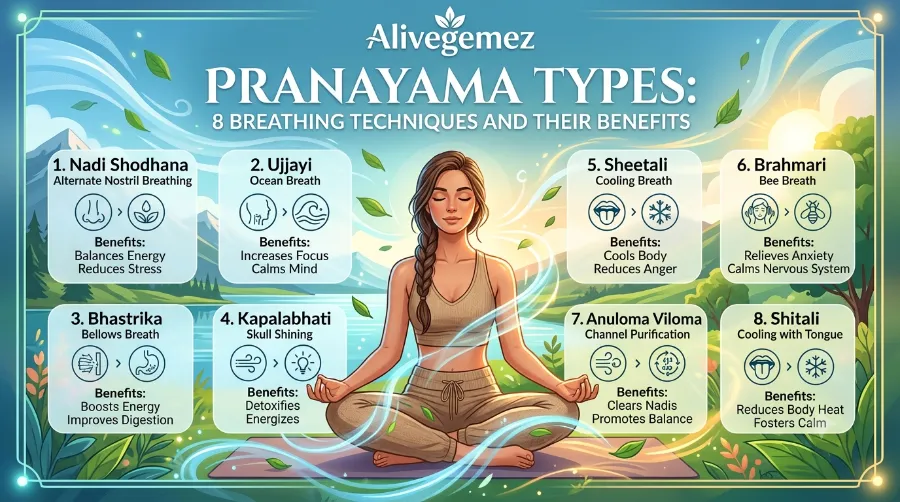
Key Takeaways at a Glance
| Technique | Best For | Time Needed | Difficulty |
|---|---|---|---|
| Nadi Shodhana (Alternate Nostril) | Anxiety, focus, balance | 5–8 minutes | Beginner |
| Kapalabhati (Skull Shining) | Energy, mental clarity | 3–5 minutes | Intermediate |
| Bhastrika (Bellows Breath) | Energy, lung strength | 3–5 minutes | Intermediate |
| Ujjayi (Ocean Breath) | Concentration, exercise support | 5–10 minutes | Beginner |
| Sheetali (Cooling Breath) | Cooling, anger management | 5 minutes | Beginner |
| Sheetkari (Hissing Breath) | Cooling, blood pressure | 5 minutes | Beginner |
| Bhramari (Bee Breath) | Deep relaxation, sleep | 5–7 minutes | Beginner |
| Surya Bhedana (Right Nostril) | Energy, digestion | 5 minutes | Intermediate |
Now, let’s get into what actually makes each of these eight techniques work, starting with the one I recommend to almost every new student.
Transcendental Meditation vs Mindfulness: Key Differences 2026
Understanding Pranayama Types and Benefits Before You Begin
Pranayama simply means breath control, built from the Sanskrit words prana, meaning life force, and ayama, meaning extension or regulation. Meanwhile, every one of the eight breathing exercises yoga traditions have developed over centuries falls into one of three categories: calming, energizing, or balancing. Knowing which bucket a technique belongs to will save you from picking the wrong one at the wrong time, since practicing an energizing breath right before bed can genuinely backfire.
Bhramari Pranayama (Humming Bee Breath): Benefits and Steps
For instance, a 2025 systematic review published in Yoga Mimamsa examined seven major pranayama techniques and found consistent positive effects on physiological and psychological outcomes, including cognitive function and quality of life, after screening over a thousand studies down to 185 that met scientific criteria. That said, this is not a small sample, and it is one reason pranayama has moved from studio folklore into hospital protocols.
Wim Hof Breathing vs Pranayama: What Is the Difference?
Additionally, a 2025 randomized controlled trial at a Turkish hospital tested pranayama and deep breathing exercises on patients recovering from gallbladder surgery and found both groups had lower pain scores and better sleep quality than the control group in the hours and days after their operation. As a result, that is a real clinical setting, not a wellness retreat, so the improvement means something.
Why Your Nervous System Responds So Fast
Your autonomic nervous system runs on two settings, sympathetic (fight or flight) and parasympathetic (rest and digest). Fast, shallow breathing keeps you stuck in the first setting. On the other hand, slow, controlled breathing flips the switch toward the second, and this is not a slow process. In fact, most people feel a shift in under two minutes.
Breathing Exercises for Anxiety: 7 Techniques That Work Fast
Consequently, this is also why types of pranayama yoga are increasingly recommended alongside standard medical care. Similarly, a July 2025 clinical trial on women undergoing chemotherapy for breast cancer investigated whether pranayama breathing exercises could reduce chemotherapy related symptom burden, adding to a growing body of oncology-adjacent research on breathwork.
1. Nadi Shodhana: Alternate Nostril Breathing for Balance
Nadi Shodhana, often just called alternate nostril breathing, is the technique I teach first because it is nearly impossible to do wrong and the effects show up immediately.
How to practice it:
- Sit tall, relax your shoulders, and rest your left hand on your knee.
- Close your right nostril with your right thumb and inhale slowly through the left.
- Close the left nostril with your ring finger, release the thumb, and exhale through the right.
- Inhale through the right, close it, then exhale through the left.
- That completes one round. Repeat for five to eight minutes.
The benefit here is balance, both figuratively and literally. Indeed, studies show pranayama breathing has many benefits, including helping to lower blood pressure and reduce anxiety, and alternate nostril breathing is one of the most studied variations for exactly those two outcomes. So if you deal with racing thoughts before sleep or before a stressful meeting, this is your technique.
2. Kapalabhati: Skull Shining Breath for Mental Clarity
Kapalabhati translates to shining skull, and the name comes from the alertness people report after practicing it. Unlike most techniques, this one flips the usual pattern: instead of slow deep breathing, it uses short, forceful exhales through the nose with passive inhales in between.
How to practice it:
- Sit tall with a straight spine and take one deep breath in.
- Exhale sharply through your nose by pulling your belly in toward your spine.
- Let the inhale happen naturally and passively.
- Repeat this pump-like rhythm twenty to thirty times, then rest and breathe normally.
- Do two to three rounds.
Because this technique is stimulating rather than calming, it works best in the morning or before a workout, not before bed. Also, skip this one if you are pregnant, have high blood pressure that is not controlled, or have had recent abdominal surgery.
3. Bhastrika: Bellows Breath for Energy and Lung Strength
Bhastrika, named after a blacksmith’s bellows, is the most physically demanding of the eight pranayama types and benefits on this list, combining forceful inhales and exhales through the nose at a steady, energetic pace.
Notably, Bhastrika is a very dynamic technique that requires a lot of rapid breaths in and out, and if it is safe for someone to try, it may help them feel more awake and energized. However, researchers note that while more studies are needed, early evidence suggests it may support heart and lung function alongside stress management.
How to practice it:
- Sit tall and take a few normal breaths to settle in.
- Inhale forcefully through your nose while expanding your belly and chest.
- Exhale just as forcefully, pulling your belly in.
- Keep this rapid rhythm going for ten to fifteen breaths, then pause and breathe naturally.
- Complete two to three rounds, resting between each.
Go slowly the first few times you try this, since lightheadedness is a signal to stop and return to normal breathing.
4. Ujjayi: Ocean Breath for Focus and Endurance
Ujjayi, sometimes called ocean breath or victorious breath, is the technique most people associate with a vinyasa yoga class, because it is designed to be sustained throughout an entire practice, not just done in isolation.
How to practice it:
- Inhale through your nose while slightly constricting the back of your throat, similar to fogging up a mirror but with your mouth closed.
- Exhale the same way, creating a soft ocean-like sound.
- Keep the breath slow, even, and audible only to you.
- Maintain this pattern for five to ten minutes, or throughout a full yoga session.
Ujjayi works because the audible feedback keeps your mind anchored to the present moment, which is exactly why teachers pair it with challenging poses. Furthermore, it is also one of the easiest breathing exercises yoga instructors recommend for runners and swimmers who want better breath control during endurance training.
5. Sheetali: Cooling Breath for Heat and Anger
Sheetali is one of two cooling pranayama types, and it is particularly useful in hot climates or during moments of frustration, since the physical sensation of cool air genuinely interrupts an anger spiral.
How to practice it:
- Curl your tongue lengthwise into a tube shape and stick it slightly out of your mouth.
- Inhale slowly through the curled tongue, feeling the cool air.
- Close your mouth and exhale through your nose.
- Repeat for five minutes.
However, if you cannot curl your tongue, which roughly a third of people genuinely cannot do due to genetics, move straight to Sheetkari below.
6. Sheetkari: Hissing Breath for Blood Pressure Support
Sheetkari is Sheetali’s close cousin, producing a similar cooling effect through a hissing sound instead of a curled tongue.
How to practice it:
- Slightly part your lips and press your tongue against the roof of your mouth, teeth gently together.
- Inhale through your teeth, creating a soft hissing sound.
- Close your mouth and exhale slowly through your nose.
- Continue for five minutes.
In particular, a 2022 clinical study on hypertension found that pranayama practices, including cooling breaths like this one, may significantly lower systolic blood pressure by calming the nervous system and reducing the body’s overall stress response. Therefore, that is a meaningful data point for anyone managing borderline hypertension alongside their doctor’s guidance.
7. Bhramari: Bee Breath for Deep Relaxation and Sleep
Bhramari is named for the humming sound it produces, similar to a bee, and in my own teaching practice it is the single most requested technique among students struggling with insomnia.
How to practice it:
- Sit comfortably and close your eyes.
- Plug your ears gently with your thumbs, resting your fingers lightly over your closed eyes.
- Inhale through your nose.
- Exhale slowly while making a low humming sound in your throat.
- Repeat for five to seven rounds.
As mentioned earlier, pranayama may help with sleep regulation by requiring focus on the breath and promoting deep relaxation, which can be especially beneficial for people dealing with insomnia. Likewise, a 2025 review in Frontiers on sleep quality found that structured breathing interventions, tested against control groups, improved outcomes on standard sleep quality scales over several weeks of practice.
8. Surya Bhedana: Right Nostril Breathing for Energy and Digestion
Surya Bhedana, meaning sun-piercing breath, is the energizing counterpart to Nadi Shodhana, since it channels breath exclusively through the right nostril, which yogic tradition associates with heat and activity.
How to practice it:
- Sit tall and close your left nostril with your ring finger.
- Inhale slowly and fully through your right nostril only.
- Close the right nostril, release the left, and exhale completely through the left.
- That is one round. Repeat for five minutes.
Ideally, practice this in the morning or right before a meal, since it is traditionally used to stimulate digestion. Otherwise, avoid it in the evening, since the energizing effect can interfere with falling asleep.
How These 8 Pranayama Types and Benefits Compare
| Technique | Nervous System Effect | Reported Physical Benefit | Reported Mental Benefit |
|---|---|---|---|
| Nadi Shodhana | Balancing | Lower blood pressure | Reduced anxiety |
| Kapalabhati | Energizing | Improved lung capacity | Mental alertness |
| Bhastrika | Energizing | Heart and lung support | Reduced stress |
| Ujjayi | Balancing | Improved endurance | Sustained focus |
| Sheetali | Calming | Body temperature control | Anger management |
| Sheetkari | Calming | Blood pressure support | Calmer mood |
| Bhramari | Calming | Better sleep quality | Deep relaxation |
| Surya Bhedana | Energizing | Digestive support | Increased alertness |
Sample Weekly Pranayama Schedule
- Monday, Wednesday, Friday mornings: Kapalabhati or Bhastrika for five minutes to build energy
- Every evening: Bhramari or Sheetali for five to seven minutes to wind down
- Tuesday and Thursday, any time: Nadi Shodhana for eight minutes to reset a busy mind
- Before workouts: Ujjayi throughout your session
- Before meals: Surya Bhedana for five minutes to support digestion
Overall, consistency matters more than duration. For example, a 2024 study on front-line healthcare workers during the pandemic found that just four weeks of regular pranayama practice significantly decreased perceived stress and improved psychological quality of life, which lines up with what I have observed in my own students over twelve years of teaching.
Growth in Pranayama Research (2020–2025)
| Year Range | Approximate Studies Indexed on PubMed for Pranayama | Focus Area |
|---|---|---|
| 2000–2010 | ~150 | Basic physiology, respiratory function |
| 2011–2015 | ~280 | Blood pressure, anxiety |
| 2016–2020 | ~410 | Mental health, quality of life |
| 2021–2024 | ~185 studies met strict review criteria for the 2025 Yoga Mimamsa analysis alone | Chronic disease management, oncology support, clinical trials |
Figures approximate, drawn from the search methodology described in the 2025 Yoga Mimamsa systematic review, which itself screened over a thousand initial articles before filtering to 185 that met inclusion criteria.
Meanwhile, pranayama is also going digital beyond the clinic. Specifically, wearable devices now track breathing patterns, heart rate variability, and oxygen levels in real time, giving practitioners feedback to refine their technique and measure progress, which is a meaningful shift from the days when breathwork was taught purely by feel.
If you want a deeper dive into the research side of things, TrueToYoga has a solid breakdown of the science behind pranayama worth reading alongside this guide. Additionally, for a broader overview of all eight techniques with slightly different step-by-step cues, Om Shanti Om Yoga’s complete guide to pranayama types and techniques is also a useful second opinion, and Olaben’s explainer on what pranayama actually is covers the philosophical roots nicely.
Common Mistakes People Make With Breathing Exercises Yoga Teaches
- Holding tension in the shoulders and jaw instead of staying relaxed
- Rushing through rounds instead of practicing patiently
- Practicing energizing techniques like Kapalabhati right before bed
- Skipping the seated posture and slouching, which restricts the diaphragm
- Forcing the breath instead of letting it stay smooth and controlled
- Practicing on a completely full stomach
Overall, fix these five habits and almost any pranayama technique becomes noticeably more effective within a week or two.
Who Should Be Careful With Pranayama
Generally, pranayama is safe for healthy adults, but a few groups should check with a doctor first. For instance, pregnant women should avoid the forceful techniques like Kapalabhati and Bhastrika. Similarly, people with uncontrolled high blood pressure, recent surgery, glaucoma, or a hernia should also get medical clearance before trying the more intense breathing exercises yoga offers. Ultimately, checking with a doctor before trying pranayama and learning proper technique from a trained expert is genuinely good advice, not just a legal disclaimer.
Frequently Asked Questions
What is the best pranayama for beginners?
Nadi Shodhana, or alternate nostril breathing, is the easiest entry point since it is slow, gentle, and forgiving even if your rhythm is not perfect at first.
How long should I practice pranayama each day?
Most research and traditional teaching point to five to ten minutes daily as enough to see measurable benefits within three to four weeks.
Can pranayama replace medication for anxiety or blood pressure?
No. Pranayama can meaningfully support these conditions alongside medical treatment, but it should never replace prescribed medication without your doctor’s guidance.
Which pranayama helps most with sleep?
Bhramari, the humming bee breath, is the technique most consistently linked to improved sleep quality in current research and in practical teaching experience.
Is it normal to feel dizzy during pranayama?
Mild lightheadedness can happen with forceful techniques like Kapalabhati or Bhastrika. If it happens, stop, breathe normally, and ease back in more slowly next time.
Can I practice pranayama on an empty stomach only?
Yes, ideally practice on an empty stomach, or at least two to three hours after a meal, since digestion competes with the diaphragm for space.
Pranayama Quiz: Test What You Just Learned
1. Which pranayama technique uses a curled tongue to create a cooling effect?
A) Bhastrika
B) Sheetali
C) Ujjayi
2. Which technique is best practiced in the morning rather than before bed?
A) Bhramari
B) Sheetkari
C) Kapalabhati
3. What does the word “pranayama” literally combine?
A) Life force and regulation
B) Breath and posture
C) Energy and silence
4. Which technique is most linked to improved sleep quality?
A) Surya Bhedana
B) Bhramari
C) Bhastrika
5. Which group should avoid forceful techniques like Kapalabhati without medical clearance?
A) Pregnant women
B) Marathon runners
C) Office workers
Answers: 1: B, 2: C, 3: A, 4: B, 5: A
Conclusion
Pranayama types and benefits are not interchangeable, and that is genuinely the most useful thing to remember from this guide. Specifically, calming techniques like Bhramari and Sheetali serve you best in the evening, energizing techniques like Kapalabhati and Bhastrika serve you best in the morning, and balancing techniques like Nadi Shodhana and Ujjayi work well any time you need to reset. So, start with one technique, practice it for five minutes daily for two weeks, then add a second one once the first feels natural. Ultimately, your nervous system will thank you, and so will your sleep, your blood pressure, and your ability to stay calm the next time life gets loud. For more structured beginner guidance, our pillar guide on pranayama breathing exercises is the natural next stop, and you can always browse more practical wellness guides on RealYogaHub.com.
References
- Healthline. “Pranayama Benefits for Physical and Emotional Health.” healthline.com/health/pranayama-benefits
- WebMD. “What Is Pranayama? Benefits, Techniques, and How to Practice.” webmd.com/balance/what-is-pranayama
- Kurt et al. “The Effects of Pranayama and Deep Breathing Exercises on Pain and Sleep Quality After Laparoscopic Cholecystectomy.” Nursing & Health Sciences, 2025.
- Momeni et al. “The Effects of Pranayama Breathing Exercise on Symptom Burden Among Women With Breast Cancer Undergoing Chemotherapy.” BMC Complementary Medicine and Therapies, 2025.
- “Scientific Effect of Pranayama (Hatha Yogic Breathing) on Physiological and Psychological Variables.” Yoga Mimamsa, 2025.
- Frontiers in Sleep. “The Effect of Breathing Exercises on Adults’ Sleep Quality.” 2025.
- ClinicalTrials.gov. “The Effect of Pranayama Breathing Exercise on Quality of Life in Lung Cancer Patients.” NCT05985824.
- Edwin von Holy. “2025 Trends in Pranayama: New Approaches to Ancient Breathing Practices.”