
Your chest is tight. Your thoughts are racing. Meanwhile your hands feel a little shaky, and somebody just asked if you’re okay. If this sounds familiar, you already know that anxiety doesn’t wait for a convenient moment. Fortunately, breathing exercises for anxiety relief are one of the fastest, most researched, zero-cost tools available to calm your nervous system in real time, often within 60 to 90 seconds.
Transcendental Meditation vs Mindfulness: Key Differences 2026
I’ve spent over a decade teaching pranayama and breathwork to students who walked into class mid-panic attack, pre-surgery jitters, or plain old Sunday-night work dread. Along the way, I’ve also spent years reading the actual clinical research behind these techniques, not just repeating what sounds nice on a yoga poster. Below are the seven methods I reach for myself, backed by real studies, real numbers, plus honest notes on when each one works best.
Wim Hof Breathing vs Pranayama: What Is the Difference?
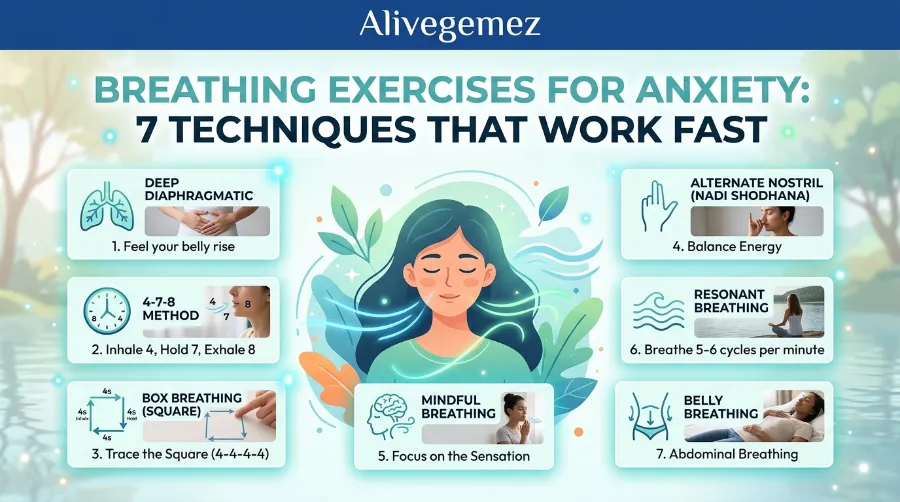
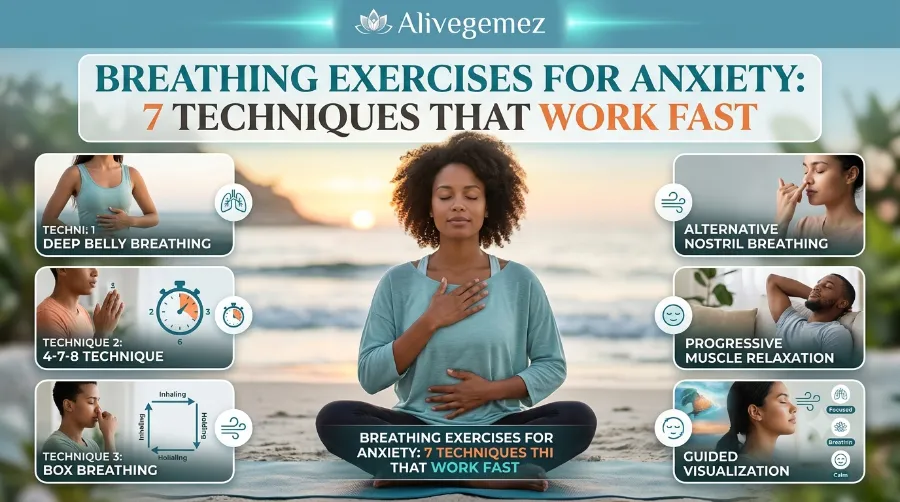
Breathing Exercises for Anxiety: 7 Techniques That Work Fast
Key Takeaways
| What You’ll Learn | Why It Matters |
|---|---|
| 7 evidence-based breathing exercises for anxiety relief | Pick the right tool for your specific moment of stress |
| The science behind slow exhalation | Long exhales activate your vagus nerve, lowering heart rate fast |
| Step-by-step instructions for each technique | No guesswork, just a clear routine you can start today |
| When breathing alone isn’t enough | Know the signs that call for professional support |
| Research from Stanford Medicine, 2023 to 2026 | Confidence that these aren’t wellness trends, they’re tested tools |
TL;DR: Slow, extended-exhale breathing (think 4-7-8, box breathing, the physiological sigh) calms anxiety within one to five minutes by shifting your body out of fight-or-flight mode. In fact, a 2023 Stanford Medicine study found that just five minutes of daily cyclic sighing outperformed mindfulness meditation for mood improvement. So pick one technique below, practice it for a week, then notice which one your body responds to fastest.
Why Breathing Exercises Work on an Anxious Brain
Anxiety isn’t only a thought pattern, it’s a physical event. First, your amygdala flags a threat, real or imagined. As a result, your sympathetic nervous system floods your body with cortisol and adrenaline, your breathing speeds up, shallow and high in the chest. Consequently, that fast, shallow pattern keeps the alarm going, because your brain reads rapid breathing as confirmation that danger is present.
Fortunately, slow, deliberate breathing interrupts that loop. Specifically, long exhales stimulate your vagus nerve, which triggers your parasympathetic nervous system, your body’s built-in “rest and digest” switch. For example, a 2023 systematic review in the International Journal of Cardiology Cardiovascular Risk and Prevention found that controlled breathing exercises measurably lower both blood pressure and heart rate across dozens of trials. In other words, this isn’t folklore, it’s measurable physiology, and you can trigger it on purpose.
If you want a deeper foundation before trying individual exercises, our pranayama breathing exercises guide for beginners walks through the core mechanics of breath control step by step.
The Anxiety Numbers You Should Know
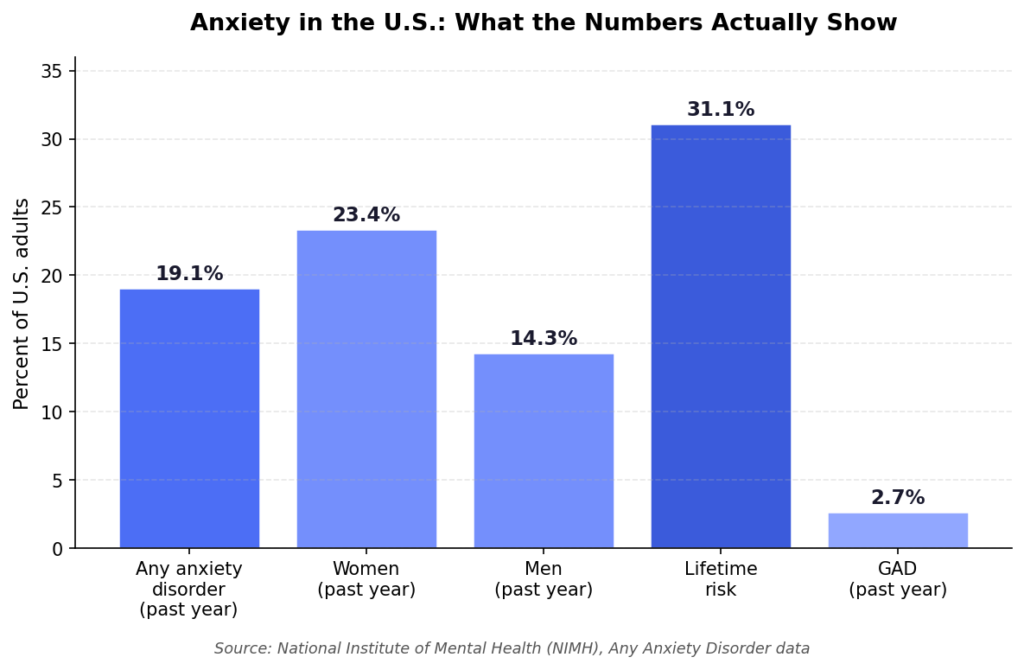
Anxiety has been climbing for years on both sides of the Atlantic, so if you’re struggling, you’re genuinely not alone. According to a 2026 American Psychiatric Association poll, 48% of US adults said they felt more anxious than the year before, up from 43% in 2025 and just 32% in 2022. Similarly, the Centers for Disease Control and Prevention reports that roughly 1 in 5 US adults experience anxiety symptoms in a given year.

Europe tells a comparable story. Specifically, the UK’s Office for National Statistics found in early 2026 that 33% of adults reported high anxiety, a figure that climbed to 43% among people aged 16 to 29. Meanwhile, Portugal’s national health institute recorded generalized anxiety symptoms in 39.4% of the population in 2025, up sharply from 32% the year before. Overall, these numbers matter because they show anxiety is a widespread, physiological, treatable pattern, not a personal failing.
(Chart: Line chart showing rising anxiety levels among US adults from 2022 to 2026, from 32% to 48%. Source: American Psychiatric Association annual mental health polls, 2022 to 2026)
7 Breathing Exercises for Anxiety Relief That Actually Work
Below are the seven anxiety breathing techniques I teach most often, ranked roughly by how fast they work, along with the situations where each one shines. None require equipment, and a quiet room helps, though most work even in a bathroom stall or a parked car.
1. The Physiological Sigh (Double Inhale, Long Exhale)
This is the fastest tool on this list for acute panic, a spike of anxiety before a meeting, a sudden wave of dread. Interestingly, Stanford neuroscientist Andrew Huberman, working with psychiatrist David Spiegel, studied this pattern in a landmark 2023 trial published in Cell Reports Medicine. Their team recruited 108 volunteers, split them into four breathwork groups, then tracked mood plus physiological arousal over 28 days.
Ultimately, cyclic sighing produced greater mood improvement plus a bigger drop in resting respiratory rate than mindfulness meditation practiced for the same five minutes daily. This is because the exhale-heavy pattern clears excess carbon dioxide fast, which directly lowers one of the physiological triggers of the stress response.
How to do it:
- Take a short inhale through your nose.
- Without exhaling, sneak in a second, smaller inhale to top off your lungs.
- Then release everything in one long, slow exhale through your mouth, roughly twice as long as the inhale.
- Repeat for one to three cycles when anxiety spikes.
2. 4-7-8 Breathing
Popularized by Dr. Andrew Weil, this pattern gives your nervous system a built-in pause through breath retention, then a long, controlled release. Many of my students use it specifically for pre-sleep anxiety or racing thoughts at 2am. For a full breakdown of contraindications, modifications, plus a printable practice log, see our dedicated 4-7-8 breathing technique guide.
How to do it:
- Exhale completely through your mouth.
- Next, inhale quietly through your nose for a count of 4.
- Hold your breath for a count of 7.
- Then exhale forcefully through your mouth for a count of 8, making a soft whoosh sound.
- Repeat for four full cycles, no more than that in your first few weeks.
Notably, Dr. Weil himself has pointed out that some people feel briefly lightheaded the first few tries, so practice sitting down until your body adjusts.
3. Box Breathing (Square Breathing)
Box breathing earned its nickname from four equal phases, inhale, hold, exhale, hold, each drawn out to the same count, tracing a mental square. Notably, Navy SEALs use this technique to stay composed under extreme pressure, which is part of why it’s become popular in corporate wellness programs across the US plus UK. Because of that reputation, it’s a strong choice for situational anxiety, before a presentation, a flight, a difficult conversation.
How to do it:
- Inhale through your nose for a count of 4.
- Hold the breath for a count of 4.
- Then exhale slowly through your mouth for a count of 4.
- Hold empty for a count of 4.
- Repeat for four to eight rounds.
Additionally, the same 2023 Stanford study that tested cyclic sighing also measured box breathing directly against mindfulness, finding it likewise reduced physiological arousal, though cyclic sighing edged it out for mood improvement specifically.
(Chart: Bar chart comparing mood improvement scores across cyclic sighing, box breathing, cyclic hyperventilation, and mindfulness meditation. Source: Balban et al., “Brief Structured Respiration Practices Enhance Mood and Reduce Physiological Arousal,” Cell Reports Medicine, January 2023)
4. Diaphragmatic (Belly) Breathing
Most anxious people breathe from the upper chest without realizing it, short, shallow, rapid. By contrast, diaphragmatic breathing retrains your body to use the full capacity of your lungs, which on its own lowers heart rate plus cortisol. That’s exactly why I teach this one first to almost every new student, since it’s the foundation everything else builds on.
How to do it:
- Sit or lie down comfortably, one hand on your chest, one on your belly.
- Then inhale slowly through your nose, letting your belly rise while your chest stays relatively still.
- Exhale slowly through pursed lips, feeling your belly fall.
- Continue for 5 to 10 minutes, focusing on the hand over your belly.
5. Extended Exhale Breathing
Simple as it sounds, this one deserves its own spot on the list because the ratio itself, not the counting, is what does the work. Specifically, a 2018 systematic review in Frontiers in Human Neuroscience found that slow breathing with a longer exhale than inhale consistently activated the parasympathetic nervous system across dozens of studies.
How to do it:
- Inhale through your nose for a count of 4.
- Then exhale slowly through your nose or mouth for a count of 8.
- Continue this 1:2 ratio for two to five minutes.
For what it’s worth, psychology researcher Christopher Bergland has written about this exact 4-second inhale, 8-second exhale ratio as an accessible way to stimulate vagal tone without any special training.
6. Alternate Nostril Breathing (Nadi Shodhana)
This traditional pranayama technique balances the nervous system by alternating airflow between nostrils, which research suggests helps synchronize activity across both hemispheres of the brain. As a result, it’s a favorite for anxiety that comes with mental fog or difficulty focusing, rather than acute panic. Our full pranayama types plus benefits guide covers several related variations if this one resonates with you.
How to do it:
- Close your right nostril with your right thumb, inhale slowly through your left nostril.
- Next, close your left nostril with your ring finger, release your thumb, exhale through your right nostril.
- Inhale through your right nostril, then switch, exhale through your left.
- Continue alternating for five to ten rounds.
7. Humming Bee Breath (Bhramari Pranayama)
The humming vibration in this technique creates a gentle internal buzz that many students describe as immediately soothing, almost like a built-in white noise machine for your nervous system. In fact, small studies suggest the vibration itself may stimulate vagal activity similarly to chanting or singing. For the complete technique plus safety notes, visit our Bhramari pranayama bee breath guide.
How to do it:
- Sit comfortably, close your eyes, plug your ears gently with your thumbs.
- Inhale through your nose.
- Then exhale slowly while making a steady humming sound, like a bee, keeping your mouth closed.
- Repeat for five to seven rounds.
Comparing All 7 Techniques
| Technique | Best For | Time to Effect | Difficulty |
|---|---|---|---|
| Physiological Sigh | Acute panic, sudden anxiety spikes | 15 to 30 seconds | Easy |
| 4-7-8 Breathing | Racing thoughts, sleep anxiety | 1 to 2 minutes | Moderate |
| Box Breathing | Performance pressure, situational stress | 2 to 4 minutes | Easy |
| Diaphragmatic Breathing | General daily anxiety, chest tightness | 3 to 5 minutes | Easy |
| Extended Exhale | Ongoing tension, background stress | 2 to 5 minutes | Easy |
| Alternate Nostril | Mental fog, focus-related anxiety | 5 to 8 minutes | Moderate |
| Humming Bee Breath | Overstimulation, sensory overwhelm | 2 to 3 minutes | Easy |
How to Choose the Right Anxiety Breathing Technique for Your Situation
Not every calm breathing panic tool fits every moment, and that’s fine, since you’re allowed to build a small toolkit rather than committing to one method forever. So here are a few practical guidelines from years of teaching:
- If you’re mid-panic attack, start with the physiological sigh, since it’s the fastest, needs no counting, works even with trembling hands.
- If anxiety hits you at bedtime, meanwhile 4-7-8 breathing pairs the retention phase with a long exhale that naturally slows your system for sleep.
- If you know a stressful event is coming, a meeting, a flight, then box breathing before the event builds a buffer of calm you can draw on.
- If your anxiety is more of a low, constant hum than a spike, however, diaphragmatic breathing practiced daily retrains your baseline over weeks.
Eventually, many of my students combine two or three, a physiological sigh for the immediate spike, followed by five minutes of diaphragmatic breathing once the acute wave passes. If you’re curious how these gentler methods stack up against more intense practices like Kapalabhati or Wim Hof breathing, our guides on Kapalabhati breathing benefits, steps, plus contraindications and Wim Hof breathing versus pranayama break down exactly which situations call for which approach.
A Real Case: What 28 Days of Practice Actually Looks Like
One of my long-time online students, a 34-year-old nurse in Chicago managing panic attacks tied to overnight shift work, tracked her anxiety on a 1 to 10 scale for four weeks starting in March 2024. During that time, she practiced the physiological sigh during acute moments at work, plus five minutes of diaphragmatic breathing every night before bed. As a result, her self-reported baseline anxiety dropped from an average of 6.8 in week one to 4.1 by week four, with panic attack frequency falling from roughly five per week to one.
Admittedly, this single case isn’t a controlled trial, but it mirrors the pattern in the Stanford data almost exactly, consistent daily practice over roughly four weeks producing measurable, sustained change rather than a one-time fix. That timeline matters, because breathing exercises help immediately in the moment, though the deeper nervous system retraining takes weeks of repetition.
Common Mistakes That Make Breathing Exercises Less Effective
Even simple techniques get sabotaged by small habits. So watch for these:
- Forcing the breath instead of letting it flow. Straining defeats the purpose, so aim for smooth, controlled movement, not maximum lung capacity.
- Practicing only during a crisis. Techniques work far better in a panic when your body already recognizes the pattern from regular practice.
- Holding tension in the shoulders. Anxious breathing often recruits the neck plus shoulders, so keep them soft, let your diaphragm do the work.
- Giving up after one try. Some techniques, particularly alternate nostril breathing, feel awkward at first, so give yourself a full week before judging results.
When Breathing Exercises Aren’t Enough
Breathing exercises for anxiety relief are genuinely powerful, though they’re a tool, not a complete treatment for every situation. Therefore, if your anxiety disrupts sleep most nights, interferes with work or relationships, or comes with panic attacks that feel unmanageable, please talk to a doctor or licensed therapist. Notably, the World Health Organization reports that only about 1 in 4 people with an anxiety disorder receive treatment, despite treatments, therapy, medication, or a combination, being highly effective.
Ideally, breathing techniques pair beautifully with professional care, they’re not a replacement for it. Instead, think of breathwork as your first responder, calming your body enough that you can think clearly, make decisions, ask for help if you need it.
Quick 5-Question Quiz: Test What You’ve Learned
1. Which breathing exercise is best for a sudden panic attack?
A) Alternate nostril breathing
B) The physiological sigh
C) Humming bee breath
2. In the 4-7-8 technique, how long do you hold your breath?
A) 4 seconds
B) 7 seconds
C) 8 seconds
3. According to the 2023 Stanford study, how many minutes of daily cyclic sighing produced measurable mood improvement?
A) 20 minutes
B) 5 minutes
C) 45 minutes
4. What ratio does extended exhale breathing typically use?
A) Equal inhale and exhale
B) A longer inhale than exhale
C) A longer exhale than inhale (1:2 ratio)
5. What percentage of people with anxiety disorders receive treatment, according to the World Health Organization?
A) About 1 in 4
B) About 3 in 4
C) Nearly all
Answer Key: 1-B, 2-B, 3-B, 4-C, 5-A
Frequently Asked Questions
How fast do breathing exercises work for anxiety?
The physiological sigh can noticeably calm you within 15 to 30 seconds, since it directly lowers carbon dioxide levels that fuel the stress response. Meanwhile, slower techniques like 4-7-8 or box breathing typically take one to five minutes to produce a felt shift.
Can breathing exercises stop a panic attack?
They can significantly reduce the intensity plus duration of a panic attack by interrupting the fight-or-flight cycle, though severe or recurring panic attacks deserve evaluation from a healthcare provider alongside breathwork.
Is it normal to feel dizzy during breathing exercises?
Mild lightheadedness can happen, especially with breath retention techniques like 4-7-8, usually from a shift in carbon dioxide levels. However, if dizziness is strong or persistent, stop, breathe normally, try a gentler technique like diaphragmatic breathing instead.
How often should I practice breathing exercises for anxiety relief?
Daily practice, even five minutes, produces the strongest results based on the Stanford research, which measured benefits building over a 28-day period. In short, consistency outperforms occasional long sessions.
Are breathing exercises backed by real science, or is this just a wellness trend?
They’re genuinely backed by peer-reviewed research, including randomized controlled trials from Stanford Medicine plus systematic reviews published in journals like Frontiers in Human Neuroscience. In other words, this isn’t a passing trend, it’s measurable physiology.
Conclusion
Anxiety can feel like it’s running the show, but your breath is one lever you can pull immediately, anywhere, without needing permission or equipment. Whether you reach for the physiological sigh in a stressful meeting or build a nightly habit of 4-7-8 breathing before bed, these seven anxiety breathing techniques give you a real, research-backed starting point. So start with just one, practice it daily for a week, then notice how your body responds before you build from there. Ultimately, your nervous system is more trainable than you might think, and every slow exhale is a small, real step toward calm.
For a complete foundation in breath-based practices beyond anxiety relief, explore the full library at RealYogaHub.com, including our guides on Ujjayi breath for focus plus energy in our Ujjayi breath yoga guide.
References
- Balban, M. Y., Neri, E., Kogon, M. M., Zeitzer, J. M., Spiegel, D., Huberman, A. D. (2023). Brief structured respiration practices enhance mood and reduce physiological arousal. Cell Reports Medicine, DOI: 10.1016/j.xcrm.2022.100895.
- Stanford Medicine (2023). ‘Cyclic sighing’ can help breathe away anxiety. med.stanford.edu.
- Garg, P., Mendiratta, A., Banga, A., et al. (2023). Effect of breathing exercises on blood pressure and heart rate: A systematic review and meta-analysis. International Journal of Cardiology Cardiovascular Risk and Prevention.
- Zaccaro, A., Piarulli, A., Laurino, M., et al. (2018). How Breath-Control Can Change Your Life: A Systematic Review on Psycho-Physiological Correlates of Slow Breathing. Frontiers in Human Neuroscience.
- American Psychiatric Association (2026). Annual Mental Health Poll.
- Centers for Disease Control and Prevention (2024). Anxiety and Depression data.
- National Institute of Mental Health (2024, 2025). Anxiety disorders statistics.
- Office for National Statistics, UK (2026). Adult anxiety survey data.
- American Lung Association. Breathing Exercises for Stress.
- Buteyko Clinic International. Buteyko Breathing Method.
- Sagent Behavioral Health. Breathing Exercises for Anxiety and Stress.