
Two friends of mine tried breathwork the same month. One joined a Wim Hof workshop and came out gasping, tingling, and grinning like she’d run a race sitting down. The other started a slow pranayama routine before bed and told me it felt like someone had turned the volume down on her anxious thoughts. Same word, “breathwork,” two completely different bodies of experience. That gap is exactly why so many people search for wim hof breathing vs pranayama and end up more confused than when they started.
Transcendental Meditation vs Mindfulness: Key Differences 2026
I have spent twelve years teaching pranayama, and I have also gone through the Wim Hof fundamentals training myself, ice baths included. So this comparison is not theory pulled from a textbook. It is built from practice, from client sessions, and from the peer reviewed research that backs (or does not back) the claims flying around social media.
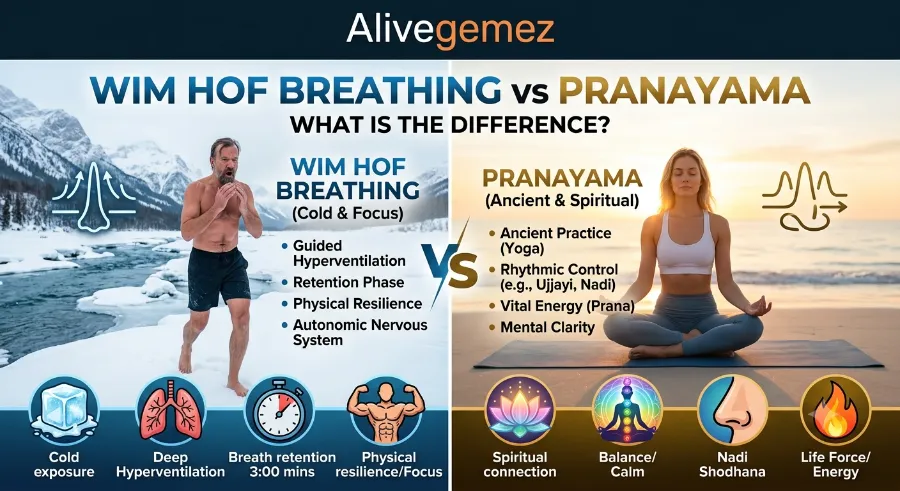
Wim Hof Breathing vs Pranayama: What Is the Difference?
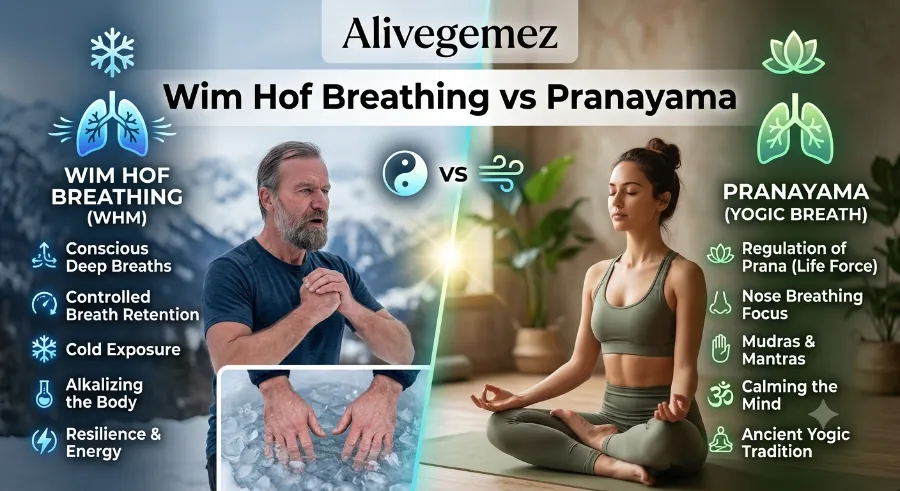
TL;DR: Wim Hof breathing is a fast, forceful hyperventilation-plus-breath-hold method built for a strong sympathetic nervous system jolt, adrenaline, alertness, and cold tolerance. Pranayama is a broad, mostly slow, ancient yogic breathing system built for calm, focus, and long-term nervous system balance. If you want an energizing shock to the system, Wim Hof breathing wins; if you want steady, sustainable regulation, pranayama wins.
Breathing Exercises for Anxiety: 7 Techniques That Work Fast
Key Takeaways
| Factor | Wim Hof Breathing | Pranayama |
|---|---|---|
| Origin | Developed by Wim Hof, Netherlands, popularized from the 1990s onward | Ancient Indian yogic system, documented in texts over 2,000 years old |
| Typical pace | Fast, forceful hyperventilation (30 to 40 breaths per round) then a long exhale hold | Mostly slow and controlled (4 to 8 breaths per minute), though some forms like Kapalabhati are fast |
| Nervous system effect | Strong sympathetic activation, adrenaline surge, then a rebound calm | Parasympathetic activation, calm, steady focus |
| Best used for | Cold exposure prep, energy, mental toughness, immune modulation | Anxiety management, sleep, blood pressure, daily stress regulation |
| Research depth | Growing, notably the 2014 Kox et al. PNAS study | Decades of studies on heart rate variability, blood pressure, and anxiety |
| Beginner risk level | Moderate, do seated or lying down, never in water | Low, though fast forms like Kapalabhati need guidance |
What Is Wim Hof Breathing, Exactly?
Wim Hof breathing is the breathing pillar of the Wim Hof Method, a three-part system that also includes cold exposure and commitment or mindset training. The Dutch athlete known as “the Iceman” built his reputation on climbing Kilimanjaro in shorts and swimming under Arctic ice, then packaged the breathing technique he used to prepare his body for that punishment.
The mechanics are simple to describe, though not always simple to do well the first time. You take 30 to 40 deep, forceful breaths in a row, full inhale through the nose or mouth, a passive, unforced exhale. After the final breath, you exhale and hold your breath for as long as you comfortably can. Then you take a deep recovery breath, hold for 15 seconds, and repeat the cycle three or four times.
That hyperventilation phase blows off carbon dioxide faster than your body can replace it. Your blood becomes temporarily alkaline, a state called respiratory alkalosis. Practitioners typically report tingling in the hands and feet, lightheadedness, and afterward, a wave of clarity and calm once the breath hold ends and CO2 levels normalize. If you have already looked at the pillar guide on our pranayama breathing exercises for beginners page, you already know that most yogic techniques are built to slow this exact process down rather than accelerate it, which is the core wim hof breathing vs pranayama split.
The Science Behind Wim Hof Breathing
The technique got serious scientific attention after a landmark 2014 study published in the Proceedings of the National Academy of Sciences. Researchers at Radboud University trained twelve healthy volunteers in the Wim Hof Method for just ten days, breathing, cold exposure, and meditation combined, then injected them with bacterial endotoxin alongside twelve untrained controls. The trained group showed significantly higher levels of epinephrine, dramatically suppressed pro-inflammatory cytokines including IL-6, IL-8, and TNF-alpha, and reported fewer and milder flu-like symptoms compared to untrained controls. That single study is the reason “Wim Hof method comparison” articles across the internet keep citing his name next to words like “immune system.” PLOS
A 2024 systematic review in PLOS One pulled together nine papers on the method and reached a more measured conclusion. The findings suggest the Wim Hof Method may reduce inflammation in healthy and non-healthy participants as it increases epinephrine levels, causing an increase in interleukin-10 and a decrease in pro-inflammatory cytokines, though effects on exercise performance and respiratory parameters showed mixed results. Translation, the anti-inflammatory effect looks real and repeatable, but claims about performance boosts are still shaky.
A smaller pilot trial out of Slovakia looked specifically at people with Multiple Sclerosis. Over a 12-week randomized trial with 60 participants, both a Wim Hof group and a standard lifestyle group (exercise plus diet changes) showed significant reductions in key inflammatory cytokines including IL-17A, with the Wim Hof group uniquely also showing a reduction in IFN-gamma, an immune signaling molecule linked to attacks on myelin. That is early, small-sample evidence, not a green light to replace medical care, but it does suggest the breathing method has a measurable physiological footprint beyond hype. PLOS
What Is Pranayama, Exactly?
Pranayama is the ancient Sanskrit umbrella term for breath control in yoga, from “prana” (life force or breath) and “ayama” (extension or control). Unlike Wim Hof breathing, which is one specific technique, pranayama is a whole family of practices, some slow and calming, some rapid and energizing, developed over centuries within the yogic tradition. If you are new to this landscape, our guide on pranayama types and benefits breaks each one down individually.
Common pranayama techniques include:
- Nadi Shodhana (alternate nostril breathing), slow, balancing, used for focus and calm before meditation
- Ujjayi (ocean breath), a soft throat constriction that creates an audible hiss, common during asana practice, covered in depth in our Ujjayi breath guide
- Bhramari (bee breath), a humming exhale shown to activate the vagus nerve, explained fully in our Bhramari pranayama guide
- Kapalabhati (skull shining breath), a rapid, forceful exhale technique that is actually the closest cousin to Wim Hof breathing within the pranayama family, detailed in our Kapalabhati breathing guide
This variety is why the phrase “pranayama vs wim hof breathing” is a bit of an oversimplification. Most pranayama, especially the slow forms, sits at the opposite end of the spectrum from Wim Hof breathing. But Kapalabhati and Bhastrika (bellows breath) share some hyperventilation characteristics with it.
The Science Behind Pranayama
The research base for pranayama is older and broader than for Wim Hof breathing, largely because slow breathing practices have been studied by cardiology and psychiatry researchers for decades. A 2021 randomized clinical trial in hypertensive patients compared Nadi Shodhana and Bhramari pranayama. Nadi Shodhana Pranayama showed a significant decrease in auditory reaction time, and Bhramari Pranayama showed an even more significant decrease, with both techniques proving effective in balancing sympathovagal tone. doaj
A study on anxiety disorder patients at JIPMER in India assigned 140 people to either eight weeks of slow pranayama plus routine psychiatric care, or routine care alone. After eight weeks, the pranayama group showed heart rate variability parameters shifting significantly toward the parasympathetic domain, along with a significant increase in parasympathetic reactivity, a decrease in sympathetic reactivity, and improved baroreflex sensitivity. That is a direct, measurable nervous system shift toward calm, the opposite direction from the sympathetic spike Wim Hof breathing produces. nih
A 2025 pilot study comparing slow-paced breathing to Bhramari humming breathing found both techniques significantly increased heart rate variability, with higher values across several markers than a simple resting condition, and no meaningful difference between the two methods. This matters for anyone choosing between pranayama styles, since it suggests you do not need a complicated technique to get a real physiological benefit, consistency matters more than complexity. doaj
The Real Physiological Difference: Fast vs Slow
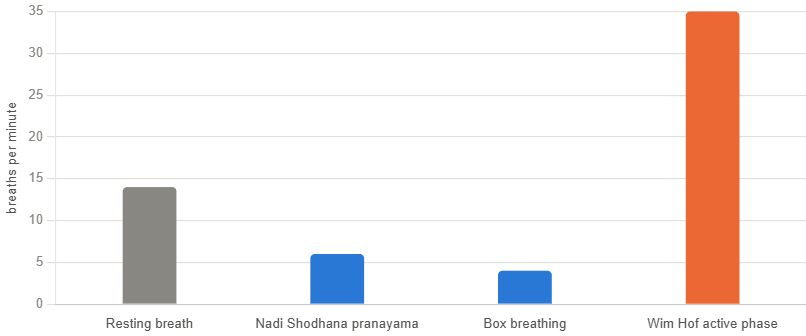
Here is the part most articles skip. The wim hof breathing vs pranayama question is really a question about breathing rate and its downstream effects on your blood chemistry. Wim Hof breathing pushes your breathing rate up toward 30 to 40 breaths per minute during the active phase. Most pranayama, by contrast, slows breathing down toward 4 to 6 breaths per minute or less.
That chart above shows the gap clearly. Resting breath sits around 14 breaths per minute for most adults. Nadi Shodhana pranayama slows that down to roughly 6. Box breathing, a related slow technique many of my clients use before public speaking, drops even lower toward 4. Wim Hof breathing during its active phase jumps to 30 or higher, more than double resting rate.
Fast breathing blows off CO2 and triggers a mild stress response on purpose, adrenaline rises, alertness spikes, and after the breath hold, a rebound of calm follows. Slow breathing does close to the opposite, it raises CO2 tolerance slightly, activates the vagus nerve, and nudges the body toward rest and digest mode. A 2021 observational study on experienced Kriya yoga practitioners found that slow deep breathing at a pattern of roughly four breaths per minute produced a statistically significant decrease in heart rate, supporting the idea that regular pranayama practice can strengthen cardio-vagal reserve and beneficially affect cardiovascular regulation over time.
Where Holotropic Breathwork Fits In
No breathwork types comparison is complete without mentioning holotropic breathwork, developed by psychiatrist Stanislav Grof in the 1970s. It shares some surface similarity with Wim Hof breathing, both use continuous, connected, faster-than-normal breathing to shift consciousness. But the intent and setting differ sharply. Holotropic sessions run for one to three hours, use evocative music, and are typically facilitated in group settings aimed at emotional release and altered states of awareness, closer to a guided psychological journey than a physical conditioning tool. Wim Hof breathing is shorter, more physically oriented, and often done solo at home in a few minutes.
For a deeper side-by-side breakdown of these approaches, the comparison over at DeepBreathe’s Wim Hof vs pranayama guide is worth a look, and The Physical Evolution’s breathwork vs pranayama piece covers the training and coaching angle well.
Benefits Compared Side by Side
| Benefit Area | Wim Hof Breathing | Pranayama |
|---|---|---|
| Energy and alertness | Strong, immediate boost | Mild, more sustained |
| Anxiety and stress | Post-practice calm after the spike | Direct, steady reduction |
| Sleep support | Not ideal before bed due to stimulation | Well suited, especially Bhramari or slow nasal breathing |
| Cold tolerance | Specifically trains this | Not a focus |
| Immune modulation | Emerging evidence, notably the 2014 PNAS study | Limited direct evidence, more indirect via stress reduction |
| Blood pressure | Not well studied for this | Multiple studies show reductions, particularly with slow and Bhramari forms |
| Beginner accessibility | Needs guidance and safety awareness | Generally easier to start solo |
Safety: What You Actually Need to Know
I tell every client the same thing before they try Wim Hof breathing for the first time, do it seated or lying down, never in or near water, and never while driving. The breath holds and the lightheadedness that follow hyperventilation can cause fainting, and fainting near water has led to documented drowning deaths among people practicing Wim Hof style breathing while swimming. This is not a scare tactic, it is the single most important safety note in this entire article.
Pranayama carries lower general risk, but it is not risk-free either. Fast forms like Kapalabhati and Bhastrika should be avoided during pregnancy, with high blood pressure that is not well controlled, or with certain eye or ear conditions like glaucoma or a recent retinal issue. If you have a cardiac condition, epilepsy, or a history of panic attacks, talk to your doctor before starting either practice, and consider starting with a slower pranayama technique under a qualified teacher’s guidance rather than jumping straight into rapid hyperventilation styles.
A Real Case Study From My Practice
A client of mine, a 41-year-old marketing director I will call Priya, came to me in early 2025 wanting more energy without relying on her fourth cup of coffee. We started her on Wim Hof breathing three mornings a week, three rounds each session. Within two weeks she reported clearer focus by 10 a.m. and less reliance on caffeine after lunch. But her sleep did not improve, if anything, doing the rounds too close to bedtime once left her wired until midnight.
So we added a second practice, ten minutes of Nadi Shodhana pranayama every evening. Six weeks later she told me her resting heart rate, tracked on her fitness watch, had dropped by about four beats per minute on average, and she was falling asleep noticably faster. That combination, Wim Hof breathing for morning energy, pranayama for evening wind-down, is a pattern I now recommend often, because the two techniques are not competitors, they are tools for opposite jobs.
How to Choose Between Them
Ask yourself what you actually need right now.
- Need a jolt of energy or mental toughness training? Start with Wim Hof breathing, seated, three rounds, ideally in the morning.
- Need to calm anxiety, lower blood pressure, or fall asleep faster? Start with a slow pranayama technique like Nadi Shodhana or Bhramari.
- Preparing for cold exposure or an endurance event? Wim Hof breathing was built for exactly this.
- Managing a chronic stress condition with your doctor’s involvement? Pranayama has the deeper long-term evidence base for this.
- Want a middle ground? Try 4-7-8 breathing, a simple pranayama-adjacent technique that slows the breath using a counted pattern, gentle enough for daily use and a good bridge if fast hyperventilation feels intense.
You do not have to pick one forever. Many of the most consistent practitioners I know, myself included, rotate both depending on the time of day and what their nervous system is asking for.
Frequently Asked Questions
Is Wim Hof breathing a type of pranayama?
Not traditionally. Wim Hof breathing was developed independently in the Netherlands, though its hyperventilation pattern resembles Bhastrika and Kapalabhati, two fast pranayama techniques from the yogic tradition.
Which is better for anxiety, Wim Hof breathing or pranayama?
Slow pranayama generally has stronger, more direct research support for anxiety reduction, since it activates the parasympathetic nervous system immediately rather than causing an initial stress spike.
Can I practice both in the same day?
Yes, and many practitioners do, Wim Hof breathing in the morning for energy, slow pranayama in the evening for calm and sleep.
Is Wim Hof breathing dangerous?
It carries real risk if done incorrectly, mainly fainting from the breath holds. Always practice seated or lying down, never in or near water.
Do I need a teacher to start pranayama?
Slow forms like Nadi Shodhana are safe to try solo with good instructions. Faster forms like Kapalabhati and Bhastrika benefit from guided instruction, especially if you have any underlying health conditions.
Conclusion
The wim hof breathing vs pranayama debate is not really about which technique is superior, it is about matching the tool to the moment. Wim Hof breathing gives you a fast, forceful reset, adrenaline up, then a wave of calm and clarity once the breath hold ends, and it comes with a growing body of research around inflammation and immune response. Pranayama, especially its slower forms, offers steady, well-researched support for blood pressure, anxiety, and sleep, built on a tradition thousands of years old. Try each one with attention to how your own body responds, keep safety front of mind, and let your goals, not a trend, decide which breath you take first each morning.
Take the Quiz: Test What You Learned
1. What is the primary physiological effect of Wim Hof breathing’s active phase?
A) Increased carbon dioxide retention
B) Respiratory alkalosis from blowing off CO2
C) Immediate parasympathetic activation
2. Which pranayama technique is closest in style to Wim Hof breathing?
A) Nadi Shodhana
B) Kapalabhati
C) Bhramari
3. According to the 2014 Kox et al. study, what happened to pro-inflammatory cytokines in the trained Wim Hof group?
A) They increased significantly
B) They stayed the same
C) They were significantly suppressed
4. What is the main safety warning for practicing Wim Hof breathing?
A) Never practice it seated
B) Never practice it in or near water
C) Never practice it in the morning
5. Which practice generally has stronger research support for reducing anxiety directly?
A) Wim Hof breathing
B) Slow pranayama
C) Neither has been studied
Answer Key: 1-B, 2-B, 3-C, 4-B, 5-B
References
- Kox, M., van Eijk, L.T., Zwaag, J., et al. (2014). Voluntary activation of the sympathetic nervous system and attenuation of the innate immune response in humans. Proceedings of the National Academy of Sciences, 111(20), 7379-7384.
- Almahayni, O., & Hammond, L. (2024). Does the Wim Hof Method have a beneficial impact on physiological and psychological outcomes in healthy and non-healthy participants? A systematic review. PLOS One.
- Bahenský, P., et al. Pilot study on Wim Hof Method and chronic inflammation in Multiple Sclerosis, cited via Wim Hof Method science summary.
- Upadhyay, J., Nandish, N.S., Shetty, S., et al. (2023). Effects of Nadishodhana and Bhramari Pranayama on heart rate variability, auditory reaction time, and blood pressure. Journal of Ayurveda and Integrative Medicine, 14(4).
- JIPMER study on slow pranayama and cardiac autonomic function in anxiety disorder patients, PMC.
- Acute effects on heart rate variability during slow deep breathing in Kriya yoga practitioners. Mymensingh Medical Journal, 30(1), 208-213.
- Effects of slow-paced breathing and humming breathing on heart rate variability and affect. ScienceDirect, pilot investigation.
- National Center for Biotechnology Information systematic overview of breathwork research, PMC9540300.