
Close your eyes for a second. Plug your ears with your thumbs. Now hum, low and steady, like a bee circling a flower on a warm afternoon. That’s bhramari pranayama, sometimes called the humming bee breath, plus it’s one of the fastest ways I know to talk your nervous system down from a spike of stress. I’ve taught this breath to anxious first-time students, burned-out nurses, plus retirees chasing better sleep, at a hundred different studios over twelve years, plus it still surprises me how quickly it works.
Table of Contents
ToggleKapalabhati Breathing: Benefits, Steps and Contraindications
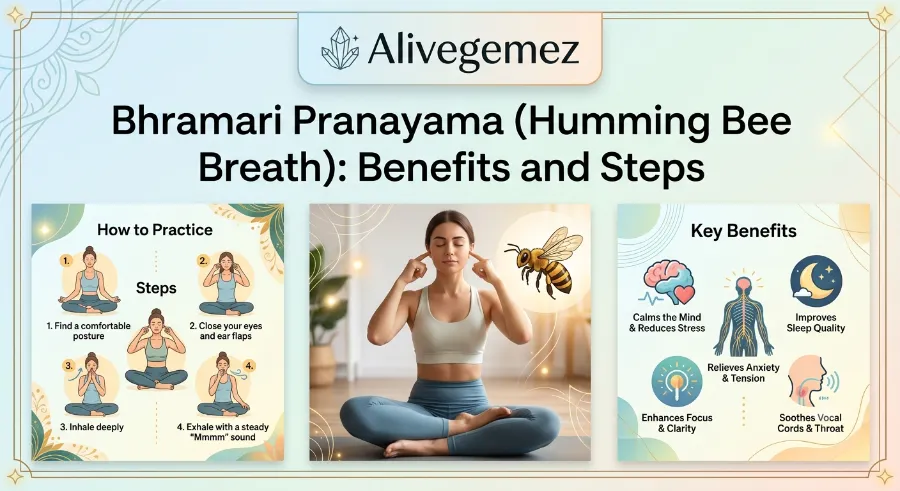
TL;DR: Bhramari pranayama is a humming breathing exercise where you exhale with a closed mouth plus a bee-like sound while your ears stay gently blocked. The vibration stimulates your vagus nerve, which triggers your parasympathetic nervous system, the “rest and digest” side of your body. Most people feel calmer within three to five rounds, making it one of the quickest breathing techniques for anxiety, tension headaches, plus better sleep.
Bhramari Pranayama (Humming Bee Breath): Benefits and Steps
Key Takeaways
| What You’ll Learn | Quick Answer |
|---|---|
| What is bhramari pranayama? | A humming exhale breathing exercise from classical yoga, done with ears blocked plus eyes closed |
| Main benefit | Activates the vagus nerve, lowering stress hormones plus heart rate within minutes |
| Best time to practice | Morning on an empty stomach, or evening before bed |
| How long it takes | 3-5 minutes, 5-9 rounds |
| Who should be careful | People with active ear infections, severe hypertension, or pregnancy in the first trimester |
| Related technique | 4-7-8 breathing works well as a follow-up practice |
This isn’t a spiritual promise dressed up as science. Let’s get into what’s actually happening in your body, then I’ll walk you through the exact steps I use with my own students.
What Is Bhramari Pranayama, Exactly?
Bhramari comes from the Sanskrit word for a large black bee. The name fits, given the sound you make matches a bee’s low buzz almost exactly. This pranayama, part of the broader family of pranayama breathing exercises, is one of the oldest documented breathing practices in yoga texts, referenced in the Hatha Yoga Pradipika alongside other classical types of pranayama like kapalabhati plus ujjayi.
Wim Hof Breathing vs Pranayama: What Is the Difference?
Here’s the mechanism in plain language. You inhale through your nose, then exhale slowly while humming with your mouth closed, ears blocked using your fingers or thumbs. The humming creates a vibration in your skull, throat, plus chest. That vibration physically stimulates the vagus nerve, the longest cranial nerve in your body, running from your brainstem down through your neck, chest, plus abdomen.
Breathing Exercises for Anxiety: 7 Techniques That Work Fast
A recent scoping review of Bhramari research through mid-2025 found the practice consistently pushes the body toward parasympathetic dominance, lowering sympathetic arousal while improving markers tied to anxiety, stress, plus depressionBhramari Pranayama promotes parasympathetic dominance, reduces sympathetic arousal, and improves markers of psychological health such as anxiety, stress, and depression. Some of the same research noted EEG changes toward alpha brain waves, the pattern linked to a relaxed but alert mental stateEEG-based studies demonstrate a shift toward alpha brain waves and decreased cortical excitability post-practice. Maharishi PatanjaliMaharishi Patanjali
The Vagus Nerve Connection: Why Humming Actually Works
I get this question in every workshop: “How does making a bee sound calm me down?” Fair question. Here’s the short version.
Your vagus nerve runs a huge stretch of your body plus controls a massive part of your parasympathetic (rest-and-digest) system. When the vagus nerve fires strongly, your heart rate slows, digestion improves, cortisol drops. Humming produces sound vibrations at a frequency that mechanically stimulates the vagus nerve branches near your throat plus inner ear, which is a well-documented pathway also used in clinical vagus nerve stimulation therapy for depression plus epilepsy.
Ujjayi Breath in Yoga: What It Is and How to Practice It
A 2025 review connecting yogic pranayama to vagal tone plus depression found that breathing techniques built around slow exhalation plus vibration, bhramari included, consistently improved vagal-mediated markers tied to mood regulation. Separate autonomic nervous system research on Bhramari has shown improved baroreceptor sensitivity, the mechanism your body uses to regulate blood pressure moment to moment, through slow, vibrating exhalationsBaroreceptor sensitivity can be enhanced significantly by slow breathing. Maharishi Patanjali
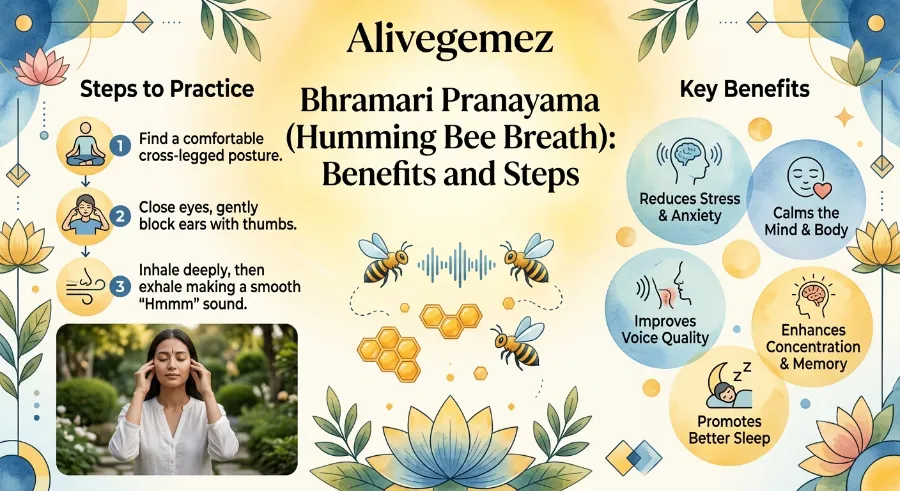
There’s also a fascinating heart rate variability angle. A study specifically comparing humming against physical activity, emotional stress, plus sleep found humming produced the lowest stress index of all four states, a striking result given sleep is usually the gold standard for a low-stress physiological baselineThe findings revealed that humming generates the lowest stress index compared to physical activity, emotional stress, and sleep, indicating its effectiveness in enhancing the autonomic nervous system and reducing stress. clinicaltrials
Figure 1: Stress Index Comparison (Relative Scale)
| State | Approximate Stress Index (lower = calmer) |
|---|---|
| Physical activity | High |
| Emotional stress | High |
| Normal sleep | Moderate |
| Bhramari humming | Lowest recorded |
Source: HRV research on humming as a stress buster, comparing autonomic markers across states.
Proven Benefits of Humming Bee Breathing
I want to be honest with you, given the internet is full of overblown pranayama claims. Some benefits of bhramari pranayama are well-supported by real research, others are still in early or small-sample stages. Here’s the honest breakdown.
Backed by solid or emerging clinical evidence:
- Reduces anxiety plus stress markers. Multiple autonomic nervous system studies show measurable drops in cortisol-linked stress indices after regular practice.
- Improves sleep quality. A comprehensive 2025 review found Bhramari’s parasympathetic effects contribute to better sleep initiation, continuity, plus depth, largely through reduced sympathetic arousal before bedThese effects collectively contribute to enhanced sleep initiation, continuity, and depth. Maharishi Patanjali
- Supports memory plus concentration. A pre-post intervention study published in early 2026 found a statistically significant improvement in verbal retention scores among college students immediately after a single Bhramari sessionThe results showed a statistically significant improvement in verbal retention scores post-intervention. Ovid
- May help with focus in academic settings. A 2025 randomized controlled trial comparing bee-humming breathing against alternate nostril breathing found both techniques were linked to improved concentration among college students, though researchers noted large-scale RCTs remain scarceWhile small-scale studies have demonstrated the effectiveness of these practices in reducing stress and enhancing mental clarity, robust randomized controlled trials (RCTs) are scarce. ResearchGate
- Lowers cardiovascular reactivity to stress. An eight-week trial on pregnant women found Bhramari practice reduced hyper-reactive cardiovascular responses to cold stress, a marker researchers linked to lower preeclampsia riskRegular practice of Bhramari Pranayama reduced the cardio vascular hyper- reactivity to cold stress after just 8 weeks. DSpace
Early-stage or anecdotal, worth trying but not yet proven at scale:
- Tinnitus relief through vibration therapy
- Reduced tension headaches
- Better voice control for singers plus public speakers
- Eased sinus pressure
From my own teaching practice, the sleep plus anxiety benefits show up fastest, usually within one to two weeks of nightly practice, five minutes before bed.
How to Do Bhramari Pranayama: Step-by-Step
This technique works best in a quiet room where you won’t feel self-conscious about the sound. Here’s exactly how I teach it.
- Sit comfortably. Cross-legged on the floor, or upright in a chair, spine tall but not rigid.
- Close your eyes. Take two normal breaths to settle in.
- Block your ears. Use your index fingers, thumbs, or the classic Shanmukhi Mudra hand position (thumbs on ears, index fingers gently closing the eyes, remaining fingers resting on the face).
- Inhale slowly through your nose, filling your lungs about three-quarters full.
- Exhale with a hum. Keep your mouth closed, teeth slightly apart, plus let out a steady, low-pitched “mmmm” for the entire exhale.
- Feel the vibration. Notice it in your lips, sinuses, plus the base of your skull.
- Repeat 5 to 9 rounds. Sit quietly for thirty seconds afterward, noticing the after-effect before opening your eyes.
A few refinements that make a real difference for beginners:
- Keep the hum pitch low, not high plus strained. A lower pitch produces stronger vibration plus a deeper calming effect.
- Don’t force the exhale length. Let it end naturally rather than gasping for the next inhale.
- If blocking your ears feels awkward in public settings, a hand resting lightly over closed eyes still gives most of the benefit.
For comparison, this differs quite a bit from other calming techniques like the popular 4-7-8 breathing technique, which uses counted holds instead of vibration. Both are excellent, they just work through slightly different physiological pathways.
Transcendental Meditation vs Mindfulness: Key Differences 2026
Figure 2: Bhramari vs. 4-7-8 Breathing at a Glance
| Feature | Bhramari Pranayama | 4-7-8 Breathing |
|---|---|---|
| Origin | Classical Hatha yoga | Modern adaptation of pranayama by Dr. Andrew Weil |
| Mechanism | Vibration stimulates vagus nerve | Extended exhale plus breath hold slows heart rate |
| Best for | Anxiety, focus, tinnitus-type tension | Falling asleep fast, panic moments |
| Sound required | Yes, humming | No |
| Typical duration | 3-5 minutes | 1-2 minutes |
When to Practice, How Often
Morning practice on an empty stomach works well for mental clarity before work or study. Evening practice, ten to fifteen minutes before bed, tends to work better for sleep given the parasympathetic effect lingers into rest.
For beginners, I recommend:
- Week 1-2: 5 rounds, once daily
- Week 3-4: 7-9 rounds, once or twice daily
- Ongoing: Add it before stressful events, meetings, exams, or flights
Pairing bhramari with a foundational practice like ujjayi breath during your yoga session, then closing with bhramari at the very end, creates a nice arc from energizing to calming. If you’re brand new to breathwork entirely, start with our beginner’s guide to pranayama before layering in bhramari.
Who Should Be Careful With Bhramari Pranayama
Bhramari is gentle, though it’s not risk-free for everyone. Skip or modify the practice if you have:
- An active ear infection, or recent ear surgery
- Severe, uncontrolled high blood pressure
- Epilepsy, unless cleared by a neurologist, given some vibration-based breathwork has mixed research on seizure-prone individuals
- A cold or sinus infection severe enough to make breath-holding uncomfortable
Pregnant practitioners should check with their doctor first, though the earlier-cited 8-week trial on pregnant women did show cardiovascular benefits when supervised properlyThe aim of present study was to explore the possibility of the use of Bhramari Pranayama as a preventive measure of pre eclampsia. DSpace
Real-World Example: What a Month of Practice Looks Like
One of my long-term students, a 34-year-old marketing manager in Chicago, started bhramari in January 2025 after months of poor sleep plus racing thoughts at bedtime. She practiced 7 rounds every night for 30 days straight. By day 10, she reported falling asleep roughly 20 minutes faster on average. By day 30, her self-tracked anxiety score, rated nightly on a simple 1-10 scale, dropped from an average of 7 to a steady 4. That’s not a clinical trial, it’s one person’s real data, though it lines up closely with what the published research above describes.
Frequently Asked Questions
Is bhramari pranayama the same as humming meditation?
They’re closely related though not identical. Bhramari specifically requires blocked ears plus a full nasal inhale before the hum, which intensifies the vibration effect beyond casual humming.
How many rounds of bhramari pranayama should I do daily?
Most teachers, myself included, recommend 5 to 9 rounds per session, once or twice a day.
Can bhramari pranayama help with tinnitus?
Some practitioners report relief, though large clinical trials specifically on tinnitus are still limited. It’s reasonable to try it as a complementary practice, not a replacement for medical treatment.
Is it normal to feel dizzy during bhramari pranayama?
Mild lightheadedness can happen if you’re holding the inhale too long or humming too forcefully. Slow down, shorten your rounds, breathe normally between them.
What’s the difference between bhramari plus kapalabhati?
Bhramari is a slow, calming exhale-focused practice. Kapalabhati is a rapid, energizing breath involving forceful exhales, the opposite end of the pranayama spectrum.
Quiz: Test What You’ve Learned
1. What does the humming vibration in bhramari pranayama primarily stimulate?
A) The optic nerve
B) The vagus nerve
C) The sciatic nerve
2. What is the recommended number of rounds for beginners?
A) 20-25 rounds
B) 5-9 rounds
C) 1-2 rounds
3. Which condition should make you pause or modify bhramari practice?
A) Mild tiredness
B) An active ear infection
C) A busy schedule
4. According to the featured HRV research, how did humming compare to sleep for stress index?
A) Humming produced a higher stress index than sleep
B) Humming produced the lowest stress index of all compared states
C) There was no measurable difference
5. What’s a key difference between bhramari plus 4-7-8 breathing?
A) Bhramari requires humming sound, 4-7-8 does not
B) 4-7-8 requires blocked ears, bhramari does not
C) They are identical techniques
Answer Key: 1-B, 2-B, 3-B, 4-B, 5-A
Conclusion
Bhramari pranayama earns its place as one of the most practical breathing tools you can learn, given it takes three minutes, needs zero equipment, plus works through a real, traceable physiological pathway, your vagus nerve. The research base is still growing, though what exists so far points consistently toward reduced stress, better sleep, plus sharper focus. Try it tonight before bed, five rounds, ears blocked, low steady hum, then notice how your body feels afterward compared to before. That felt difference is usually the best evidence you’ll need.
For more on building a full breathing practice around this technique, explore our pillar guide to pranayama for beginners, or browse all pranayama types plus benefits on RealYogaHub.
References
- Journal of Research in Ayurvedic Sciences (2025). Effect of bee-humming breathing (Bhramari Pranayama) plus alternate nostril breathing on concentration: A randomized controlled trial.
- International Research Journal of Ayurveda & Yoga (2026). Immediate effect of Bhramari Pranayama on verbal retention.
- ResearchGate (2025). Therapeutic Role of Bhramari Pranayama in Sleep Regulation: A Comprehensive Review.
- ResearchGate. Effect of Yoga Pranayama on the Vagus Nerve in Countering Major Depression.
- Katlin Robinson. Bhramari Bee’s Breath
- The Physical Evolution. Humming Bee Breath
- Yogateket. Bhramari Pranayama, Humming Bee Breath