
If you have ADHD, someone has probably told you to “just try yoga” at least a dozen times, usually right after you interrupted them mid-sentence or forgot why you walked into the kitchen. It’s annoying advice. It’s also, frustratingly, not wrong. After twelve years of teaching yoga and researching how movement changes the brain, I can tell you that yoga for ADHD focus in adults is one of the most misunderstood tools in mental health. It is not about sitting cross-legged and emptying your mind. For an ADHD brain, that instruction is almost cruel. Real yoga ADHD focus adults training looks completely different, and once you see how it actually works, the whole thing makes a lot more sense.
Key Takeaways
| What you’re wondering | Short answer |
|---|---|
| Does yoga actually help ADHD in adults? | Yes, as a support tool. Several small trials show real drops in symptom severity, though yoga works best alongside other treatment, not instead of it. |
| What type of yoga is best? | Active, breath-led styles (vinyasa, power yoga) tend to beat slow, still styles for most adults with ADHD. |
| How much yoga do I need? | Research protocols mostly use 20-45 minute sessions, 3-8 weeks, showing measurable change by week eight. |
| What’s the fastest win? | Breath work. A single 4-7-8 breathing round can shift your nervous system in under two minutes. |
| Is this a replacement for medication or therapy? | No. Think of it as a genuine add-on, not a substitute for clinical care. |
TL;DR: Yoga will not cure ADHD, but a growing body of research and plenty of first-hand teaching experience shows it can measurably lower inattentive and hyperactive symptoms, reduce stress, and rebuild the mind-body connection that ADHD tends to scramble. The catch is that it has to be the right kind of yoga, done consistently, for it to actually move the needle.
What’s Actually Happening in an ADHD Brain (In Plain English)
ADHD is not a focus problem in the way most people picture it. It is a regulation problem. The brain’s executive function network, the part that manages working memory, impulse control, and switching attention between tasks, runs differently in ADHD brains, and dopamine and norepinephrine signaling is part of that story.
That matters here because it explains why generic “focus tips” so often fail. Telling someone with ADHD to “just concentrate harder” is like telling someone with a sprained ankle to “just walk normally.” The system underneath needs support, not willpower.
How Yoga Lowers Cortisol: The Science Explained Simply
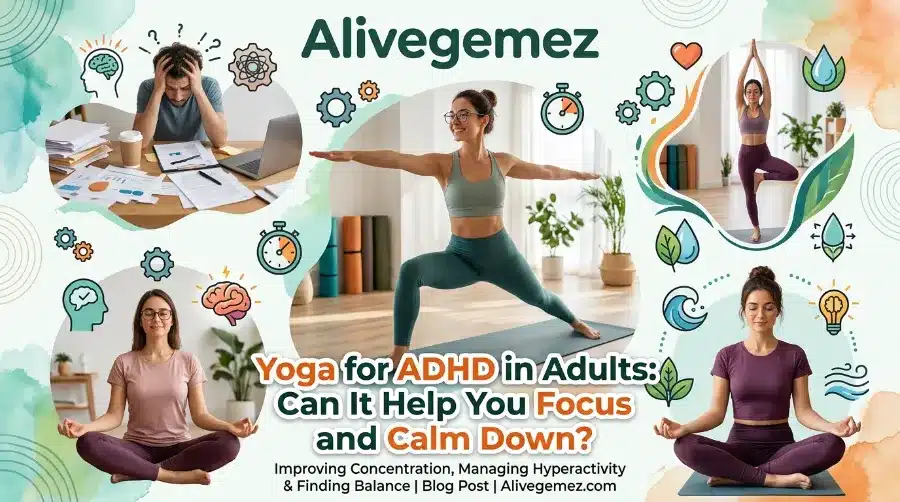
This is exactly where yoga attention deficit research gets interesting. Yoga is not one thing. It is a bundle of separate tools stacked together: movement, controlled breathing, body awareness, and short bursts of directed attention. Each of those pieces taps a slightly different part of the nervous system, and for ADHD brains, that combination can do things that sitting still and “trying harder” never will.
Yoga Stress Relief Poses: 7 Evidence-Based Poses & Sequences That Actually Calm You Down
I first saw this shift in my own studio around 2014, teaching a Tuesday evening vinyasa class. A student, an accountant in his mid-thirties, told me after week six that he had stopped losing his car keys every single morning. That is not a clinical outcome, but it is exactly the kind of small, real-world change that adds up for adults managing this condition daily.
Can Yoga Really Help ADHD Adults Focus? Here’s What the Research Says
Let’s get the honest answer out of the way. Yoga concentration adults research is still young, sample sizes are small, and nobody is claiming yoga replaces medication. But the direction of the data is consistently positive.
A 2025 study out of the College of Wooster followed adults with ADHD through an eight-week Vinyasa yoga intervention alongside executive-function testing and self-report questionnaires. Compared to a control group, participants showed measurable improvement across several mindfulness-related and ADHD-symptom measures. A related 2026 follow-up at the same institution compared yoga against a general movement intervention in undergraduates with ADHD; overall symptom severity dropped meaningfully in both groups, though it’s worth being honest that the yoga group did not outperform simple aerobic movement on every measure. That is useful nuance, not a reason to write yoga off. It tells us movement itself, structured and consistent, is doing real work, and yoga is a genuinely enjoyable, sustainable way to get that movement in.
Meanwhile, King’s College London is currently running “Yoga4ADHD,” a feasibility randomized controlled trial specifically built for adults with ADHD, with results expected by the end of 2026. That a major UK university is funding this now, in 2026, tells you where the research world thinks this is heading.
Yoga for Grief and EmotionalHealing: A Gentle Guide
Earlier neuroimaging work has also shown structural and functional changes after regular yoga practice in regions tied to memory, emotional processing, and executive control, the exact circuitry that runs differently in ADHD. None of this is a magic fix. But taken together, it is a solid, growing case for yoga as a real, evidence-informed part of an ADHD management plan, not just wellness-industry noise.
A Quick Look at the Numbers
ADHD in adulthood is far more common than most people assume, which is part of why this topic matters so much right now.
| Statistic | Figure |
|---|---|
| U.S. adults with a current ADHD diagnosis | 6.0%, roughly 15.5 million people |
| Adults diagnosed after turning 18 | 55.9% |
| Adults who received no ADHD treatment in the past year | 36.5% |
| Adults aged 25-49 among those with current ADHD | About 63% |
Source: CDC/NCHS Rapid Surveys System, October-November 2023, published via MMWR, October 2024.
That last figure matters more than it looks. A third of adults with ADHD are getting zero formal treatment right now. That is not a criticism of anyone; therapy waitlists are long, medication shortages are real, and access is uneven across the US, UK, and Europe. It is exactly why an accessible, low-cost tool like yoga concentration adults training deserves a serious look, not as a replacement, but as something people can actually start doing this week.
Yoga for PTSD and Trauma: A Trauma-Sensitive Practice Guide
The ADHD Yoga Benefits Worth Knowing About
Based on the research above and what I have watched happen in students over more than a decade of teaching, here is what consistent practice tends to change:
- Better emotional regulation. Slower exhale-focused breathing activates the parasympathetic nervous system, taking you out of fight-or-flight faster.
- Reduced physical restlessness. Active flows give hyperactive energy somewhere useful to go, rather than asking you to suppress it.
- Stronger interoception. You get better at noticing tension, distraction, or overwhelm building before it takes over your whole day.
- A workable entry point into mindfulness. Straight meditation is genuinely hard with ADHD. Moving mindfulness, one breath per movement, is a far gentler on-ramp.
- Lower baseline stress. Chronic stress makes every ADHD symptom worse. Yoga reliably lowers cortisol and perceived stress across the wellness research base.
These ADHD yoga benefits compound. A calmer nervous system makes focus easier. Easier focus makes daily tasks less overwhelming. Less overwhelm means less stress. It is a loop, and yoga is one of the few tools that can enter that loop at almost any point.
Yoga and Intermittent Fasting: Is This Combo Actually Safe?
Which Type of Yoga Actually Works for ADHD Adults
This is where most generic yoga advice falls apart. A slow restorative class, the kind therapists sometimes assume is automatically “calming,” can actually be miserable for an ADHD brain. Stillness without a strong internal anchor tends to make racing thoughts louder, not quieter.
What tends to work better:
- Vinyasa or power yoga. Continuous movement gives the brain a steady job to do, which crowds out mental noise.
- Breath-led practices. Ujjayi breathing paired with movement gives you an audio and physical cue to follow at the same time.
- Short sessions, done often. Fifteen to twenty-five focused minutes, four or five times a week, beats one exhausting ninety-minute class most people abandon by week two.
- Classes with clear, simple cueing. A teacher who gives one instruction at a time, rather than a long paragraph of cues, keeps working memory from getting overloaded.
- Practices that end with a real, guided Savasana. The stillness lands better once the nervous system has already burned through its excess energy.
If sitting through a full class still feels impossible some days, that is completely normal, and it is worth pairing your practice with other stress-focused tools; our guide to yoga poses for stress relief is a good place to build a shorter, gentler backup routine for the days that need it.
Yoga for Insomnia: A 4-Week Sleep Improvement Plan
The 4-7-8 Breathing Technique: Your Fastest ADHD Reset
If you only take one tool from this entire post, make it this one. The 4-7-8 breathing technique is fast, requires zero equipment, and works whether you are at your desk, in your car, or lying awake at 1 a.m.
How to do it:
- Sit or lie down comfortably and let your shoulders drop.
- Inhale quietly through your nose for a count of 4.
- Hold that breath gently for a count of 7.
- Exhale slowly and fully through your mouth for a count of 8, making a soft whoosh sound.
- Repeat for four full rounds to start.
The extended exhale is the key mechanism. It stimulates the vagus nerve and shifts you out of a sympathetic, “on edge” state, which is exactly the state a lot of ADHD adults live in by default, whether from the condition itself or from years of masking it.
Use it when a task feels too overwhelming to start, right before a meeting that’s making you spiral, or as part of a wind-down before bed. If sleep is where your ADHD hits hardest, our four-week sleep and insomnia yoga guide builds this exact technique into a full nightly routine.
A Simple 20-Minute Yoga ADHD Focus Routine You Can Start Today
Here is a realistic starting sequence, no equipment needed beyond a mat and roughly 20 minutes.
- Minutes 0-3: Cat-Cow flow, synced one breath per movement, to link body and breath before anything else.
- Minutes 3-8: Sun Salutation A, repeated slowly three times, to burn off restless energy.
- Minutes 8-14: Warrior II into Extended Side Angle, holding each side for five slow breaths, to build focused, sustained attention.
- Minutes 14-17: Seated forward fold, which many people with ADHD find genuinely calming rather than boring.
- Minutes 17-20: Legs-up-the-wall pose with 4-7-8 breathing to close.
Do this most days for three weeks before judging whether it’s working. Both the Wooster studies and the earlier neuroimaging research point to the six-to-eight-week mark as when self-reported change tends to become noticeable, not day three.
Yoga, ADHD, and the Conditions That Travel With It
ADHD rarely shows up alone. Anxiety, low mood, and sleep disruption are extremely common alongside it, and yoga’s benefits tend to overlap across all of them. If anxiety spikes are part of your daily pattern, it’s worth reading our deeper breakdown of yoga for anxiety and panic attacks. If low mood is more of your experience, our piece on yoga, depression, and the research behind it walks through similar evidence in that space. And if a difficult past experience makes any form of stillness feel unsafe, our trauma-sensitive yoga guide is written specifically for that. All of this connects back to the bigger picture in our pillar guide on the mental health benefits of yoga, which is worth bookmarking if you’re building a full wellness plan rather than a single fix. You can also browse the full site at RealYogaHub.com for more practice guides.
What the Wider Wellness World Is Saying
RealYogaHub is not the only place writing about this, and it shouldn’t be. Coaches and wellness sites like DIG Coaching’s piece on ADHD mindfulness and yoga and Trainwell’s guide to yoga and ADHD both land on the same core point we found in the research: active, breath-forward yoga styles tend to work far better for ADHD brains than slow, still ones, and finding the right teacher matters more than finding the “right” style. OM Magazine’s coverage of yoga and ADHD adds a useful angle too, looking at how postures like forward bends can support focus and coordination specifically. Reading across these alongside the clinical trial data gives a much fuller picture than any single article can, which is exactly why we’ve pulled it all together here.
Frequently Asked Questions
Does yoga help with ADHD in adults, or is that just wellness marketing?
It helps, based on real trial data, but it is a support tool alongside treatment, not a standalone cure. Multiple small controlled studies from 2025 and 2026 show measurable symptom improvement after eight weeks of consistent practice.
What is the best yoga for ADHD adults specifically?
Active, breath-synced styles like vinyasa or power yoga generally outperform slow, still styles such as restorative yoga or long seated meditation for most adults with ADHD.
How often do I need to practice to notice a difference?
Most research protocols use sessions three to five times a week for six to eight weeks before measuring outcomes. Shorter, more frequent sessions tend to beat occasional long ones.
Can yoga replace ADHD medication?
No. Nothing in current research supports replacing prescribed treatment with yoga. It works best as an added layer of support, not a substitute.
I can’t sit still for meditation. Is yoga still worth trying?
Yes, and this is genuinely common. Moving, breath-led yoga is specifically easier for restless minds than still meditation, which is exactly why it tends to work where sitting meditation fails.
Quick Quiz: How Much Did You Take In?
1. What is the primary nervous system mechanism behind the 4-7-8 breathing technique?
A) It raises heart rate for alertness
B) It stimulates the parasympathetic response through a longer exhale
C) It increases oxygen intake sharply
D) It has no measurable physiological effect
2. Which yoga style tends to work best for ADHD adults, based on current research and practice?
A) Slow restorative yoga
B) Long, seated silent meditation
C) Active, breath-led styles like vinyasa or power yoga
D) Hot yoga specifically for heat exposure
3. According to CDC data, roughly what percentage of U.S. adults have a current ADHD diagnosis?
A) 1%
B) 6%
C) 15%
D) 25%
4. Around what point in a consistent yoga practice did research participants start showing measurable ADHD-symptom improvement?
A) After a single session
B) After about six to eight weeks
C) Only after one full year
D) Improvement was never measured
5. What percentage of U.S. adults with current ADHD received no treatment at all in the past 12 months, per CDC data?
A) 5%
B) 15%
C) 36.5%
D) 60%
Answer key: 1-B, 2-C, 3-B, 4-B, 5-C
The Bottom Line
Yoga will not make ADHD disappear, and anyone promising that isn’t being straight with you. What it can genuinely do, backed by real trial data and more than a decade of watching it happen in a studio, is calm an overactive nervous system, build a stronger connection between body and mind, and give you a consistent, low-cost tool to lean on between harder days. Start small, pick an active style over a slow one, use the 4-7-8 breath as your emergency reset, and give it the full six to eight weeks before deciding whether it’s working for you. For most adults with ADHD, that patience pays off.
References
- CDC/NCHS Rapid Surveys System (Oct-Nov 2023), via CHADD, “General Prevalence of ADHD in Adults.” chadd.org
- MMWR/CDC, October 2024, adult ADHD prevalence and treatment data.
- King’s College London, “Yoga4ADHD” feasibility randomized controlled trial, ClinicalTrials.gov NCT07541820, 2026.
- Wallack, D., “Have You Tried Yoga? The Wellness Effects of a Yoga Intervention on Young Adults with ADHD,” College of Wooster Independent Study Thesis, 2026.
- Fazazi, S., “Yoga Intervention Improves ADHD and Cognitive Measures in Emerging Adults with ADHD,” College of Wooster I.S. Symposium, 2025.
- Moody, L. et al., “Daily Yoga on Working Memory and Symptomology of Attention Deficit Hyperactivity,” Cognitive Neuroscience Society Poster Session, 2026.
- Medical News Today, “How Does Yoga Help With ADHD?”
- Trainwell, “Yoga and ADHD: How to Calm Your ADHD Brain With Yoga.”
- OM Magazine, “Yoga and ADHD.”