
If you’re reading this at 2 a.m. because your body won’t settle down, welcome. You’re not broken, you’re not overreacting, you’re carrying something real in your nervous system, and yoga PTSD trauma sensitive practice is one of the few tools that speaks directly to the body instead of asking you to just “think your way out of it.” I’ve spent twelve years teaching yoga plus researching mind-body healing, and this guide is the one I wish someone had handed me the first time a student froze mid-pose, eyes wide, clearly somewhere else entirely.
This isn’t a generic “yoga cures everything” post. It’s a science-informed, trauma-informed yoga walkthrough built for real nervous systems, real triggers, real progress that happens slower than the wellness industry wants to admit.
TL;DR
Trauma-sensitive yoga won’t erase PTSD, but multiple clinical trials show it can meaningfully lower PTSD, depression, plus anxiety symptoms when practiced consistently for eight or more weeks. The method matters more than the pose: choice-based language, no hands-on adjustments, plus a slow build toward interoceptive awareness make the difference between a practice that helps versus one that harms. Start small, work with a trained trauma-informed teacher where possible, pair the physical practice with therapy rather than replacing it.
Key Takeaways
| Question | Quick Answer |
|---|---|
| Does yoga help PTSD? | Yes, per multiple randomized controlled trials, though effects are strongest for depression plus arousal symptoms rather than a full symptom cure |
| What makes yoga “trauma-sensitive”? | Invitational language, optional touch only, predictable structure, a focus on interoception rather than performance |
| How long until I notice a difference? | Most studies measuring real change used 8 to 10 weeks of consistent practice, roughly one to two sessions a week |
| Can yoga replace therapy for PTSD? | No, current evidence supports yoga as a complementary tool alongside trauma-focused therapy, not a stand-alone treatment |
| Is trauma-sensitive yoga safe for everyone? | Mostly yes, but people with dissociative disorders or in acute crisis should practice under professional guidance |
What “Trauma-Sensitive Yoga” Actually Means
Trauma-informed yoga isn’t a softer version of a normal class where the teacher just talks quieter. It’s a specific clinical framework, most famously developed as Trauma Center Trauma-Sensitive Yoga (TCTSY) by Bessel van der Kolk’s team plus researcher David Emerson, built around one core idea: people who’ve survived trauma often lost a felt sense of choice over their own bodies, so the practice hands that choice back, one small decision at a time.
Yoga for Grief and EmotionalHealing: A Gentle Guide
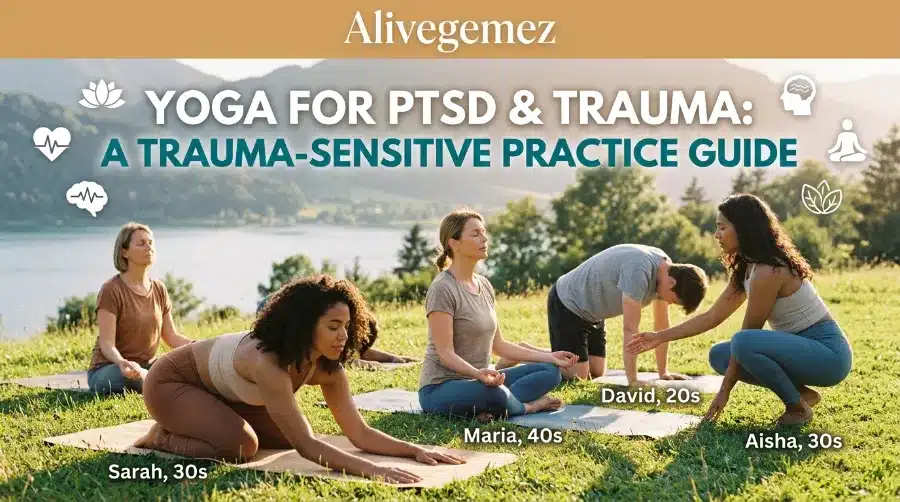
A trauma-informed yoga class for PTSD survivors usually drops a few things you’d expect from a typical studio session. There’s no hands-on adjustment unless explicitly requested. There’s no “correct” version of a pose. The teacher offers options rather than commands: “you might notice what it feels like to lift your arms, or you might keep them where they are.” That single shift, from instruction to invitation, is the entire foundation of PTSD yoga USA programs currently running through the VA, university trauma clinics, plus community centers.
Yoga for Insomnia: A 4-Week Sleep Improvement Plan
If you want the fuller picture of how movement affects mood plus the nervous system beyond PTSD specifically, our guide on yoga’s mental health benefits breaks down the broader research.
The Science: What Research Actually Says About Yoga for Trauma
Here’s where I want to be honest with you, because this space is full of overpromising. PTSD affects an estimated 8.3% of the U.S. population at some point in life, per national trauma exposure data, so if you’re dealing with this, you’re sitting alongside roughly 27 million other Americans, not failing at something everyone else finds easy.
A 2024 systematic review plus meta-analysis of randomized controlled trials, published in the journal Psychoneuroendocrinology, pooled data from trials comparing yoga against control groups or standard cognitive processing therapy in people with PTSD. The results showed yoga groups had meaningfully lower depression symptoms immediately after the intervention, plus that improvement held up at follow-up months later. Anxiety symptom reduction, though, didn’t reach statistical significance in that same pooled analysis, which tells us yoga is genuinely useful but isn’t a universal fix for every symptom cluster.
Yoga Stress Relief Poses: 7 Evidence-Based Poses & Sequences That Actually Calm You Down
A newer 2026 meta-analysis in the Journal of Traumatic Stress dug even deeper, examining which specific PTSD symptom clusters respond best to yoga: intrusion memories, avoidance, negative mood shifts, or hyperarousal. Researchers pulled studies through October 2025 measuring subscale scores rather than just total PTSD scores, moving the field toward more precise, personalized recommendations instead of blanket claims.
On the ground level, a pilot study published in the International Journal of Yoga in late 2025 tracked women survivors of sexual trauma through a virtual Trauma-Sensitive Yoga program. Women who completed seven or more sessions showed measurable drops in PTSD, depression, plus anxiety symptoms following the program, a meaningful finding given how many survivors can’t access in-person trauma-informed classes.
Yoga for ADHD in Adults: Can It Help You Focus and Calm Down?
Even outside clinical populations, the need is enormous. A 2025 survey of 339 college students at a southeastern U.S. university found that 94% had experienced at least one traumatic event, 30% reported clinically elevated PTSD symptoms, yet only 2% had ever actually tried trauma-sensitive yoga despite 73% expressing interest once they learned what it was. Cost, scheduling, plus simple lack of access were the biggest barriers, not skepticism about whether it works.
What the Data Shows, Visually
| Study / Source | Population | Key Finding |
|---|---|---|
| Meta-analysis, Psychoneuroendocrinology, 2024 | Adults with PTSD, pooled RCTs | Significant reduction in depression symptoms post-intervention plus at follow-up |
| Meta-analysis, Journal of Traumatic Stress, 2026 | Trauma-exposed adults, RCTs through Oct. 2025 | Yoga affects specific PTSD symptom clusters differently, arousal/reactivity shows strongest signal |
| Pilot study, International Journal of Yoga, 2025 | Women survivors of sexual trauma, virtual TCTSY | 7+ sessions linked to reduced PTSD, depression, anxiety scores |
| Survey, Journal of American College Health, 2025-26 | 339 U.S. college students | 94% trauma exposure, 30% elevated PTSD symptoms, only 2% had tried trauma-sensitive yoga |
Symptom Improvement Snapshot (based on pooled RCT data)
| Symptom Area | Yoga vs. Control Group |
|---|---|
| Depression | Moderate, statistically significant improvement |
| PTSD hyperarousal/reactivity | Strongest reported improvement among symptom clusters |
| General anxiety | Improvement noted, though not always statistically significant |
| Sleep quality | Frequently reported secondary benefit across studies |
For a deeper look at how movement-based practices intersect with clinical depression specifically, we’ve covered the evidence in detail in our piece on yoga plus depression research.
Core Principles of Trauma-Informed Yoga
Before you roll out a mat, it helps to understand the ground rules that separate a trauma-sensitive class from a regular vinyasa flow. These aren’t stylistic preferences, they come directly from the clinical TCTSY model plus similar frameworks used in VA hospitals across the country.
- Invitational language over commands. “You might try” replaces “now do.” Every cue leaves room for a no.
- No hands-on assists without explicit, ongoing consent. Touch can trigger a trauma response even from a well-meaning teacher.
- Consistent, predictable class structure. Surprises are the enemy of a nervous system already on high alert.
- Focus on interoception, not alignment perfection. The goal is noticing internal sensation, not achieving a picture-perfect pose.
- Exits are always available. Students can leave a pose, leave the room, or simply lie still without explanation.
Getting Started Safely: A Step-by-Step Approach
Jumping straight into a 75-minute power yoga class is genuinely one of the worst ways to begin if you’re managing PTSD symptoms. Instead, build slowly, in this order.
- Start seated, feet on the floor, eyes open. Notice five things you can see in the room before you close your eyes for anything. This grounds you in the present moment first.
- Practice tiny movements before full poses. Rolling the shoulders, tilting the head, gently pressing hands into thighs, these micro-movements rebuild trust between your mind plus your body.
- Try one supported pose per session for the first two weeks. Child’s pose with a bolster, or simply lying on your back with knees bent, is plenty.
- Add breathwork only once movement feels tolerable. Breath awareness can sometimes intensify anxiety for trauma survivors before it calms them, so sequence it carefully.
- Track your response after each session, not during. A short note like “felt shaky after, calmer an hour later” builds real self-knowledge over time.
Real example: a 2025 pilot cohort of sexual trauma survivors practicing virtual TCTSY didn’t see meaningful symptom change until after the seventh session, roughly seven weeks into a once-weekly program. That timeline matters. If you quit at week two because “it’s not working,” you’re stopping right before the window where most people start to feel a shift.
If panic or racing thoughts are your dominant experience alongside trauma symptoms, our detailed guide on yoga for anxiety plus panic attacks pairs well with the trauma-informed approach outlined here.
How Yoga Lowers Cortisol: The Science Explained Simply
5 Trauma-Sensitive Poses to Begin With
- Supported Child’s Pose — knees wide, forehead resting on a stacked fist or bolster, arms anywhere that feels neutral.
- Reclined Bound Angle — lying on your back, soles of feet together, knees supported by pillows if the hips feel tight.
- Seated Cat-Cow — small spinal waves done seated in a chair, useful if lying down ever feels vulnerable.
- Legs-Up-The-Wall — a gentle inversion known for calming the nervous system without demanding flexibility or strength.
- Mountain Pose with Eyes Open — standing tall, gaze soft but open, building tolerance for stillness without the vulnerability of closed eyes.
Each of these can be modified endlessly. If lying on the floor ever feels unsafe, do the same shapes seated in a sturdy chair instead. There’s no version of trauma-sensitive practice where “toughing it out” is the goal.
4-7-8 Breathing Technique: How to Do It and When to Use It
Breathwork sits at an interesting crossroads for trauma survivors, useful for many, activating for some, so it deserves its own careful section rather than a quick mention.
The 4-7-8 method was popularized by Dr. Andrew Weil, drawing from older pranayama traditions in yoga. Here’s the pattern:
- Exhale completely through the mouth, making a soft whoosh sound.
- Close the mouth, inhale quietly through the nose for a count of four.
- Hold the breath gently for a count of seven.
- Exhale fully through the mouth for a count of eight, whoosh sound again.
- Repeat for four full cycles to start, working up to eight over several weeks.
A 2025 scoping review examining 15 studies published between 2013 plus 2024 found the technique consistently linked to lower anxiety plus improved physiological markers of stress across varied populations, from post-bariatric surgery patients to nursing students facing exam stress. Separately, a randomized trial of 90 bariatric surgery patients found the 4-7-8 group showed significantly lower state anxiety than both a standard deep-breathing group plus an untreated control group. Mechanistically, the extended exhale plus breath hold appear to stimulate the vagus nerve, nudging the body toward parasympathetic, “rest and digest” activity.
When to use it: before sleep, before a known trigger like a medical appointment or crowded space, or right after a wave of anxiety hits.
When to skip it: during an active flashback or dissociative episode. Holding the breath can feel like losing control to someone whose trauma involved restriction or suffocation, so in those moments, simple slow exhales without a hold, or grounding through the five senses, tend to work better.
This single technique also connects directly to broader stress physiology; if you want the full picture of how breath plus posture combine to lower cortisol, our guide to yoga poses for stress relief is a natural next stop.
Yoga and Intermittent Fasting: Is This Combo Actually Safe?
What to Look for in a Trauma-Sensitive Yoga Teacher or Class
Not every “gentle yoga” class is trauma-informed, plus not every teacher claiming the label has real training. Look for these signals before you commit.
- Certification through a recognized program, such as TCTSY-F (Trauma Center Trauma-Sensitive Yoga Facilitator).
- A stated no-touch or opt-in-touch policy in the class description.
- Small class sizes, ideally under 12 people, so no one feels watched.
- Willingness to answer questions about their trauma-informed training before you attend.
- Classes offered through hospitals, VA facilities, rape crisis centers, or university counseling programs, which tend to hold higher training standards.
Common Challenges Plus How to Navigate Them
Dissociation mid-practice. If you notice yourself “leaving” your body, orient back through your senses: name the texture of the mat under your hands, the temperature of the room, a sound in the distance. This is normal, not a failure.
Sudden emotional release. Crying, shaking, or unexpected anger can surface during body-based work, this is often the nervous system discharging stored activation rather than something going wrong.
Feeling nothing at all. Numbness is just as valid a trauma response as overwhelm. Progress sometimes looks like noticing the numbness itself, rather than immediately feeling calm.
Avoidance of the mat altogether. If you keep intending to practice but never do, that’s worth naming to a therapist rather than pushing through alone, avoidance is often the trauma symptom itself, not a character flaw.
Real Stories: What Survivors Report
In clinical interviews accompanying several TCTSY trials, participants describe the shift less as “feeling happy” plus more as “feeling like my body is mine again.” One veteran in a VA-affiliated program described being able to sit through a full session without checking the exits for the first time in years, a change she noticed only after week six. Another survivor in a university-based trauma yoga pilot reported that noticing her own breath without panic, something that took roughly two months of consistent practice, was the first physical sensation she’d registered without immediate fear since her assault three years earlier.
These aren’t miracle stories, they’re incremental, unglamorous, exactly the kind of change that real trauma recovery actually looks like.
Where This Fits Into Your Bigger Healing Picture
Trauma-sensitive yoga works best as one piece of a larger care plan rather than a stand-alone fix. Pair it with trauma-focused therapy such as EMDR or cognitive processing therapy where possible, keep your medical or mental health provider informed if trauma symptoms intensify during practice, plus give yourself permission to go slowly. If pregnancy or postpartum recovery is also part of your story right now, our guide on postpartum yoga safety walks through exactly what a body-aware, trauma-conscious approach looks like in that specific season of life.
For deeper reading beyond RealYogaHub, DoYogaWithMe’s overview of yoga for PTSD offers a practical sequence library, SavantCare’s clinical breakdown of trauma-informed yoga explains how therapists integrate it into treatment plans, plus Psychology Today’s coverage of trauma-sensitive yoga for military sexual trauma survivors captures the veteran-specific research landscape well.
Frequently Asked Questions
Is yoga a proven treatment for PTSD? Yoga is best described as an evidence-supported complementary approach rather than a stand-alone proven cure. Multiple RCTs show real symptom improvement, particularly for depression plus hyperarousal, but it works best alongside trauma-focused therapy.
Can trauma-sensitive yoga trigger flashbacks? It can, especially early on, since certain poses or breath patterns may echo physical sensations from the trauma itself. This is exactly why trained teachers use invitational language plus offer constant exits from any pose.
How is trauma-informed yoga different from a regular gentle yoga class? The core difference is control. Trauma-informed classes emphasize choice, predictability, plus zero unsolicited touch, while a standard gentle class may still include hands-on adjustments plus fixed sequences.
How often should I practice for real results? Most research showing measurable symptom change used sessions once or twice weekly for a minimum of seven to ten weeks, so consistency over months matters more than intensity in any single session.
Is online or virtual trauma-sensitive yoga effective? Yes, a 2025 pilot study specifically testing virtual TCTSY with sexual trauma survivors found meaningful symptom reduction after seven or more sessions, making it a genuinely useful option for people without local access.
Can I practice trauma-sensitive yoga without a diagnosed PTSD? Absolutely, the approach is built for anyone carrying stress or trauma history, diagnosed or not, since the principles of choice plus gentle interoceptive awareness benefit a nervous system under any kind of chronic strain.
Quick Knowledge Check: 5-Question Quiz
1. What is the core clinical model behind trauma-sensitive yoga called? A) Restorative Flow Therapy B) Trauma Center Trauma-Sensitive Yoga (TCTSY) C) Hot Power Yoga Method
2. According to the 2024 pooled meta-analysis, which symptom showed the clearest significant improvement from yoga in PTSD patients? A) Depression B) Chronic pain C) Blood pressure
3. In the 4-7-8 breathing technique, how long should the breath hold last? A) 4 seconds B) 7 seconds C) 8 seconds
4. In the 2025-26 college student survey, roughly what percentage had ever actually tried trauma-sensitive yoga? A) 2% B) 30% C) 73%
5. What should you do if breath-holding during 4-7-8 breathing feels overwhelming during a flashback? A) Push through the hold, it gets easier B) Switch to slow exhales without holding, or ground through your senses instead C) Stop breathing exercises for good
Answer Key: 1-B, 2-A, 3-B, 4-A, 5-B
Conclusion
Healing a trauma-affected nervous system was never going to happen through willpower alone, plus yoga PTSD trauma sensitive practice offers something therapy alone sometimes can’t: a direct, physical route back into a body that finally feels like home again. The research is real, the timelines are honest, seven weeks, ten weeks, sometimes longer, plus the goal was never perfection on a mat. It was choice, safety, plus one small moment of noticing your own breath without fear. Start seated, start small, start with a teacher or program that understands what you’re carrying, then let the evidence, plus your own body, show you the rest.
References
- Sinnott, S.M., et al. (2026). The impact of yoga on posttraumatic stress disorder symptom clusters: A systematic review and meta-analysis. Journal of Traumatic Stress.
- McKenna, B., et al. (2025). Virtual Trauma Sensitive Yoga Intervention Reduces PTSD, Depression, and Anxiety Symptoms Among Women Survivors of Sexual Trauma. International Journal of Yoga, 18(3).
- Dietrich, K.M., et al. (2025/2026). College students’ needs, interest, barriers, and preferences for a trauma-sensitive yoga program. Journal of American College Health.
- Efficacy of yoga for posttraumatic stress disorder: A systematic review and meta-analysis of randomized controlled trials. (2024). Psychoneuroendocrinology.
- Kilpatrick, D.G., Resnick, H.S., Milanak, M.E., et al. (2013). National estimates of exposure to traumatic events and PTSD prevalence using DSM-IV and DSM-5 criteria. Journal of Traumatic Stress, 26.
- Exploring 4-7-8 Breathing for Stress Relief and Improved Quality of Life. (2025). Scoping review, 15 studies 2013–2024.
- Aktaş, et al. (2022). The Effect of Deep Breathing Exercise and 4-7-8 Breathing Techniques Applied to Patients After Bariatric Surgery on Anxiety and Quality of Life. Obesity Surgery.
- DoYogaWithMe: Yoga for PTSD
- SavantCare: Trauma-Informed Yoga for PTSD
- Psychology Today: Trauma-Sensitive Yoga for Military Sexual PTSD