
If you’ve been lying awake at 2 a.m. doing math about how many hours of sleep you’ll get “if you fall asleep right now,” you already know insomnia is not just annoying. It’s exhausting in a way that bleeds into everything else — your mood, your focus, your patience with your kids, your work. A yoga insomnia sleep plan is not a magic fix, but it is one of the few things backed by real research that you can start tonight, for free, in your living room.
I’ve spent over a decade teaching yoga and working with people whose main goal wasn’t flexibility or fitness — it was simply wanting to sleep through the night again. This guide lays out a structured, 4-week yoga insomnia sleep plan built from that experience and from the clinical research on yoga for sleep problems, so you’re not guessing which poses actually help and which ones are just internet noise.
Key Takeaways
| What You’ll Learn | Why It Matters |
|---|---|
| A structured 4-week yoga insomnia sleep plan | Gradual progression works better than “trying everything at once” |
| The specific poses research links to better sleep | Not all yoga helps insomnia equally — restorative styles matter most |
| The 4-7-8 breathing technique and when to use it | Breathwork calms your nervous system faster than stretching alone |
| Realistic expectations, week by week | So you don’t quit on night 4 expecting a miracle |
| How this fits with anxiety, stress, and mental health | Insomnia rarely travels alone |
TL;DR: A consistent, gentle yoga practice — done in the evening, combined with slow breathing techniques like 4-7-8 — can measurably improve how fast you fall asleep and how long you stay asleep. Research on yoga for sleep problems shows people fall asleep roughly 30 minutes faster and gain more total sleep time compared to no intervention. This 4-week yoga insomnia sleep plan gives you the exact sequence, in order, so you’re not just randomly stretching before bed and hoping for the best.
Does Yoga Actually Help With Insomnia, Or Is This Wellness Hype?
This is a fair question, so let’s answer it honestly instead of just cheerleading.
A large analysis of 22 studies covering more than 1,300 participants compared yoga, tai chi, walking, and jogging as sleep interventions. Researchers found that yoga added roughly 110 minutes of sleep per night compared with lifestyle advice or stretching alone. That same review showed yoga participants fell asleep about half an hour faster and woke up less often during the night.
How Yoga Lowers Cortisol: The Science Explained Simply
What the Clinical Studies Specifically Show
Separately, a systematic review and meta-analysis published in BMC Psychiatry looked at yoga’s effect on sleep quality and insomnia in women with sleep problems, drawing from major databases including PubMed, Embase, and the Cochrane Library. Harvard Medical School ran its own study on chronic insomnia patients, having them practice yoga daily for eight weeks while tracking results through sleep diaries; the findings pointed to broad improvements in both total sleep time and sleep quality across people with primary and secondary insomnia alike.
Newer research has also focused on older adults specifically. A 12-week RMIT University study of 74 participants aged 60 to 87, run in collaboration with Shaare Zedek Medical Centre in Israel, found that practicing yoga for at least 25 minutes a day over 12 weeks improved participants’ sleep along with their emotional and psychological wellbeing. That result matters because insomnia in older adults often gets written off as “just aging,” when it’s actually one of the more responsive groups to gentle movement and breathwork.
Yoga Stress Relief Poses: 7 Evidence-Based Poses & Sequences That Actually Calm You Down
None of this is hype. It’s one of the better-studied non-drug approaches to insomnia currently available. For a deeper outside read on the mechanism, Flow Yoga Center has a solid piece on yoga’s role in beating insomnia.
Why Yoga Works For Sleep (The Nervous System Explanation)
Insomnia is usually a nervous system problem before it’s a “can’t sleep” problem. Your body is stuck in sympathetic activation — the fight-or-flight state — even while you’re lying still in bed. Yoga works because slow, controlled movement paired with long exhales activates your parasympathetic nervous system, the “rest and digest” side that actually allows sleep to happen.
This is also exactly why yoga for anxiety and panic attacks works through a similar mechanism, since anxiety and insomnia often share the same overactive stress response. If racing thoughts at bedtime sound familiar, that guide breaks down why the two conditions frequently reinforce each other.
Yoga for Grief and EmotionalHealing: A Gentle Guide
Your 4-Week Yoga Insomnia Sleep Plan
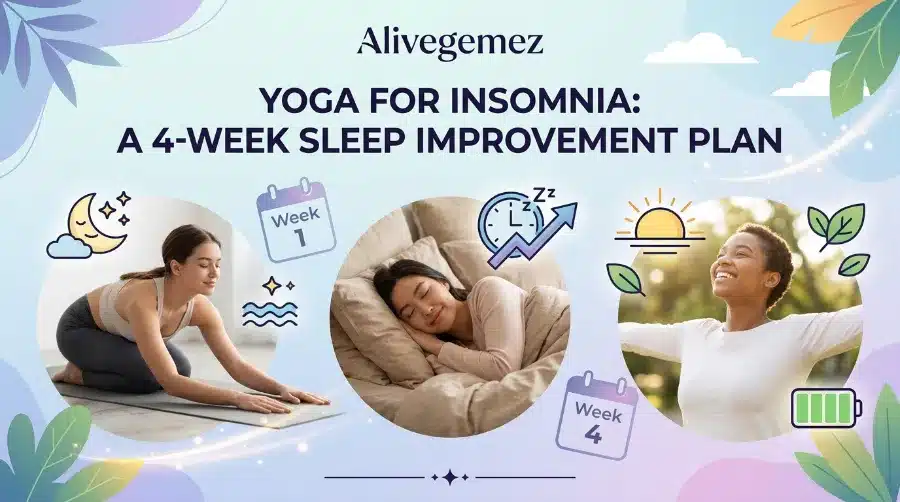
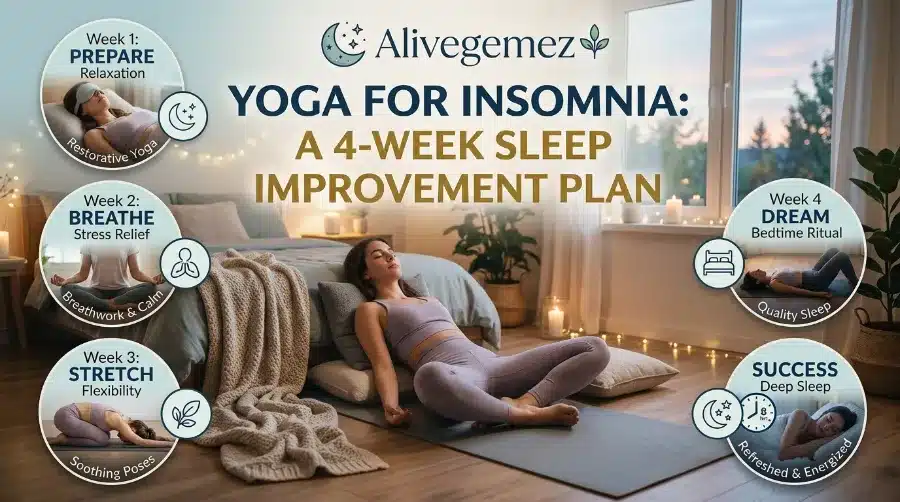
Here’s the actual yoga insomnia sleep plan, broken into four progressive weeks. Each week builds on the last. Do this 15 to 20 minutes before bed, in dim light, phone away.
Week 1: Building the Habit (Nights 1–7)
The goal this week isn’t depth — it’s consistency. Most people quit a sleep routine by day 4 because they expect instant results. Don’t.
- Child’s Pose (Balasana) — 1 minute. Forehead down, arms extended or resting by your sides.
- Legs-Up-The-Wall (Viparita Karani) — 5 minutes. This alone is one of the most-recommended poses for yoga for sleep problems because it drains tension out of the legs and lowers heart rate.
- Seated Forward Fold (Paschimottanasana) — 1 minute, knees soft.
- 4-7-8 Breathing — 4 rounds (see full technique below).
Week 2: Adding Restorative Depth (Nights 8–14)
Now you extend hold times and introduce gentle twists, which help release tension stored in the lower back from a full day of sitting.
- Supine Twist — 1 minute per side.
- Legs-Up-The-Wall — increase to 7–8 minutes.
- Reclined Butterfly (Supta Baddha Konasana) — 3 minutes, pillow under knees.
- Child’s Pose — 2 minutes.
- 4-7-8 Breathing — 6 rounds.
Week 3: Deepening the Wind-Down (Nights 15–21)
By week three, your body should start associating this sequence with “it’s time to sleep.” This is the Pavlovian effect of a consistent bedtime routine, and it’s the reason a yoga 4 week sleep plan works better than a single random session.
- Cat-Cow — 8 slow rounds, synced to breath.
- Legs-Up-The-Wall — 10 minutes.
- Reclined Butterfly — 4 minutes.
- Corpse Pose (Savasana) — 5 minutes. For more on this specific pose, Tune Up Fitness has a focused piece on savasana for insomnia.
- 4-7-8 Breathing — 8 rounds.
Week 4: The Full Sleep Ritual (Nights 22–28)
This is the complete yoga insomnia sleep plan, all together, meant to become your permanent nightly wind-down.
- Cat-Cow — 6 rounds
- Child’s Pose — 2 minutes
- Supine Twist — 1 minute per side
- Legs-Up-The-Wall — 10 minutes
- Reclined Butterfly — 4 minutes
- Savasana — 5–8 minutes
- 4-7-8 Breathing — 8 rounds, lights off
The 4-7-8 Breathing Technique: How to Do It and When to Use It
This single breathing pattern is arguably more powerful than any pose on this list, because it directly manipulates your nervous system’s arousal state.
How to do it:
- Exhale completely through your mouth.
- Close your mouth, inhale quietly through your nose for a count of 4.
- Hold your breath for a count of 7.
- Exhale completely through your mouth, making a whoosh sound, for a count of 8.
- That’s one round. Repeat 4 to 8 times.
When to use it: at the very end of your yoga sequence, lying in bed, lights off. It also works mid-night if you wake up at 3 a.m. and your mind starts spinning — a few rounds will slow your heart rate back down without you needing to get up or check the time.
Yoga for ADHD in Adults: Can It Help You Focus and Calm Down?
A Realistic Weekly Progress Chart
| Week | Focus | Typical Reported Change |
|---|---|---|
| 1 | Habit formation | Slightly calmer at bedtime, sleep onset roughly the same |
| 2 | Restorative depth | Falling asleep 10–15 minutes faster on average |
| 3 | Routine association | Fewer night wakings, more consistent bedtime |
| 4 | Full ritual | Sleep onset improved by up to 30 minutes, consistent with research findings |
This mirrors what the broader research shows: yoga participants fell asleep about half an hour faster and didn’t wake up as frequently during the night compared to non-yoga groups — but that benefit builds over weeks, not days.
Yoga for PTSD and Trauma: A Trauma-Sensitive Practice Guide
Yoga Insomnia USA: Why This Matters More Here
Insomnia rates in the United States are notably high, with estimates of Americans experiencing insomnia running as high as 22%. Combine that with a culture of late-night screens, high caffeine intake, and irregular work schedules, and you get a population that’s chronically under-rested but often reaches straight for sleep medication instead of trying a non-drug approach first. Researchers have noted that exercise interventions like yoga are well-suited for integration into primary care and community health programs due to their low cost and minimal side effects.
If stress is a major driver of your sleeplessness specifically, it’s worth also looking at our guide on yoga for stress relief poses, since chronic stress and insomnia are two sides of the same coin for a lot of people.
When Insomnia Is Connected to Something Deeper
Sometimes sleeplessness isn’t standalone — it’s a symptom of depression, unresolved trauma, or chronic anxiety. If that sounds like you, yoga can still help, but it works best alongside proper care rather than instead of it. Our guides on yoga and depression research and trauma-sensitive yoga for PTSD go into more depth on those specific connections, and our pillar guide on yoga and mental health ties all of it together. You can also explore the full library of guides at RealYogaHub.com.
Frequently Asked Questions
How long before yoga starts helping with insomnia?
Most people notice mild changes within the first week — mainly feeling calmer at bedtime — with more measurable sleep improvements by week 3 or 4, consistent with the 8- to 12-week timelines used in clinical studies.
What’s the best yoga pose for insomnia specifically?
Legs-Up-The-Wall and Savasana consistently show up as favorites in both clinical literature and teaching experience, largely because they require zero strength or flexibility and directly calm the nervous system.
Can yoga replace sleep medication?
Not on its own, and not without talking to your doctor first. But it’s a legitimate first step, especially since research supports it as a low-cost, low-risk option worth trying before or alongside medical treatment.
Is morning or evening yoga better for insomnia?
Evening yoga, done 30–60 minutes before bed, is what the research and this plan focus on. Morning yoga has its own benefits, but it doesn’t directly address nighttime sleep onset.
What if I fall asleep during the routine itself?
That’s a good sign, not a failure — it means the parasympathetic response is kicking in exactly as intended.
Conclusion
A yoga insomnia sleep plan won’t fix everything overnight, and anyone promising that is overselling it. What the research — and years of watching this play out with real students — actually shows is that consistency beats intensity. Four weeks of gentle, repeated movement paired with slow breathing retrains your nervous system to associate bedtime with calm instead of alertness. Start with week one tonight. Don’t skip ahead. Your sleep will catch up to your effort.
References
- WUSF Public Media — “Sleep struggles? Yoga may be the natural solution, study finds” (2025)
- BMC Psychiatry — “The effect of yoga on sleep quality and insomnia in women with sleep problems: a systematic review and meta-analysis”
- Psychology Today — “Yoga Can Help Insomnia” (Harvard Medical School study summary)
- Western Sydney University / RMIT — “Yoga shown to help insomnia in the elderly”
- Jamaica Gleaner — “Yoga helps people to sleep better” (2025 exercise-modality study)