
I used to do 100 crunches a night. Every night, for almost two years, back when I thought a strong core meant a six-pack and a six-pack meant a strong core. Then, in 2014, I hurt my lower back reaching for a coffee mug on a top shelf. Not lifting weights. Not falling. Just reaching. That was the moment I stopped counting crunches and started studying what core strength actually is.
Pigeon Pose for Tight Hips Deep Stretch Tutorial, Benefits & Modifications
Twelve years and a Ph.D. in health science later, here’s what I know for certain: yoga core strength poses do something crunches simply cannot. They train your abs, your back, your hips, and your shoulders to work together, the way your body actually moves through a real day. This guide walks you through the ten best poses for building that kind of strength, why they beat crunches on almost every measure that matters, and exactly how to fit them into your week.
Yoga Splits Progression Plan 30 Days to Full Splits (Real Results)
Key Takeaways
| What You’ll Learn | The Short Answer |
|---|---|
| Best yoga poses for core strength | Plank, Boat, Side Plank, Bird Dog, Dolphin, and five more below |
| Yoga vs crunches | Yoga poses activate your entire core system; crunches mostly isolate one muscle |
| How often to practice | 3 to 4 sessions a week, 15 to 20 minutes each |
| Who this is for | Beginners through advanced practitioners, all ages 25 to 55+ |
| Equipment needed | None. Just a mat and your own bodyweight |
| Results timeline | Most people feel a difference in 2 to 3 weeks, see visible change in 6 to 8 |
TL;DR: Crunches isolate your rectus abdominis and can strain your neck and spine over time. Yoga core strength poses like Plank, Boat, and Side Plank train your deep stabilizing muscles, obliques, and back together, which builds a core that actually supports your daily movement. Practice the ten poses below three to four times a week and you’ll build real strength, not just a burn.
Why Core Strength Matters More Than a Six-Pack
Your core is not your abs. It’s a full system of muscles wrapping around your midsection, your deep transverse abdominis, your obliques, your lower back, even your glutes and diaphragm. A strong core keeps your spine stable, protects your back, and improves your balance, your posture, and how easily you carry groceries up three flights of stairs.
This is the part most gym routines miss. Chasing visible abs through endless crunches trains one muscle in one direction. Real core strength trains your whole midsection to brace, rotate, and stabilize under pressure, which is exactly what daily life, and a serious yoga practice, demands.
If you’ve explored advanced yoga poses before, you already know that arm balances, inversions, and deep backbends all depend on core stability first. You cannot hold a solid Crow Pose or a steady headstand without a core that fires on command. Every core yoga exercise in this guide is preparing you for that next level, whether you get there or simply want a stronger, pain-free back.
Yoga vs Crunches: What Does the Research Actually Say
Here’s where I want to be honest with you, because plenty of fitness blogs oversimplify this. Crunches aren’t useless. A 2013 muscle activation study from the Les Mills research team found that certain plank variations produced up to 30 percent more rectus abdominis activation and 20 percent more oblique activation than a standard crunch, largely because plank-style holds recruit the shoulders, hips, and spine stabilizers at the same time instead of isolating one muscle.
Yin Yoga Poses for Beginners 10 Long-Hold Stretches Guide
More recent clinical research backs this up. A 2025 study from Core Physio Clinic comparing plank-based training against other rehabilitation methods for postural core dysfunction found measurable improvements in core function among participants who trained with sustained isometric holds. Separately, a 2025 review on yoga’s role in core stabilization for junior athletes reported significant gains in core muscular endurance after a structured yoga program, with average hold times nearly doubling from pre-test to post-test scores.
Here’s the side-by-side breakdown.
| Factor | Crunches | Yoga Core Strength Poses |
|---|---|---|
| Muscles trained | Mostly rectus abdominis | Rectus abdominis, obliques, transverse abdominis, back, hips, shoulders |
| Movement type | Repetitive flexion | Isometric holds, dynamic stability, rotation |
| Spine impact | Repeated neck and spine flexion | Neutral or supported spine in most poses |
| Functional carryover | Low, isolated movement | High, mimics real-life stabilizing demands |
| Injury risk | Neck strain, lower back strain with poor form | Low when alignment is correct |
| Breath integration | Usually none | Built in, supports nervous system regulation |
The takeaway isn’t that crunches are evil. It’s that yoga abs workout routines simply ask more of your body per rep, which is why so many physical therapists now recommend planks, boat poses, and bird dogs over spinal flexion exercises for anyone managing back pain or looking for long-term core stability.
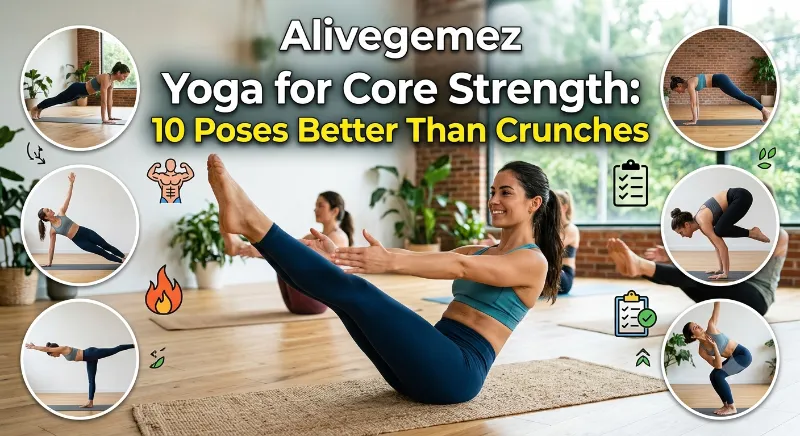
The 10 Best Yoga Core Strength Poses (Better Than Crunches)
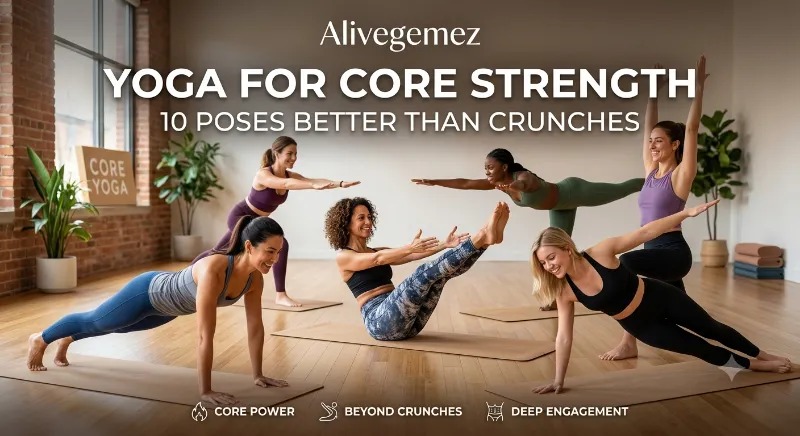
Practice these in order for a complete session, or pick three or four for a quick 10-minute core yoga exercises circuit. Hold each pose for 20 to 45 seconds unless noted, and always warm up your wrists and spine first.
1. Plank Pose (Kumbhakasana)
Plank is the foundation of almost every yoga core strength pose on this list, and for good reason.
- Start in a push-up position, wrists under shoulders, feet hip-width apart.
- Draw your navel toward your spine and squeeze your inner thighs together.
- Keep your neck long, eyes down, body in one straight line from head to heels.
- Hold for 20 to 45 seconds, breathing steadily.
I worked with a client in 2021, a 42-year-old marketing executive with chronic desk-related back pain, who couldn’t hold a plank for more than eight seconds. After six weeks of practicing plank three times a week, she held a clean 60-second plank and reported her lower back pain had dropped from a daily 6 out of 10 to an occasional 2.
2. Boat Pose (Navasana)
Boat pose is the closest yoga comes to a crunch, except it works your hip flexors and back extensors at the same time, not just your abs.
- Sit with knees bent, feet flat on the mat.
- Lean back slightly and lift your feet off the floor, shins parallel to the ground.
- Extend your arms forward, palms facing each other.
- For more challenge, straighten your legs into a V shape.
- Hold for 20 to 30 seconds, then rest and repeat twice more.
3. Side Plank (Vasisthasana)
This pose targets your obliques directly, the muscles crunches almost never reach.
- From plank, shift your weight onto your right hand and the outer edge of your right foot.
- Stack your left foot on top of your right, or step it forward for balance.
- Reach your left arm toward the ceiling.
- Hold for 20 to 30 seconds, then switch sides.
4. Bird Dog (Table Top Balance)
Bird Dog trains the deep stabilizers that keep your spine safe during rotation, which is exactly the muscle group most desk workers lose first.
- Start on hands and knees, wrists under shoulders, knees under hips.
- Extend your right arm forward and left leg back, keeping your hips level.
- Hold for 5 seconds, then switch sides without letting your torso sway.
- Repeat 8 to 10 times per side.
5. Dolphin Plank Pose
Dolphin Plank builds shoulder and core endurance together, making it a natural stepping stone toward inversions.
- Start on forearms and knees, elbows under shoulders.
- Tuck your toes and lift your knees, forming a straight line from head to heels.
- Press firmly through your forearms and engage your abdominal wall.
- Hold for 20 to 30 seconds.
This is one of the exact poses I recommend before attempting a headstand, since it builds the same shoulder and core stability without the risk of an inversion before you’re ready.
6. Forearm Plank Variation with Knee Taps
A more dynamic take on plank that challenges your obliques through controlled movement.
- Start in forearm plank, elbows under shoulders.
- Gently tap your right knee toward the mat, then return.
- Alternate sides slowly, keeping your hips stable throughout.
- Perform 10 to 12 taps per side.
7. Half Boat with Twist
Adding rotation to Boat Pose recruits your obliques far more than static holds alone.
- Sit with knees bent, lean back slightly to balance on your sit bones.
- Clasp your hands together and twist gently to the right, then to the left.
- Keep your chest lifted and core engaged throughout.
- Perform 10 twists per side.
8. Locust Pose (Salabhasana)
Your core includes your back, and Locust Pose is one of the few poses that trains the posterior chain directly, balancing out all the forward-flexion work in poses like Boat.
- Lie face down, arms alongside your body, palms down.
- Inhale and lift your chest, arms, and legs off the mat simultaneously.
- Keep your gaze slightly forward to protect your neck.
- Hold for 15 to 20 seconds, rest, and repeat twice.
9. Crow Pose Prep (Bakasana Prep)
Crow Pose is an advanced arm balance, but even the preparation demands serious core engagement, and practicing the entry teaches your abs to fire under load.
- Squat low, hands planted shoulder-width apart, fingers spread wide.
- Lean forward, resting your knees against the backs of your upper arms.
- Shift your weight forward, engaging your core to lift one foot at a time.
- Hold for 5 to 10 seconds as you build strength.
If you’re ready to go further, our full Crow Pose tutorial breaks down the complete pose step by step.
10. Reclined Leg Lifts with Pelvic Tilt
A gentler pose that’s ideal for beginners or anyone rebuilding core strength after a back injury.
- Lie on your back, legs extended, lower back pressed gently into the mat.
- Lift both legs to a 90-degree angle.
- Slowly lower them halfway, keeping your lower back flat, then lift back up.
- Repeat 10 to 12 times, moving slowly and with control.
How to Build a 15-Minute Yoga Abs Workout Routine
Consistency beats intensity every time. Here’s a simple weekly structure I’ve used with clients for over a decade.
| Day | Focus | Poses |
|---|---|---|
| Monday | Foundation | Plank, Boat, Bird Dog |
| Wednesday | Rotation and obliques | Side Plank, Half Boat with Twist, Knee Taps |
| Friday | Full circuit | All 10 poses, 20 to 30 seconds each |
| Weekend | Recovery and mobility | Pigeon Pose for hip release plus gentle stretching |
Start with three sessions a week for the first month, then add a fourth once your form feels solid. Quality always beats quantity here, a wobbling 45-second plank teaches your body bad habits, while a controlled 20-second plank builds real strength.
One detail people often skip is breath control during holds. Slow, steady breathing keeps your nervous system calm and your core engaged longer without tensing your shoulders or jaw. Many of my clients pair their yoga abs workout with a short breathing practice like the 4-7-8 technique before or after their session, since it lowers pre-workout tension and helps the body settle into deeper, more controlled holds during poses like Boat and Side Plank.
Common Mistakes That Cancel Out Your Core Work
- Holding your breath during Plank or Boat Pose, which spikes tension instead of building stable strength
- Letting your hips sag in Plank, which shifts the load onto your lower back
- Rushing through Bird Dog without pausing to check hip alignment
- Skipping the warm-up and going straight into Boat Pose, which strains the hip flexors
- Practicing only forward-flexion poses without balancing them with backbends like Locust Pose
For more structured routines and pose breakdowns, Adventure Yogi’s guide to core-focused yoga poses offers a solid companion sequence, and Jason Yoga’s core strength guide covers helpful modifications for tighter hips. Yogaia’s core strength collection is also worth bookmarking if you want additional pose variations to rotate into your week.
Core Activation Comparison Chart
Based on published EMG research comparing plank variations to standard crunches, here’s how muscle activation stacks up.
| Exercise | Rectus Abdominis Activation | Oblique Activation | Muscles Beyond the Abs |
|---|---|---|---|
| Standard Crunch | Baseline | Minimal | None significant |
| Plank with Hand Reach | +20% vs crunch | Moderate | Shoulders, glutes |
| Plank with Knee Lift | +30% vs crunch | +20% vs crunch | Shoulders, glutes, spine stabilizers |
| Side Plank | Moderate | High | Shoulders, hips, obliques |
| Boat Pose | High | Moderate | Hip flexors, back extensors |
Frequently Asked Questions
Is yoga actually better than crunches for core strength? Yoga core strength poses train more muscle groups at once and put less repetitive strain on your neck and spine, making them a better long-term choice for most people, especially anyone managing back pain.
How many times a week should I do core yoga exercises? Three to four sessions a week, 15 to 20 minutes each, gives your muscles time to recover while still building consistent strength gains.
Can beginners do these poses? Yes. Start with Bird Dog, Reclined Leg Lifts, and short Plank holds, then build up to Boat Pose and Side Plank once your foundation feels stable.
Will yoga give me visible abs? Combined with a healthy diet and consistent practice, yes, but the bigger win is a stronger, more stable core that protects your spine and improves posture, which matters far more than appearance alone.
Do I need any equipment? No. A yoga mat is helpful for cushioning, but every pose on this list uses only your bodyweight.
Conclusion
Core strength was never really about crunches, it was about training your body to stabilize, rotate, and support itself the way real life demands. These ten yoga core strength poses do that work more completely than any crunch ever will, engaging your abs, obliques, back, and hips as one connected system. Start with three sessions a week, focus on form over speed, and give it six weeks before you judge the results. Your back, your posture, and your next arm balance will thank you.
Quick Core Yoga Quiz
Test what you just learned.
1. Which pose activates the obliques the most, according to EMG research? A) Standard Crunch B) Plank with Knee Lift C) Reclined Leg Lift
2. How often should beginners practice core yoga exercises each week? A) Once a month B) Three to four times a week C) Every single day without rest
3. What is the main downside of relying only on crunches? A) They build too much oblique strength B) They isolate one muscle and repeatedly flex the neck and spine C) They require expensive equipment
4. Which pose is recommended as prep before attempting Crow Pose? A) Locust Pose B) Crow Pose Prep (Bakasana Prep) C) Reclined Leg Lifts
5. What should you avoid doing during Plank Pose? A) Breathing steadily B) Holding your breath and letting your hips sag C) Engaging your core
Answers: 1-B, 2-B, 3-B, 4-B, 5-B
References
- Les Mills Research Team (2013). EMG comparison of plank variations versus crunches for abdominal activation.
- Core Physio Clinic, Layyah (2025). Comparative effects of plank exercises and muscle energy techniques in patients with Lower Cross Syndrome.
- Gergüz, Ç., & Aras Bayram, G. (2023). Effects of yoga training on core stabilization and physical fitness in junior athletes, Complementary Medicine Research.
- CNN Health (2025). Forget crunches: the smarter way to strengthen your core.
- Kumar, N., et al. (2025). Effect of progressive postural control exercise and yoga on core muscle function.