
Picture this. It is 9:40 pm, your legs feel like two sandbags after a day of standing, sitting in traffic or chasing a toddler, and your brain will not stop replaying tomorrow’s to-do list. You do not need a forty-five minute yoga class for that. You need a wall.
Yoga for Jet Lag Best Poses to Reset Your Body Clock Fast
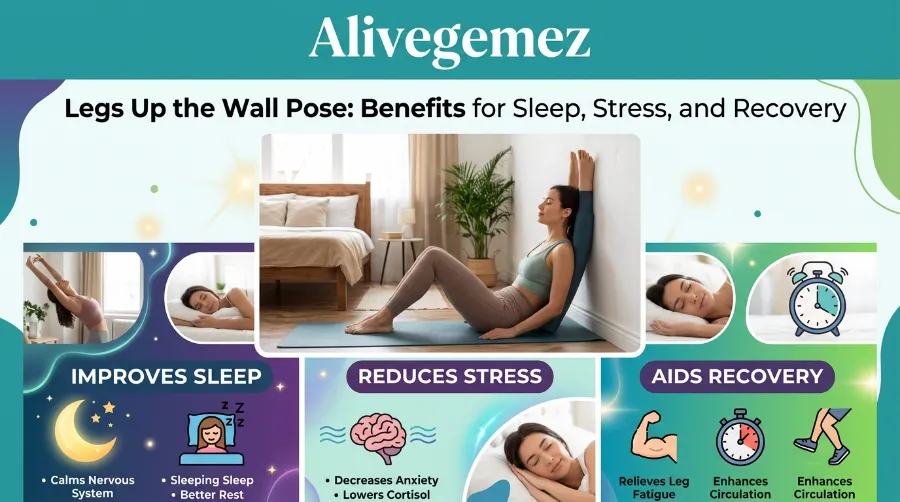
Legs up the wall pose benefits go far beyond a pretty Instagram stretch. This one restorative shape, held for as little as five minutes, can calm a racing nervous system, drain tired legs, and set the stage for genuinely better sleep. As a yoga teacher and health researcher who has spent the last twelve years watching students fall asleep mid-pose in nearly every restorative class I have taught, I can tell you this is one of the few “wellness hacks” that actually earns its reputation.
Savasana Yoga Benefits Why Corpse Pose Is the Most Important Pose
In this guide we will walk through exactly why legs up the wall pose benefits your sleep, stress levels and physical recovery, what the science says, how to do it correctly, who should modify or skip it, and how to pair it with other proven tools like the 4-7-8 breathing technique for an even deeper wind-down.
Key Takeaways
| What You’ll Learn | Quick Answer |
|---|---|
| What is it? | A gentle inversion (viparita karani) where your legs rest up a wall while your hips stay low and heart-friendly |
| Best for | Sleep onset, stress and anxiety relief, tired or swollen legs, post-workout recovery |
| How long to hold | 5 to 20 minutes, most benefits show up by minute 10 |
| When to practice | Before bed, during a midday slump, or after a long run or flight |
| Who should be careful | People with glaucoma, uncontrolled high blood pressure, serious neck or back injuries, or in later pregnancy |
| Equipment needed | Just a wall, plus an optional cushion or folded blanket under the hips |
TL;DR: Legs up the wall pose benefits come from a simple shift in gravity that calms your nervous system, encourages blood to move back toward your heart, and eases tension in tired legs and a busy mind. Ten to fifteen minutes before bed, paired with slow breathing, is one of the simplest ways to fall asleep faster and wake up feeling less wound up.
What Is Legs Up the Wall Pose (Viparita Karani)?
Legs up the wall pose is known in Sanskrit as viparita karani, which loosely translates to “inverted action.” It is one of the gentlest inversions in the entire yoga practice, and that gentleness is exactly the point.

Unlike a headstand or shoulder stand, your neck and spine stay completely neutral here. You simply lie on your back, scoot your hips toward a wall, and rest your legs straight up against it so your body forms a soft L-shape. Your heart stays higher than your feet without any of the strain that comes with a full inversion.
Progressive Relaxation vs Yoga Which One Actually Relieves Stress More?
If you have ever done a bedtime yoga routine or finished a restorative class lying quietly with your legs propped up, you have already practiced viparita karani, even if nobody called it that. It is a staple of restorative and yin yoga because it asks almost nothing of your muscles while giving your circulatory and nervous systems a genuine break.
Legs Wall Yoga USA: Why This Pose Went Viral
The legs wall yoga USA trend picked up serious traction on TikTok and Instagram over the past two years, and the clips are not exaggerating much. Millions of viewers have tried propping their legs against a wall or headboard after a long shift, a flight, or a hard workout, and the reaction is almost always the same: an audible exhale within the first minute. What is happening underneath that viral moment is real physiology, and that is what the rest of this article breaks down.
The Science: Why This Simple Position Works So Well
There are two systems doing most of the work in this pose, and understanding them is the difference between doing the pose and actually feeling its benefits.
Yoga for Insomnia A 4 Week Sleep Improvement Program
Your nervous system shifts gears. Lying still with your legs elevated and your breath slowing down nudges your body out of “fight or flight” and into the parasympathetic, or “rest and digest,” state. Heart rate tends to drop, breathing deepens, and the mental chatter that keeps you scrolling at midnight starts to quiet down. Cleveland Clinic researcher Dr. Robert Saper has noted that restorative poses like this one are specifically designed to guide the body into that relaxed state, even though he is careful to point out that legs up the wall is not a cure for medical conditions like chronic headaches or high blood pressure.
Gravity helps your circulation. When your legs are elevated above your heart, blood and lymphatic fluid that has pooled in your feet, ankles and calves over the day gets an assist moving back toward your core. This is sometimes called improved venous return, and it is a large part of why the pose feels so good after a day of standing, flying, or sitting at a desk. A 2015 study published in PLOS ONE, which measured eye pressure changes during common yoga positions including viparita karani, is one of several pieces of research confirming that this pose meaningfully changes blood flow and internal pressure throughout the body, which is also why people with glaucoma are told to approach it with caution.
Put those two mechanisms together and you get a pose that works on both the mind and the body at the same time, which is rare for something this simple.
Legs Up the Wall Pose Benefits for Sleep
This is the benefit most people search for, and for good reason.
A well-known Harvard study on insomnia found that participants who practiced yoga consistently over eight weeks slept longer and more soundly than those who did not. Legs up the wall pose benefits sleep specifically because it targets the exact obstacle that keeps most adults awake: an overactive nervous system that has not gotten the memo that the day is over.
Here is what tends to happen when you make this part of your bedtime yoga routine:
- Your heart rate and breathing slow down within the first few minutes
- Cortisol, your primary stress hormone, begins to drop as your body senses safety rather than alertness
- Tension stored in tight hips, hamstrings and lower backs starts to release
- Your mind has fewer physical distractions pulling attention away from rest
One widely cited restorative yoga teacher, Gail Boorstein Grossman, has written that twenty minutes in this pose can offer restorative benefits comparable to a short nap, which lines up with what I hear from students constantly: many describe it as the closest thing to a reset button they have found for a wired, overtired brain.
If falling asleep is your main goal, pairing legs up the wall with a full yoga nidra sleep guide practice or a short session of yoga nidra science and benefits work can deepen the effect even further, since both approaches lean on the same parasympathetic pathway.
Legs Up the Wall Pose Benefits for Stress and Anxiety
Stress does not just live in your thoughts. It lives in your shoulders, your jaw, and often in your legs, especially if you spend your day standing, walking a hospital floor, teaching, or sitting hunched over a laptop.
Kate Ingram, a Registered Yoga Teacher who works with The Vitality Dietitians, has described viparita karani as one of the most effective tools for relieving physical tension in the back and hips while simultaneously quieting the mind, essentially hitting a reset button for the nervous system. That combination, physical release plus mental quiet, is exactly why this pose shows up so often in restorative yoga burnout plans for people dealing with chronic overwhelm or workplace stress.
A few reasons this pose is such a reliable stress-reliever:
- It removes the option to “do” anything, which forces a passive, rather than effortful, kind of rest
- The mild inversion increases blood flow to the brain, which many practitioners describe as mentally clarifying
- It is accessible even on your worst, most exhausted days, since it requires zero flexibility or strength
Kristina Rihanoff, a yoga teacher based in the UK, has explained that this semi-reclining pose combined with slow, deep breathing helps slow down every system in the body at once, which in turn lowers heart rate and reduces feelings of anxiety and insomnia. If you have ever tried the 4-7-8 breathing technique on its own, adding it while your legs are up the wall essentially stacks two of the most well-studied relaxation tools on top of each other.
Legs Up the Wall Pose Benefits for Recovery and Circulation
Runners, travelers, nurses, teachers, retail workers and new parents tend to become the most loyal fans of this pose, and it is not a coincidence.
For athletes and active people, elevating the legs after a hard workout or long run helps flush metabolic waste out of tired muscles and reduces the heavy, swollen feeling that shows up in the calves and feet. It has become a common post-training ritual precisely because it costs nothing and takes almost no time.
For frequent flyers, sitting for hours on a plane is one of the fastest ways to develop puffy ankles and stiff hips. Practicing legs up the wall on arrival, alongside strategies from a yoga jet lag recovery routine, can help reset circulation and signal to your body that it is safe to wind down, even in an unfamiliar time zone.
For anyone on their feet all day, the gentle drainage effect on swelling and tired legs is one of the most immediately noticeable legs up the wall pose benefits. You do not need twenty minutes to feel it either; even five minutes tends to bring a lighter, less achy sensation to the lower legs.
There is also emerging interest in how this pose may support people managing PMS-related sleep disruption, with at least one study finding that a practice incorporating legs up the wall reduced sleep disturbances tied to the menstrual cycle. This is a promising area, though as with any pose marketed as a wellness fix, it is worth treating it as one supportive tool rather than a guaranteed remedy.
How to Do Legs Up the Wall Pose Step by Step
You do not need a yoga mat, special clothing, or any prior experience. You need about ten minutes and a clear stretch of wall.
- Clear a space next to a wall, wide enough to lie down with your hips close to it
- Sit sideways against the wall with one hip touching it, knees bent
- Swing your legs up the wall as you lower your upper body down to the floor, using your hands for support as you go
- Scoot your hips toward the wall until your sit bones are close to or lightly touching it, whichever feels comfortable
- Let your arms rest out to the sides, palms up, or place one hand on your belly and one on your chest
- Soften your legs, letting your thighs relax rather than actively holding them straight
- Close your eyes and breathe slowly, aiming for a longer exhale than inhale
- Hold for 5 to 20 minutes, and if your legs start to tingle or fall asleep, simply bend your knees or slide slightly away from the wall
A folded blanket or thin cushion under the hips can make a noticeable difference, especially if your hamstrings are tight. It keeps your lower back from over-flattening and lets you relax more fully into the pose, similar to the prop guidance used in most savasana yoga benefits routines.
Who Should Be Careful With This Pose
Legs up the wall pose is one of the safest inversions available, but “gentle” does not mean “for absolutely everyone.” A little caution goes a long way here.
| Condition | Recommendation |
|---|---|
| Glaucoma or other eye pressure issues | Avoid or consult your ophthalmologist first; inversions can raise intraocular pressure |
| Uncontrolled high blood pressure | Check with a doctor before practicing; the pose can shift blood pressure |
| Serious neck or back injury | Skip or practice only with guidance from a qualified instructor |
| Later stages of pregnancy | Avoid, or use a side-lying restorative pose instead |
| Heart conditions | Get medical clearance before attempting any inverted position |
| Menstruation | Personal preference; some find it soothing for cramps, others prefer to skip it |
If any of this applies to you, that does not mean restorative yoga is off the table. A savasana yoga benefits session or a gentle bedtime yoga routine without inversion can offer many of the same nervous-system benefits without the added pressure changes.
Legs Up the Wall vs Other Restorative Poses
Not sure how this pose compares to other calming favorites? Here is a quick side-by-side.
| Pose | Primary Focus | Typical Hold Time | Best Time to Practice |
|---|---|---|---|
| Legs Up the Wall (Viparita Karani) | Circulation, nervous system reset | 5 to 20 minutes | Evening or after activity |
| Savasana | Full-body surrender, mental stillness | 5 to 15 minutes | End of any practice, or bedtime |
| Yoga Nidra | Guided deep relaxation, body scanning | 15 to 45 minutes | Bedtime or midday reset |
| Child’s Pose | Gentle back and hip release | 3 to 10 minutes | Anytime, including mid-workday |
Many students end up using more than one of these depending on the night. On a low-energy evening, five minutes of legs up the wall followed by a short yoga nidra sleep guide session tends to be the combination that gets people to sleep the fastest, based on what I consistently hear from clients working through a full yoga for better sleep plan.
Pairing It With the 4-7-8 Breathing Technique
If you want to get the most out of this pose, add your breath into the equation. The 4-7-8 breathing technique, popularized by integrative medicine physician Dr. Andrew Weil, works beautifully here because you are already lying still with nothing else to do with your attention.
Here is the simple version:
- Exhale completely through your mouth
- Inhale quietly through your nose for a count of 4
- Hold your breath gently for a count of 7
- Exhale audibly through your mouth for a count of 8
- Repeat for 4 full cycles to start, building up to 8 over time
Dr. Weil has described this pattern as a natural tranquilizer for the nervous system, and combining it with legs up the wall essentially layers two well-established relaxation tools into one short session. It takes less time than scrolling through one more episode recap, and it is far more likely to actually help you fall asleep.
Frequently Asked Questions
How long should I hold legs up the wall pose? Five to twenty minutes is the effective range for most people. Shorter holds still trigger the parasympathetic response, while longer holds tend to bring deeper relaxation and more noticeable relief in the legs.
Can I do legs up the wall pose every night? Yes, most teachers and researchers agree it is safe to practice once or twice a day for people without the contraindications listed above. It is one of the few poses gentle enough for daily use.
Does legs up the wall pose really help you fall asleep faster? It is not a guaranteed sleep switch, but by lowering heart rate and cortisol and easing physical tension, it removes several of the biggest barriers to falling asleep, which is why so many sleep-focused yoga routines include it.
Is legs up the wall pose the same as viparita karani benefits you read about in yoga books? Yes, viparita karani is simply the traditional Sanskrit name for legs up the wall pose, so any viparita karani benefits you come across apply directly here.
What if my legs fall asleep or tingle during the pose? Bend your knees slightly or move your hips a few inches away from the wall. Tingling usually means it is time to adjust, not push through.
Can beginners do this pose safely? Absolutely. It requires no flexibility, no strength and no prior yoga experience, which makes it one of the most beginner-friendly poses in the entire practice.
A Quick Quiz: How Well Do You Know Legs Up the Wall Pose?
- What is the Sanskrit name for legs up the wall pose? A) Savasana B) Viparita Karani C) Balasana
- Roughly how long should you hold the pose to feel meaningful benefits? A) 30 to 60 seconds B) 5 to 20 minutes C) 2 to 3 hours
- Which nervous system state does this pose activate? A) Sympathetic, or fight or flight B) Parasympathetic, or rest and digest C) Central nervous system only
- Who should check with a doctor before trying this pose? A) Anyone with glaucoma or uncontrolled high blood pressure B) Anyone who has ever done yoga before C) Anyone under the age of 30
- What breathing technique pairs especially well with this pose? A) Rapid chest breathing B) 4-7-8 breathing C) Holding your breath entirely
Answers: 1) B, 2) B, 3) B, 4) A, 5) B
The Bottom Line
Legs up the wall pose benefits are not hype. Between the shift toward parasympathetic calm and the simple, gravity-assisted boost to circulation, this pose earns its place as one of the most useful five-to-twenty-minute habits you can build into your evening. It costs nothing, it needs no equipment beyond a wall, and it meets you exactly where you are, whether that is wired from a long commute, sore from a workout, or simply done with the day. Try it tonight, add slow breathing if you want to go deeper, and give your nervous system the kind of break it has probably been asking for all day.
References
- Cleveland Clinic, “The Yoga Pose You Need: The Health Benefits of Legs Up the Wall”
- WebMD, “What to Know About the Legs-Up-the-Wall Yoga Pose”
- Yoga Journal, “Legs Up the Wall Is a Quick Way to Calm Your Mind and Body”
- Baskaran, M. et al., “Intraocular Pressure Rise in Subjects With and Without Glaucoma During Four Common Yoga Positions”, PLOS ONE
- Cleveland Clinic, “How to Do the 4-7-8 Breathing Exercise”
- Weil, A., “The 4-7-8 Breath: Health Benefits and Demonstration”
- Stylist UK, “Yoga for Stress: Legs Up the Wall Pose”
- A Knead for Wellness, “Benefits of Legs Up the Wall”
- Dr. William Hatten, “Revitalize Your Body with Legs Up the Wall”
- Shades of Yoga, “Legs Up Wall Yoga Pose Benefits”