
Almost everyone does, at some point. The teacher says “come into savasana,” your legs are already half off the mat, and your brain is drafting a grocery list before your shoulders even hit the floor. I get it. I taught yoga for over a decade before I understood, in my own body, that savasana yoga benefits are not a bonus round tacked onto the end of class. They are the point. Corpse pose is where your nervous system actually collects the paycheck for the work your body just did.
Key Takeaways
| What You’ll Learn | Why It Matters |
|---|---|
| What savasana yoga benefits actually are, physically and mentally | So you stop treating it as “nap time” and start treating it as training |
| The nervous system science behind corpse pose benefits | Because the shift from sympathetic to parasympathetic state is measurable, not mystical |
| A step-by-step guide to savasana relaxation | So you get results even if lying still makes you fidgety |
| Common mistakes that block the benefits | So ten minutes of lying down isn’t wasted |
| How savasana connects to sleep, burnout recovery, and yoga nidra | Because this pose is a gateway, not a dead end |
TL;DR: Savasana yoga benefits include lower resting heart rate, reduced cortisol, better sleep onset, and a calmer nervous system, and this happens because lying still in the final resting pose triggers your parasympathetic “rest and digest” response. Corpse pose benefits show up fastest when you practice with intention rather than just collapsing on the mat. Give it five to twelve honest minutes and your body starts doing the real work of yoga.
What Is Savasana, Really?
Savasana comes from two Sanskrit words: sava, meaning corpse, and asana, meaning pose. It’s usually the last posture in a yoga class, which is why teachers everywhere call it the yoga final resting pose. You lie flat on your back, arms slightly away from your body, palms open, legs relaxed apart, eyes closed. Nothing moves. That’s it.
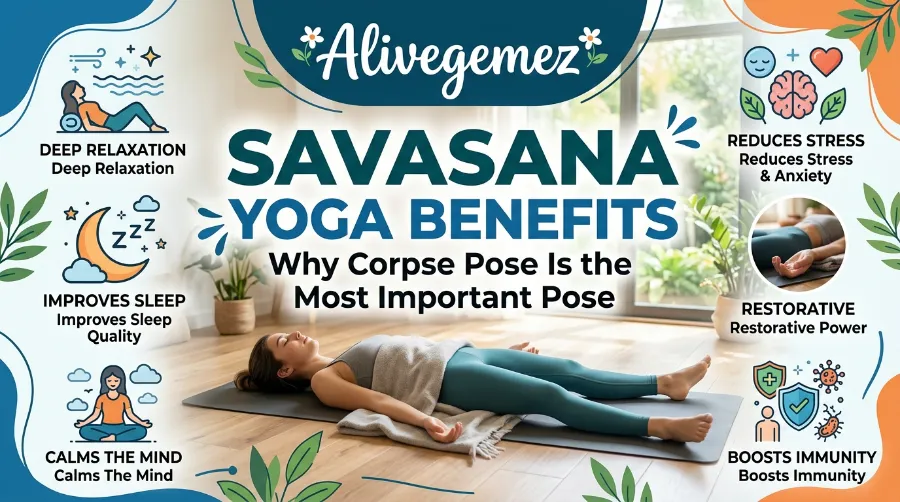
Except that’s not it, not even close. Savasana looks like doing nothing, but underneath the stillness your body is running a full physiological reset. Your heart rate settles. Your breathing slows and deepens on its own. Your blood pressure drops a few points. Your muscles, which just spent forty-five minutes contracting, twisting, and stretching, finally get the message that the work is over and it’s safe to let go.
Legs Up the Wall Pose Benefits for Sleep, Stress and Recovery
I remember teaching a 6 a.m. class in Brooklyn back in 2015 where a woman named Priya told me she’d been skipping savasana for three years because “lying still felt like wasting time she could spend showering before work.” Once she started staying for the full eight minutes, she noticed within about two weeks that her afternoon anxiety spikes softened. That’s not a controlled study, obviously, but it lines up with what the research actually shows about savasana yoga benefits, which we’ll get into shortly.
The Science Behind Savasana Yoga Benefits
Here’s where I put my Ph.D. hat on for a second, because this pose has more research behind it than most people assume.
A controlled physiological study published in January 2025 in the European Journal of Cardiovascular Medicine had thirty healthy adults do a thirty-minute yoga protocol that included alternate nostril breathing, sun salutations, and savasana, while a control group just sat and read quietly for the same amount of time. The relaxation components, including savasana, were linked to reduced cortisol and a pullback in sympathetic nervous system activity. In plain English: the corpse pose group’s stress chemistry calmed down more than the group that just sat quietly. nihnih
Yoga for Jet Lag Best Poses to Reset Your Body Clock Fast
Separately, a 2025 pilot trial on breath-based relaxation practices found that this kind of deep relaxation work can help rebalance the hypothalamic-pituitary-adrenal axis, which is the system that governs your cortisol output, and that this can ease the kind of physiological over-arousal that disrupts sleep. Savasana relaxation isn’t the only practice that does this, but it’s one of the most accessible, because you don’t need equipment, flexibility, or a class pass. You need floor space and permission to stop. doaj
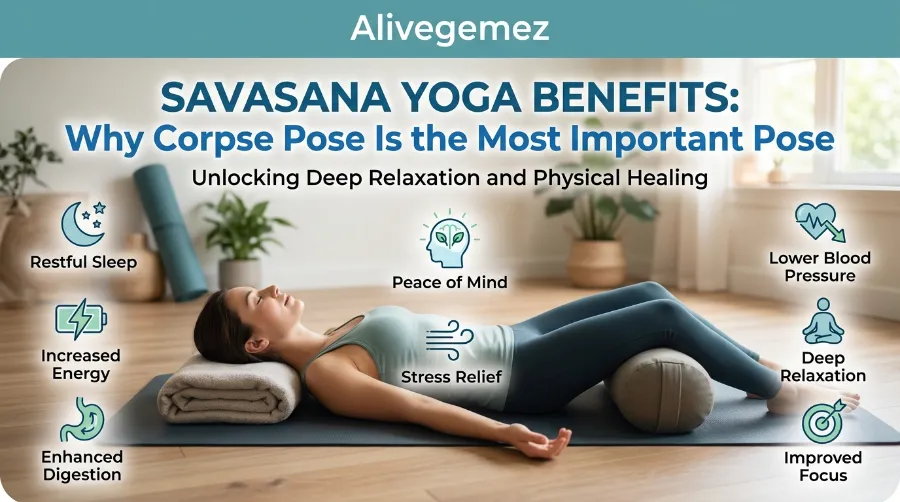
Savasana Yoga Benefits Why Corpse Pose Is the Most Important Pose
What Happens Inside Your Body During Corpse Pose
Below is a simplified snapshot of what shifts during a typical 8 to 10 minute savasana practice, based on aggregated findings across yoga-relaxation physiology research:
| Marker | Typical Change During Savasana | Approximate Timeframe |
|---|---|---|
| Resting heart rate | Drops 5–12 beats per minute | Within 5–8 minutes |
| Blood pressure (systolic) | Drops 3–8 mmHg in most healthy adults | Within 10 minutes |
| Cortisol (stress hormone) | Measurable reduction with regular practice | Cumulative, over weeks |
| Heart rate variability (HRV) | Increases, signaling better stress resilience | Builds over consistent practice |
| Brainwave pattern | Shift from beta (alert) toward alpha/theta (calm, drowsy) | Within several minutes |
I want to be honest with you here, because I promised no vague spiritual promises: these numbers vary by person, by how stressed you were walking in, and by how consistently you practice. A single session won’t rewire your nervous system. But stack these sessions over weeks and the corpse pose benefits compound, similar to how a single workout doesn’t build muscle, but a training block does.
Top Savasana Yoga Benefits, One at a Time
Let’s break down exactly what you’re getting when you commit to this pose instead of bailing early.
1. It Calms an Overactive Nervous System
Most of us walk around in a low-grade sympathetic state, sometimes called “tired but wired.” Savasana flips the switch toward the parasympathetic branch, the one responsible for digestion, repair, and rest. This is arguably the single biggest savasana yoga benefit, because so many modern health complaints, from poor digestion to disrupted sleep, trace back to a nervous system that never gets the “stand down” signal.
Progressive Relaxation vs Yoga Which One Actually Relieves Stress More?
2. Better Sleep Onset and Quality
If you struggle to fall asleep because your mind won’t stop replaying the day, savasana relaxation trains your body to recognize stillness as safe rather than boring or unproductive. This is exactly why it pairs so well with a proper bedtime yoga routine for better sleep, and it’s a big part of why our full guide to yoga for better sleep leans on this pose as a foundation rather than an afterthought.
3. Lower Blood Pressure and Heart Rate
Even a single well-executed corpse pose session has been associated with measurable, temporary drops in resting heart rate and blood pressure, particularly when it follows a full yoga sequence rather than being practiced cold.
4. Muscle Recovery and Reduced Physical Fatigue
Your muscles did work during class. Savasana is where they actually absorb the benefit of that work, similar to a cooldown after a run. Skip it consistently and you may notice more soreness, more tightness, and slower recovery.
5. Reduced Anxiety and Mental Fatigue
Because savasana forces a pause between sympathetic activation and your next task, it interrupts the anxiety spiral many of us live in without noticing. You finish class, you lie down, and for a few minutes there’s nothing to fix, plan, or answer.
6. Improved Focus and Mental Clarity Afterward
People consistently report sharper focus in the hour or two after a full corpse pose practice. This tracks with the shift toward calmer brainwave states, since a nervous system that isn’t scanning for threats has more bandwidth for actual thinking.
7. Emotional Regulation Over Time
This one builds slowly. Regular savasana relaxation teaches your body what calm actually feels like, which makes it easier to recognize and return to that state outside of class, during a stressful meeting, a hard conversation, or a sleepless 2 a.m.
How to Actually Practice Savasana (Step-by-Step)
A lot of the confusion about corpse pose benefits comes from doing the pose badly, or rather, doing it absent-mindedly. Here’s how to do it properly.
- Lie flat on your back on a firm surface, ideally your yoga mat rather than a soft bed, so your spine has support.
- Let your legs fall open naturally, feet rolling outward, roughly hip-width apart.
- Rest your arms slightly away from your torso, palms facing up, fingers soft.
- Close your eyes and take one deliberate deep breath in through the nose, then let it go slowly through the mouth.
- Scan your body from toes to scalp, consciously releasing tension at each stop: feet, calves, thighs, belly, chest, hands, shoulders, jaw, forehead.
- Let your breath return to its natural rhythm, don’t force it, just observe it.
- Stay for 5 to 12 minutes. Set a gentle timer if you’re worried about falling asleep or losing track of time.
- Exit slowly, wiggle fingers and toes, roll to one side, pause, then press up to seated.
If your mind won’t settle, that’s completely normal, not a sign you’re “bad at savasana.” A body scan, like the one above, or a short guided savasana relaxation script, gives your attention something specific to do instead of spiraling.
Common Mistakes That Block Savasana Yoga Benefits
- Leaving before the pose even starts. This is the single biggest one. You cannot get corpse pose benefits from a pose you skip.
- Checking the clock or your phone. This keeps your nervous system in low-grade alert mode, the opposite of what you’re going for.
- Forcing your breath. Savasana relaxation works because you’re allowing the breath to slow naturally, not because you’re controlling it like in pranayama.
- Practicing on a soft, sinking surface. A mattress that’s too soft can misalign your spine and pull you toward actual sleep rather than restful wakefulness.
- Treating it as optional. If your studio or app cuts savasana short, that’s a red flag about the program, not a sign the pose doesn’t matter.
Savasana vs. Yoga Nidra: What’s the Difference?
People confuse these constantly, so let’s clear it up. Savasana is a physical pose, typically five to fifteen minutes, usually placed at the end of an asana class. Yoga nidra is a longer, guided practice, often thirty to forty-five minutes, that uses the same physical position as a launchpad into a structured, deeply relaxed state between waking and sleep.
Think of savasana as the doorway and yoga nidra as the room on the other side of it. If corpse pose leaves you wanting more, our complete yoga nidra sleep guide walks through exactly how to take that relaxation further, and our breakdown of the science behind yoga nidra covers the research in more depth than we have room for here.
Who Gets the Most Out of Savasana Relaxation
Savasana yoga benefits aren’t limited to seasoned yogis. In my own teaching practice, three groups consistently reported the biggest shifts:
- People recovering from burnout, who often need permission to stop moving before their nervous system will actually cooperate. If that’s you, our restorative yoga plan for burnout recovery builds savasana in as a non-negotiable, not a nice-to-have.
- Shift workers and new parents, whose sleep windows are unpredictable and who need a fast, reliable way to downshift the nervous system in a short amount of time.
- Anxious high-performers, the type-A crowd who treat rest as unproductive until they feel the actual physiological payoff in their own body.
What the Wider Yoga Community Gets Right About Corpse Pose
Plenty of respected teachers and outlets have written about this pose, and worth noting where their coverage overlaps with what the research shows. Several experienced instructors interviewed for a well-known feature on savasana’s role in nervous system regulation describe corpse pose as the counterbalance to the up-regulating effect of active asana practice, which lines up with the sympathetic-to-parasympathetic shift we covered above. A wellness-brand deep dive on the neuromuscular case for savasana makes a similar point about muscle recovery, and an Irish yoga studio’s writeup on the benefits of savasana covers the mental-clarity angle that so many practitioners report anecdotally.
Where a lot of these guides fall short, in my opinion, is treating savasana as a footnote rather than connecting it to the bigger picture: sleep architecture, burnout recovery, and the longer yoga nidra practices it feeds into. A strength and wellness brand’s piece on savasana as the unsung hero of a yoga practice gets closer to this, framing the pose as integration rather than idle time, which is the framing I’d encourage you to adopt too.
Yoga for Insomnia A 4 Week Sleep Improvement Program
Frequently Asked Questions
How long should you hold savasana for maximum benefit?
Five minutes is a reasonable minimum, but most research and teaching experience points to 8 to 12 minutes as the sweet spot for meaningful savasana relaxation, especially after a full practice.
Is it bad if I fall asleep during corpse pose?
Occasionally, no. If it happens every time, it likely means you’re sleep-deprived and your body is using the pose to catch up, which is worth addressing separately.
Can I practice savasana without doing a full yoga class first?
Yes. A standalone savasana session, even five minutes on your bedroom floor, still delivers nervous system benefits, though the effect is often stronger after physical movement has already discharged some tension.
What’s the difference between corpse pose benefits and just lying down and resting?
The intentional structure matters, the body scan, the breath awareness, the stillness without sleep. Passive lying down doesn’t reliably trigger the same parasympathetic shift.
Is savasana safe during pregnancy?
Lying flat on the back isn’t recommended past the first trimester for most people. A supported side-lying or slightly elevated version delivers similar savasana yoga benefits safely, ideally under guidance from a prenatal-certified instructor.
Conclusion
Savasana yoga benefits aren’t a wellness myth dressed up in Sanskrit. They’re measurable: a calmer heart rate, lower blood pressure, reduced cortisol, better sleep, and a nervous system that finally gets the memo to stand down. Corpse pose is deceptively simple and genuinely hard, because doing nothing on purpose is a skill most of us never practiced. Next time your teacher calls savasana, stay. Your body already knows how to use those minutes well, you just have to give it the chance.
Quick Quiz: Test What You Learned
1. What does “savasana” mean in Sanskrit?
a) Warrior pose
b) Corpse pose
c) Breath of fire
2. Which nervous system branch does savasana primarily activate?
a) Sympathetic
b) Parasympathetic
c) Neither
3. What is the recommended minimum time to hold savasana for meaningful benefit?
a) 30 seconds
b) 5 minutes
c) 1 hour
4. What’s the main difference between savasana and yoga nidra?
a) They’re identical
b) Yoga nidra is a longer, guided practice built on the same starting position
c) Savasana is only for advanced yogis
5. Which of these is a common mistake that blocks savasana yoga benefits?
a) Closing your eyes
b) Checking your phone during the pose
c) Lying on a firm surface
Answers: 1-b, 2-b, 3-b, 4-b, 5-b
References
- European Journal of Cardiovascular Medicine, Effect of Yoga on Resting Heart Rate and Blood Pressure: A Controlled Physiological Study, January 2025 — https://www.healthcare-bulletin.co.uk/article/effect-of-yoga-on-resting-heart-rate-and-blood-pressure-a-controlled-physiological-study-3832/
- medRxiv, Effects of Sudarshan Kriya Yoga (SKY) Breath Meditation on Heart Rate Variability, Sleep and Mental Health in Healthy Individuals, January 2025 — https://www.medrxiv.org/content/10.1101/2025.01.04.25319992v1.full
- Yoga Journal, Tempted to Skip Savasana? 10 Top Yoga Teachers Explain Why It’s the Most Important Pose — https://www.yogajournal.com/teach/benefits-of-savasana/
- The Output by Peloton, The Essential Role of Savasana in Yoga Practice — https://www.onepeloton.com/blog/benefits-of-savasana
- Insight Timer Blog, Meaning of Savasana and Why You Should Do Corpse Pose — https://insighttimer.com/blog/savasana-meaning/
- RealYogaHub, Yoga for Better Sleep — https://realyogahub.com/yoga-for-better-sleep/
- RealYogaHub, Yoga Nidra Sleep Guide — https://realyogahub.com/yoga-nidra-sleep-guide/