
You’re tired, wound up, and someone just told you to “try yoga” for the hundredth time. Meanwhile your other friend swears by lying on the floor tensing and releasing every muscle in her body like she’s auditioning for a horror movie. Both of you are talking about real, studied techniques. The progressive relaxation vs yoga question isn’t a trick question, and it isn’t a tie either. After twelve years of teaching both methods to clients who range from anxious college students to burned-out nurses, I can tell you the honest answer depends on what your nervous system needs tonight, not on which practice sounds more impressive at a dinner party.
Key Takeaways
| Question | Short Answer |
|---|---|
| Which lowers stress faster in one session? | Progressive muscle relaxation (PMR), based on multiple head-to-head trials |
| Which builds longer-term resilience? | Yoga, thanks to breathwork, movement, and community elements |
| Which is better for sleep? | PMR, especially the tense-and-release version done in bed |
| Which needs more time and space? | Yoga, since most sequences run 20 to 60 minutes with a mat |
| Can you do both? | Yes, and research suggests combining them beats using either alone |
TL;DR: Progressive muscle relaxation tends to produce a quicker, more physical drop in tension because you’re actively tensing and releasing muscle groups in a fixed sequence. Yoga works more slowly but touches more systems at once, mood, breath, posture, and body awareness, which is why it holds up better over months. If you only have ten minutes and a racing mind, start with PMR. If you’re building a long-term stress management practice, yoga is the stronger investment.
What Progressive Muscle Relaxation Actually Is
Progressive muscle relaxation was developed by physician Edmund Jacobson in the 1920s, long before “self-care” was a marketing term. His theory was simple: you cannot be mentally anxious and physically relaxed at the same time, so if you teach the body to let go of tension, the mind eventually follows. PMR works through a fixed sequence, usually toes, calves, thighs, glutes, stomach, hands, arms, shoulders, face, where you tense each group for five to ten seconds, then release for twenty to thirty seconds, noticing the contrast.
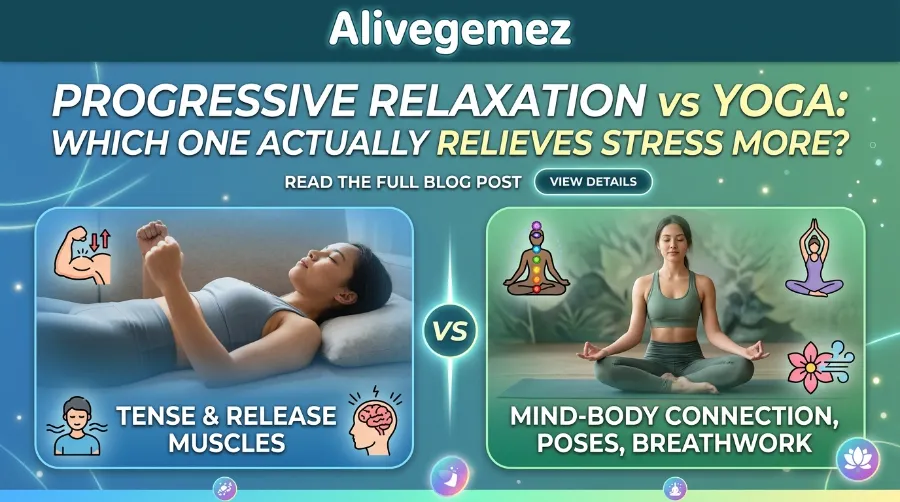
That contrast is the whole mechanism. Most people carry tension they don’t even notice until they deliberately squeeze a muscle and then let it go. This is why PMR is often the first relaxation technique taught in hospital pain clinics and headache programs, it requires no flexibility, no equipment, and almost no instruction.
What Yoga Brings to the Table That PMR Doesn’t
Yoga is not one technique, it’s a category that includes physical postures (asana), breath control (pranayama), and stillness practices like yoga nidra. When people compare progressive relaxation vs yoga, they’re usually picturing a gentle hatha or restorative class, slow stretches held for several breaths, paired with intentional breathing.
Yoga for Insomnia A 4 Week Sleep Improvement Program
Where PMR isolates the muscular system, yoga layers in circulation, joint mobility, and a breathing pattern that slows the heart rate on its own. If you’ve ever tried a savasana yoga benefits practice at the end of class, you already know that stillness after movement feels different from stillness alone. That’s not a coincidence. Movement first, then rest, appears to deepen the parasympathetic response compared to going straight into stillness.
Progressive Relaxation vs Yoga: What the Research Actually Shows
This is where most articles online get vague. Here’s what the actual studies found, with real numbers and real dates.
The Five-Week Head-to-Head Study
A controlled trial split forty participants into a PMR group and a hatha yoga stretching group, both practicing once a week for five weeks, and measured them using the Smith Relaxation States Inventory. By week four, the PMR group showed significantly higher physical relaxation and disengagement, and by week five, higher mental quiet and post-session joy than the yoga group. Neither group beat the other on energy or awareness scores. In plain language: over five weeks, PMR produced a faster, deeper drop in physical tension, muscle by muscle, than gentle yoga stretching did.
When Yoga Won: The South Australia Trial (2007)
A separate randomized trial ran the comparison the other direction. Researchers followed 131 adults with mild to moderate stress in South Australia, comparing a yoga program against a relaxation-based program, checking in at 10 and 16 weeks. Over that longer timeline, yoga edged ahead on reducing stress and improving quality of life. This lines up with what I see in practice, PMR wins the sprint, yoga wins the marathon.
The Asthma and Stress Study
A 2016 to 2017 trial on young adults with stress-induced asthma split thirty patients into a progressive relaxation group and a yoga group over three months. The yoga group showed a significantly greater reduction in stress symptoms and better quality of life by the end, likely because yoga’s breathing component directly supports airway and lung function in a way that muscle tensing alone cannot.
PMR for Sleep: The Bedtime Angle
If your stress shows up mainly at 11 p.m. when you’re staring at the ceiling, PMR has a specific advantage. Sleep researchers regularly note that PMR is one of the few relaxation techniques people fall asleep during, precisely because it gives a busy mind a physical task to focus on instead of racing thoughts. This is also why PMR pairs so well with a bedtime yoga routine for sleep, tensing and releasing muscles first, then settling into stillness, mimics what yoga nidra does more slowly through guided body scanning. If you want the physiology behind why that slower body-scan approach works so well, the science behind yoga nidra breaks it down in more depth.
PMR vs Yoga: Side-by-Side Comparison
| Factor | Progressive Muscle Relaxation | Yoga |
|---|---|---|
| Time per session | 10 to 20 minutes | 20 to 60 minutes |
| Equipment needed | None | Mat, optional props |
| Best for | Acute stress spikes, insomnia, muscle tension | Chronic stress, mood, flexibility, breath control |
| Learning curve | Very low | Low to moderate |
| Physical demand | Minimal | Low to moderate |
| Evidence strength | Strong for short-term relaxation and sleep | Strong for long-term stress and anxiety reduction |
| Works well combined with | Yoga nidra, deep breathing | PMR, meditation |
A quick visual, based on the average relaxation-score improvement reported across the studies above, at the four-week mark and the sixteen-week mark:
Relaxation improvement over time (illustrative, based on cited trials)

Week 4:   PMR  ████████████████░░░░  high
          Yoga ██████████░░░░░░░░░░  moderate

Week 16:  PMR  ████████████░░░░░░░░  moderate-high (plateaus)
          Yoga ██████████████████░░  high (keeps climbing)
When Progressive Muscle Relaxation Is the Better Choice
- You have a panic spike, tension headache, or clenched jaw right now and need relief in under fifteen minutes
- You struggle to fall asleep because of racing thoughts, not physical pain
- You have limited mobility, a recent injury, or simply don’t want to move
- You want something you can do lying in bed, in a chair, or even on a plane
When Yoga Is the Better Choice
- Your stress has been building for weeks or months, not just tonight
- You also deal with poor posture, stiffness, or shallow breathing during the day
- You want a practice that supports mood over the long run, not just tonight’s tension
- You’re recovering from burnout and need something that rebuilds energy as well as calms it, which is exactly the territory covered in a restorative yoga burnout plan
The Real Answer: Combining Both
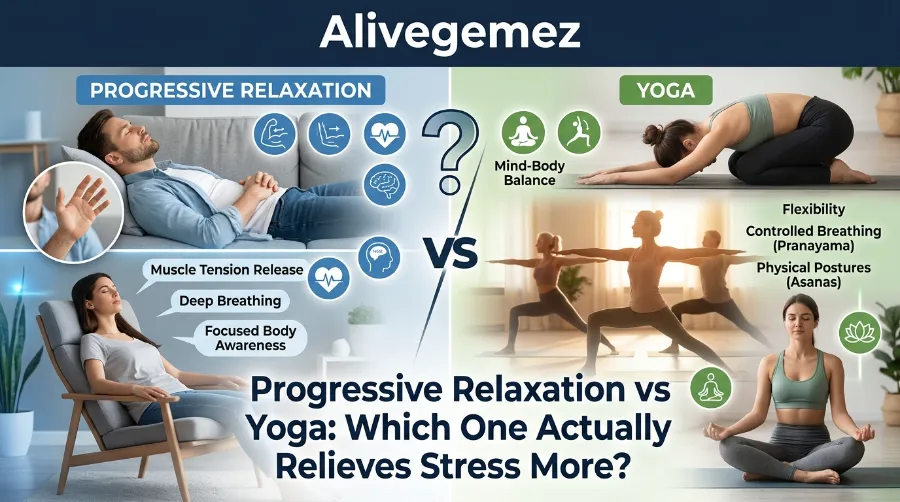
After years of teaching this comparison, my honest take is that framing progressive relaxation vs yoga as a competition misses the point. They target different layers of the stress response. PMR resets the muscular layer fast. Yoga resets breath, posture, and mood more slowly but more thoroughly. A 2021 pilot trial out of a U.S. university tested eight combinations of yoga, PMR, and deep breathing on college students and found the combined approaches held up at least as well as any single technique alone, sometimes better.
In practice, that might look like ten minutes of PMR right before bed, followed by five minutes of legs-up-the-wall or gentle yoga nidra for sleep. Or it might mean a short PMR session before a stressful meeting, paired with a longer yoga practice three or four times a week to build baseline resilience. The yoga for better sleep guide on this site walks through exactly how to sequence that combination for a full week.
How to Do Progressive Muscle Relaxation, Step by Step
- Lie down or sit somewhere quiet, and take three slow breaths before starting
- Start with your feet, curl your toes tightly for five seconds, then release completely for twenty seconds
- Move to your calves, tense, hold, release, and notice the difference
- Work upward through thighs, glutes, stomach, hands, arms, shoulders, and finally your face
- After finishing every muscle group, lie still for two to three minutes and simply notice how your whole body feels
If you tend to hold tension in your neck and shoulders during the day, this practice pairs naturally with the stretches in a legs-up-the-wall pose session afterward, since that pose passively drains tension from the lower body once the upper body is already relaxed.
Frequently Asked Questions
Is progressive muscle relaxation a type of yoga? No. PMR was developed in Western medicine in the 1920s by Edmund Jacobson and is a standalone clinical technique. Many yoga teachers borrow elements of it inside a broader practice, but PMR itself has no roots in yoga philosophy.
Which works faster for anxiety, PMR or yoga? Based on the five-week comparison study above, PMR produced faster gains in physical relaxation within the first month. Yoga tends to catch up and surpass PMR on stress and mood measures by around ten to sixteen weeks.
Can I do progressive muscle relaxation every night? Yes. Sleep researchers commonly recommend nightly PMR for two weeks as a trial period, then continuing with whichever relaxation technique works best for your body afterward.
Does yoga help with the same muscle tension PMR targets? Somewhat, through stretching and holding poses, but yoga doesn’t isolate individual muscle groups the way PMR’s tense-and-release sequence does. That’s why combining both covers more ground.
What if I fall asleep during PMR before finishing the sequence? That’s actually a common and welcome outcome, especially if you’re using PMR at bedtime. Falling asleep mid-sequence simply means the technique did its job.
A Quick Quiz: Which One Fits You Tonight?
1. Right now, my main problem is: a) A racing mind that won’t switch off b) Weeks of built-up stress and low energy c) A stiff neck and shoulders from sitting all day
2. I have about: a) 10 minutes and I’m already in bed b) 30 to 45 minutes and a mat c) 15 minutes and no equipment
3. My biggest goal is: a) Falling asleep faster tonight b) Building resilience over the next few months c) Releasing physical tension without much effort
4. I prefer practices that involve: a) Lying still and following a simple sequence b) Movement, breathing, and stretching together c) Either, as long as it’s quick
5. If I only pick one technique to stick with long-term, I’d choose one that: a) Works fast, even if the effect fades by morning b) Builds slowly but keeps improving over months c) I can do anywhere, anytime, without a mat
Answer key: Mostly A’s, start with PMR before bed. Mostly B’s, prioritize a regular yoga practice. Mostly C’s, PMR is your best low-effort entry point, then layer in yoga as your energy returns.
For those wanting to expand the toolkit further, the yoga for jet lag recovery guide and the four-week yoga insomnia plan both build directly on the PMR-plus-yoga approach described here. Beyond this site, wellness educator Christine’s guide on tense-and-release PMR for sleep offers a useful script for beginners, Calm’s overview of yoga for relaxation covers five accessible poses, and HealthPartners has a solid ten-minute PMR video walkthrough for days when a full yoga session isn’t realistic. Another related technique worth exploring alongside both of these is the 4-7-8 breathing method, which works well as a bridge between an active PMR sequence and a slower yoga nidra wind-down.
For more comparisons like this one, RealYogaHub’s full library of yoga and stress-relief guides is a good next stop.
Conclusion
The progressive relaxation vs yoga debate isn’t really about which one wins, it’s about matching the technique to the moment. PMR gives you a fast, reliable way to physically release tension when you need relief tonight, while yoga builds a deeper, longer-lasting kind of calm that keeps paying off for months. The research backs both, just on different timelines. Try PMR the next time stress hits hard and fast, build a regular yoga practice for the stress that’s been quietly building for weeks, and don’t be surprised if the combination of both ends up working better than either one alone.
References
- Progressive muscle relaxation, yoga stretching, and ABC relaxation theory, PubMed
- A randomised comparative trial of yoga and relaxation to reduce stress and anxiety, Complementary Therapies in Medicine, 2007
- Efficacy of progressive relaxation technique and yoga in patients with stress-induced asthma, 2016-2017 randomized trial
- Effectiveness of Progressive Muscle Relaxation, Deep Breathing, and Guided Imagery in Promoting Psychological and Physiological States of Relaxation, PMC
- Stress Management in College Students, factorial pilot trial, ClinicalTrials.gov
- Relaxation techniques: Try these steps to lower stress, Mayo Clinic
- Sleepless Nights? Try Stress Relief Techniques, Johns Hopkins Medicine