
Somewhere between your third cup of coffee and your fifth open browser tab, someone told you to “just meditate.” Fair advice, terrible instructions. Meditation is not one thing. It is a whole toolbox, and two of the most talked-about tools in that box are transcendental meditation and mindfulness. If you have spent any time researching transcendental meditation vs mindfulness, you already know the internet is full of confident, contradictory opinions. This guide clears that up in plain language, backed by real research, real numbers, and twelve years of teaching both practices to actual humans with actual busy lives.
Breathing Exercises for Anxiety: 7 Techniques That Work Fast

Key Takeaways
| Factor | Transcendental Meditation (TM) | Mindfulness Meditation |
|---|---|---|
| Core method | Silent repetition of a personal mantra | Focused attention on breath, body, or sensation |
| Goal | Transcend thought, reach restful awareness | Stay present with thoughts, without judgment |
| Effort level | Effortless, no concentration required | Active, gentle redirection of attention |
| Training | Certified teacher, structured course, fee involved | Self-taught, app-based, or free classes |
| Typical session | 20 minutes, twice daily, eyes closed | 5 to 45 minutes, flexible, eyes open or closed |
| Best researched benefit | Blood pressure and cardiovascular stress markers | Anxiety, depression, and chronic pain management |
| Cost to start | $380 to $1,000 for a certified course in the US | Free to low-cost (apps, community classes) |
TL;DR: Transcendental meditation uses a personal mantra to help the mind settle into deep rest without any effort to concentrate, while mindfulness trains you to stay anchored in the present moment through the breath or body. Research backs both: TM shows the strongest results for blood pressure and cardiovascular stress, mindfulness shows the strongest results for anxiety, depression, and pain management. Neither one beats the other across the board, so the right pick depends on your goals, your schedule, and your budget.
Wim Hof Breathing vs Pranayama: What Is the Difference?
What Is Transcendental Meditation, Really
Transcendental meditation was developed by Maharishi Mahesh Yogi in the 1950s, and it has held a devoted following ever since, including entrepreneurs, athletes, and musicians who credit it for their focus. The practice is simple to describe even though it takes real training to learn properly.
A certified TM teacher gives you a personal mantra, a sound with no specific meaning, chosen for you during a one-on-one session. You sit comfortably, close your eyes, and silently repeat that mantra for about 20 minutes, twice a day. There is no attempt to concentrate, block out thoughts, or control your breathing. You simply let the mantra do its work.
Transcendental Meditation vs Mindfulness: Key Differences 2026
That “no effort” instruction is the single most important thing to understand about TM. Calm’s meditation researchers describe the practice as effortless, more like stepping onto an airport moving walkway than actively pushing yourself forward. You are not fighting your thoughts. You are letting the repetition carry you toward what practitioners call “transcendental consciousness,” a state of deep rest paired with full mental alertness.
This is also why TM requires certified instruction rather than a free app. Learning the technique properly, including how to choose and use your mantra, typically happens across a short structured course, and it comes with a fee that many beginners find surprising.
What Is Mindfulness Meditation, Really
Mindfulness meditation traces back to Buddhist contemplative traditions, though the version taught in Western wellness spaces today has been secularized and studied extensively since the late 1970s, largely thanks to Jon Kabat-Zinn’s Mindfulness-Based Stress Reduction (MBSR) program at the University of Massachusetts Medical School.
Where TM asks you to let go, mindfulness asks you to pay attention. You pick an anchor, usually the breath, sometimes body sensations or ambient sound, and you rest your attention there. When your mind wanders, and it will, you simply notice that and guide your attention back, without judging yourself for drifting.
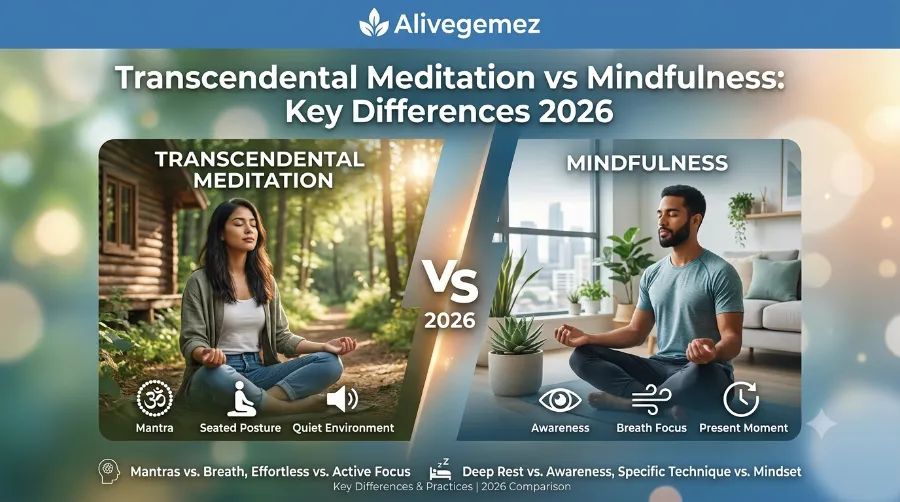
That “noticing without judging” piece is the heart of mindfulness. It is less about reaching a special state and more about building a skill you can use anywhere: in traffic, before a hard conversation, during a panic spiral at 2am. A few common mindfulness formats include:
- Body scan meditation: slowly moving attention from your toes to your head, noticing sensation without trying to change it
- Mindful breathing: resting attention on the natural rhythm of the breath, one of the most accessible entry points for beginners
- Mindful walking: feeling each step and shift of weight instead of zoning out
- Mindful eating: slowing down to actually taste and notice a meal instead of scrolling through it
Because mindfulness does not require a certified teacher or a specific mantra, it is far easier to try today, right now, through a free app, a YouTube video, or simply five quiet minutes with your eyes closed.
Transcendental Meditation vs Mindfulness: The Core Differences
Once you strip away the marketing language, the transcendental meditation vs mindfulness comparison comes down to five practical differences. Understanding these will do more for your decision than any amount of philosophy.
1. Technique
TM uses a personal mantra given by a certified teacher. Mindfulness uses an external anchor, most often the breath, that you can choose and adjust yourself.
2. Goal
TM aims to transcend active thought entirely and settle into restful awareness. Mindfulness aims to stay engaged with the present moment, thoughts and all, while observing everything without judgment.
3. Level of Effort
TM is designed to be effortless. You are not trying to concentrate or push thoughts away. Mindfulness asks for gentle, repeated effort, since you actively notice when your mind wanders and bring it back.
4. Instruction and Accessibility
TM requires a certified instructor and a paid course, usually delivered across four consecutive days. Mindfulness can be self-taught through books, apps, or free community classes, which makes which practice fits your budget an easy question to answer for most beginners.
5. Typical Practice Structure
TM is practiced twice daily for about 20 minutes, seated with eyes closed, following a fixed structure. Mindfulness is far more flexible, with sessions ranging from a two-minute breathing break at your desk to a 45-minute formal sit, and it works with eyes open or closed depending on the exercise.
TM vs Mindfulness Compared: What the Research Actually Shows
This is where a lot of blog posts get lazy and repeat vague claims like “both reduce stress.” Real research paints a more specific, more useful picture, and it matters if you are choosing a practice for a particular health goal.
Blood pressure and cardiovascular health. A 2022 meta-analysis covering 18 studies and more than 1,200 participants found that TM reduced systolic blood pressure by 3.3 mm Hg and diastolic blood pressure by 1.8 mm Hg compared with control groups, though the effect faded after about three months of stopping practice. An earlier meta-analysis published in 2008 found a slightly larger drop, around 4.7 mm Hg systolic and 3.2 mm Hg diastolic, with the American Heart Association later stating that TM may reasonably be considered as part of a treatment plan for hypertension. Mindfulness-based programs also help here. A meta-analysis covering three decades of MBSR trials found a statistically significant reduction in diastolic blood pressure, with the benefit growing larger among people already taking blood pressure medication.
Anxiety, depression, and mental health. This is mindfulness’s strongest territory. A comprehensive meta-analysis of 29 MBSR studies with 2,668 participants found moderate to large effects on stress, anxiety, depression, and quality of life, with benefits still measurable an average of 19 weeks later. In oncology patients specifically, mindfulness-based interventions produced a medium effect on anxiety symptoms across 36 independent studies. Among military veterans, a 2024 systematic review found MBSR meaningfully reduced depression and PTSD symptoms, alongside improved quality of life.
Chronic pain. Mindfulness again shows solid data here, with meta-analyses reporting effect sizes between 0.3 and 0.5 for reducing pain intensity and pain interference in chronic conditions such as lower back pain, a range clinicians generally consider small to moderate but clinically meaningful.
| Health Outcome | Best-Supported Practice | Key Finding |
|---|---|---|
| Blood pressure | Transcendental Meditation | −3.3/−1.8 mm Hg (2022 meta-analysis, n=1,207) |
| Anxiety and depression | Mindfulness (MBSR) | Moderate to large effects, 29-study meta-analysis |
| Chronic pain | Mindfulness (MBSR/MBI) | Effect sizes 0.3–0.5 across multiple reviews |
| PTSD symptoms | Mindfulness (MBSR) | Medium effect, Hedges’ g = 0.46 |
| Cardiovascular stress markers | Transcendental Meditation | Multiple NIH-funded RCTs, five research institutions |
Neither practice “wins” outright. TM has the deepest bench of cardiovascular research, partly because it has been studied by dedicated research institutions since the 1970s. Mindfulness has the deepest bench of mental health research, largely because MBSR was built from the ground up as a clinical intervention inside a hospital system.
Types Meditation Differences: Where Breathwork Fits Into the Picture
Neither TM nor mindfulness is the only doorway into a calmer nervous system, and breath-based practices deserve a mention here because they overlap with both. If you are new to this whole world, our pranayama breathing exercises guide for beginners is the best place to start, since it lays out the foundational vocabulary before you pick a lane.
Pranayama, the yogic science of breath control, is technically its own category, distinct from both TM and mindfulness, though mindfulness borrows heavily from breath awareness. Our guide to pranayama types and their benefits breaks down how different breathing patterns affect the nervous system differently, which matters if your goal is sleep versus focus versus anxiety relief.
A few specific techniques worth knowing, since readers researching TM vs mindfulness compared often end up here next:
- 4-7-8 breathing is a fast-acting calming pattern, useful right before bed or during a spike of anxiety
- Kapalabhati breathing is energizing rather than calming, so it pairs better with mornings than with meditation for sleep
- Ujjayi breath is the ocean-sounding breath often used inside a yoga flow, which can act as a moving form of mindfulness
- Bhramari pranayama, the bee breath, uses sound vibration to settle the mind, closer in feel to a mantra practice than plain breath awareness
- Curious how a modern cold-exposure method stacks up against traditional yogic breathing? Our Wim Hof breathing vs pranayama comparison covers that exact question
- If anxiety is the main driver behind your search for a meditation practice, start with our dedicated guide to breathing exercises for anxiety relief before committing to a full meditation course
Think of breathwork as the on-ramp. Many students find a few weeks of simple breath practice makes it far easier to sit down for either TM or mindfulness later, since it trains basic body awareness first.
Which Practice Is Right for You
Neither practice is objectively better, so this decision comes down to matching the method to your actual life, not the version of your life you wish you had.
Consider TM if:
- You want a fixed, repeatable routine and do not want to make decisions mid-session
- You are drawn to the idea of “effortless” practice and find active concentration frustrating
- You have the budget for certified instruction, generally a few hundred dollars in the US
- Your primary goal is cardiovascular health or general stress resilience
- You like structure, ritual, and a clear technique you never have to modify
Consider mindfulness if:
- You want to start today, for free, with just your phone or a quiet corner
- Your main goal is managing anxiety, low mood, or chronic pain
- You want a skill you can apply in the middle of daily life, not only during a formal session
- You like flexibility and want to experiment with body scans, walking, or eating meditations
- You are comfortable with your mind wandering and want to build the muscle of noticing it, rather than transcending it
Real-World Examples: How the Numbers Play Out
Research studies are one thing, workplace and clinical settings are another, and this is where the difference between TM and mindfulness becomes concrete.
In corporate wellness programs, TM is frequently offered as a structured four-day course delivered by a certified instructor, often at a per-employee cost in the $400 to $700 range, which is why larger organizations with dedicated wellness budgets adopt it more often than small teams. Hospital-based MBSR programs, by contrast, are typically delivered as an eight-week group class, closely following Jon Kabat-Zinn’s original 1979 University of Massachusetts model, and many hospital systems now offer MBSR at low or no cost because it is billed as part of integrative medicine care.
The blood pressure numbers are also worth sitting with for a second. A drop of 3 to 5 mm Hg in systolic blood pressure, the range TM research consistently shows, is roughly comparable to the effect seen from cutting daily sodium intake by about 1,000 mg, according to cardiovascular researchers. That is not a dramatic transformation, but for someone managing borderline hypertension alongside medication, it is a meaningful, low-risk addition.
On the mental health side, the 19-week average follow-up window in the MBSR meta-analysis matters more than it looks. Most stress-relief interventions people try fade fast once life gets busy again. Mindfulness holding measurable benefit almost five months after the last structured session is one of the more reassuring findings in the entire meditation research landscape.
How to Get Started With Each Practice
Starting Transcendental Meditation
- Find a certified TM teacher through an accredited TM organization near you
- Book an introductory session, where the process and expected time commitment are explained before you commit financially
- Attend the personal instruction session, where you receive your individual mantra
- Practice twice daily for 20 minutes, seated comfortably with eyes closed
- Attend the standard follow-up sessions most programs include, so a teacher can check your technique
Starting Mindfulness Meditation
- Pick one anchor to start with, the breath is the easiest for almost everyone
- Set a short timer, five minutes is plenty for week one
- Sit comfortably, eyes closed or softly open, and rest attention on your chosen anchor
- When your mind wanders, notice it without frustration, then return attention to the anchor
- Add two minutes per week until you reach a duration that fits your schedule, most people land somewhere between 10 and 20 minutes daily
Frequently Asked Questions
Is transcendental meditation better than mindfulness for anxiety? Mindfulness currently has the stronger and larger body of anxiety-specific research, including meta-analyses covering thousands of participants across clinical and nonclinical populations. TM can still support anxiety through general stress reduction, but it has not been studied for anxiety as extensively.
Can I practice both TM and mindfulness together? Yes, many practitioners do exactly this, using mindfulness informally throughout the day and reserving TM for their fixed twice-daily sessions. There is no research suggesting the two conflict with each other.
Why does transcendental meditation cost money while mindfulness is often free? TM requires personal instruction from a certified teacher and a specific, individually assigned mantra, which is delivered through a structured paid course. Mindfulness techniques are open-source in practice, taught widely through books, hospitals, and free apps, so no licensing fee applies.
Does mindfulness meditation require sitting still with eyes closed? No. Mindfulness can be practiced with eyes open, while walking, while eating, or during ordinary daily tasks. TM is more fixed in structure, generally practiced seated with eyes closed.
How long before I notice results from either practice? Some MBSR research shows measurable changes in stress and anxiety within the standard eight-week program. TM research on blood pressure has shown effects within a similar multi-week to few-month timeframe, though benefits from both practices tend to strengthen with consistent, ongoing use rather than a single short course.
Conclusion
Choosing between transcendental meditation and mindfulness is not about finding the objectively superior technique, since the research simply does not support a clean winner. It is about matching the method to your goals, your schedule, and your budget. If cardiovascular health and a structured, effortless routine appeal to you, TM has decades of dedicated research behind it. If anxiety, mood, or chronic pain are your main concern, and you want something you can start for free this afternoon, mindfulness has the stronger evidence base. The best meditation practice, in the end, is simply the one you will actually keep doing.
Quiz: Test What You Know
1. Who developed Transcendental Meditation? A) Jon Kabat-Zinn B) Maharishi Mahesh Yogi C) Thich Nhat Hanh
2. What does a TM practitioner silently repeat during a session? A) A gratitude list B) A personal mantra C) A breath count
3. Which practice generally requires a certified teacher and a paid course to learn properly? A) Mindfulness B) Transcendental Meditation C) Neither
4. According to research covered in this guide, which practice shows the strongest evidence for anxiety and depression? A) Transcendental Meditation B) Mindfulness-Based Stress Reduction C) Neither has been studied for this
5. What is the typical TM practice schedule? A) Once a week for an hour B) 20 minutes, twice daily C) 5 minutes, whenever convenient
Answer key: 1-B, 2-B, 3-B, 4-B, 5-B
References
- Reangsing, C., et al. (2022). Effects of Transcendental Meditation on Blood Pressure: A Meta-analysis. PubMed.
- Rainforth, M.V., et al. (2008). Blood pressure response to transcendental meditation: a meta-analysis. PubMed.
- Khoury, B., et al. (2015). Mindfulness-based stress reduction for healthy individuals: A meta-analysis. ScienceDirect.
- Solano López, A.L. (2021). Is Mindfulness-Based Stress Reduction Effective for People with Hypertension? A Systematic Review and Meta-Analysis. NCBI.
- Li, W.W., et al. (2024). The effectiveness of MBSR on depression, PTSD, and mindfulness among military veterans: A systematic review and meta-analysis. PMC.
- TM.org. TM vs Mindfulness: What’s the Difference? https://usa.tm.org/blog/meditation/tm-mindfulness-whats-the-difference/
- Mindful.org. What’s the Difference Between Transcendental Meditation and Mindfulness: A Teacher Explains. https://www.mindful.org/whats-the-difference-between-transcendental-meditation-and-mindfulness-a-teacher-explains/
- The Holistic Care. Transcendental Meditation vs Mindfulness. https://www.theholisticcare.com/blog/transcendental-meditation-vs-mindfulness