
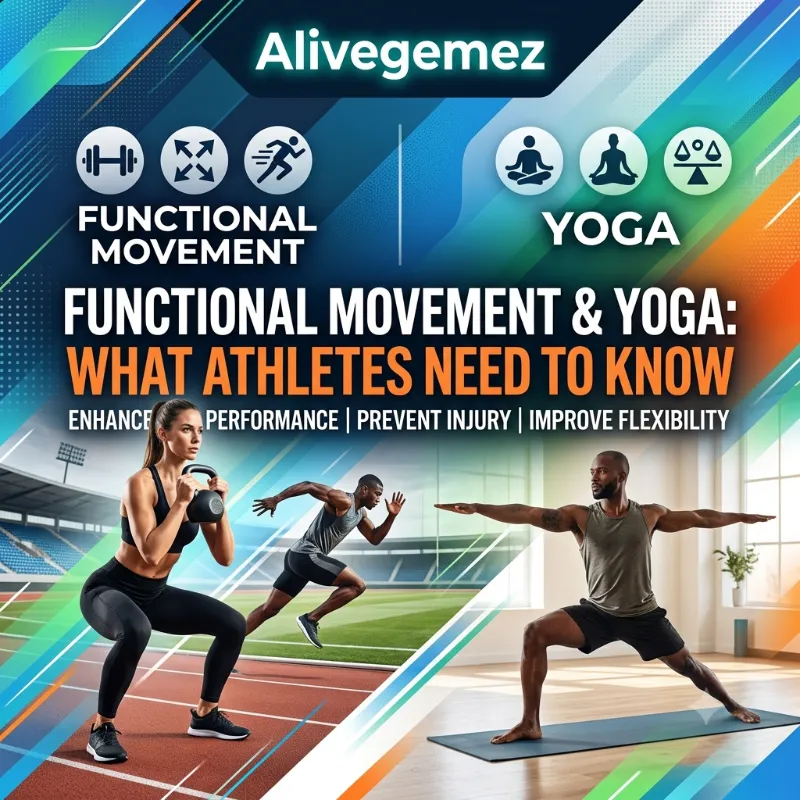
Functional movement yoga athletes rely on doesn’t look like the yoga you see on a studio flyer. It looks like training. If you compete, lift, run, or grind through a weekly sport schedule, the way you move under load matters more than how far you can fold forward. This guide breaks down exactly how functional movement and yoga work together, which patterns actually transfer to performance, and how to build a routine that makes you harder to injure and easier to coach.
Key Takeaways
| Topic | What You Need to Know |
|---|---|
| Core idea | Functional movement yoga athletes practice trains the body to move the way real sport demands, not just to stretch |
| Movement patterns | Hip hinge, squat, lunge, rotation, push, pull and gait are the seven patterns worth training |
| Best use | Two to three sessions weekly as a supplement to sport training, not a replacement for strength work |
| Biggest mistake | Chasing flexibility instead of control through a joint’s full range |
| Who benefits most | Runners, lifters, team-sport athletes and anyone recovering from repetitive strain |
TL;DR: Functional movement yoga athletes use focuses on training real movement patterns like hip hinges, squats, and rotation, not just static flexibility. Two to three focused sessions a week, built around your sport’s demands, can reduce injury risk and improve how your joints handle load. The goal is control through range, not just range itself.
Yoga and HIIT Together How to Combine for Maximum Results
What Is Functional Movement, And Why Athletes Get It Wrong
Functional movement means your joints and muscles can produce, control, and absorb force through the ranges your sport actually asks of them. It is not the same as flexibility. A gymnast can be extremely flexible and still move poorly under fatigue. A powerlifter can be relatively stiff and still move with excellent control.
Most athletes confuse the two. They stretch their hamstrings for ten minutes, feel looser, and assume they have fixed a movement problem. Passive flexibility rarely transfers to active performance. Your nervous system has to trust a range before it lets you use it under speed or load, and that trust is built through controlled movement, not passive holding.
Functional Movement Yoga for Athletes Complete Guide
This is exactly where functional movement yoga athletes benefit from comes in. A well-built yoga practice trains strength and control at the end ranges of motion, which is precisely where most sports injuries happen. Hamstring tears, ankle sprains, and shoulder impingements usually occur at the outer edges of a joint’s range, not the middle.
Mobility Versus Stability: The Distinction That Changes Everything
Mobility is how far a joint can move. Stability is how well you can control that joint once it gets there. Athletes often need less raw mobility and far more stability at the ranges they already have.
Yoga for Runners 10 Poses to Improve Speed and Recovery
A basketball player landing from a rebound does not need more ankle range than they already have. They need the calf, foot, and hip to absorb that landing without collapsing inward. This is a control problem, not a flexibility problem, and it is why generic static stretching routines so often fail athletes long term.
Yoga Movement Patterns Every Athlete Should Train
Rather than thinking in terms of individual poses, it helps to think in terms of movement patterns. Sports science groups human movement into a handful of foundational categories, and yoga happens to train nearly all of them when programmed correctly.
| Movement Pattern | Sport Relevance | Yoga Poses That Train It |
|---|---|---|
| Hip hinge | Sprinting, jumping, deadlifting | Uttanasana, Ardha Uttanasana, Warrior III |
| Squat | Skating, cycling, basketball defense | Malasana, Utkatasana, Chair variations |
| Lunge | Running stride, lateral cutting | Anjaneyasana, Warrior I and II |
| Rotation | Throwing, swinging, striking | Revolved Triangle, Revolved Lunge |
| Push | Swimming, football, gymnastics | Chaturanga, Plank to Downward Dog |
| Pull | Rowing, climbing, tackling | Locust variations, Bow Pose |
| Gait and single-leg stability | Running, agility sports | Tree Pose, Warrior III, Half Moon |
Training these seven patterns through yoga movement patterns builds a body that can handle load in the same shapes your sport requires. This is the actual mechanism behind why athletic yoga has become common in professional training rooms over the last decade, not because it looks good on social media, but because the carryover is measurable in how athletes move under fatigue.
If you want a deeper breakdown of how yoga fits alongside heavier lifting, our guide on yoga and strength training walks through the full relationship between the two disciplines.
Why Rotation Gets Ignored (And Why That’s a Problem)
Most gym programs train forward and backward movement extremely well through squats, lunges, presses, and rows. Rotation gets almost no attention, despite the fact that throwing, swinging a bat, kicking, and changing direction are all rotational actions. Revolved poses train the core and hips to control rotation, which directly reduces the risk of oblique strains and lower back injuries common in golf, baseball, and tennis.
Functional Fitness Yoga Versus Traditional Studio Yoga
Not all yoga is built for athletes, and that distinction matters more than most fitness content admits.
| Feature | Traditional Studio Yoga | Functional Fitness Yoga |
|---|---|---|
| Primary goal | Relaxation, flexibility, mindfulness | Strength, control, injury resilience |
| Pace | Slow, held poses | Mix of held and dynamic holds |
| Focus | Deep stretching | End-range strength and control |
| Best for | Stress relief, general wellness | In-season and off-season athletes |
This does not mean traditional yoga has no value. A slow, restorative class after a heavy training block genuinely helps recovery and nervous system regulation. But if your goal is performance, functional fitness yoga programmed with intent will do more for you than a generic flow class built for a general wellness crowd.
Trainers like the team at Movement with Jenn Choi have built entire coaching practices around this exact gap, blending yoga with functional training principles specifically for people who move for a living or for sport. It reflects a broader shift happening across strength and conditioning, where organizations like the Functional Movement Systems group have spent years building screening tools that identify exactly where an athlete’s movement breaks down before injury happens.
Building an Athletic Yoga Routine: A Weekly Framework
Here is a simple, realistic structure that works alongside most sport training schedules without overloading your recovery capacity.
- Two sessions of 25 to 35 minutes focused on movement patterns relevant to your sport
- One shorter session of 10 to 15 minutes on a rest day, focused on breathing and mobility rather than strength
- Session placement matters as doing dynamic yoga right before heavy lifting can reduce force output, so schedule it for after training or on separate days
- Rotate emphasis weekly between hip-dominant patterns, rotational patterns, and upper body pulling patterns based on your sport’s demands
Runners, for example, benefit enormously from hip hinge and single-leg work, and our dedicated guide on yoga for runners performance breaks this down sport by sport. Office-bound athletes juggling a desk job with training also deal with a specific set of hip and thoracic restrictions, which our piece on yoga for office workers’ back health covers in detail.
Timing It Around Recovery Days
The best window for functional movement yoga is usually a lighter training day or the day after a hard session, when your nervous system can actually absorb the work instead of fighting fatigue. Our guide on yoga as active recovery goes deeper into exactly how to sequence this without interfering with strength adaptations.
Does Yoga Actually Build Athletic Strength?
This is the question athletes ask most, and the honest answer is yes, with a caveat. Bodyweight yoga poses held for time, especially in deep lunges, single-leg balances, and plank variations, build genuine isometric and eccentric strength. That strength transfers well to control and injury resistance.
What yoga will not do is replace heavy progressive overload for building maximal strength or muscle mass. If your goal is raw power, you still need barbells. Our full breakdown on whether yoga builds muscle covers exactly where the line sits between the two training styles.
Common Mistakes Athletes Make With Functional Movement Yoga
- Chasing maximum flexibility instead of control at end range
- Doing dynamic, fatiguing yoga sessions right before max-effort lifts or competition
- Copying generic yoga routines that ignore their specific sport’s movement demands
- Skipping breathwork, which regulates the nervous system and directly affects recovery quality
- Treating yoga as a once-a-month activity instead of a consistent weekly input
In practice, the athletes who see the biggest change are rarely the most flexible ones walking in. They are the ones who show up consistently and treat the sessions like actual training rather than a stretch break. A collegiate sprinter I worked with over an eight-week block did not gain much new range of motion at all, yet her hamstring tightness complaints during speed work dropped noticeably, simply because her hips and hamstrings finally had the control to trust the range they already had.
That pattern shows up again and again across different sports. A recreational cyclist dealing with chronic low back tightness found more relief from four weeks of hip hinge and rotational yoga work than from months of foam rolling, because the issue was never tissue tightness, it was a hip that had stopped moving well under load and a spine compensating for it.
Breathwork’s Role in Athletic Recovery
Functional movement yoga is not only about poses. Controlled breathing directly influences how quickly your nervous system shifts out of a stressed, sympathetic state and into a recovered, parasympathetic one after hard training. This matters for athletes because chronic sympathetic dominance from overtraining is linked to poor sleep, slower tissue repair, and higher injury rates.
One simple, well-studied technique worth building into a cooldown is the 4-7-8 breathing method.
4-7-8 Breathing Technique: How to Do It and When to Use It
The 4-7-8 technique is a simple breath-control pattern that slows the nervous system down quickly, making it useful for athletes right after intense training or before competition when anxiety spikes.
- Inhale quietly through the nose for a count of 4
- Hold the breath for a count of 7
- Exhale completely through the mouth for a count of 8
- Repeat for 4 to 8 cycles
Use it after a hard training session to speed the shift into recovery mode, before bed if training-related adrenaline is keeping you awake, or in the minutes before competition to steady pre-performance nerves. It pairs naturally with a post-session yoga cooldown, since a slower nervous system state is exactly what allows the deeper end-range holds to actually take effect.
Should Yoga Replace Part of Your Gym Routine?
For most athletes, the answer is no, yoga should not replace strength training, but it can absolutely replace some of the low-value stretching and mobility work already sitting in a typical program. If you are currently spending 20 minutes on static stretching that is not moving the needle, swapping that time for a structured functional movement yoga session is a straightforward upgrade.
Some athletes go further and use yoga as a genuine alternative to certain gym days entirely, particularly during deload weeks or travel periods without gym access. Our guide on whether yoga can replace a gym membership walks through exactly when that trade-off makes sense and when it does not.
There is also a growing coaching movement built specifically around blending these two worlds. Programs like ManFlow Yoga were built around the idea that traditionally flexibility-averse athletes, particularly strength-focused men, need a version of yoga that speaks their language, built on strength and control rather than incense and chanting.
Morning or Evening: When Should Athletes Practice?
Timing genuinely changes how a session feels and what it accomplishes. Morning sessions tend to prioritize activation and waking up stiff joints, while evening sessions lean toward deeper holds and nervous system downregulation before sleep. Our detailed comparison of morning versus evening yoga breaks down which timing fits which training goal, since an athlete training for explosive power has different needs than one focused purely on recovery.
How Many Calories Does an Athletic Yoga Session Burn?
This depends heavily on style and intensity. A slow, restorative session burns relatively little, while a dynamic, strength-based flow can rival a moderate bodyweight circuit. If energy expenditure factors into your training load calculations, our full breakdown on calories burned doing yoga gives realistic numbers across different practice styles.
Frequently Asked Questions
Is functional movement yoga good for athletes?
Yes. It trains strength and control through the specific ranges of motion your sport demands, which directly supports injury resilience and movement efficiency.
How often should athletes do yoga for performance?
Two to three sessions weekly, scheduled around harder training days, works well for most sports without interfering with strength or speed work.
Can yoga prevent sports injuries?
It cannot guarantee injury prevention, but training control at end ranges, especially in the hips, hamstrings, and shoulders, meaningfully reduces common injury risk factors.
Is yoga enough strength training on its own for athletes?
No. Yoga builds excellent isometric and control-based strength, but athletes chasing maximal strength or power still need progressive resistance training with external load.
What type of yoga is best for athletes?
Dynamic, pattern-based styles focused on strength and control, sometimes labeled power yoga or vinyasa flow, tend to transfer better to sport than slow, purely restorative styles.
Quick Knowledge Check: Test What You Learned
1. What is the main difference between mobility and stability?
A) Mobility is strength, stability is speed
B) Mobility is how far a joint moves, stability is how well you control it
C) They are the same thing
2. Which movement pattern is most often ignored in traditional gym programs?
A) Squat
B) Push
C) Rotation
3. When is the best time to schedule a dynamic yoga session?
A) Immediately before a max-effort lift
B) After training or on a separate lighter day
C) It never matters
4. What does the 4-7-8 breathing technique primarily help with?
A) Building muscle mass
B) Calming the nervous system after training or before competition
C) Increasing joint flexibility permanently
5. Should yoga fully replace strength training for athletes chasing power?
A) Yes, always
B) No, yoga complements but does not replace progressive overload training
C) Only for team-sport athletes
Answers: 1-B, 2-C, 3-B, 4-B, 5-B
Conclusion
Functional movement yoga athletes use effectively is not about touching your toes or holding a pretty pose for a photo. It is about training your body to control the exact ranges of motion your sport demands, so that under fatigue, speed, or unexpected load, your joints do what you need them to do. Start with two focused sessions a week built around your sport’s movement patterns, add breathwork for recovery, and give it eight weeks before judging the results. The athletes who stick with it consistently are the ones who stop getting sidelined by the same nagging injuries every season.
References
- Functional Movement Systems – functionalmovement.com
- National Academy of Sports Medicine (NASM) – nasm.org
- American Council on Exercise (ACE) – acefitness.org
- Movement with Jenn Choi – movementwithjennchoi.com
- ManFlow Yoga – manflowyoga.com