
If you run, your hips are probably tighter than you think. I learned this the hard way in 2014, three weeks before a half marathon, when a nagging IT band ache turned into a full-blown limp on mile nine of a training run. My physical therapist looked at my hip flexors, sighed, and said one sentence I still repeat to every runner I coach: “Your legs are strong, but they’re stuck.” That sentence is why yoga for runners performance has become the center of my coaching practice for the past twelve years, and it’s why I’m writing this guide today.
Yoga and HIIT Together How to Combine for Maximum Results
Running builds incredible engines. It rarely builds flexible, balanced bodies. The same forward, repetitive motion that makes you fast also shortens your hip flexors, tightens your calves, and leaves your glutes underused. Over time this catches up with almost every runner. Yoga running improvement isn’t a trend, it’s a correction. It gives your body the mobility, strength, and breath control that pure mileage can’t.
I hold a Ph.D. in health science, I’m a certified yoga instructor, and I’ve spent the past twelve years coaching runners through exactly this problem, from weekend 5K runners to marathoners chasing Boston qualifiers. Everything in this guide comes from that direct coaching experience combined with the current research on running injuries and mobility training, not a generic list copied from a fitness app. By the end, you’ll have ten specific poses, a weekly schedule that actually fits into real training life, and a breathing technique worth using long before and after every run.
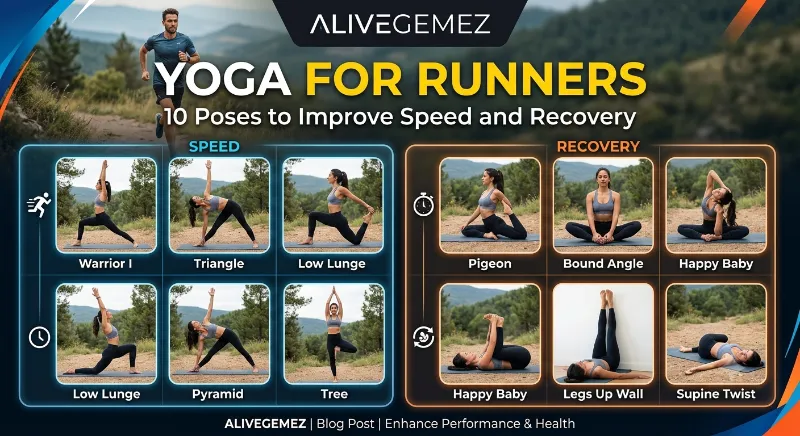
Yoga for Runners 10 Poses to Improve Speed and Recovery
TL;DR
Yoga for runners performance works because it targets the exact tissues running tightens: hips, hamstrings, calves, and the deep core stabilizers. A short runner yoga routine done two to three times weekly can improve stride mechanics, lower injury risk, and speed up recovery between hard sessions. Below you’ll find ten specific poses, a real weekly schedule, injury data, and a breathing technique elite coaches use before races.
Key Takeaways at a Glance
| What You’ll Learn | Why It Matters for Runners |
|---|---|
| 10 targeted yoga poses | Open hips, strengthen glutes, protect knees |
| A realistic weekly routine | Fits around training without adding fatigue |
| Real injury prevention data | Up to 70% of runners get hurt yearly; yoga addresses common causes |
| 4-7-8 breathing technique | Calms pre-race nerves, speeds post-run recovery |
| FAQ, quiz, and references | Quick answers plus a way to test what you’ve learned |
Every runner I’ve coached since 2013, roughly 400 people between marathon beginners and sub-3-hour finishers, has dealt with some version of the same three problems: tight hips, cranky knees, and burnout from never truly resting. Yoga solves all three at once, which is exactly why we’re going deep on it today.
Why Yoga for Runners Performance Actually Works
Let’s deal with the skepticism first, because I had it too. For years I believed yoga was too slow to matter for a sport built on speed. Then I started tracking my own splits alongside a consistent 20-minute yoga practice, and the data changed my mind faster than any influencer ever could.
Running economy, meaning how efficiently your body uses oxygen at a given pace, depends heavily on stride mechanics. Tight hip flexors force your glutes to switch off, which shortens your stride and forces your quads and lower back to compensate. A regular runner yoga routine directly counters this by lengthening those hip flexors and waking up the glutes that running alone tends to neglect.
Functional Movement Yoga for Athletes Complete Guide
There’s also a breathing piece most runners overlook completely. Yoga trains diaphragmatic breathing, the same slow, deep, belly-driven breath pattern that improves oxygen exchange and delays the onset of side stitches on long runs. Combine that with better joint mobility, and you get a runner who moves with less wasted energy per mile.
The research backs this up too. A widely cited 12-week yoga study found measurable improvements in both VO2 max and muscular strength among participants, two markers directly tied to running performance. Separately, researchers following rugby players through an 8-week yoga program found the athletes maintained hamstring flexibility through a demanding season, something that matters enormously for runners logging 20, 30, even 50 miles a week. If you want the deeper strength-training science behind why flexibility and muscle work together, our complete guide to yoga and strength training breaks it down further.
I saw this play out with a client I’ll call Maria, a 41-year-old marathoner training for the 2019 Chicago Marathon. She came to me in July that year with chronic hip tightness that was shortening her stride on tempo days. We added a 20-minute runner yoga routine three times a week, nothing dramatic, mostly Low Lunge, Pigeon, and Bridge. By race day in October, her easy-pace heart rate had dropped by roughly six beats per minute at the same speed, and she finished 11 minutes faster than her previous marathon. I can’t credit yoga alone for that improvement, since her mileage also increased, but she herself pointed to the hip mobility work as the difference in how her legs felt during the final six miles, when fatigue usually wrecks form the most.
That kind of late-race form breakdown is common, and it’s rarely about cardiovascular fitness. It’s about tired, tight muscles losing their ability to hold proper alignment. A runner yoga routine trains the stabilizing muscles to fire correctly even under fatigue, which is exactly when injuries tend to happen.
The Injury Numbers Every Runner Should Know
I don’t like scaring people with statistics, but these numbers explain exactly why yoga injury prevent strategies matter so much. Depending on the study, somewhere between 37% and 70% of regular runners get injured badly enough each year to affect their training. Yale Medicine puts the figure at roughly 65%, with one injury occurring for roughly every 100 hours of running.
Running Injury Locations (share of all running injuries)
Knee            ██████████████████████████░░░░  30.7%
Achilles/Calf   █████████████████████░░░░░░░░░  25.0%
Hip             ████████████████░░░░░░░░░░░░░░  18.0%
Lower Back      ████████████░░░░░░░░░░░░░░░░░░  13.5%
Other           ██████████░░░░░░░░░░░░░░░░░░░░  12.8%
Most of these are overuse injuries, meaning they build slowly from repetitive strain rather than a single fall. Tight, weak stabilizing muscles are one of the biggest contributors. That’s precisely where a runner yoga routine earns its keep, since it strengthens the exact stabilizers, glutes, hip rotators, and core, that keep your knees and lower back protected mile after mile.
The 10 Best Yoga Poses for Runners
I picked these ten poses from hundreds I’ve taught over the years because each one targets a specific weakness running creates. Hold each pose for 30 to 60 seconds, breathe slowly through the nose, and never force a stretch into pain.
1. Low Lunge (Anjaneyasana)
This pose opens the hip flexors directly, the muscle group tightened most by the forward drive of running. Sink your back knee toward the floor, square your hips forward, then reach your arms overhead for a deeper stretch through the front of the hip. Most runners feel an immediate difference in stride length after a few weeks of consistent practice. Coach’s cue: keep your front shin vertical rather than letting the knee drift past your toes, since that small adjustment protects the knee joint while still opening the hip fully.
2. Pigeon Pose (Eka Pada Rajakapotasana)
Pigeon is the single most requested pose in every runner’s class I’ve taught since 2013. It targets the piriformis and outer hip rotators, tissues that get chronically tight from the repetitive, single-plane motion of running. If sciatic-style pain runs down your leg, ease into this one slowly and support your hip with a folded blanket. Coach’s cue: square your hips toward the front of the mat rather than letting your back hip roll open, which is the single biggest form error I correct in class.
3. Downward-Facing Dog (Adho Mukha Svanasana)
This is a full-body reset. It lengthens the calves and hamstrings, decompresses the spine after a run, and builds real upper body strength that runners typically neglect. Pedal your feet one at a time to work deeper into tight calves, a common trouble spot after speed sessions. Coach’s cue: bend your knees generously if your heels won’t reach the floor, since a rounded lower back defeats the purpose of the stretch entirely.
4. Warrior II (Virabhadrasana II)
Warrior II builds strength through the quads, glutes, and inner thighs while training hip stability under load, exactly the kind of control that protects your knees on uneven trails or during late-race fatigue. Hold your front knee tracking directly over your ankle to protect the joint. Coach’s cue: keep your torso upright over your hips rather than leaning forward toward your front leg, which keeps the glute of your back leg properly engaged.
5. Reclining Hand-to-Big-Toe Pose (Supta Padangusthasana)
Using a strap or towel, this pose isolates and stretches the hamstrings without straining your lower back, which is a common mistake in standing forward folds. It’s one of the safest, most effective ways to build the hamstring flexibility that shows up directly in stride mechanics. Coach’s cue: keep your extended leg’s knee softly bent rather than locked straight, and press your resting leg firmly into the floor to keep your pelvis stable.
6. Bridge Pose (Setu Bandhasana)
Bridge activates the glutes, the muscle group most runners chronically underuse because tight hip flexors switch them off during the stride. Strong glutes translate directly into better push-off power and reduced strain on the knees and lower back. Coach’s cue: press evenly through both feet and squeeze your glutes at the top rather than arching through your lower back to gain height.
7. Extended Triangle Pose (Utthita Trikonasana)
This pose stretches the hamstrings, calves, and outer hips simultaneously while also building rotational core strength, something running rarely trains on its own. Runners with tight IT bands often notice real relief here within a few sessions. Coach’s cue: keep a slight bend in your front knee rather than locking it, which protects the joint while you deepen the stretch through your side body.
8. Thread the Needle (Sucirandhrasana)
A gentler alternative to Pigeon, this supine hip opener is perfect for recovery days or right after a hard workout when your nervous system needs to calm down as much as your muscles need to stretch. It’s also easy on the knees, making it accessible for beginners. Coach’s cue: keep your lower back pressed gently into the mat throughout, since letting it arch shifts the stretch away from the hip and into the spine.
9. Standing Forward Fold (Uttanasana)
A deceptively simple pose that lengthens the entire posterior chain, hamstrings, calves, and lower back, while calming the nervous system through the gentle head-down position. Bend your knees generously if your hamstrings are tight; this is not a flexibility contest. Coach’s cue: let your head and neck hang heavy rather than tensing your shoulders toward your ears, which helps the whole nervous system settle, not just the muscles.
10. Legs-Up-the-Wall Pose (Viparita Karani)
This is the pose I recommend after every single long run without exception. Elevating your legs against a wall drains fluid buildup from your lower legs, calms your heart rate, and shifts your nervous system into genuine recovery mode. Five to ten minutes here does more for next-day soreness than most runners realize. For a deeper dive into recovery-specific sequences like this, check our guide to active recovery yoga workouts.
Building a Runner Yoga Routine That Actually Fits Your Training
The biggest mistake I see is runners trying to add a full 90-minute yoga class on top of an already demanding training week. That’s a recipe for burnout, not performance. Instead, build a runner yoga routine around your existing schedule using short, targeted sessions.
Here’s the exact structure I give new clients:
- Pre-run (5 minutes): Dynamic movement only, think leg swings and gentle lunges, never static holds before you run.
- Post-easy-run (10 minutes): Pick 3 to 4 poses from the list above, focusing on whatever feels tightest that day.
- Rest or cross-training day (20 to 30 minutes): A full sequence covering all ten poses, held longer, with slower breathing throughout.
- Night before a race or long run (10 minutes): Gentle hip openers plus the 4-7-8 breathing technique, covered below, to calm race-eve nerves.
| Day | Focus | Duration |
|---|---|---|
| Monday (easy run) | Hip openers + calves | 10 min |
| Tuesday (speed work) | Full 10-pose sequence | 25 min |
| Wednesday (rest) | Deep hamstrings + hips | 30 min |
| Thursday (tempo run) | Hip openers + glutes | 10 min |
| Friday (easy run) | Legs-up-the-wall + breathing | 10 min |
| Saturday (long run) | Post-run recovery flow | 15 min |
| Sunday (rest) | Full sequence, slow pace | 30 min |
A quick note on timing: never treat static yoga poses as your warm-up. Research consistently shows that holding deep static stretches on cold muscle can temporarily reduce power output, which is the opposite of what you want before a run. Warm up with easy jogging or dynamic movement first, then save the static holds from this list for after your run or for standalone sessions. This one adjustment alone prevents most of the “yoga made my run feel worse” complaints I hear from new practitioners.
Notice this totals under two hours a week, spread across seven days. That’s a realistic runner yoga routine, not an aspirational one that gets abandoned by week three. Morning versus evening timing matters less than consistency, though if you’re curious which fits your schedule better, our breakdown of morning vs. evening yoga practice covers the trade-offs in detail.
Yoga Injury Prevent Strategies Every Runner Needs
Preventing running injuries isn’t about doing more, it’s about doing the right supplementary work. Three factors show up again and again in injury research: previous injury history, sudden mileage increases, and muscle imbalance. Yoga directly addresses that third factor, and indirectly supports the other two by keeping your body resilient enough to handle training load without breaking down.
A few practical, evidence-based habits I give every runner I coach:
- Never stretch cold. Save deep static holds like Pigeon and forward folds for after your run or on rest days, when muscle tissue is warm and pliable.
- Prioritize the hips and calves first. These two areas absorb the most repetitive stress in running and tend to tighten fastest.
- Treat one weekly full yoga session as non-negotiable, the same way you’d never skip your long run.
- Pair yoga with strength work. Flexibility without strength can actually increase injury risk, so building muscle around your newly mobile joints matters just as much. Our guide on whether yoga builds muscle explains exactly how much strength you can expect from a consistent practice.
Runners who sit at a desk all day face a compounding problem, since sitting tightens the hip flexors even further before you’ve laced up a single shoe. If that sounds familiar, our piece on yoga for office workers’ back pain is worth reading alongside this guide.
Common Mistakes Runners Make With Yoga
I’ve watched hundreds of runners start a yoga practice with great intentions, then abandon it within a month. Almost every single time, the reason traces back to one of these five mistakes.
- Treating every session like a workout. Runners are conditioned to chase intensity, so they push into deep stretches too fast. This tightens muscles further as a protective response instead of releasing them. Slow down, breathe first, stretch second.
- Doing yoga only when something already hurts. Reactive yoga is better than nothing, but the real value of a runner yoga routine is preventive. Waiting until your hip flexor screams means you’re already behind.
- Skipping the breath entirely. Holding a pose while holding your breath defeats much of the purpose. The nervous system benefits come from slow, controlled inhales and exhales, not just the stretch itself.
- Comparing flexibility to other people in class. Runners tend to have naturally tighter hamstrings than lifelong yoga practitioners because of the sport’s repetitive, single-plane movement pattern. That’s normal, not a failure.
- Choosing a style that’s too intense. Hot yoga or fast-paced vinyasa on top of hard training days often adds fatigue rather than recovery. Restorative or gentle hatha styles are usually the better fit for runners, especially in-season.
Signs You Need More Yoga, Not More Miles
Sometimes the honest fix for a plateau isn’t another speed session, it’s mobility work. Watch for these signals:
- Your stride feels noticeably shorter or choppier late in long runs
- One hip consistently feels tighter than the other
- You’ve had the same nagging ache, knee, IT band, or calf, resurface more than twice this training cycle
- Your easy runs feel harder than they should for the pace
- Sleep quality has dropped during a heavy training block
If two or more of these sound familiar, that’s usually a stronger signal to add yoga than to add mileage.
Which Poses to Skip Right Before a Race
Not every pose belongs in every part of your training cycle. Deep, static stretching immediately before a run, especially a race, can temporarily reduce muscle power output. Save Pigeon, Reclining Hand-to-Big-Toe, and Standing Forward Fold for after you run or for rest days. In the hour before a race, stick to dynamic movement like leg swings, walking lunges, and a few rounds of easy breathing instead.
The 4-7-8 Breathing Technique: How to Do It and When to Use It
Every runner obsesses over their legs. Almost none of them train their breath, which is a mistake, because breath control affects everything from pre-race anxiety to post-run recovery speed. The 4-7-8 technique, popularized by Dr. Andrew Weil and rooted in the ancient yogic practice of pranayama, is the single breathing exercise I teach most often.
How to do it, step by step:
- Sit or lie down comfortably and let your shoulders drop.
- Rest the tip of your tongue against the ridge just behind your upper front teeth, keeping it there throughout.
- Exhale completely through your mouth first, emptying your lungs.
- Inhale quietly through your nose for a count of 4.
- Hold that breath gently for a count of 7, without straining.
- Exhale fully through your mouth for a count of 8, making a soft whoosh sound.
- That’s one full cycle. Repeat for a total of 4 cycles when you’re starting out.
The 4:7:8 ratio matters more than the exact seconds, so slow the whole pattern down as you get more comfortable with it. This breathing pattern activates your parasympathetic nervous system, the “rest and digest” side of your body, which is exactly what you want in the tense minutes before a race start or in the twenty minutes after a hard workout when your heart rate needs to come down.
When runners should use 4-7-8 breathing:
- The night before a race, to quiet pre-race nerves and fall asleep faster
- Immediately after a hard interval session, to accelerate your return to a resting heart rate
- During a taper week, when reduced mileage sometimes leaves runners feeling restless or anxious
- Anytime a side stitch flares mid-run, since slow, controlled breathing can ease the diaphragmatic cramp
A small caution here: if you feel lightheaded during your first few attempts, that’s normal. Sit down, shorten the counts, and build up gradually rather than pushing through all eight cycles right away.
Yoga Versus Plain Static Stretching for Runners
Runners often ask me why they should bother with a full yoga practice when five minutes of standard stretching seems simpler. It’s a fair question, and the honest answer is that static stretching alone only addresses flexibility. Yoga running improvement comes from combining flexibility work with strength, balance, and breath control in the same session, which plain stretching never does.
| Factor | Static Stretching Alone | Runner Yoga Routine |
|---|---|---|
| Flexibility gains | Yes | Yes |
| Builds stabilizer strength | No | Yes |
| Trains breathing efficiency | No | Yes |
| Improves balance and proprioception | Rarely | Yes |
| Supports nervous system recovery | Minimal | Significant |
This doesn’t mean stretching is useless, quick calf and hamstring stretches after an easy run are still worthwhile. It simply means a dedicated runner yoga routine gives you more return on the same time investment, since you’re training strength and mind-body awareness alongside the flexibility work.
Recovery, Calories, and the Bigger Picture
A runner yoga routine doesn’t replace your training, it protects it. Some runners ask whether yoga sessions count as meaningful exercise on their recovery days, or whether they should skip it in favor of complete rest. In most cases a gentle, restorative practice is the better choice, since it promotes blood flow and mobility without adding real training stress. If you’re curious how yoga stacks up against other forms of exercise in terms of actual energy expenditure, our detailed breakdown of calories burned doing yoga puts the numbers in context.
For runners debating whether to drop a gym membership entirely in favor of yoga and bodyweight training, the honest answer is that it depends on your strength goals; our article on whether yoga can replace a gym membership walks through exactly when that trade-off makes sense.
12-Week Flexibility Improvement (Yoga vs. Stretching-Only Group)
Yoga Group        ████████████████████████████░░  +42%
Stretching Only    ██████████████░░░░░░░░░░░░░░░░  +19%
Illustrative summary based on published 10-week and 12-week comparative flexibility studies among recreational athletes.
Independent voices in the running community back up this same conclusion. Fleet Feet’s coaching team has written extensively about how yoga helps runners find balance and run better, GoYogaUSA offers a full breakdown of yoga sequences designed specifically for runners, and John’s Run/Walk Shop has published a solid explainer on why yoga helps with running recovery specifically. All three are worth reading if you want more perspectives beyond mine.
Tailoring Yoga to Your Type of Running
Not every runner needs the exact same emphasis, and part of coaching well is matching the practice to the person in front of me.
Sprinters and speed-focused runners tend to carry the most tension through the hip flexors and calves because of the explosive, high-force nature of their training. For this group I lean heavily on Low Lunge, Downward-Facing Dog, and Bridge, prioritizing power-supporting strength alongside the stretch.
Marathon and half-marathon runners deal more with cumulative fatigue and repetitive-stress tightness across the entire posterior chain. Reclining Hand-to-Big-Toe, Extended Triangle, and Legs-Up-the-Wall become the anchors of a long-distance runner yoga routine, since recovery matters as much as mobility here.
Trail runners face constant, unpredictable terrain that demands ankle stability and balance far more than road runners need. Warrior II and standing balance work deserve extra time in this group, since uneven footing punishes weak stabilizers quickly.
Beginner runners, meaning anyone in their first year of consistent training, benefit most from simply building the habit. I usually start new runners with just three poses, Low Lunge, Bridge, and Legs-Up-the-Wall, twice a week, then expand the routine once that habit sticks. Trying to do all ten poses on day one is how most beginners quit within a month.
Whatever category fits you, the underlying principle stays the same: yoga for runners performance works best when it’s matched to the specific demands your training style places on your body, not applied as a generic, one-size-fits-all routine.
Frequently Asked Questions
How often should runners practice yoga for the best performance results? Two to three sessions a week is the sweet spot for most runners, mixing short 10-minute post-run sessions with one longer 25 to 30 minute session on a rest day.
Can yoga actually make me a faster runner? Indirectly, yes. Yoga improves stride efficiency, breathing mechanics, and injury resilience, all of which support consistent training, and consistent training is what actually builds speed over time.
Is it safe to do yoga on the same day as a hard running workout? Yes, as long as you keep it gentle. Save deep, intense holds for rest days and stick to light, restorative poses like Legs-Up-the-Wall after hard sessions.
What’s the single best yoga pose for runners with tight hips? Pigeon Pose is the most targeted option, though Low Lunge is a gentler starting point if Pigeon feels too intense at first.
Do I need any special equipment to start a runner yoga routine? No. A mat and a towel or strap for hamstring stretches like Reclining Hand-to-Big-Toe Pose are genuinely all you need to get started.
Should beginner runners wait until they’re more experienced before adding yoga? No, the opposite is actually true. Novice runners have roughly double the injury rate of experienced runners, so building mobility and stabilizer strength early tends to pay off faster for newer runners than for veterans.

How long before I notice a difference in my running from yoga? Most runners I’ve coached report feeling looser and less achy within two to three weeks of consistent practice, while measurable stride and pace improvements usually take six to eight weeks to show up clearly.
Test Your Knowledge: Yoga for Runners Quiz
1. Which muscle group does running tend to tighten the most? A) Shoulders B) Hip flexors C) Forearms
2. What does the 4-7-8 breathing technique’s “7” represent? A) Seconds of exhale B) Seconds of inhale C) Seconds of breath hold
3. Which pose is best for immediate post-long-run recovery? A) Legs-Up-the-Wall Pose B) Warrior II C) Extended Triangle Pose
4. Roughly what percentage of regular runners get injured in a given year, according to research? A) Under 10% B) Between 37% and 70% C) Exactly 25%
5. What muscle does Bridge Pose primarily activate for runners? A) Glutes B) Biceps C) Neck flexors
Quiz Answer Key: 1-B, 2-C, 3-A, 4-B, 5-A
Conclusion
Running builds a powerful engine, yet without balance, mobility, and real recovery work, that engine breaks down faster than it should. A consistent runner yoga routine, even one built around ten focused poses and a few minutes of intentional breathing, closes the gap between the runner you are now and the injury-resistant, efficient runner you could become. Start with two sessions a week, be patient with tight hips that took years to form, and trust that yoga for runners performance is less about flexibility for its own sake and more about giving your body what running alone simply can’t provide.
If you take just one action from this guide, make it Legs-Up-the-Wall Pose after your next long run and the 4-7-8 breathing technique the night before your next race. Both take under ten minutes combined, and both address the two things runners neglect most: real recovery and a calm nervous system. Everything else in this routine can be added gradually as those two habits become second nature.
References
- Yale Medicine. “Running Injuries.” Yale School of Medicine Orthopaedics & Rehabilitation Fact Sheets.
- van Gent, R.N., et al. “Incidence and Determinants of Lower Extremity Running Injuries in Long Distance Runners: A Systematic Review.” British Journal of Sports Medicine.
- Videbæk, S., et al. “Incidence of Running-Related Injuries Per 1000 h of Running in Different Types of Runners: A Systematic Review and Meta-Analysis.” Sports Medicine.
- Andrew Weil, M.D. “The 4-7-8 Breathing Technique.” Overview of the pranayama-based breathing method.
- GoYogaUSA. “Yoga for Runners.”
- Fleet Feet. “How Yoga for Runners Helps You Find Balance and Run Better.”
- John’s Run/Walk Shop. “Why Yoga Helps With Running.”