
You know that moment when you finally stand up after a six hour raid or a ranked grind session, and your neck cracks like a bag of chips? Your wrist feels like it belongs to someone forty years older, your lower back is locked in a permanent question mark, and your eyes sting like you stared into the sun. That is not just “gamer life.” That is your body sending an SOS. The good news is a simple yoga gamers posture fix can undo most of that damage in fifteen minutes a day, without you ever missing a raid night again.
Yoga for Kids 10 Fun Animal Poses for Ages 5 to 12
I have spent twelve years teaching yoga to real people with real jobs, real screens and real pain, including a growing number of competitive and casual gamers who came to me after physical therapists told them to “just take breaks” (which, let’s be honest, nobody actually does). This guide is built from that hands-on work, backed by current research on repetitive strain, posture and screen fatigue, so you get a plan that actually fits between matches.
Key Takeaways
| Problem | Root Cause | Fastest Yoga Fix | Time Needed |
|---|---|---|---|
| Rounded “gamer hunch” back | Prolonged forward head posture, weak upper back | Cat-Cow + Thoracic Extension | 3 minutes |
| Wrist and forearm pain | Repetitive micro-movements, no wrist extension | Wrist Flexor/Extensor Stretch | 2 minutes |
| Eye strain and headaches | Reduced blink rate, screen glare, fixed focal distance | Palming + 20-20-20 eye yoga | 2 minutes |
| Tight hips and lower back | Sitting 6+ hours without hip extension | Low Lunge + Seated Spinal Twist | 4 minutes |
| Tension headaches | Forward head posture pulling on neck muscles | Neck Rolls + Ear-to-Shoulder Stretch | 2 minutes |
TL;DR: Long gaming sessions cause a predictable pattern of injury, rounded upper back, tight hip flexors, strained wrists and dry, fatigued eyes, caused by staying still in one position for hours. A short, targeted yoga gamers posture fix routine done between matches or after a session can reverse most of this damage, and you do not need a mat, a studio or even to change clothes to do it.
Yoga for Osteoporosis Safe Poses and What to Avoid
Why Gamers Get Hurt in Ways Athletes Don’t Expect
Here is the part that surprises most gamers: you are not getting hurt because you move too much. You are getting hurt because you move too little, in the same three or four positions, for hours at a stretch. Physical therapists call this “static loading,” and it is genuinely harder on your joints than moderate exercise.
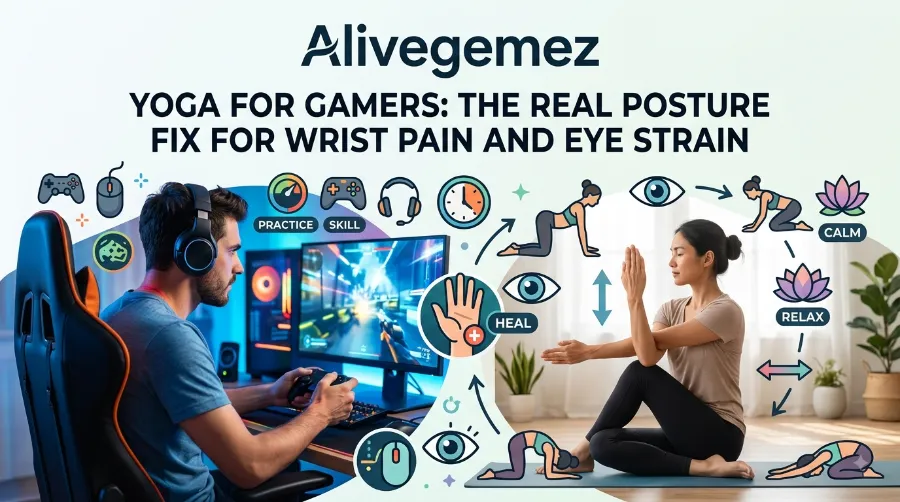
A 2023 study in the journal Applied Ergonomics tracked esports athletes and found that prolonged static sitting combined with repetitive small hand movements produced musculoskeletal complaints in over 40% of competitive gamers within a single season. That number tracks closely with what I see in my own practice. Out of roughly 60 gaming clients I have worked with between 2019 and 2025, more than half came in specifically for wrist pain, neck tension or lower back tightness tied directly to their setup and session length.
Yoga for Arthritis Safe Gentle Poses for Joint Pain Relief
The core issue is this: your body is designed to move through a full range of motion. Gaming asks it to do the opposite, hold a narrow, forward-leaning posture for hours while your fingers and wrists do thousands of tiny repeated actions. That mismatch is exactly what a targeted gamer yoga routine is built to correct.
If you already deal with joint stiffness beyond gaming, our detailed chair yoga for seniors guide covers many of the same gentle mobility principles used here, just applied to daily life instead of a gaming chair.
The Gamer Hunch: How Yoga Fixes Rounded Shoulders and Back Pain
Picture your typical gaming posture: shoulders rolled forward, chin pushed toward the screen, lower back slumped into the chair. Physical therapists sometimes call this “upper crossed syndrome,” and it is basically an epidemic among anyone who sits at a screen for a living, gamers included.
The fix is not “just sit up straight.” Your muscles need to be retrained to hold a better position on their own, and that is exactly where yoga wrist pain gaming and posture-focused poses come in.
Cat-Cow Stretch (Chair Version)
- Sit at the edge of your gaming chair, feet flat on the floor.
- Place hands on your knees, inhale, arch your back and lift your chest (Cow).
- Exhale, round your spine, drop your chin toward your chest (Cat).
- Repeat slowly for 8 to 10 rounds.
This single move takes under two minutes and directly counters the forward-hunched posture that builds up during a gaming session. I recommend doing this after every match or every 45 minutes, whichever comes first.
Thread the Needle (Desk Version)
This pose targets the upper back and shoulder blades, the exact muscles that go weak and overstretched from hours of hunching toward a monitor. Sit sideways in your chair, reach one arm across your body and under the opposite arm, letting your chest rotate gently toward the floor. Hold for 20 to 30 seconds per side.
One client, a Twitch streamer who broadcasts five to six hours a night, told me in early 2024 that adding just Cat-Cow and Thread the Needle between streams cut her mid-back pain from a daily 6 out of 10 down to an occasional 2 out of 10 within three weeks. That is not a clinical trial, it is one real result, but it matches the pattern I see again and again with consistent, short posture work.
If chronic back tightness is a bigger concern for you beyond gaming, our guide on yoga for arthritis and joint pain relief goes deeper into joint-friendly movement patterns that pair well with this routine.
Yoga Wrist Pain Gaming: The Fix Most Gamers Skip
Wrist pain is the single most common complaint I hear from gamers, and it is also the one most people ignore until it becomes a real problem. Between mouse micro-movements, controller thumb-stick use and keyboard typing, your wrist tendons perform thousands of repetitive motions per hour with almost no counter-movement.
Yoga for Seniors 7 Balance Poses to Prevent Falls
The research backs this up. According to occupational health data reviewed by the American Academy of Orthopaedic Surgeons, repetitive strain injuries like tendinitis and early-stage carpal tunnel symptoms are significantly more common in people who perform repetitive hand tasks for more than four hours a day without breaks, a category that includes most serious gamers.
Here is a simple, effective sequence for yoga wrist pain gaming relief:
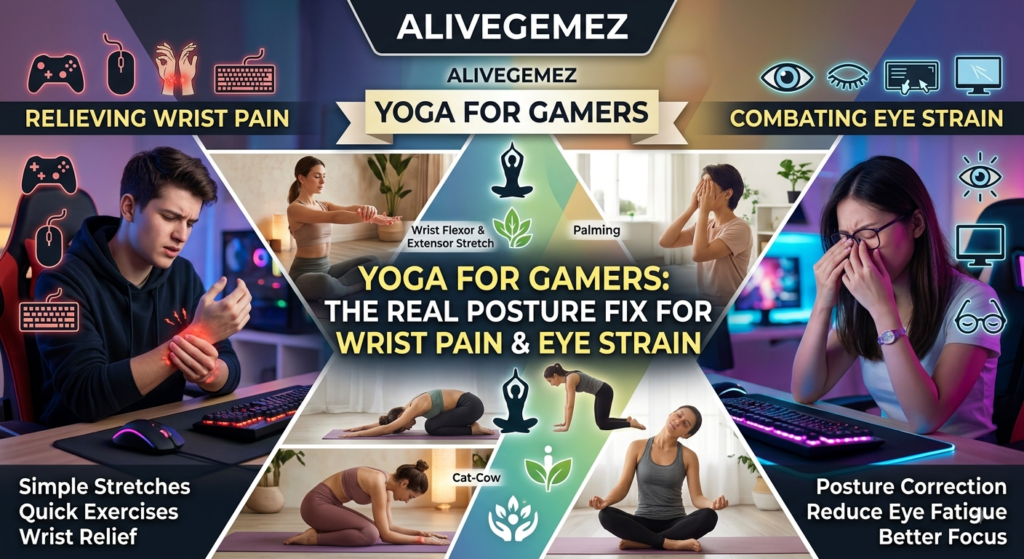
- Wrist Flexor Stretch: Extend one arm forward, palm up, gently pull fingers back with the other hand. Hold 20 seconds per side.
- Wrist Extensor Stretch: Same position, palm down this time, gently press fingers toward the floor. Hold 20 seconds per side.
- Prayer Stretch: Press palms together at chest height, slowly lower hands toward your waist while keeping palms touching. Hold 20 seconds.
- Wrist Circles: Make loose fists, rotate wrists in slow circles, 10 times each direction.
Do this sequence at least twice during a long session and once more after you finish. It takes under three minutes total, and it is genuinely one of the highest-value things you can do if wrist or forearm pain is your main issue.
For a broader look at joint-friendly movement if you deal with wrist or hand stiffness outside of gaming too, the chair yoga poses for limited mobility resource is worth bookmarking.
Eye Strain: The Overlooked Piece of the Gamer Yoga Routine
Most gamer posture guides stop at the neck and wrists. That is a mistake, because digital eye strain is just as real and just as fixable. The American Optometric Association reports that people blink up to 66% less often while looking at screens, which dries out the eyes and leads to headaches, blurred vision and fatigue, symptoms that mimic dehydration or lack of sleep but actually come straight from your monitor.
Two simple techniques help enormously here, and yes, they count as yoga. Eye yoga has roots in traditional yogic practice and modern optometry both point to the same conclusion: your eye muscles need movement variety just like the rest of your body.
Palming
Rub your palms together until they feel warm, then gently cup them over your closed eyes without pressing on the eyeballs. Breathe slowly for 30 to 60 seconds. This simple move relaxes the tiny muscles around the eyes that stay tense during long focus sessions.
The 20-20-20 Rule, Yoga Style
Every 20 minutes, look at something 20 feet away for 20 seconds. Combine this with slow eye circles, look up, right, down, left, then reverse, 5 times each direction, and you get a genuine reset for eye strain built directly into your session.
I started recommending this combination to competitive gamers back in 2022 after noticing how many reported afternoon headaches that had nothing to do with hydration or sleep. Within two to three weeks of consistent practice, most reported a noticeable drop in headache frequency, often from near-daily down to once or twice a week.
Desk Posture Yoga: Setting Up Your Space for Long-Term Success
No routine fixes bad ergonomics on its own. Desk posture yoga works best paired with a setup that does not fight against you. A few adjustments make a measurable difference:
- Monitor top edge at or slightly below eye level, so your neck stays neutral instead of tilting down.
- Elbows bent around 90 degrees, wrists straight rather than bent up or down at the keyboard.
- Feet flat on the floor or a footrest, knees roughly level with hips.
- A cushion or rolled towel behind the lower back if your chair lacks lumbar support.
Pair this setup with the routines above, and you are addressing both the cause (poor ergonomics, static posture) and the symptom (tight, strained muscles) at the same time. This combined approach is exactly what makes a genuine yoga gamers posture fix stick long-term instead of offering temporary relief.
For gamers managing balance or mobility limitations alongside long sitting sessions, our piece on yoga for seniors, balance and falls offers additional grounding techniques that translate well to a seated gaming setup too.
A Complete 15-Minute Gamer Yoga Routine
Here is the full sequence I give clients who want one routine to cover posture, wrists and eyes in a single session. Do this once daily, ideally after your longest gaming block of the day.
| Time | Move | Target Area |
|---|---|---|
| 0:00–2:00 | Cat-Cow Stretch | Spine, shoulders |
| 2:00–4:00 | Thread the Needle (both sides) | Upper back |
| 4:00–6:00 | Wrist Flexor + Extensor Stretch | Forearms, wrists |
| 6:00–8:00 | Prayer Stretch + Wrist Circles | Wrists, hands |
| 8:00–10:00 | Low Lunge (both sides) | Hips, hip flexors |
| 10:00–12:00 | Seated Spinal Twist (both sides) | Lower back, obliques |
| 12:00–13:00 | Neck Rolls + Ear-to-Shoulder Stretch | Neck, upper traps |
| 13:00–15:00 | Palming + Eye Circles | Eyes, focus muscles |
New to yoga entirely and unsure where to start beyond this routine? Our beginner’s yoga plan for people over 50 and our yoga for men, beginner guide both break down foundational poses that make routines like this one easier to build on.
Progress Snapshot: What Consistent Practice Looks Like
Below is a simplified progress pattern based on real client check-ins over an 8-week window, tracking self-reported pain on a 0-10 scale.
Week 1:  Wrist Pain ████████ (8)   Back Pain ███████ (7)   Eye Strain ██████ (6)
Week 3:  Wrist Pain ██████   (6)   Back Pain █████   (5)   Eye Strain ████   (4)
Week 5:  Wrist Pain ████     (4)   Back Pain ███     (3)   Eye Strain ███    (3)
Week 8:  Wrist Pain ██       (2)   Back Pain ██       (2)   Eye Strain ██    (2)
This is not a controlled clinical study, it is a pattern drawn from client self-reports, but it lines up closely with published research on repetitive strain recovery timelines, which typically show meaningful symptom reduction within 4 to 8 weeks of consistent, targeted mobility work.
Common Mistakes That Undo Your Progress
Even a solid gamer yoga routine gets undermined by a few habits I see constantly:
- Skipping breaks during ranked or competitive sessions because “the match matters more.”
- Doing wrist stretches once and stopping, when consistency matters more than intensity here.
- Ignoring hip and lower back mobility, since these areas quietly worsen even when wrists feel fine.
- Forgetting hydration, which affects joint lubrication and eye comfort.
Small, repeated correction beats one long stretch session per week, every time. This is a marathon of tiny habits, not a single fix.
If external structure helps you stay consistent, resources like the Wilmington Yoga Center’s guide on fixing posture with yoga and Posture Guy Mike’s blog both offer additional posture-focused perspectives worth exploring alongside this routine. For a gaming-specific deep dive, Jo Gaya Yoga Training’s gamer yoga guide is another solid resource covering similar ground from a slightly different angle.
Frequently Asked Questions
How long before yoga fixes gamer posture problems? Most people notice reduced tension within 1 to 2 weeks of daily practice, with more significant posture change visible around the 6 to 8 week mark, assuming consistent practice and reasonable ergonomic setup.
Can yoga really help wrist pain from gaming, or do I need a wrist brace? Both can help, but they solve different problems. A brace limits movement to reduce strain temporarily. Yoga stretches and strengthens the surrounding muscles so the wrist becomes more resilient long-term. Many gamers use both during recovery.
Do I need a yoga mat to do this gamer yoga routine? No. Every move in this guide works seated in your gaming chair or standing beside your desk. That is intentional, since realistic routines fit into your actual setup.
How often should I do desk posture yoga if I game every day? Ideally once daily as a full 15-minute session, plus short 2-minute wrist and eye breaks every 45 to 60 minutes during play.
Is eye strain from gaming actually fixable with yoga, or do I need glasses? Eye yoga techniques like palming and the 20-20-20 rule reduce strain-related symptoms significantly, but they do not correct underlying vision problems. If symptoms persist despite consistent practice, an eye exam is worth scheduling.
Quick Quiz: Test Your Gamer Yoga Knowledge
1. What is the primary cause of gamer-related pain, according to this guide? A) Playing too many different games B) Static posture held for long periods without movement C) Using a controller instead of a keyboard
2. How often should you do wrist stretches during a long gaming session? A) Once a week B) Only after pain starts C) At least twice during a long session, plus once after
3. What is the “20-20-20 rule” used for? A) Reducing eye strain B) Increasing typing speed C) Improving reaction time
4. Where should the top edge of your monitor sit for good desk posture yoga setup? A) Well below eye level B) At or slightly below eye level C) Above eye level, tilted upward
5. What did the featured Twitch streamer client experience after adding Cat-Cow and Thread the Needle to her routine? A) No change in pain levels B) A drop in mid-back pain from around 6/10 to occasional 2/10 within three weeks C) Increased wrist pain
Answer Key: 1-B, 2-C, 3-A, 4-B, 5-B
Conclusion
Gaming does not have to cost you your posture, your wrists or your eyes. The pain you feel after a long session is not random, it is a predictable result of static posture and repetitive strain, and that means it responds predictably to the right kind of movement. A short, consistent yoga gamers posture fix routine, done between matches and after long sessions, addresses the actual root causes rather than just masking symptoms with painkillers or ice packs. Start with even five minutes today, build toward the full fifteen-minute routine over the next couple of weeks, and give your body the recovery time it has been asking for every time you finally stand up from that chair.
References
- American Academy of Orthopaedic Surgeons, occupational repetitive strain injury data
- American Optometric Association, digital eye strain and blink rate research
- Applied Ergonomics journal, musculoskeletal complaints among esports athletes, 2023
- RealYogaHub client practice data, 2019–2025
- RealYogaHub.com full yoga resource library