
If you just got a bone density scan back and the word “osteoporosis” is sitting heavy in your chest, you are not alone. One in three women and one in five men over 50 will experience an osteoporotic fracture in their lifetime, and many of them are told to “just be careful” without ever being told what careful actually looks like on a yoga mat. That vague advice is not helpful, and honestly, it is a little scary.
Yoga for Gamers The Real Posture Fix for Wrist Pain and Eye Strain
This guide fixes that. Below you will find the yoga osteoporosis safe poses that build strength without risking your spine, the specific movements that research links to fractures, and a clear plan for practicing yoga bone density work at any age. I have spent over a decade teaching yoga to people over 50, including several clients managing osteoporosis and osteopenia, and I am going to walk you through exactly what has worked in real bodies, not just in theory.
Key Takeaways
| Topic | What to Know |
|---|---|
| Best poses for bone health | Standing poses, gentle backbends, and weight-bearing balance poses like Tree Pose and Warrior II |
| Poses to skip | Deep forward folds, Plow Pose, aggressive twists, and any pose with rounded-spine crunches |
| Why it matters | Spinal flexion under load is the leading cause of yoga-related vertebral compression fractures |
| Science backing it | A 10-year Columbia University study of 741 people found measurable bone density gains in the spine and femur with a 12-minute daily routine |
| Who should modify | Anyone with a T-score below -2.5, a prior fracture, or advanced osteopenia should work with a yoga bones elderly-informed teacher or physical therapist |
TL;DR: Yoga can genuinely help protect and even support bone density, but only certain poses are safe for osteoporosis, because deep spinal flexion and forceful twisting raise the risk of compression fractures. Stick to standing poses, gentle extension, and supported balance work, and skip deep forward folds and Plow Pose. The research is encouraging, not scary, once you know which poses belong in your routine.
Yoga for Kids 10 Fun Animal Poses for Ages 5 to 12
Why Yoga and Osteoporosis Need a Careful Conversation
Osteoporosis means your bones have lost density and become more porous, so they cannot absorb the same forces they once could. Osteopenia is the earlier stage, the flashing yellow light before osteoporosis. Neither one means you have to quit yoga. It means you have to get pickier about which poses you choose.
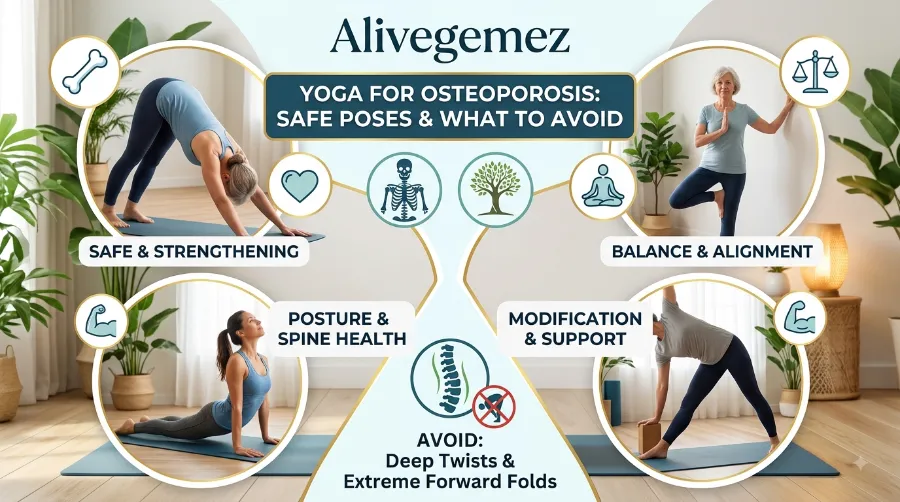
Here is the part most articles skip. Mayo Clinic reviewed the records of 89 people who developed pain from their yoga practice between 2006 and 2018, and the injured group named 12 specific poses as the culprits. According to the study’s senior author, Dr. Mehrsheed Sinaki, yoga improves balance, flexibility, and strength and is a good social activity, but people with osteoporosis or osteopenia need to modify their postures to accommodate their condition. That single sentence is the whole philosophy behind this article. Yoga is not the enemy. The wrong pose, done the wrong way, is.
Yoga for Osteoporosis Safe Poses and What to Avoid
A separate research review looking specifically at yoga and vertebral fractures reached a similar, more technical conclusion. Movements involving spinal flexion can increase the risk of vertebral compression fractures, although a combination of mild spinal flexion with other factors changes that risk profile. So this is not internet fear-mongering. It is published research, and it gives us a very clear map of what to build a safe practice around. Itsyogapuertorico
If you are also dealing with joint pain alongside low bone density, our guide to yoga for arthritis and joint pain relief pairs well with everything below.
The Physics Behind Why Some Poses Hurt Bones
You do not need a physiology degree to understand this, so let me put it simply. A healthy vertebra is shaped like a short, sturdy cylinder, and it handles weight best when that weight comes straight down through it, like a stack of coins. When you bend forward, the front edge of that cylinder gets squeezed. In a strong spine, that squeeze is no big deal. In a spine with osteoporosis, that squeeze can be enough to crack the front of the bone, which is called an anterior wedge fracture.
Yoga for Osteoporosis Safe Poses and What to Avoid
This is why forward folds, not backbends, are usually the bigger concern with osteoporosis. It surprises a lot of people, because forward folds feel gentle and safe. They are gentle on your hamstrings. They are not always gentle on your spine.
Yoga for Gamers Fix Posture, Wrist Pain and Eye Strain
Twisting adds a second kind of stress: rotational force. Combine a twist with a forward bend, which happens in poses like a seated twist done with a rounded back, and you get compression and rotation stacked on top of each other. That combination shows up repeatedly in the case reports of yoga-related spinal injuries.
Yoga Poses to Avoid With Osteoporosis
Let’s name names, because vague warnings do not protect anyone. These are the poses that show up again and again in the yoga osteoporosis avoid conversation among physical therapists and yoga researchers.
Yoga for Seniors: 7 Balance Poses to Prevent Falls
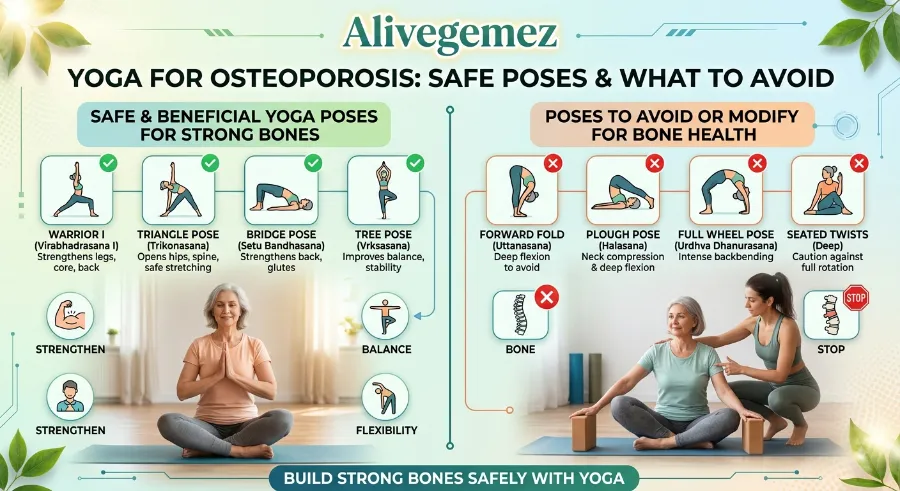
- Plow Pose (Halasana) – Puts your full body weight onto a deeply flexed neck and upper spine. This one shows up on nearly every contraindicated list for osteoporosis.
- Shoulder Stand (Sarvangasana) – Same mechanism as Plow Pose, loaded weight on a flexed cervical spine.
- Deep seated forward folds (Paschimottanasana) – Rounding forward over straight legs compresses the front of the lumbar vertebrae.
- Standing forward folds with a rounded back (Uttanasana) – Especially risky if you drop into it quickly using momentum rather than lowering with control.
- Child’s Pose with deep rounding – Often taught as a “resting” pose, but a heavily rounded spine under any sustained load still counts as loaded flexion.
- Full wheel or deep backbends without guidance – Extreme extension can also stress the spine if your core is not strong enough to support it.
- Forceful, fast twists – Rapid rotation, especially combined with forward bending, is a common trigger for rib and vertebral injuries.
None of this means these poses are evil. It means they are not a good match for a spine with reduced bone density right now. A skilled teacher can often offer modified versions, but if you are practicing at home or in a general class, it is smarter to substitute them entirely.
Yoga Osteoporosis Safe Poses That Actually Build Bone
Now for the good news, because there is real good news here. Standing, weight-bearing poses are where yoga bone density benefits actually come from, and they are also the safest category for a fragile spine.
- Tree Pose (Vrksasana) – Standing on one leg loads the hip and femur exactly the way research suggests helps stimulate bone-building cells. Stand near a wall if balance is a concern.
- Warrior II (Virabhadrasana II) – Loads both legs and the hips through a strong, stable stance with a neutral spine.
- Chair Pose (Utkatasana) – Excellent for hip and thigh bone loading, and it also strengthens the muscles that protect against falls.
- Mountain Pose (Tadasana) – Looks simple, but standing tall with good alignment is a legitimate weight-bearing exercise for the spine and legs.
- Triangle Pose (Trikonasana), done with a straight spine – Side-bending rather than forward-flexing, which keeps compressive force off the front of the vertebrae.
- Gentle backbend, like Cobra with support – Encourages spinal extension, which research links to lower fracture risk compared to flexion.
- Bridge Pose (Setu Bandhasana) – Strengthens the glutes and spine extensors without deep flexion.
These poses share a theme. They ask your muscles to pull against your bones under a held, controlled load, which is exactly the stimulus that appears to trigger bone remodeling.
If limited mobility or a fear of falling is holding you back, you do not need to skip yoga altogether. Our chair yoga poses for limited mobility guide adapts several of these same movements into seated versions that are just as effective for bone loading.
What the Research Actually Shows About Yoga and Bone Density
Here is where I want to slow down, because this is the part most wellness blogs get sloppy with, and accuracy matters when we are talking about your skeleton.
Dr. Loren Fishman, a physiatrist at Columbia University, ran a long-term study starting around 2005 and tracked participants for a full decade. Of the 741 original participants, 227 who practiced a 12-minute daily yoga routine at least every other day showed significant bone density improvements in both the spine and femur. The average participant in that successful group was 78 years old, and 83 percent of them already had osteoporosis or osteopenia when they started, which tells you this was not a study of young, flexible bodies. It was a study of people very much like the person reading this article. HealthCentralHealthCentral
Fishman himself explained the mechanism this way: yoga puts more pressure on bone than gravity does, and by opposing one muscle group against another, it stimulates osteocytes, the bone-making cells. HealthCentral
I want to be fair about the limits of this study too, because overselling research does readers a disservice. Some analyses of the same data point out that the measured bone density change over the roughly two-year DEXA tracking window was small enough that critics question whether it represents true bone rebuilding rather than measurement variation. My honest take, after reading both the original paper and its critics, is this: yoga alone is very unlikely to be a substitute for medication or resistance training if you have diagnosed osteoporosis, but it appears to be a genuinely useful add-on, and the safety data is reassuring. Across roughly 90,000 hours of practice among participants who mostly had low bone density, none experienced a fracture or injury related to the yoga practice. AlgaeCalOsteostrongatx
That safety record only holds because the poses used in the study were deliberately chosen to avoid deep flexion. That is not a coincidence. It is the whole point of this article.
Yoga for Arthritis Safe Gentle Poses for Joint Pain Relief
Bone Density Change Comparison (Fishman Study, Yoga Group vs. Control)
| Measurement Site | Yoga Practice Group | Non-Yoga Control Group |
|---|---|---|
| Spine BMD | Statistically significant improvement | Decline observed |
| Femur BMD | Statistically significant improvement | Decline observed |
| Total Hip BMD | Slight improvement, not statistically significant | Decline observed |
| Reported Fractures Over Study Period | Zero among yoga participants | Not specified in available data |
For deeper reading on the prevention side, Harvard Health has a solid overview of yoga as another way to prevent osteoporosis, and the physical therapy-focused site MelioGuide has a thorough breakdown of yoga and osteoporosis written specifically for a clinical audience. A peer-reviewed literature review on yoga, vertebral fractures, and osteoporosis is also worth bookmarking if you like reading primary sources.
Building a Weekly Yoga Routine for Bone Health
Consistency matters more than intensity here. A short, safe routine done four to six times a week beats an intense hour-long class done once.
- Warm-up (3 minutes): Gentle Mountain Pose, shoulder rolls, and a few slow neck turns.
- Standing sequence (6 minutes): Warrior II, Chair Pose, Triangle Pose with a straight spine, held for 20 to 30 seconds each side.
- Balance work (3 minutes): Tree Pose near a wall, alternating legs.
- Gentle extension (3 minutes): Supported Cobra or a small Bridge Pose lift.
- Cool-down (2 minutes): Seated breathing with the spine tall, not rounded.
That is roughly 15 to 17 minutes, close to the 12-minute window that showed real results in Fishman’s research. If you are newer to movement in general, our yoga beginners over 50 plan is a gentler on-ramp before you add bone-specific poses. If falls or balance are your bigger worry right now, pair this with our yoga for seniors balance and fall prevention guide, since fall prevention is arguably just as important as bone density for avoiding fractures.
For anyone practicing mostly seated or with significant mobility limits, our full chair yoga for seniors at home resource is the pillar guide for adapting everything in this article to a chair-based practice.
A Simple Breathing Practice to Pair With Your Bone-Safe Routine
Stress and poor sleep do not directly weaken bone the way a hard fall does, but chronic stress raises cortisol, and elevated cortisol over time is linked to bone loss. A short breathing practice before or after your yoga session helps with that stress load, and it also calms the nervous system before balance work, which tends to improve stability. Our detailed guide on the 4-7-8 breathing technique explains exactly how to do it and when it helps most, and I recommend trying it as a two-minute close to the routine above.
Yoga for Seniors 7 Balance Poses to Prevent Falls
Common Mistakes People With Osteoporosis Make in Yoga Class
- Following a general class without telling the teacher. Most instructors will happily modify poses on the spot if they know your bone density status.
- Using momentum to drop into forward folds. A slow, controlled hinge is far safer than a quick bend, even in the exact same pose.
- Avoiding all movement out of fear. Immobility is its own risk factor for further bone loss, so the goal is smart movement, not no movement.
- Skipping strength work entirely. Yoga pairs well with resistance training, it should not replace it if your doctor has recommended weight-bearing exercise beyond yoga.
- Practicing balance poses without support nearby. A wall or chair back is not cheating, it is what makes Tree Pose safe for someone managing fracture risk.
Frequently Asked Questions
Is yoga safe if I already have a spinal compression fracture?
Generally yes, once your doctor or physical therapist clears you, but the poses need tighter modification. Deep flexion and twisting are off the table entirely, and standing, weight-bearing poses with a neutral spine become your main tools.
Can yoga alone reverse osteoporosis?
Research suggests yoga can meaningfully support bone density, particularly in the spine and femur, but most clinicians view it as a strong complement to medication and resistance training rather than a replacement for either.
What yoga style is best for bone density?
Hatha and Iyengar styles tend to work well because they emphasize alignment, prop use, and longer holds rather than fast flow, which matches what the bone-loading research suggests is effective.
Are all twisting poses off-limits?
No. Gentle, seated twists done with a tall spine and a small range of motion are usually fine. The concern is forceful, deep twisting, especially combined with a forward bend.
How often should I practice for bone benefits?
The strongest available research used a daily 12-minute routine, but practicing four to six times a week still appears to offer meaningful benefit, and it’s far more sustainable for most people.
Quick Knowledge Check
1. Which type of spinal movement is most linked to compression fractures in people with osteoporosis?
A) Standing tall
B) Spinal flexion (forward bending)
C) Slow walking
2. In Dr. Fishman’s 10-year study, how long was the daily yoga routine?
A) 45 minutes
B) 12 minutes
C) 2 hours
3. Which of these poses is generally considered contraindicated for osteoporosis?
A) Warrior II
B) Plow Pose
C) Mountain Pose
4. What is a safer alternative to a deep forward fold for spinal health?
A) A gentle backbend or standing pose with a neutral spine
B) A faster forward fold
C) Holding the forward fold longer
5. What did Mayo Clinic’s study identify as the most common cause of yoga-related injury in people with low bone density?
A) Weak grip strength
B) Extreme flexing or extending of the spine
C) Practicing in bare feet
Answers: 1-B, 2-B, 3-B, 4-A, 5-B
Conclusion
Osteoporosis changes what a safe yoga practice looks like, but it does not have to end your practice. The research is genuinely encouraging when you use it correctly, standing poses, gentle extension, and supported balance work appear to protect and even support bone density, while deep flexion and forceful twisting are the moves worth skipping. Start small, stay consistent, and if you are working around an existing diagnosis, loop in a teacher or physical therapist who understands bone health specifically. Your spine has carried you this far. With the right poses, yoga can help it keep doing that for a long time to come.
References
- Mayo Clinic News Network. (2019). People with osteoporosis should avoid certain spinal poses in yoga, Mayo Clinic study says.
- Sinaki, M. et al. Yoga, vertebral fractures, and osteoporosis: research and recommendations. PubMed.
- Fishman, L. (2016). Twelve-Minute Daily Yoga Regimen Reverses Osteoporotic Bone Loss. Topics in Geriatric Rehabilitation.
- Harvard Health Publishing. Yoga: Another way to prevent osteoporosis.
- MelioGuide. Yoga and Osteoporosis.
- National Institutes of Health, PMC. Yoga, vertebral fractures, and osteoporosis: research and recommendations.