
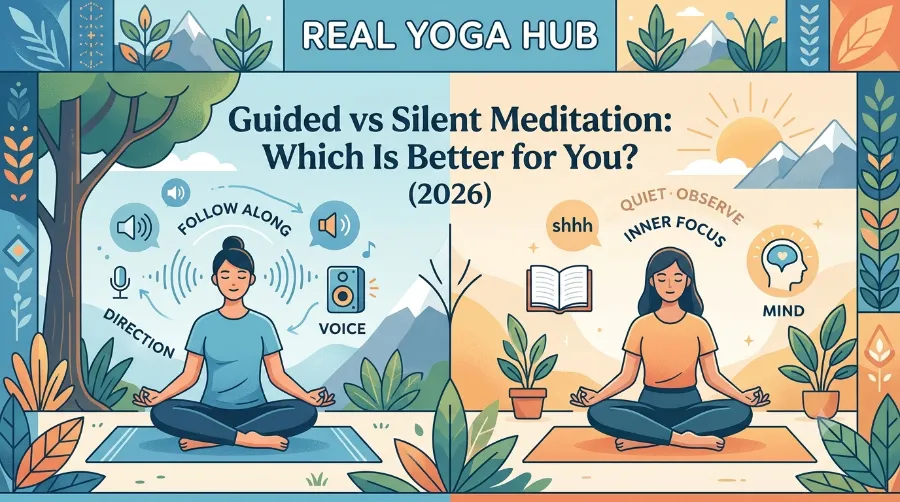
guided vs silent meditation You sit down to meditate. Then the question hits before your breath even settles: should you press play on a guided vs silent meditation session, or just close your eyes and sit in nothing? I get asked this almost every week by students in my classes and readers here at RealYogaHub. There is no single right answer, but there is a right answer for you, and by the end of this guide you will know exactly which one that is.
To get a better understanding of How Long Should You Meditate Every Day our guide breaks down exactly what to expect.
Key takeaways
| What you want to know | Quick answer |
|---|---|
| Best for beginners | Guided meditation, because it gives structure and reduces overwhelm |
| Best for deep focus and long-term growth | Silent sitting meditation, once you have some experience |
| Best for anxiety or racing thoughts | Guided meditation, since a voice keeps your attention anchored |
| Best for self-awareness and inner stillness | Silent meditation, because there is nothing between you and your mind |
| Most common choice among real practitioners in 2026 | Silent, unguided practice, now the most popular method overall |
| Ideal long-term approach | A blend of both, adjusted to your mood, energy, and goals each day |
What guided meditation actually is
Guided meditation means a teacher, or increasingly an app voice, walks you through the entire practice step by step. You are told when to breathe, where to place your attention, and how to handle a wandering mind. Think of it as having a personal trainer for your brain instead of figuring out the workout alone.
This style became the default entry point for millions of people over the last decade, and for good reason. A narrated voice removes the guesswork. You are not sitting there wondering if you are doing it right, because someone is telling you exactly what to do next.
If you are brand new to any of this, I always send my students to our meditation techniques for beginners guide first. It breaks down the basics before you ever have to choose between styles.
Types meditation compared: where guided fits in
When we line up the types meditation compared side by side, guided meditation usually falls into one of these categories.
- Body scan sessions, where a voice moves your attention slowly from your toes to your scalp
- Visualization journeys, often used for stress relief or better sleep
- Loving-kindness practice, where you are guided to send goodwill to yourself and others
- Breath-focused sessions, where counting or pacing is spoken aloud
Our detailed body scan meditation steps walk through one of the most researched guided formats, and it is a great place to start if you tend to hold tension in your body without realizing it.
Piedmont Healthcare notes that both formats offer genuine mental health benefits, and the better option often comes down to personal preference and what a person is realistically able to stick with long term, which matches exactly what I see in my own students year after year. Similarly, the practice comparison from The Mindful Counselor points out that the best method is the one that actually gets used consistently, not the one that sounds more advanced on paper. Zenify reaches a similar conclusion in its own comparison, that fit and consistency matter more than tradition.
In “Guided benefits” section, replace the AI paragraph with:
There is also a growing body of research on AI-narrated sessions. A 2026 study covered by the American Psychological Association found people rated meditation exercises noticeably higher when they believed a human, not an algorithm, created them, so the human touch in guided meditation still matters to how effective it feels, even as AI-powered apps continue to expand access.
If you want to learn more about Mantra Meditation Beginners Guide check out our detailed guide for practical tips and expert advice
What silent meditation actually is
guided vs silent meditation Silent sitting meditation, sometimes called unguided meditation, is exactly what it sounds like. You set a timer, you pick a technique such as breath awareness or mantra repetition, and then you sit with nothing but your own mind for company. If you enjoyed working with a mantra, our loving kindness meditation guide uses a similar repetition style, but directs each phrase toward warmth and compassion instead.
There is no narration, no music, no cues. Just you, your breath, and whatever thoughts show up. Traditional Buddhist and yogic lineages have used this format for thousands of years, and many long-term practitioners consider it the gold standard because it builds a direct, unfiltered relationship with your own awareness.
That said, silent practice is not automatically harder or more advanced. Beginners can absolutely start here too, especially with short sessions and a simple anchor like the breath.
Want to learn more about Somatic Breathing Exercises for Stress and Trauma Recovery read our latest blog post
The 2026 numbers: what people are actually choosing
guided vs silent meditation Data helps cut through the noise, so I want to show you what real practitioners are doing right now rather than relying on old assumptions.
A 2026 practice survey from Mindful Leader found that silence has become the dominant method, chosen by fifty-nine percent of respondents, edging out guided formats as the most common approach among committed meditators. Nearly two thirds of these practitioners meditate daily, morning practice is the clear anchor of the day, and the vast majority practice alone rather than in groups. Breath awareness remains close to universal, and open awareness style practice has climbed to become the second most common approach, a real shift compared to prior years.
The chart above shows how these three practice styles stack up among today’s practitioners. Notice that breath awareness sits at the top of nearly every approach, whether the session is guided or silent, because it is the anchor most teachers build everything else around.
On a broader population level, a National Health Interview Survey analysis covering two decades of United States data found meditation use overall reached roughly 18 percent of adults by 2022, translating to about 60 million Americans, with steady growth across the full twenty year period. That is not a niche habit anymore. It is mainstream health behavior, similar to how people now treat exercise or sleep tracking.
Interestingly, the biggest barrier reported by practitioners in 2026 shifted. Too many distractions overtook not enough time as the top obstacle to consistent practice, a reversal from the year before. That single data point tells you something important: the problem for most people is not finding twenty minutes, it is finding twenty minutes of actual quiet attention. Which, as you will see below, matters a lot when choosing between guided and silent formats.
Guided benefits: why so many people start here and stay
Let me be direct with you, because I do not believe in vague spiritual promises. Guided benefits are real, measurable, and backed by how the brain actually learns new skills.
- Lower barrier to entry. You do not need to know any technique in advance. The voice tells you what to do, so anxiety about doing it wrong disappears.
- Built-in accountability. A twenty minute audio session naturally keeps you in your seat longer than silence does, especially in the first few months.
- Structured stress relief. Sessions built around a specific theme, such as sleep, panic, or grief, meet you exactly where you are emotionally.
- Community and consistency. Apps and instructors provide daily reminders and gentle nudges, which recent survey data shows is one of the most requested forms of support among practitioners, right behind community connection.
- Faster relaxation response. Because your attention is directed rather than wandering, many beginners drop into a calmer state within minutes rather than sitting in frustration.
If sleep is your main goal, our Yoga Nidra sleep technique guide for beginners is one of the most guided-heavy formats we teach, and readers consistently tell me it is the fastest way to fall asleep without medication.
There is also a growing body of research on AI-narrated sessions. Some meditation apps now report their AI companions handling millions of conversations a year, showing just how far guided technology has scaled. Yet recent research found people rated meditation exercises noticeably higher when they believed a human, not an algorithm, created them, so the human touch in guided meditation still matters to how effective it feels.
Silent sitting meditation: the deeper end of the pool
Silent sitting meditation asks more of you upfront, but many long-term practitioners say it gives more back over time. Here is what makes it different.
- No external dependency. You can meditate anywhere, anytime, without headphones, an app, or a Wi-Fi signal.
- Direct self-observation. Without a voice directing your attention, you notice your own mental patterns far more clearly, including habits you did not know you had.
- Deeper stillness over time. Long-term silent practitioners often report a quality of quiet that guided sessions rarely reach, simply because there is no narration filling the space.
- Builds independent skill. Silence trains your own attention muscle directly, rather than borrowing someone else’s structure every time.
The tradeoff is real too. Silence can feel uncomfortable at first, especially if your mind is loud or your life is stressful. That discomfort is not a sign you are failing. It is simply what an untrained mind sounds like when nothing is distracting it.
If you want a gentler bridge into silence, try our box breathing technique, which gives your mind one simple, silent task to hold onto without requiring a narrator.
Guided vs silent meditation: the honest side-by-side comparison
| Factor | Guided meditation | Silent meditation |
|---|---|---|
| Best for | Beginners, high stress, sleep issues | Experienced practitioners, self-inquiry |
| Structure | High, voice leads every step | Low, you set your own anchor |
| Equipment needed | App, headphones, or teacher | None, just a timer |
| Learning curve | Gentle | Steeper at first |
| Depth of self-awareness | Moderate | High over time |
| Popularity in 2026 | Common entry point | Most common among daily practitioners, close to sixty percent |
| Risk of over-reliance | Can create dependency on external voice | Very low |
| Session length people choose | Often shorter, five to ten minutes | Slightly longer, ten to twenty minutes is most common |
Who should choose guided meditation right now
You are probably a better fit for guided sessions if any of this sounds like you.
- You are new to meditation and silence feels intimidating rather than calming
- You struggle with anxiety, panic, or racing thoughts that need an anchor
- You want help falling asleep, and a soothing voice genuinely helps you drift off
- You have tried sitting in silence before and gave up within a week
There is zero shame in this. Even monks with decades of practice use guided formats for specific goals like grief processing or trauma-sensitive work. Structure is not a crutch, it is a tool.
Who should choose silent sitting meditation right now
Silent practice tends to fit better if you recognize yourself here.
- You have practiced consistently for at least a few months and crave more depth
- You want to build genuine independence from apps and external cues
- You are working through a specific emotional pattern and need unfiltered space to observe it
- You already have a reliable anchor, such as breath or a mantra, and trust yourself to use it
A simple entry point many of my readers use is our five minute morning meditation routine for beginners, which starts light and gently nudges you toward more silence as your confidence grows.
The smartest approach: stop choosing sides
Here is what twelve years of teaching has taught me. The guided vs silent meditation debate is a false choice for most people. Your nervous system does not care about labels, it cares about consistency and fit.
A pattern I recommend to almost every student:
- Start your week with two or three guided sessions if you are stressed, sleep-deprived, or emotionally raw
- Add one or two short silent sits once your mind feels slightly more settled
- Let your mood decide day to day rather than forcing a rigid rule
- Track how you feel afterward, not how correctly you think you practiced
Piedmont Healthcare notes that both formats offer genuine mental health benefits, and the better option often comes down to personal preference and what a person is realistically able to stick with long term, which matches exactly what I see in my own students year after year. Similarly, the practice comparison from The Mindful Counselor points out that the best method is the one that actually gets used consistently, not the one that sounds more advanced on paper. Zenify has covered this same ground and reaches a similar conclusion, that fit matters more than tradition.
Common mistakes people make with both styles
- Jumping straight into thirty minutes of silence with zero experience, then quitting after one uncomfortable session
- Relying on guided sessions forever without ever testing your own independent focus
- Judging a session as a failure because thoughts appeared, when thoughts appearing is simply what minds do
- Meditating only when already highly stressed, instead of building a steady baseline habit
Frequently asked questions
Is guided or silent meditation better for anxiety?
Guided meditation is usually gentler for anxiety at first, because the voice gives your mind something concrete to hold onto instead of spiraling. As anxiety eases with practice, many people naturally shift toward some silent sitting too.
Can silent meditation cause more anxiety in beginners?
It can, briefly. Without a voice directing attention, some beginners notice their thoughts more intensely at first. This usually settles within a few weeks of consistent short sessions.
How long should a beginner meditate, guided or silent?
Most practitioners today favor sessions between ten and twenty minutes, though even five minutes daily builds real momentum if you are just starting out.
Do apps make guided meditation less authentic?
Not necessarily, though research shows people tend to rate sessions higher when they believe a human created them rather than an algorithm, so the human element still carries real weight.
Can I switch between guided and silent meditation on the same day?
Yes, and many experienced practitioners do exactly this, using guided sessions for specific emotional needs and silent sits for open, spacious practice.
Quick quiz: which style fits you right now
1. When you sit down to meditate, your mind usually feels:
A) Loud and hard to settle
B) Fairly calm already
C) Completely unpredictable, it depends on the day
2. How long have you been meditating consistently?
A) Less than one month
B) Six months or more
C) On and off for years
3. What is your main goal right now?
A) Falling asleep or calming anxiety
B) Building deeper self-awareness
C) Just staying consistent, whatever that takes
4. How do you feel about silence in general?
A) It makes me uncomfortable
B) I find it grounding
C) It depends entirely on my mood
5. Which sounds more appealing today?
A) A calm voice guiding me through each step
B) Sitting quietly with just my breath
C) A mix of both, whatever fits the moment
Answer key: Mostly A’s mean guided meditation is your best starting point right now. Mostly B’s mean you are ready for more silent sitting practice. Mostly C’s mean a flexible blend of both, adjusted daily, will serve you best.
Conclusion
Guided vs silent meditation is not really a competition, it is a question of timing, mood, and where you are in your own practice. Guided sessions meet you with structure when your mind is loud or your life is heavy. Silent sitting meets you with space when you are ready to go deeper on your own. The practitioners who stick with meditation long term rarely pick one side forever, they simply learn to reach for whichever one their nervous system needs that day. Start wherever feels honest right now, stay consistent, and let your practice evolve naturally from there.
References
- Mindful Leader, 2026 Meditation Practice Report guided vs silent meditation
- National Health Interview Survey analysis, Prevalence and 20-year trends in meditation, yoga, guided imagery and progressive relaxation use among US adults from 2002 to 2022, PMC guided vs silent meditation
- Piedmont Healthcare, Guided vs Silent Meditation guided vs silent meditation
- getstillmind.com, Meditation Statistics 2026 guided vs silent meditation
- The Mindful Counselor, Guided vs Silent Meditation guided vs silent meditation
- Zenify World, Guided vs Silent Meditation: Which Practice Is Best for You guided vs silent meditation