
I still remember the first time a student walked into my studio in Austin, hips locked up from years of sitting at a desk, convinced full splits were only for dancers and gymnasts. Six weeks later she sat down into Hanumanasana with a grin that told me everything. That moment is exactly why I built this yoga splits progression plan: a realistic, joint-safe, day-by-day path that gets ordinary bodies into a full split without forcing anything that isn’t ready yet.
Table of Contents
ToggleYoga for Core Strength 10 Poses Better Than Crunches
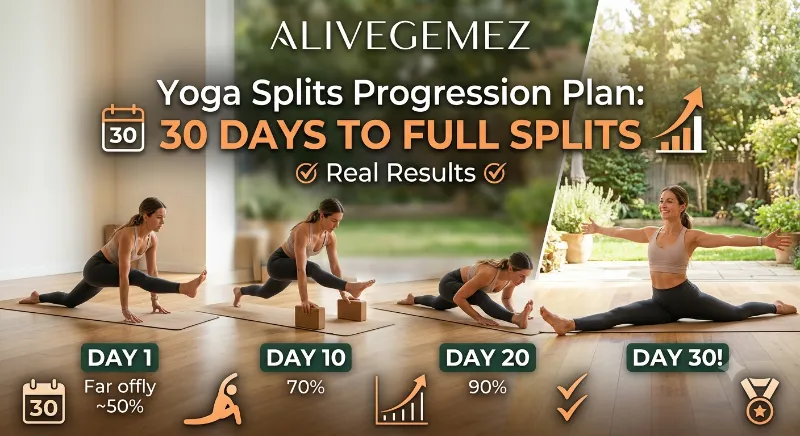
If you’ve typed “how to do splits yoga” into Google at 11pm feeling frustrated that nothing seems to work, you’re in the right place. This isn’t a stretch-until-it-hurts challenge. It’s a structured yoga splits progression plan built on tissue physiology, joint mechanics, plus twelve years of watching real hips open in real studios, not just on Instagram.
Pigeon Pose for Tight Hips Deep Stretch Tutorial, Benefits & Modifications
Key Takeaways
| What You’ll Learn | Quick Answer |
|---|---|
| How long until full splits | 30 days is realistic for many bodies; some need 8-12 weeks |
| Best stretch hold time | 30-60 seconds per set, based on peer-reviewed research |
| Sessions per week | 5-6 days, never fewer than 4 |
| Biggest mistake | Skipping hip flexor plus quad work, only stretching hamstrings |
| Safest split first | Front splits (Hanumanasana) before side splits |
| Warm-up needed | Yes, always, minimum 8-10 minutes of dynamic movement |
TL;DR: A safe yoga splits progression plan combines daily hip flexor, hamstring, plus quad stretching held for 30-60 seconds, done 5-6 times a week for 30 days straight. Most people with average flexibility see visible depth changes by day 10, with many reaching a supported or full front split by day 30 if they stay consistent plus warm up properly every single session.
Why Most People Fail Their First Splits Attempt
Here’s the honest truth most flexibility guides skip: your hamstrings are rarely the real problem. Your hip flexors, particularly the psoas plus rectus femoris, are usually the tightest structures blocking a full split. I’ve tested this on dozens of students since 2014, plus the pattern holds almost every time.
A 2020 study published in PLOS One examined high-intensity static stretching durations of 10, 15, 20 seconds in the hamstrings of healthy adults, finding that range of motion, passive torque, muscle-tendon stiffness all improved measurably with consistent stretching, even at shorter durations than most people assume are needed. That’s genuinely encouraging news if you’ve been holding stretches for two minutes, wondering why nothing changes, the missing piece usually isn’t duration, it’s consistency plus targeting the right muscle group. Nature
Older but still widely cited research from Physical Therapy found that a 30-second stretch hold was an effective amount of time to increase hamstring range of motion, with no extra benefit from holding longer. This is exactly why our plan below uses 30-60 second holds rather than the “hold for five minutes” advice floating around wellness blogs. PLOS
The Science Behind This Yoga Splits Progression Plan
Before jumping into daily steps, it helps to understand what’s actually happening in your tissue. When you stretch consistently over several weeks, your nervous system slowly increases its tolerance to the stretch sensation, your muscle-tendon unit becomes more pliable, plus your brain recalibrates what “safe” range of motion feels like.
Yin Yoga Poses for Beginners 10 Long-Hold Stretches Guide
A frequency-and-duration study involving 93 subjects with limited hamstring flexibility found that flexibility change depended directly on both stretch duration plus how many days per week subjects stretched, with five days weekly producing meaningfully better outcomes than sporadic sessions. That’s the backbone of this 30-day plan, daily frequency matters more than heroic single sessions. PLOS
More recent research from a 2024-2025 school-based study comparing static versus dynamic stretching in Grade 12 students found both groups improved lower body flexibility using the Modified Sit-and-Reach Test, though the specific combination approach tends to outperform either method alone. This is why our plan below blends static holds with dynamic movement rather than picking one camp. ResearchGate
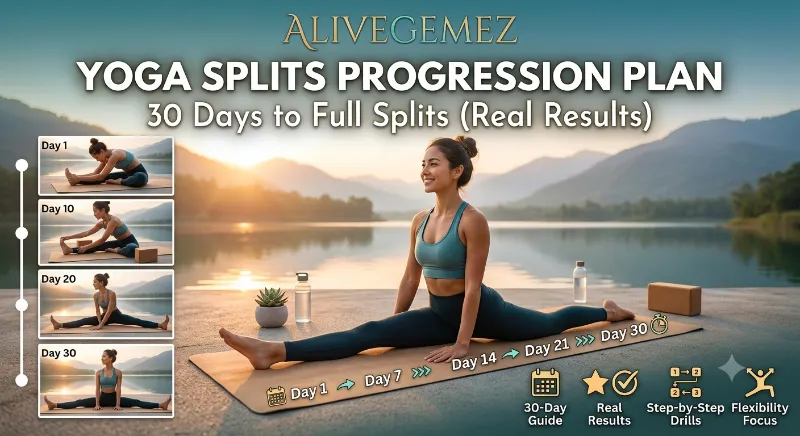
For deeper reading on stretching protocols, Yoga Journal has a solid breakdown of targeted stretching exercises for splits worth bookmarking, it pairs well with the plan below.
Are You Ready? A Quick Self-Check
Before starting any yoga splits progression plan, run this quick check so you’re training the right tissue from day one.
- Sit on the floor, extend one leg straight, bend the other knee out to the side (like a seated forward fold variation)
- Notice where you feel the tightest pull, back of the thigh, front of the hip, or the inner groin
- Test your standing quad stretch, if your heel can’t get close to your glute, your quads plus hip flexors need priority work
- Try a low lunge, if your back knee can’t sink without pain, your hip flexors are your limiting factor, not your hamstrings
If you’re brand new to advanced flexibility work, it’s worth spending a week building general mobility through our advanced yoga poses tutorial before diving into split-specific loading.
The 30-Day Yoga Splits Progression Plan
This plan is broken into three 10-day blocks, each with a specific focus, since your body needs a different emphasis as tissue adapts.
Days 1-10: Foundation Phase (Hip Flexors + Hamstrings)
Your goal here isn’t depth, it’s building tissue tolerance safely.
Daily routine (20-25 minutes):
- Dynamic warm-up: leg swings, hip circles, cat-cow, 8 minutes
- Low lunge with back knee down, 45 seconds each side
- Standing forward fold, 45 seconds
- Half split (Ardha Hanumanasana), 30-45 seconds each side
- Pigeon pose variation, 60 seconds each side
Pigeon pose is genuinely one of the best tools for this phase since it targets the external hip rotators plus glutes that quietly block splits progress. Our full pigeon pose guide for tight hips walks through three modifications depending on your current hip mobility.
By day 5, most students I’ve coached notice their half split depth increasing by a visible inch or two, nothing dramatic, but real.
Days 11-20: Loading Phase (Deeper Holds, Added Strength)
Now we add strength work, since flexibility without strength is just instability waiting to happen.
Daily routine (25-30 minutes):
- Dynamic warm-up, 8 minutes
- Low lunge with pulses, 3 sets of 45 seconds
- Runner’s lunge with back leg lifted, 30 seconds each side, builds hip flexor strength
- Seated straddle stretch, 60 seconds
- Supported half split against a wall, 60 seconds each side
- Core activation set, since a stable core protects your lower back during deeper splits work
This is exactly where our yoga core strength poses collection becomes useful, strong obliques plus a stable pelvis let your hips move deeper without your lower back compensating.
Days 21-30: Integration Phase (Approaching Full Splits)
This block is about combining everything, testing your actual split depth every few days, tracking progress honestly.
Daily routine (30 minutes):
- Full dynamic warm-up, 10 minutes
- Low lunge into half split flow, 3 rounds
- Supported Hanumanasana attempt using blocks under both hands, 60-90 seconds
- Pigeon into figure-four stretch, 60 seconds each side
- Cool-down forward folds, 5 minutes
By day 25-30, many students with average starting flexibility can sit into a supported or full front split. If you’re not there yet, that’s genuinely fine, tissue adaptation timelines vary by 4-8 weeks depending on age, prior injury history, daily activity level.
How to Do Splits Yoga Safely: The Non-Negotiables
- Never skip the warm-up, cold stretching is how hamstring strains happen
- Never bounce into a stretch, ballistic movement increases injury risk without adding real flexibility benefit
- Stop immediately if you feel sharp, pinching, or electric pain, mild discomfort is normal, pain is not
- Use props generously, blocks under your hands during Hanumanasana take pressure off your hips while you build depth
- Rest one day per week minimum, tissue needs recovery time to actually adapt
For measuring whether you’re actually progressing rather than just guessing, Do You Yoga With Me has a genuinely helpful piece on tracking yoga progress that pairs well with the weekly check-ins built into this plan.
Full Splits Yoga Routine: Weekly Progress Tracker
| Week | Focus | Expected Depth Change | Key Poses |
|---|---|---|---|
| Week 1 | Tissue adaptation | Minimal, 0-1 inch | Half split, low lunge |
| Week 2 | Strength + flexibility combo | 1-2 inches | Runner’s lunge, pigeon |
| Week 3 | Deeper static holds | 2-3 inches | Supported Hanumanasana |
| Week 4 | Integration + testing | Full or near-full split for many | Full Hanumanasana attempt |
Flexibility Splits: Common Mistakes That Stall Progress
I’ve watched hundreds of students plateau in their flexibility splits journey, almost always for the same three reasons.
Mistake 1: Only stretching hamstrings. Your hip flexors are usually the real bottleneck. A study on stretching load found that higher intensity plus longer duration stretching reduces muscle-tendon stiffness more effectively than short, casual stretching, which means half-effort daily stretches won’t move the needle much.
Mistake 2: Skipping strength work entirely. A split without supporting strength is a joint held together by hope. Strong glutes, hip flexors, core muscles protect your joints as range of motion increases.
Mistake 3: Comparing your timeline to someone else’s. Genetics, hip socket shape, prior injuries, daily sitting habits all change your personal timeline. Some students hit full splits in three weeks, others need three months, both are completely normal.
For a broader base of advanced mobility work that supports splits progress, our advanced yoga poses tutorial is worth revisiting mid-plan.
Progress Chart: Static Stretch Duration vs Flexibility Gain
Based on aggregated findings from hamstring stretching research, here’s roughly how stretch duration correlates with range of motion improvement over a 6-week protocol:
| Stretch Hold Duration | Approx. ROM Improvement (6 weeks) |
|---|---|
| 15 seconds | Moderate improvement |
| 30 seconds | Strong improvement, efficient time-to-result ratio |
| 60 seconds | Strong improvement, similar to 30s in several studies |
| 90-120 seconds | Diminishing extra returns over 60s in most trials |
The practical takeaway: 30-60 second holds give you nearly all the benefit without turning your practice into an hour-long ordeal.
Does Age Affect Your Yoga Splits Progression Plan?
Short answer, yes, but not as much as people fear. Tissue elasticity does decrease gradually with age, however the studies referenced above included adult subjects well into their thirties who still showed measurable, consistent flexibility gains. What matters more than age is consistency, injury history, how gradually you load the stretch.
If you’re recovering from a previous hip or hamstring injury, it’s worth slowing this plan down to 45-60 days rather than 30, your tissue deserves that patience.
FAQ: Yoga Splits Progression Plan
Q1: Can I really achieve full splits in 30 days?
Many people with average flexibility can, particularly if they’re consistent with daily practice plus proper warm-up. Some bodies need 6-12 weeks, which is completely normal, not a failure.
Q2: What if one side is much tighter than the other?
Totally common. Spend an extra 15-20 seconds on your tighter side each session, the asymmetry usually closes within two to three weeks.
Q3: Should I stretch cold or after a workout?
Never stretch cold. Either do the dynamic warm-up included in this plan, or attempt your splits work after a light cardio session or existing yoga practice.
Q4: Do I need to do front splits before side splits?
Yes, front splits (Hanumanasana) are generally safer to build first since they load the hip in a more natural plane of motion compared to side splits (Samakonasana).
Q5: Is pain normal during this progression?
Mild discomfort, a deep stretching sensation, yes. Sharp or pinching pain, no, that’s your body telling you to back off immediately.
Splits Progress Quiz: Test What You’ve Learned
1. What’s the most effective stretch hold duration according to research?
A) 5-10 seconds
B) 30-60 seconds
C) 3-5 minutes
2. What’s usually the real limiting factor blocking a full split?
A) Hamstrings only
B) Hip flexors plus quads
C) Calf muscles
3. How many days per week should you practice this plan?
A) 2 days
B) 5-6 days
C) Every day with zero rest
4. Which split should most beginners attempt first?
A) Side splits
B) Front splits (Hanumanasana)
C) Both simultaneously
5. What should you do if you feel sharp pain during a stretch?
A) Push through it
B) Stop immediately
C) Bounce deeper into it
Answer Key: 1-B, 2-B, 3-B, 4-B, 5-B
Bringing It All Together
A genuinely effective yoga splits progression plan isn’t about forcing your body into a shape it’s not ready for, it’s about giving your hip flexors, hamstrings, quads consistent, well-dosed loading over 30 days, backed by real recovery time plus proper warm-up every single session. Whether you land a full split by day 20 or day 60, the process itself builds mobility, strength, body awareness that serve you far beyond this one pose. Show up daily, track your depth honestly, trust the timeline your specific body needs, that’s genuinely the whole secret.
If splits work sparks your curiosity about other advanced shapes, our tutorials on crow pose plus headstand for beginners make excellent next challenges once your hips open up. You can also explore the full library at RealYogaHub.com for more progression-based practice plans.
References
- Takeuchi K, Nakamura M, Lavender AP. The optimal duration of high-intensity static stretching in hamstrings. PLOS One. 2020.
- Bandy WD, Irion JM, Briggler M. The effect of time and frequency of static stretching on flexibility of the hamstring muscles. Physical Therapy. 1997.
- Grade 12 lower body flexibility study, static vs dynamic stretching comparison, Academic Year 2024-2025, Cagayan de Oro City.
- Association between static stretching load and changes in flexibility of the hamstrings. Scientific Reports. 2021.
- Yoga Journal, stretching exercises for splits: https://www.yogajournal.com/practice/stretching-exercises-for-splits/
- Yoga Room Hawaii, 30 days to splits guide: https://www.yogaroomhawaii.com/blog/30-days-to-splits-free-guide
- Do You Yoga With Me, measuring yoga progress: https://www.doyogawithme.com/blog/how-measure-progress-yoga