
Your lungs do more work in twenty minutes of sitting than you’d think. Most of us breathe shallow, high in the chest, barely using half our lung capacity. Kapalabhati flips that pattern on its head. It’s a short, sharp, rhythmic breathing practice that yoga teachers call “skull shining breath” or “breath of fire,” and it has one of the strongest research bases of any pranayama technique out there.
Bhramari Pranayama (Humming Bee Breath): Benefits and Steps
I’ve taught this practice to beginners, athletes, and people managing chronic stress for over a decade, and it’s rarely love at first try. It feels strange, even a little intense, the first few rounds. Give it a fair week of practice though, and most people notice sharper focus and calmer mornings.
Kapalabhati Breathing: Benefits, Steps and Contraindications
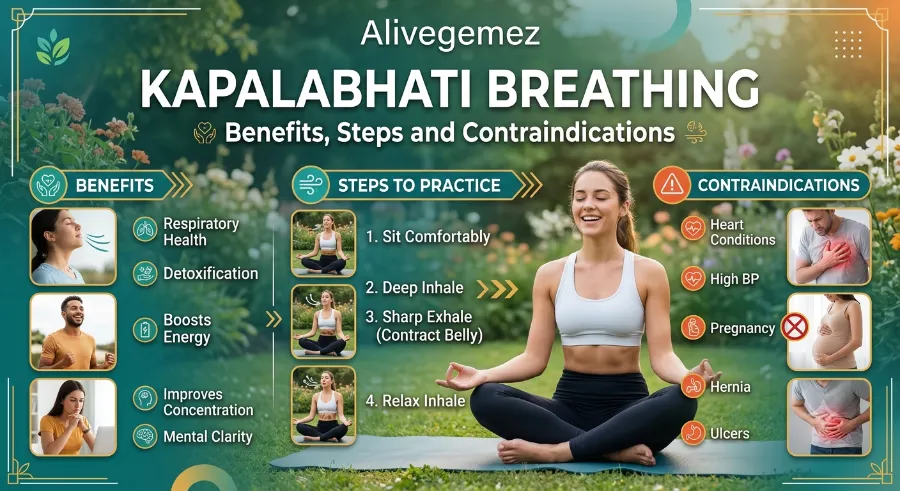
This guide covers exactly what kapalabhati is, the research behind kapalabhati breathing benefits and steps, who should skip it, and how to build it into a daily pranayama routine safely.
Ujjayi Breath in Yoga: What It Is and How to Practice It
Key Takeaways
| Topic | What You Need to Know |
|---|---|
| What it is | Rapid, forceful exhales through the nose, passive inhales, powered by the lower belly |
| Best time | Morning, empty stomach, seated upright |
| Typical session | 3 rounds of 20-30 pumps, building up over weeks |
| Backed benefits | Better lung function, sharper focus, lower stress reactivity |
| Skip it if | Pregnant, high or low blood pressure, hernia, epilepsy, recent surgery, heart disease |
| Learning curve | Best learned in person or with slow video guidance first |
TL;DR: Kapalabhati is a fast belly-pumping breath technique that strengthens the diaphragm, clears the sinuses, and calms the nervous system when practiced correctly. Research from 2024-2026 links it to better lung function, reduced anxiety, and sharper attention, but it isn’t for everyone. Pregnant women, people with high or low blood pressure, hernias, epilepsy, or heart conditions should avoid it or check with a doctor first.
Transcendental Meditation vs Mindfulness: Key Differences 2026
What Is Kapalabhati Pranayama, Really
Kapalabhati comes from two Sanskrit words: kapala, meaning skull, and bhati, meaning shining or illuminating. Traditional yoga texts describe it as a practice that clears the mind, so the name isn’t just poetic branding.
Physically, it works like this: you exhale sharply through the nose by pulling your navel in toward your spine, then you let the inhale happen on its own, no effort involved. One exhale-inhale pair counts as one round. A typical practice session runs three sets of 20 to 30 rounds, with rest in between.
Wim Hof Breathing vs Pranayama: What Is the Difference?
This is different from the slower belly breathing most beginners learn first. It’s also different from bhastrika, or bellows breath, which uses forceful breathing on both the inhale and the exhale. If you’ve read our pranayama types and benefits guide, you already know pranayama covers a wide spectrum from slow, calming breaths to fast, activating ones. Kapalabhati sits firmly on the activating end.
Kapalabhati Breathing Benefits, According to Research
Here’s where kapalabhati pranayama stands apart from a lot of wellness trends: the research on it is genuinely solid, not just anecdotal.
Lung Capacity and Respiratory Strength
A study published in the Indian Journal of Integrative Medicine in early 2024 tracked healthy young adults through six weeks of kapalabhati training and found a statistically significant rise in peak expiratory flow rate, a key marker of lung function. Separate research on university-age women found measurable gains in tidal volume, vital capacity, and inspiratory capacity after just four weeks of daily practice.
In plain terms, that means your lungs move more air per breath, and your diaphragm gets stronger doing it.
Focus and Working Memory
A frequently cited study measured 61 participants during an 18-minute kapalabhati session and found reduced anxiety scores alongside improved attention on a letter-cancellation task. More recent 2024 research published in the International Journal of Yoga looked specifically at how changing breath frequency, including kapalabhati-style rapid breathing, affects mood and attention states, with encouraging results for working memory.
Nervous System and Cortisol
Several researchers have measured kapalabhati’s effect on the autonomic nervous system, the part of you that runs fight-or-flight versus rest-and-digest. The practice appears to shift the balance between sympathetic and parasympathetic activity, and some findings point to lower cortisol output with consistent practice. A 2026 systematic review in a peer-reviewed yoga journal described measurable shifts in brainwave activity too, with a drop in slower delta and theta waves and a rise in gamma and beta activity after a kapalabhati session, patterns generally associated with alertness.
A Practical Note From the Mat
In my own teaching, the fastest wins I see aren’t physiological, they’re behavioral. Students who add three rounds of kapalabhati to their morning routine report skipping the second coffee less often within two to three weeks. That’s not a controlled trial, just a consistent pattern across hundreds of students, and it lines up neatly with what the alertness research above suggests.
Kapalabhati Pranayama Guide: Step-by-Step
Before starting, make sure your stomach is empty, ideally first thing in the morning or at least three hours after eating. If you’re brand new to breathwork, spend a week or two practicing simple diaphragmatic breathing first, the kind covered in our beginner’s pranayama guide, before attempting kapalabhati.
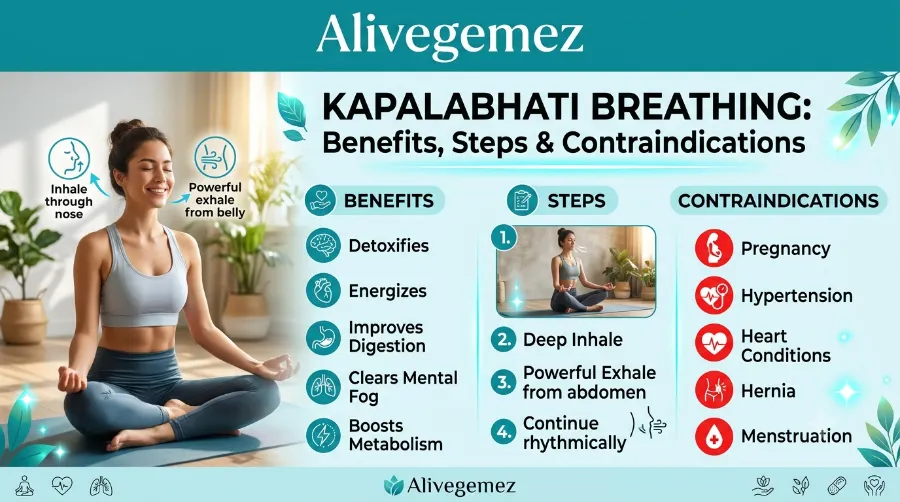
- Sit tall. Cross-legged on the floor or upright in a chair, spine straight, shoulders relaxed, hands resting on your knees.
- Take one slow, full inhale. Fill your lungs completely through the nose.
- Exhale sharply. Pull your navel firmly toward your spine, pushing air out through the nose in one quick burst.
- Let the inhale happen by itself. Release the belly and let air flow back in naturally, no pulling or forcing.
- Repeat the exhale-inhale cycle at a steady, comfortable pace, aiming for roughly one round per second once you’re warmed up.
- Start with 20 rounds, rest for 15 to 20 seconds breathing normally, then repeat for two more sets.
- Finish with stillness. After your final round, sit quietly for a minute or two and notice how your body feels before moving on with your day.
New practitioners often do best starting with 10 to 15 rounds per set and building up gradually over two to three weeks rather than pushing for speed on day one.
Kapalabhati Research Snapshot (2024-2026)
| Study Focus | Sample | Key Finding | Year |
|---|---|---|---|
| Peak expiratory flow rate | Healthy young adults | Significant rise after 6 weeks | 2024 |
| Respiratory volumes | 50 university-age women | Gains in tidal volume, vital capacity | 4-week trial |
| Working memory and mood | Adults, crossover design | Improved attention and mood states | 2024 |
| Gamma oscillation states | Healthy adults | Shifted brainwave activity toward alertness | 2024 |
| Cardio-respiratory parameters | Young healthy volunteers | Improved cardio-respiratory markers over 12 weeks | Ongoing research area |
Skull Shining Breath: Contraindications You Shouldn’t Skip
This is the part of any breath of fire yoga guide that gets rushed past too often, and it shouldn’t be. Kapalabhati raises intra-abdominal and intrathoracic pressure quickly, which is exactly why it’s powerful, and exactly why it isn’t safe for everyone.
Avoid kapalabhati entirely if you have:
- Pregnancy, at any stage
- High or low blood pressure
- Heart disease, arrhythmia, or a history of stroke
- Hernia, gastric ulcer, or recent abdominal surgery
- Epilepsy or a seizure disorder
- Glaucoma or detached retina
- Active vertigo, migraine, or frequent nosebleeds
Practice only with caution and medical guidance if you have:
- Asthma or COPD, since the technique can occasionally trigger bronchospasm if rushed
- Anxiety or panic disorder, since fast breathing can sometimes mimic panic sensations
- A pacemaker or cardiac stents
If dizziness shows up mid-practice, stop immediately and return to slow, quiet breathing. That’s your body telling you the pace was too aggressive, not a sign to push through. According to a detailed technical breakdown from The Yoga Institute’s kapalabhati resource, and echoed in physiotherapy literature from UPG Studio, this is an intermediate-to-advanced technique best learned progressively rather than rushed into on day one.
If your goal is a gentler nervous-system reset before bed rather than an energizing morning practice, our 4-7-8 breathing technique guide is the better fit, since it works in the opposite direction, slowing things down instead of speeding them up.
Frequently Asked Questions
Is kapalabhati safe to do every day?
For healthy adults without any of the contraindications above, yes, a daily 5 to 10 minute practice is generally considered safe and is how most yoga traditions teach it.
What’s the difference between kapalabhati and bhastrika?
Kapalabhati uses a passive inhale and active exhale. Bhastrika forces both the inhale and exhale, making it more physically intense.
Can beginners try kapalabhati right away?
It’s better to build a foundation with slow diaphragmatic breathing first, then add kapalabhati once that feels natural, usually after one to two weeks.
Does kapalabhati help with weight loss?
It can support metabolism and digestion indirectly through better oxygenation and stress reduction, but it isn’t a direct fat-loss tool on its own.
When should I stop practicing mid-session?
Stop right away if you feel dizzy, lightheaded, or notice chest discomfort, and return to normal breathing.
Quick Quiz: Test What You’ve Learned
1. What does the word “kapalabhati” mean?
A) Fire of the belly
B) Shining of the skull
C) Breath of the heart
2. Which part of the breath is active in kapalabhati?
A) The inhale
B) The exhale
C) Holding the breath
3. Who should avoid kapalabhati?
A) Healthy adults with no medical conditions
B) Pregnant women or those with hernias
C) Experienced yoga teachers
4. What’s a good starting round count for beginners?
A) 100 rounds
B) 10 to 15 rounds
C) 500 rounds
5. What should you do if you feel dizzy during practice?
A) Push through faster
B) Stop and breathe normally
C) Hold your breath
Answers: 1-B, 2-B, 3-B, 4-B, 5-B
Conclusion
Kapalabhati earns its place among the most researched pranayama techniques for a reason: it genuinely strengthens the lungs, sharpens focus, and helps regulate stress when practiced correctly and consistently. It isn’t a gentle warm-up breath though, and treating it that way is where people run into trouble. Learn it slowly, respect the contraindications, and build up your rounds over weeks rather than days. Do that, and this centuries-old practice earns its spot in a modern wellness routine as more than just a trend.
References
- Indian Journal of Integrative Medicine, “Pranayama for Psychophysiology,” Vol 4, Issue 1, 2024
- Yoga Mimamsa, “Kapalabhati: A Physiological Healer in Human Physiological Systems,” 2021
- International Journal of Yoga, “Effect of Volitional Modification of Breath Frequency on Attention and Mood States,” 2024
- International Journal of Yoga, “Influence of High-Frequency Yoga Breathing (Kapalabhati) on Gamma Oscillation,” 2024
- The Yoga Institute: Kapalbhati
- UPG Studio Physio Journal: Kapalabhati
- Isabel Tew: Public Breath Cards Library, Energise Kapalabhati