
body scan meditation steps Your body has been trying to talk to you all day, and you have not been listening. That tight jaw during your commute. The shoulder that crept up to your ears during that meeting. The stomach knot you ignored because there was a deadline to hit. Most of us walk around completely disconnected from our own bodies until something hurts enough to demand attention.
That is exactly the gap body scan meditation steps in to close. It is one of the simplest, most researched forms of mindfulness practice, and unlike some meditation styles, it does not ask you to empty your mind or sit cross legged for an hour. You just lie down, breathe, and pay attention to your body, one part at a time. Want to learn more about morning meditation routine beginners read our latest blog post
I have taught this technique to hundreds of students over twelve years, from anxious first timers to chronic pain patients referred by their doctors, and I have watched it work when almost nothing else did. Everything we cover here at RealYogaHub is built on that same philosophy, useful practices over vague spiritual promises. In this guide, you will get the exact body scan meditation steps I use with my own students, the progressive relaxation science behind why it works, and a beginner friendly body awareness technique you can start tonight. If you are completely new to mindfulness, our pillar guide on meditation techniques for beginners is worth reading first.
Want to learn more about Somatic Breathing Exercises for Stress and Trauma Recovery read our latest blog post
Key Takeaways
| What You Will Learn | Quick Summary |
|---|---|
| What body scan meditation is | A guided attention practice that moves through the body from head to toe or toe to head |
| Time needed | 10 to 45 minutes, though even 5 minutes helps |
| Best for | Stress, anxiety, chronic pain, insomnia, emotional regulation |
| Core mechanism | Trains the brain to notice sensation without reacting, calming the nervous system |
| Backed by | MRI studies, MBSR clinical trials, 2026 neuroscience research |
| Equipment needed | None. A quiet space and a few free minutes |
| Best time to practice | Before bed, after work, or during a stress spike |
What Is Body Scan Meditation Exactly
Body scan meditation is a mindfulness practice where you bring slow, deliberate attention to different parts of your body in sequence. You are not trying to relax on purpose. You are not trying to fix anything. You are simply noticing what is already there, warmth, tension, tingling, or sometimes nothing at all. As the team at Verywell Mind explains, this practice is often the very first exercise taught in mindfulness based programs precisely because it requires no special skill to begin.
This scan meditation guide traces its roots to Jon Kabat Zinn’s Mindfulness Based Stress Reduction program, developed at the University of Massachusetts Medical Center in 1979. Kabat Zinn built the body scan as the foundation practice of MBSR because he found that patients with chronic pain responded better to noticing sensation than to trying to push it away. Nearly five decades later, it remains one of the most studied meditation techniques in clinical psychology. If you enjoyed working with a mantra, our loving kindness meditation guide uses a similar repetition style, but directs each phrase toward warmth and compassion instead.
Here is the part that surprises most people. Body scan meditation is not about relaxation as the goal. Relaxation is often a side effect, not the point. The actual goal is body awareness, learning to notice sensation before it turns into a headache, a flare up, or a panic spiral. Once you can notice early, you can respond early instead of reacting late.
Want to learn more about Guided vs Silent Meditation: Which Is Better For You? (2026) read our latest blog post
The Science Behind Why Body Scan Meditation Works
Let me walk you through what is actually happening in your brain and nervous system, because understanding the mechanism makes the practice easier to stick with.
A 2025 theoretical framework published in predictive processing research offers a compelling explanation. Meditation practices often involve sustaining attention on the body, and in deep states, practitioners sometimes report a dissolution of rigid bodily boundaries. In simpler words, your brain constantly predicts what your body should feel like. When those predictions get too rigid, which happens in chronic pain, anxiety, and emotional overwhelm, the result is suffering that outlasts the original trigger. Body scan practice loosens that rigidity by feeding your brain fresh, accurate sensory data instead of old assumptions. If you want to learn more about Mantra Meditation Beginners Guide check out our detailed guide for practical tips and expert advice
On the physical side, research shows body scan and related mindfulness practices activate the parasympathetic nervous system, your body’s built in brake pedal. Research from Michigan State University Extension notes that mindfulness practices such as body scanning can help improve depression, anxiety, pain symptoms, and overall quality of life for people living with chronic pain. Brain imaging has shown these practices can lead to lower self reported pain, less emotional reactivity, and even less social pain by calming structures in the limbic system, including the amygdala and anterior cingulate cortex.
The structural brain changes are just as striking. A systematic review of 25 peer reviewed MRI studies found consistent structural changes in meditators, particularly in the right anterior insula, and an 8 week MBSR program produced grey matter increases in brainstem regions tied to wellbeing improvements. These are measurable, physical changes, not just a subjective feeling of calm.
Sleep is another area where the evidence keeps growing. A 2026 study on internet delivered CBT for insomnia in adolescents specifically tested adding a body scan component and tracked both subjective and objective sleep outcomes from baseline through a two month follow up, reflecting how mainstream this technique has become in clinical sleep treatment. If sleep is your main goal, pairing body scan practice with our yoga nidra guide for better sleep tends to work even better, since yoga nidra builds directly on the same body awareness technique.
Even neuroscience news in early 2026 has reinforced how fast the brain adapts to contemplative practice. Research out of UC San Diego found measurable neural and molecular changes after just seven days of a mind body based intervention, suggesting the brain begins rewiring itself far sooner than most people assume, sometimes within the first week of consistent practice.
To get a better understanding of How Long Should You Meditate Every Day our guide breaks down exactly what to expect.
Body Scan Benefits At a Glance
| Benefit | Supporting Evidence |
|---|---|
| Reduced anxiety and stress | Limbic system calming, lower cortisol reactivity |
| Chronic pain relief | Altered pain processing, reduced emotional reactivity to pain |
| Better sleep quality | Clinical trials combining body scan with CBT for insomnia |
| Improved emotional regulation | Grey matter changes in brainstem and insula |
| Greater body awareness | Trains early detection of tension before it escalates |
| Lower blood pressure | Broader meditation research links to improved cardiovascular markers |
Body Scan Meditation Steps: The Complete Beginner Walkthrough
Now let us get into the actual body scan meditation steps. I am giving you the same sequence I teach in my in person classes, adjusted so you can follow it without a teacher in the room. It follows a similar structure to the walkthrough at O2X Human Performance, though I have adapted the pacing based on what actually holds beginners’ attention.
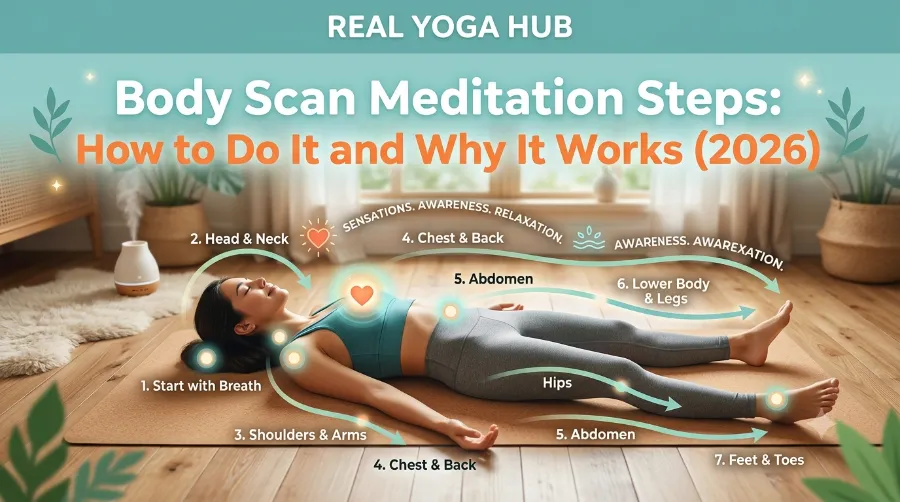
Step 1: Set up your space. Lie down on your back, ideally on a yoga mat, rug, or bed. Let your arms rest a few inches from your body, palms facing up. If lying down makes you sleepy too fast, sit in a supported chair instead.
Step 2: Settle with three slow breaths. Close your eyes. Take three breaths that are slightly longer than normal, in through the nose, out through the mouth. This signals your nervous system that it is safe to downshift. If your mind is especially busy tonight, two minutes of box breathing before this step can help settle things first.
Step 3: Start at the feet. Bring your attention to your left foot. Notice the sensation of the toes, the arch, the heel. Do not judge what you find. Just notice it, then let it be.
Step 4: Move upward slowly. Continue to the ankle, calf, knee, and thigh of the left leg, then repeat the same sequence on the right leg. Spend roughly twenty to thirty seconds per body part.
Step 5: Scan the torso. Move attention through the hips, lower back, abdomen, chest, and upper back. This is often where people discover surprising tension, especially around the stomach and shoulders.
Step 6: Scan the arms and hands. Notice the shoulders, upper arms, elbows, forearms, wrists, and fingers on both sides.
Step 7: Finish at the head. Bring attention to the neck, jaw, face, eyes, forehead, and scalp. The jaw and forehead often hold tension people never consciously notice until they check in.
Step 8: Take a whole body moment. For the final minute, sense your entire body at once, as one connected field of sensation rather than separate parts.
Step 9: Return gently. Wiggle your fingers and toes, take a deeper breath, and open your eyes when ready. Avoid jumping straight up.
Quick Reference Checklist
- Find a quiet spot and lie down comfortably
- Take three slow settling breaths
- Move attention from feet to head, or head to feet, in order
- Spend roughly 20 to 30 seconds per body part
- Notice sensation without trying to change it
- End with a whole body awareness moment
- Transition back slowly, do not rush the ending
A full session usually runs 20 to 45 minutes, but a shortened 10 minute version works well for lunch breaks or before a stressful meeting. Consistency matters more than duration. A daily 10 minute practice beats a single 45 minute session once a week.
Progressive Relaxation vs Body Scan: What Is the Difference
People often confuse body scan meditation with progressive relaxation, and honestly the confusion makes sense because they overlap. Progressive relaxation, developed by physician Edmund Jacobson in the 1920s, involves actively tensing then releasing each muscle group. Body scan meditation, by contrast, asks you to simply observe sensation without adding tension first. Meditation Moments describes this distinction well, framing body scan as an awareness practice rather than a relaxation technique with a set outcome.
Think of it this way. Progressive relaxation is like squeezing a sponge to wring out water. Body scan meditation is like holding the sponge still and just noticing how wet it already is. Both approaches calm the body, but body scan builds a deeper long term body awareness technique because it trains observation rather than manipulation.
Many teachers, myself included, blend the two for beginners who struggle to feel subtle sensation. If you cannot feel your calf muscle at first, briefly tensing it for two seconds before releasing can help you locate the sensation more easily, then you drop back into pure observation for the rest of the practice.
Common Mistakes That Sabotage a Body Scan Practice
I have watched hundreds of students stumble on the same handful of issues, so let me save you the trouble.
- Rushing the scan. If you finish your entire body in three minutes, you are moving too fast to actually notice anything.
- Judging what you find. Tension is not a failure. Numbness is not a failure. You are gathering information, not grading a test.
- Falling asleep every time. This is common and not necessarily bad, but if your goal is daytime stress relief rather than sleep, try sitting upright instead of lying flat.
- Skipping uncomfortable areas. The parts you want to skip, usually the stomach, jaw, or chest, are often exactly where the useful information lives.
- Expecting instant results. Body scan meditation is a skill that improves with repetition, and early sessions can feel awkward or even boring before the benefits click.
How Often Should You Practice Body Scan Meditation
Research generally supports daily practice for meaningful change, though the exact dosage depends on your goal.
| Goal | Suggested Frequency | Session Length |
|---|---|---|
| General stress reduction | 4 to 5 times per week | 10 to 15 minutes |
| Chronic pain management | Daily | 20 to 30 minutes |
| Insomnia relief | Nightly, before bed | 15 to 20 minutes |
| Anxiety management | Daily, plus during spikes | 5 to 10 minute check ins |
| Deep MBSR style practice | Daily for 8 weeks | 30 to 45 minutes |
An 8 week structured program mirrors the original MBSR curriculum and remains the most clinically tested timeline.
Body Scan Meditation for Specific Concerns
For Anxiety
Anxious minds often live in the future. Body scan meditation forces attention into the present physical moment, which interrupts the anxious thought loop. Start seated rather than lying down if lying flat makes you feel more exposed to racing thoughts.
For Chronic Pain
Harvard Health Publishing has documented body scan as a specific tool for pain management, and the mechanism is not about ignoring pain but about changing your relationship to it. Instead of bracing against pain, which often intensifies it, you observe it with curiosity, which research links to reduced emotional reactivity around the sensation itself.
For Insomnia
Practicing in bed, lying flat, with dim lighting and no phone nearby tends to work best. Many people fall asleep partway through, which is completely fine if sleep is the goal. For a longer, more structured wind down, our yoga nidra beginner guide extends this same body scan foundation into a full sleep ritual.
For ADHD and Restlessness
Interestingly, research published in September 2024 looked specifically at identifying body scan postures suitable for people with hyperactivity tendencies, since traditional stillness based meditation can feel nearly impossible for some ADHD brains. Shorter segments, five minutes instead of thirty, and allowing small movement between body parts made the practice more sustainable for this group.
A Real World Example
One of my long term students, a 42 year old software engineer from Chicago, started body scan meditation in January 2025 after months of tension headaches that painkillers barely touched. She committed to 12 minutes every night for six weeks. By week three she reported catching jaw clenching during the day, something she had never consciously noticed before, purely because the nightly practice trained her to feel it. By week six her headache frequency dropped from four times a week to roughly once. This is not a clinical trial, but it mirrors the pattern researchers see again and again, awareness comes first, physical change follows.
Frequently Asked Questions
Is body scan meditation the same as guided meditation?
Not exactly. Body scan can be guided by a teacher or recording, but it can also be done silently on your own once you know the sequence. Guided versions simply help beginners stay on track.
How long should a beginner practice each session?
Start with 10 minutes. There is no need to jump straight to 45 minute sessions, and shorter consistent practice beats occasional long sessions.
Can body scan meditation help with panic attacks?
It can help prevent escalation if practiced regularly, since it trains early detection of physical tension. During an active panic attack, shorter grounding techniques often work faster than a full scan.
Is it normal to feel nothing in certain body parts?
Yes, completely normal, especially early on. Numbness or a lack of sensation is simply information, not a mistake.
Do I need an app or can I do this without guidance?
You do not need an app. Many long term practitioners eventually drop guided recordings entirely once the sequence becomes familiar, though beginners often benefit from guidance for the first few weeks.
What is the difference between body scan and yoga nidra?
Body scan is typically shorter and simpler, moving attention through the body once. Yoga nidra is a longer, more structured practice that includes body scanning as one phase among several, often including intention setting and visualization.
Body Scan Meditation Quiz
Test what you just learned with this quick five question quiz.
1. Body scan meditation was popularized as part of which program?
A) Progressive Muscle Training
B) Mindfulness Based Stress Reduction
C) Transcendental Meditation
2. What is the main goal of body scan meditation?
A) Forcing relaxation
B) Building body awareness through observation
C) Falling asleep as fast as possible
3. How long should a beginner session typically last?
A) 60 minutes
B) 2 minutes
C) 10 to 15 minutes
4. What brain region has shown structural change in meditators according to MRI studies?
A) The right anterior insula
B) The cerebellum only
C) No changes have ever been found
5. What is the recommended approach when you notice tension during a scan?
A) Force it away immediately
B) Skip that body part
C) Notice it without judgment and move on
Answer Key: 1-B, 2-B, 3-C, 4-A, 5-C
Conclusion
Body scan meditation is not complicated, and that is exactly its strength. You do not need special equipment, an app subscription, or years of training to start noticing what your body has been trying to tell you all along. The body scan meditation steps in this guide give you everything needed to begin tonight, ten quiet minutes, a body scan meditation guide sequence from feet to head, and a willingness to simply notice rather than fix. The research keeps confirming what practitioners have known for decades, that this simple progressive relaxation and body awareness technique changes both the brain and the body over time. Give it two weeks of daily practice before deciding whether it works for you, because like most meditation practices, the real benefit shows up in the noticing, not the first sitting.
References
- Verywell Mind, Body Scan Meditation: Why and How, https://www.verywellmind.com/body-scan-meditation-why-and-how-3144782
- O2X Human Performance, How to Practice Body Scanning for Relaxation and Awareness, https://o2x.com/blog/how-to-practice-body-scanning-for-relaxation-and-awareness
- Meditation Moments, Body Scan Meditation, https://meditationmoments.com/meditation/bodyscan
- Harvard Health Publishing, Body Scan for Pain, https://www.health.harvard.edu/pain/body-scan-for-pain
- Michigan State University Extension, The Many Benefits of Mindful Body Scan Meditations, https://www.canr.msu.edu/news/the-many-benefits-of-mindful-body-scan-meditations
- Becattini V, Lifshitz M, Miller M. Learning to Attenuate Myself: A Predictive Processing Account of Body Scan Meditation. Neuroscience of Consciousness, 2026.
- ScienceDaily, Scientists Say 7 Days of Meditation Can Rewire Your Brain, University of California San Diego, April 2026.