
Your shoulders are somewhere near your ears right now. Your jaw is tight. You’ve read three sentences of this paragraph while thinking about four other things. Sound familiar? That’s not a personal failing, it’s your nervous system doing exactly what it was built to do under chronic pressure. The good news, backed by more than a decade of clinical research, is that a short set of yoga stress relief poses can start shifting that state within minutes, not months. I’ve taught these exact poses to thousands of stressed-out students over 12 years, from new parents to trial lawyers to college kids drowning in finals, so I know what actually works on a real mat, in a real living room, not just in a lab.
TL;DR: Seven specific yoga stress relief poses, held with slow breathing for 5 to 10 breaths each, measurably lower cortisol, calm the nervous system, quiet a racing mind. Pair them with the 4-7-8 breathing technique for the fastest effect. You don’t need 90 minutes or a studio membership, just 10 to 20 focused minutes on most days.
Key Takeaways
| What You’ll Learn | Why It Matters |
|---|---|
| 7 evidence-based yoga stress relief poses | Each one targets a specific stress response in the body |
| How yoga lowers cortisol | Research shows reductions of roughly 15-30% with regular practice |
| A ready-to-use 15-minute sequence | No guesswork, just follow the order |
| The 4-7-8 breathing technique | A 19-second reset you can use anywhere, mat or no mat |
| Common mistakes that blunt the calming effect | Small fixes that make a real difference |
| A quick self-check quiz | Test what you’ve learned before you roll out your mat |
What Stress Actually Does to Your Body (and Why Yoga Interrupts It)
Stress isn’t only a feeling, it’s a full-body chemical event. When your brain perceives a threat, real or imagined, your hypothalamic-pituitary-adrenal axis (the HPA axis) releases cortisol, your heart rate climbs, your breath gets short and shallow. This is useful for about ten seconds if a car swerves toward you. It’s not useful when it happens fifty times a day because of email.
Yoga for PTSD and Trauma: A Trauma-Sensitive Practice Guide
Chronic activation of that stress response is now a documented public health issue, not just a personal complaint. The American Psychological Association’s 2025 Stress in America survey found that roughly 75% of U.S. adults experience stress, with work cited by 69% of employed adults as a significant source. Younger adults are hit hardest: 27% of people aged 18 to 34 rate their stress at 8 out of 10 or higher, the highest of any age group tracked. If you’ve been feeling like everyone around you is more wound up than usual, the data backs that up.
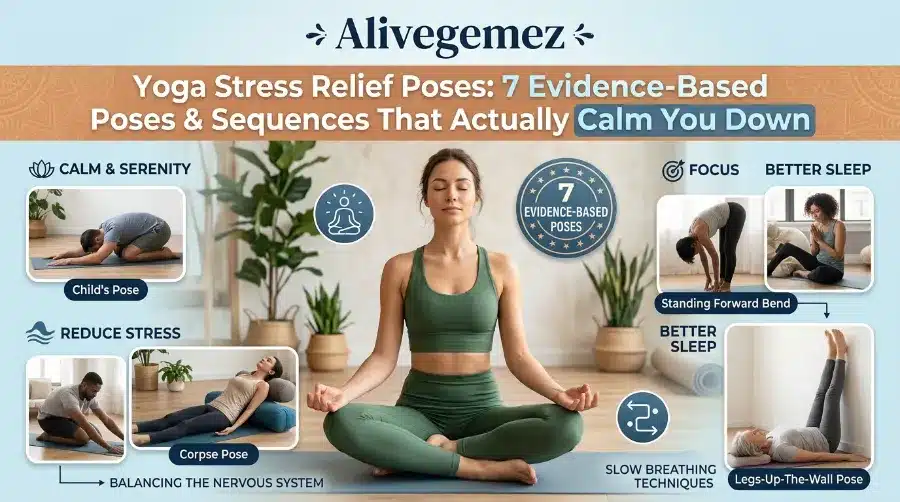
This is where yoga stress relief poses do something most quick fixes can’t. A network meta-analysis published in late 2025 compared multiple exercise types for their effect on cortisol in people with psychological distress. Yoga produced the largest reduction of any modality studied, while high-intensity interval training actually tended to raise cortisol slightly. A separate meta-analysis of 42 trials found that yoga practice was linked to lower evening cortisol, lower waking cortisol, lower resting heart rate, better heart rate variability, compared with active control groups. In plain terms, slow, deliberate poses paired with breath control send a direct signal to your nervous system that the threat has passed, so it can stand down.
Yoga for Grief and EmotionalHealing: A Gentle Guide
That’s the science. Now let’s get into the poses themselves, along with why each one earns a spot on this list instead of the dozens of others floating around Pinterest.
How Yoga Lowers Cortisol: The Science Explained Simply
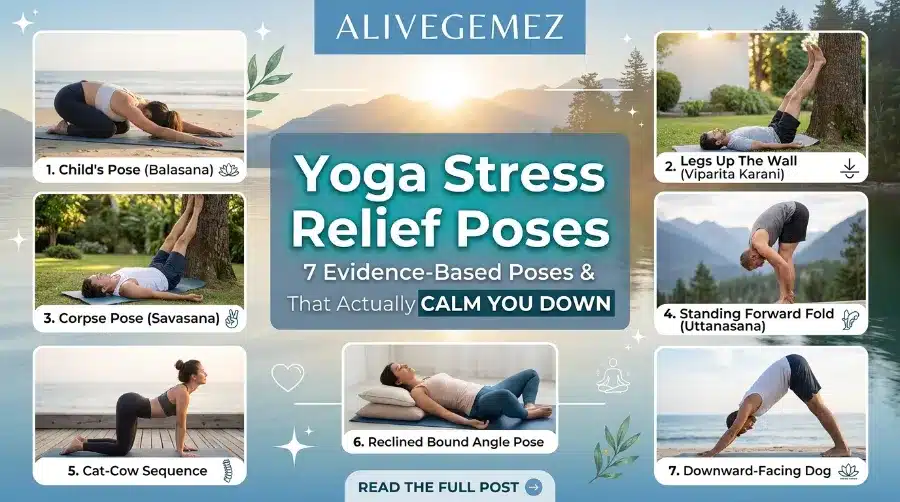
The 7 Best Yoga Stress Relief Poses, Backed by Research
I picked these seven yoga stress relief poses using three filters: they’re supported by physiological research, they’re accessible to a true beginner, they can be done in a small space without special equipment. If a pose asked for advanced flexibility or a wall, it didn’t make the cut.
1. Child’s Pose (Balasana)
This is the pose I tell every new student to return to whenever anything feels like too much, whether that’s a hard flow class or a hard Tuesday.
How to do it:
- Kneel on your mat, big toes touching, knees wide
- Fold your torso forward, resting your forehead on the mat or a block
- Let your arms rest alongside your body, palms up, or stretch them forward
- Breathe slowly for 8 to 10 breaths, feeling your back expand with each inhale
Folding forward with your head lower than your heart triggers a mild parasympathetic response, the “rest and digest” counterpart to fight-or-flight. In my own classes, this is consistently the pose students say they’d choose if they could only do one.
Yoga for Insomnia: A 4-Week Sleep Improvement Plan
2. Legs-Up-the-Wall Pose (Viparita Karani)
If you try only one pose from this entire list tonight, make it this one. Lie on your back, scoot your hips close to a wall, extend your legs straight up the wall so your body forms an L-shape. Stay for 5 to 15 minutes, arms relaxed at your sides.
Elevating the legs above heart level shifts fluid, encourages venous return, which is thought to ease the workload on your cardiovascular system while quieting mental chatter. It’s gentle enough for pregnant students in the second trimester (check with your provider first) plus anyone recovering from a long travel day or an intense workout.
3. Cat-Cow Pose (Marjaryasana-Bitilasana)
Stress lives in the spine as much as it lives in the mind, so this is one of the few active poses on the list.
How to do it:
- Start on all fours, wrists under shoulders, knees under hips
- Inhale, drop your belly, lift your chest, tilt your tailbone up (Cow)
- Exhale, round your spine toward the ceiling, tuck your chin (Cat)
- Repeat slowly for 8 to 12 rounds, linking one full breath to one full movement
This gentle spinal wave releases tension held in the lower back, the neck, the shoulders, three areas that tighten first under chronic stress. Pairing the movement with breath also builds the mind-body connection that makes every other pose on this list work better.
4. Standing Forward Fold (Uttanasana)
Stand with feet hip-width apart, soften your knees, hinge forward from the hips, let your head hang heavy toward the floor. Hold onto opposite elbows if that feels grounding. Stay for 6 to 8 breaths.
Like Child’s Pose, this inversion-lite position calms the nervous system by shifting blood flow, releasing tension along the entire back line of the body. It’s also one of the fastest resets I know for the mid-afternoon slump that hits around 3 p.m., when cortisol naturally starts to climb again for many people.
5. Reclining Bound Angle Pose (Supta Baddha Konasana)
Lie on your back, bring the soles of your feet together, let your knees fall open to the sides. Rest one hand on your heart, one hand on your belly. Stay for 5 to 10 minutes with slow, deep breaths.
This pose opens the hips, the inner thighs, areas where many people unconsciously store physical tension from sitting all day. The hand placement also gives you real-time feedback on your breath, which naturally slows once you notice it.
6. Seated Forward Bend or Easy Pose with a Twist (Sukhasana Variation)
Sit cross-legged, spine tall, place your right hand behind you, your left hand on your right knee, gently twist toward the right, then repeat on the other side.
Spinal twists are frequently recommended for stress because they stimulate the digestive organs, encourage a longer exhale as you rotate, both of which support parasympathetic activation. This is also the most desk-friendly pose on the list, since a modified version works fine in a chair.
Yoga and Intermittent Fasting: Is This Combo Actually Safe?
7. Corpse Pose (Savasana)
Every single sequence should end here, no exceptions. Lie flat on your back, legs relaxed, arms a few inches from your sides, palms up, eyes closed. Stay for a minimum of 5 minutes, ideally 10 to 20.
Savasana is often treated as an afterthought, which is a mistake. This is where your nervous system actually integrates everything the previous poses started. Research on yoga nidra, a guided deep-relaxation practice done in this same position, found measurable improvements in wellbeing after just an 11-minute daily practice compared with a waitlist control group. If you’re short on time, this is the pose to protect.
Yoga for ADHD in Adults: Can It Help You Focus and Calm Down?
A Simple 15-Minute Sequence for Stress Relief
Reading about yoga stress relief poses is one thing, stringing them together is another. Here’s the exact order I give students who want a no-frills routine they can repeat daily.
- Cat-Cow, 8 rounds (1 minute)
- Child’s Pose, 8 breaths (1.5 minutes)
- Standing Forward Fold, 8 breaths (1.5 minutes)
- Seated Twist, both sides, 5 breaths each (2 minutes)
- Reclining Bound Angle Pose, 4 minutes
- Legs-Up-the-Wall, 4 minutes
- Savasana, 5 minutes
Total time: roughly 15 to 19 minutes, which lines up closely with the dosage yoga researchers describe as effective; the dose-response analysis found an optimal response at approximately 530 MET-minutes per week, a target most people can hit with three or four sessions like this one. For a deeper dive into how consistent practice supports mental health long-term, our guide on yoga’s mental health benefits breaks down the full picture.
If your stress shows up mainly as racing thoughts or panic rather than physical tension, you might get more mileage from a routine built specifically for that experience; we cover this in detail in our piece on yoga for anxiety and panic attacks.
The 4-7-8 Breathing Technique: How to Do It and When to Use It
Poses matter, but breath is the lever that makes them work faster. The 4-7-8 breathing technique, developed by Harvard-trained physician Dr. Andrew Weil as a modern take on the yogic practice of pranayama, is the single fastest tool I teach for calming the mind on the spot.
How to do 4-7-8 breathing:
- Exhale completely through your mouth, making a soft whoosh sound
- Close your mouth, inhale quietly through your nose for a count of 4
- Hold your breath for a count of 7
- Exhale fully through your mouth for a count of 8, whoosh sound again
- Repeat for 4 full cycles to start, no more than 8 in a single sitting at first
The extended exhale stimulates the vagus nerve, your body’s primary brake on the stress response, which helps explain why the effect can be felt within a minute or two. A 2025 scoping review pulling together 15 studies on this technique found consistent evidence of reduced stress and anxiety, improved heart rate variability, improved blood pressure across the research reviewed. In one clinical trial, patients using the method regularly saw their sleep quality scores improve dramatically, falling from 13.33 to 4.93 on the Pittsburgh Sleep Quality Index, a shift that reflects a real change from poor sleep to good sleep, not just a marginal difference.
When to use 4-7-8 breathing:
- Before a stressful meeting or difficult conversation
- Lying in bed when your mind won’t stop replaying the day
- In the middle of any pose on this list, as an add-on rather than a replacement
- During a panic spiral, as a grounding anchor while you wait for the wave to pass
One caution worth repeating from breathwork researchers: if you feel light-headed during the hold, shorten it, or drop the hold entirely, keep the exhale longer than the inhale. That alone still delivers most of the calming effect.
How Yoga Calms the Mind, Not Just the Body
Physical relaxation is only half the story. Yoga calms the mind through a mechanism separate from stretching, one tied to breath regulation, focused attention, repetition. A 2010 study out of Boston University found that a single 60-minute yoga session produced a 27% increase in brain GABA, the primary inhibitory neurotransmitter responsible for reducing anxiety, calming an overactive nervous system. Regular practitioners in that research line showed even larger increases over time compared with people who simply walked for the same duration.
This matters for a US-specific reason too. Loneliness, social division, financial pressure are now named as leading drivers of stress across the country; the APA’s most recent national survey found 62% of adults say societal division is a major stressor, about half report feeling isolated, left out, or lacking companionship often or some of the time. Yoga won’t fix a divided country, but the felt sense of coming back into your own body, on your own mat, for even ten quiet minutes, is one of the few reliable antidotes available to anyone regardless of income or location. If low mood has been part of your stress picture too, our research roundup on yoga and depression evidence is worth a look.
For a broader view of stress-specific pose sequences from other respected voices in the space, Yoga Journal’s roundup of stress-relief poses is a solid companion read, as is this practical breakdown from Watson’s workplace wellness team aimed at people managing stress from a desk job. The team at Club Woodside also put together a helpful five-practice guide worth bookmarking alongside this one.
The Research at a Glance
| Study / Source | Finding | Population |
|---|---|---|
| Systematic review & network meta-analysis, 2025 | Yoga showed the largest cortisol reduction of any exercise type studied (SMD −0.59 to −0.67) | 44 RCTs, adults with psychological distress |
| Meta-analysis, ScienceDirect | Yoga linked to lower evening/waking cortisol, better heart rate variability | 42 trials, mixed adult populations |
| Boston University, 2010 | 27% increase in brain GABA after a single 60-minute session | Small controlled trial |
| Yoga Nidra RCT, 2025 | Measurable wellbeing gains from an 11-minute daily practice | 363 participants, online delivery |
| 4-7-8 Breathing scoping review, 2025 | Consistent reductions in stress, anxiety, improved cardiovascular markers | 15 pooled studies |
| APA Stress in America, 2025 | About 75% of U.S. adults report stress symptoms | 3,199 U.S. adults surveyed |
Common Mistakes That Blunt the Calming Effect
- Rushing the transitions. Moving quickly between poses keeps your sympathetic nervous system engaged, the opposite of what you’re going for.
- Skipping Savasana. This is the most skipped, most important pose on the list.
- Holding your breath out of habit, not intention. Untrained breath-holding during a stretch spikes tension rather than releasing it.
- Practicing on a full stomach right after a big meal. Give yourself at least an hour.
- Treating this as a one-time fix. A single session helps, but the cortisol research consistently shows the biggest gains come from consistency over weeks, not a single heroic 90-minute class.
Frequently Asked Questions
Do yoga stress relief poses actually lower cortisol, or is that just marketing? The research backs it up. Multiple systematic reviews, including a 2025 network meta-analysis covering 44 trials, found yoga produced a larger cortisol reduction than most other exercise types studied, including running-style cardio.
How long before I notice yoga calming my mind? Many people report feeling calmer within a single 15 to 20 minute session, largely due to breath regulation. Longer-term nervous system changes, like lower baseline cortisol, tend to build over 6 to 12 weeks of regular practice.
Can I do these poses if I’ve never done yoga before? Yes. Every pose in this guide was chosen specifically because it needs no prior flexibility or experience. A folded blanket or block under your knees or hips makes any of them more comfortable.
What’s the best time of day for yoga stress relief poses? Whichever time you’ll actually do it. Morning practice can set a calmer tone for the day, while an evening practice, paired with Legs-Up-the-Wall plus 4-7-8 breathing, is excellent for winding down before bed.
Is yoga enough on its own for chronic stress or anxiety? For many people it’s a genuinely powerful tool, but it isn’t a replacement for professional support if your stress is severe or persistent. Please talk with a doctor or therapist if stress is affecting your daily functioning, your sleep, or your safety.
Quick Quiz: Test What You’ve Learned
1. Which pose is most associated with venous return, reduced cardiovascular workload? A) Cat-Cow B) Legs-Up-the-Wall Pose C) Seated Twist
2. According to the 2025 network meta-analysis, which exercise type showed the largest cortisol reduction? A) High-intensity interval training B) Multicomponent exercise C) Yoga
3. What is the correct breath pattern for the 4-7-8 technique? A) Inhale 8, hold 7, exhale 4 B) Inhale 4, hold 7, exhale 8 C) Inhale 7, hold 4, exhale 8
4. Roughly what percentage of U.S. adults report experiencing stress, per recent survey data? A) About 40% B) About 55% C) About 75%
5. What did the 2010 Boston University study find after a single 60-minute yoga session? A) A 27% increase in brain GABA B) A 50% drop in heart rate C) No measurable change
Answers: 1) B, 2) C, 3) B, 4) C, 5) A
Bringing It All Together
Stress isn’t going anywhere this year, next year, or probably ever completely, but how your body responds to it is genuinely trainable. These seven yoga stress relief poses, backed by real cortisol research rather than wellness folklore, give you a starting point you can use tonight, no studio membership required. Pair them with the 4-7-8 breathing technique when you need a faster reset, protect your Savasana even when you’re tempted to skip it, give the practice a few consistent weeks before judging whether it’s working. Your nervous system took years to learn its current patterns; ten calm minutes a day is a reasonable, sustainable way to teach it a new one. For more evidence-based practices like this, explore the full library at RealYogaHub.com.
References
- American Psychological Association. Stress in America 2025: A Crisis of Connection.
- Sports (MDPI), 2025. The Optimal Exercise Modality and Dose for Cortisol Reduction in Psychological Distress: A Systematic Review and Network Meta-Analysis.
- ScienceDirect. Yoga, mindfulness-based stress reduction and stress-related physiological measures: A meta-analysis.
- Stress and Health (Wiley), 2025. The Effects of an Online Yoga Nidra Meditation on Subjective Well-Being and Diurnal Salivary Cortisol: A Randomised Controlled Trial.
- ResearchGate, 2025. Exploring 4-7-8 Breathing for Stress Relief and Improved Quality of Life in Chronic and Degenerative Diseases: A Scoping Review.
- Andrew Weil Center for Integrative Medicine. Just Breathe: Using Breathwork for Wellbeing.
- SingleCare / American Institute of Stress, 2025. Stress statistics: How many people are affected in the U.S.?