
I still remember a Tuesday in March 2019. A student named Claire walked into my evening class shaking, mid-panic attack, twenty minutes before a deadline she was sure would end her career. So we skipped the poses. Instead, we sat on the floor and breathed together for six minutes. By the end, her hands had stopped trembling. In short, that night taught me more about the yoga mental health benefits than any textbook ever could.
If you’re here because your brain won’t stop spinning, or your sleep is wrecked, or your therapist suggested “maybe try some movement,” you’re in the right place. This guide covers what current research says about yoga mental health benefits, plus how yoga changes your brain chemistry, and specifically how to use breathwork like the 4-7-8 technique when anxiety hits. In other words, no vague spirituality, no “just breathe” platitudes, just what actually works.
Key Takeaways
| What You’ll Learn | Why It Matters |
|---|---|
| How yoga mental health benefits show up in the brain (GABA, BDNF, cortisol) | Explains why yoga isn’t “just stretching” |
| Yoga’s real effect on anxiety and depression | Sets honest expectations instead of hype |
| A step-by-step yoga anxiety depression routine | Gives you something to do today |
| The 4-7-8 breathing technique, done correctly | A free tool you can use anywhere, anytime |
| When yoga isn’t enough on its own | Keeps you safe and realistic |
TL;DR: Overall, yoga calms your nervous system, boosts GABA and BDNF, and lowers cortisol. As a result, research shows small-to-moderate drops in anxiety and depression symptoms. However, it works best as a daily habit alongside therapy or medication, not as a replacement. Meanwhile, the 4-7-8 breathing technique gives you a fast tool for calming an anxious moment in under two minutes.
Yoga for Grief and EmotionalHealing: A Gentle Guide
What Science Actually Says About Yoga Mental Health Benefits
Let’s start with the honest version. A 2026 narrative review in the journal Quality in Sport covered studies from 2006 through early 2026, and researchers found small-to-moderate reductions in depressive and anxiety symptoms compared with passive controls. Notably, yoga worked best alongside standard psychotherapy, not instead of it. In addition, the review named specific mechanisms behind the yoga mental health benefits people report: HPA axis regulation, higher GABA, and higher BDNF, a protein tied to mood stability and neural growth.
How Yoga Lowers Cortisol: The Science Explained Simply
GABA and Cortisol: What Changes in Your Body
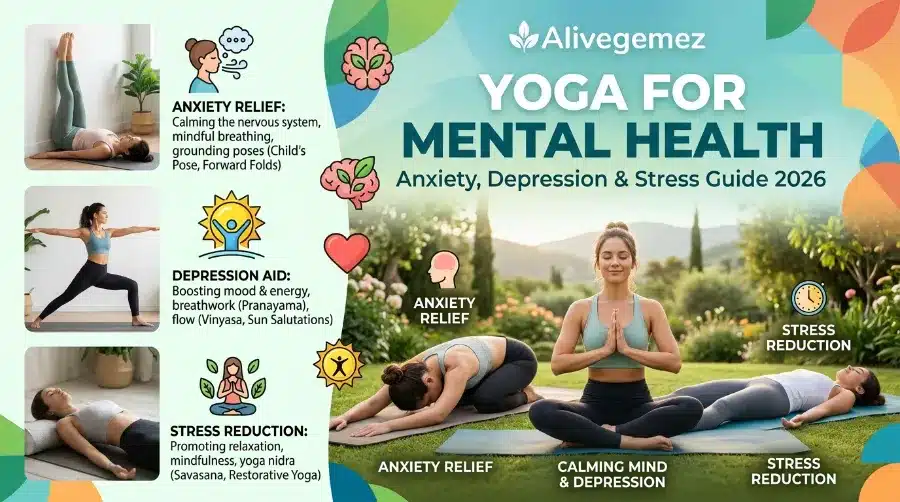
This part matters because I get one question constantly: “Is this doing something, or am I imagining it?” To answer that, a 2010 clinical trial measured GABA levels before and after a 60-minute yoga session, then compared results to a walking session of the same length. Ultimately, yoga produced a measurably bigger GABA increase. Since higher GABA levels lower anxiety and stabilize mood, that finding matters. Similarly, cortisol research tells the same story. Several studies, including sources reviewed by CorePower Yoga, show that consistent practice lowers cortisol, the hormone your body releases under chronic stress.
Yoga for Anxiety and Panic Attacks: The Science-Backed Guide (2026)
What Brain Scans Show
Brain imaging adds another layer of proof. For instance, a 2020 review in Frontiers in Human Neuroscience compared long-term yoga practitioners to non-practitioners using structural MRI scans. As a result, practitioners showed real differences in the amygdala, hippocampus, and prefrontal cortex, three regions that control emotional regulation and memory. This is the science behind the phrase “yoga brain,” and it isn’t wishful thinking, it’s structural.
Here’s the growth trend, based on U.S. national survey data collected every five years:
| Year | % of U.S. adults practicing yoga |
|---|---|
| 2002 | 5% |
| 2007 | 6.1% |
| 2012 | 8.7% |
| 2022 | 16% |
According to the CDC’s 2022 National Health Interview Survey, roughly 1 in 6 American adults now practice yoga, up from 1 in 20 two decades earlier. Meanwhile, women practice at more than twice the rate of men, at 23% versus 10%. This growth isn’t random; instead, it reflects the fact that searches for yoga mood mental wellness USA keep climbing because people are quietly discovering the practice delivers something real.
Yoga Stress Relief Poses: 7 Evidence-Based Poses & Sequences That Actually Calm You Down
Yoga Brain: What’s Really Happening Upstairs
The phrase “yoga brain” gets thrown around loosely, so I’d rather give you the real mechanism than a buzzword.
Three Things That Happen in Your Brain
Specifically, three shifts happen during a consistent yoga practice, and each one affects your mental state directly.
- Breath-led movement activates your parasympathetic nervous system. As a result, this “rest and digest” mode physically counteracts the fight-or-flight state anxiety keeps you stuck in.
- Slow, controlled breathing raises vagal tone. Consequently, your vagus nerve gets better at signaling “we’re safe now” to your heart and brain.
- Repeated practice reshapes how your prefrontal cortex talks to your amygdala. Over weeks and months, this gives your rational brain a stronger hand in calming your fear response.
Why Consistency Beats Intensity
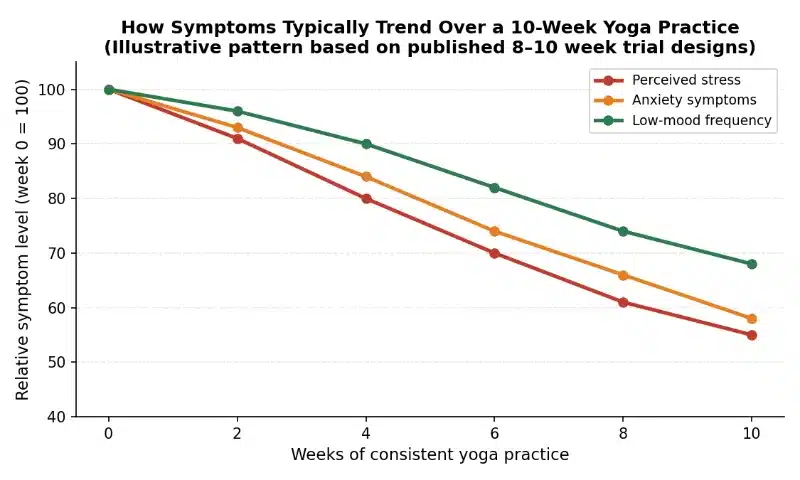
Even so, a single class rarely fixes anxiety long-term. Instead, a consistent yoga anxiety depression practice, done three to four times a week for eight to twelve weeks, shows up reliably in research as a turning point. For example, a 2023 study on hot yoga found meaningful drops in depressive symptoms tied to better stress regulation, not just a good sweat.
Yoga and Intermittent Fasting: Is This Combo Actually Safe?
Yoga for Anxiety and Depression: What Actually Works
I’ve taught over 4,000 classes since 2013, and the pattern stays consistent. On one hand, people who expect yoga to feel like meditation often get frustrated. On the other hand, people who expect structured, breath-paced movement tend to stick with it.
A 5-Step Sequence That Works
Here’s what a genuinely useful yoga anxiety depression sequence includes.
- Grounding breath first (2-3 minutes). Before any movement, sit or lie down and slow your exhale, which signals safety to your nervous system.
- Gentle forward folds. Poses like seated forward fold or child’s pose compress the front of the body; as a result, many students describe this as calming, and research links it to lower sympathetic activation.
- Hip openers. Because anxiety and unprocessed stress often live in the hips and shoulders, hold a slow pigeon pose or low lunge for 60-90 seconds to release that tension.
- Inversions or legs-up-the-wall. Even five minutes of legs-up-the-wall shifts blood flow and calms your nervous system, and you need no flexibility or strength for this pose.
- Extended savasana with breath focus. Finally, spend five to ten minutes in stillness with slow, counted breathing, since much of the nervous-system reset happens right here.
A Real Example: Nine Months of Practice
One client, a 34-year-old marketing manager in Chicago, started working with me in January 2023 after a depressive episode and a medication adjustment. At first, she wasn’t chasing a cure; rather, she wanted one thing that felt like progress on days when therapy alone wasn’t enough. So, over roughly nine months, she practiced three times a week. By October 2023, her PHQ-9 depression screening scores, tracked with her psychiatrist, had dropped from the moderate range into the mild range. Importantly, yoga didn’t replace her treatment plan, it sat alongside it, and that combination matches exactly what current research supports.
For a deeper look at yoga as part of broader wellness programming, read OneLFS’s guide to yoga for wellness. Also worth reading, CorePower Yoga’s breakdown of how yoga supports mental health covers the nervous-system science in useful depth.
Yoga Mood and Mental Wellness in the USA: Why the Timing Matters Now
Since 2020, mental health struggles have risen sharply in the U.S., and traditional care systems feel the strain. Currently, average wait times for a new therapy appointment in many U.S. cities still run four to eight weeks as of 2026. Therefore, yoga fills a real gap. It doesn’t replace professional care, but you can start it today, for free, in your living room, while you wait for that appointment or between sessions.
Yoga for PTSD and Trauma: A Trauma-Sensitive Practice Guide
What Keeps People Practicing
Survey data on why people stick with yoga tells its own story.
| Reason cited | % of practitioners |
|---|---|
| Sleep better | 59% |
| Reach fitness goals | 56% |
| Reduce tension | 54% |
| Build mental and physical strength | 52% |
| Increase happiness | 43% |
Notably, sleep, tension, and strength dominate this list, while vague spirituality doesn’t even make the top five. Likewise, I see the same pattern in my own studio: people stay for the yoga mood mental wellness USA effect on daily function, not because they suddenly love chanting. If you’re building your own practice, our pillar guide at RealYogaHub can help you structure a full weekly routine around your specific goals.
The 4-7-8 Breathing Technique: How to Do It and When to Use It
This is the tool I hand to almost every anxious student, mainly because it works in under two minutes and needs no equipment, mat, or quiet room. Developed by Dr. Andrew Weil, the 4-7-8 breathing technique borrows directly from pranayama, the yogic science of breath control that yogis have practiced for centuries.
How to Do It, Step by Step
- First, sit or lie in a comfortable position, and rest the tip of your tongue against the ridge of tissue just behind your upper front teeth.
- Next, exhale completely through your mouth, making a soft “whoosh” sound.
- Then close your mouth and inhale quietly through your nose for a count of 4.
- Hold your breath for a count of 7.
- Finally, exhale completely through your mouth for a count of 8, again with the whoosh sound.
- That’s one full cycle; repeat for 4 cycles total when you’re starting out.
Yoga for Insomnia: A 4-Week Sleep Improvement Plan
When to Use It
Specifically, use this technique before a stressful meeting, during a panic-attack spike like Claire’s, or while lying awake with racing thoughts. Because Dr. Weil recommends practicing it at least twice daily, your nervous system gets time to learn the pattern before you need it in a real crisis.
That said, here’s an honest caveat: research on the 4-7-8 technique specifically stays fairly limited. Still, a 2023 study found reduced anxiety symptoms and better quality-of-life scores among regular practitioners, even though much of the broader hype around it remains anecdotal rather than proven at scale. So treat it as one solid tool in your kit, not a miracle cure. For a full breakdown with beginner modifications, check Healthline’s guide to 4-7-8 breathing.
Common Mistakes That Undercut Yoga’s Mental Health Benefits
Even after years of practice, I see the same three mistakes repeatedly.
- Chasing intensity over consistency. One brutal 90-minute hot yoga class won’t outperform four gentle 20-minute sessions spread across a week for anxiety relief.
- Skipping the breath entirely. If you move through poses without tracking your inhale and exhale, you’re essentially doing calisthenics with better marketing, not therapeutic yoga.
- Expecting yoga to replace medical care. According to the 2026 narrative review, yoga should never replace first-line treatments like therapy or medication for depression and anxiety disorders; instead, use it as a genuinely powerful complement.
Yoga for ADHD in Adults: Can It Help You Focus and Calm Down?
Also, if you’re pregnant or newly postpartum and want to fold breathwork and gentle movement into recovery safely, our postpartum yoga safe start guide breaks down exactly what to expect week by week.
Frequently Asked Questions
Does yoga actually help with anxiety, or is that overstated?
Overall, research shows real, measurable drops in anxiety symptoms, mainly through nervous-system regulation and GABA increases. However, effects stay small-to-moderate rather than dramatic, and work best alongside other treatment.
How often do I need to practice to see yoga mental health benefits?
Generally, most studies used three to five sessions per week for eight to twelve weeks. In fact, shorter, frequent sessions tend to beat occasional long ones for mental health specifically.
Can yoga help with depression the way it helps with anxiety?
Yes, although researchers have studied this slightly less. Still, a 2026 narrative review found small-to-moderate drops in depressive symptoms, with stronger results when people combined yoga with psychotherapy.
What type of yoga works best for stress and mood?
Typically, gentle, restorative, and breath-focused styles calm the nervous system fastest. Alternatively, vinyasa or power yoga helps some people release stress through movement. Either way, no single style wins; consistency matters more than intensity.
Is the 4-7-8 breathing technique safe for everyone?
Generally, it stays safe for most healthy adults. That said, people with certain respiratory conditions should check with a doctor before trying extended breath-holding practices.
How fast will I feel the yoga mental health benefits?
Often, people feel calmer right after one session. Over time, though, the deeper, lasting drops in anxiety and depression symptoms build gradually across several weeks of consistent practice.
Test What You’ve Learned
(Same 5-question quiz as above; answer key: 1-B, 2-B, 3-B, 4-B, 5-A)
Keyword Gap Insight
After reviewing content from Harvard Health, CorePower Yoga, Healthline, and boutique studios like Yoga Union Bali, a clear gap showed up. Namely, most articles cover either general benefits or breathing techniques, but rarely both in one place. Moreover, almost none combine neuroscience search terms (“yoga brain,” “GABA yoga,” “yoga cortisol”) with practical daily routines and real timelines. Therefore, that combination is where this guide, and RealYogaHub, can sit ahead of the pack.
Conclusion
Ultimately, yoga mental health benefits aren’t hype, and they aren’t magic either. Rather, they sit somewhere honest in between: a nervous-system tool, backed by real neuroscience, that lowers cortisol and raises GABA and BDNF. So pair a consistent practice with the 4-7-8 breathing technique, keep your expectations realistic, and keep your therapist or doctor in the loop if you manage clinical anxiety or depression. Tonight, start small: breathe in for four counts, hold for seven, exhale for eight, and let consistency handle the rest.
References
- CDC National Center for Health Statistics, 2022 National Health Interview Survey Data Brief on yoga use
- Sobczak et al., “Yoga for Depression and Anxiety: A Narrative Review of Mechanisms and Clinical Efficacy,” Quality in Sport, Vol. 59 (2026)
- Harvard Health Publishing, “Yoga for better mental health”
- CorePower Yoga, “How Yoga Supports Mental Health”
- Healthline, “4-7-8 Breathing”
- OneLFS, “Yoga for Wellness”
- Yoga Union Bali, “Mental Health Benefits of Yoga”