
I want you to do something right now, before you read another word. Roll your shoulders back twice. Notice if they crept up toward your ears. Mine used to live there, permanently, back when I was writing my dissertation at a kitchen table that was six inches too low. That posture cost me two years of lower back pain and one very humbling MRI.
Yoga for Athletes: Cross-Training Guide to Improve Performance
Here’s the thing nobody tells desk workers: your body was not built to fold into a chair for eight hours a day, and no amount of willpower fixes that — only movement does. This guide, from our team at RealYogaHub.com, gives you a real, science-backed workplace yoga routine USA and UK office workers can actually use between meetings, plus the exact desk yoga WFH sequence I now teach clients who sit for a living. And because the same habits that undo desk damage are the ones elite athletes use to stay injury-free, we’ll also touch on how yoga to improve athletic performance overlaps almost perfectly with fixing “office body.
Family Yoga at Home: Fun Routines for Parents and Kids
TL;DR: Sitting for long stretches tightens your hip flexors, rounds your shoulders, and quietly overloads your lower back but five minutes of targeted desk yoga every 90 minutes can reverse most of that. The routine below needs no mat, no change of clothes, and works whether you’re in a cubicle, a home office, or a shared co-working desk.
Key Takeaways
| What You’ll Learn | Why It Matters |
|---|---|
| The 3 posture patterns desk work creates | Most back pain office workers feel starts here, not in the gym |
| A 5-minute desk yoga WFH routine | Fits between calls, no equipment needed |
| The 90-minute rule | Backed by occupational health research on sedentary breaks |
| Yoga poses that double as athletic training | Same mobility work used by athletes to improve performance |
| A stress-reset breathing technique (4-7-8) | Calms your nervous system in under two minutes |
Why Office Work Wrecks Your Body (And Why Yoga Athletes Use to Improve Performance Also Fixes It)
Let’s get specific about what actually happens to your body at a desk. Your hip flexors shorten because your hips sit at 90 degrees for hours. Your upper back rounds forward because your arms reach toward a keyboard. Your neck juts out because your eyes chase a screen that’s just slightly too low.
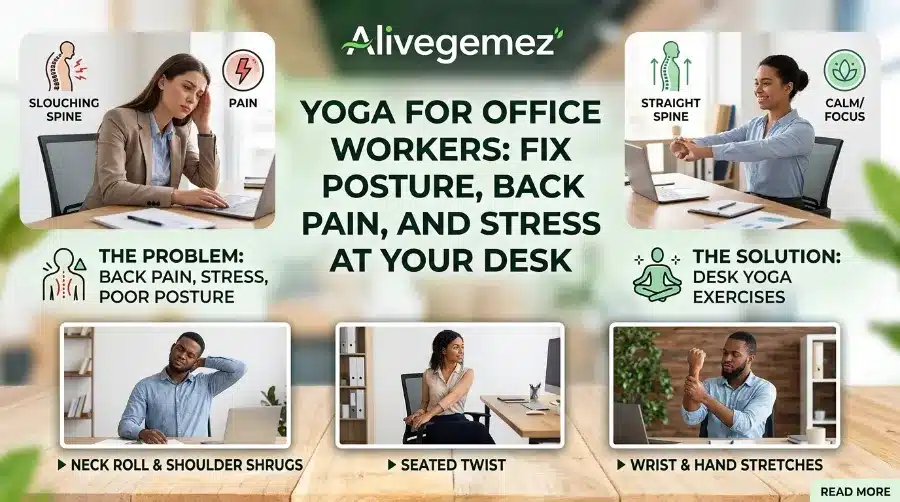
Occupational health researchers have tracked this for decades, and the pattern has a name: upper crossed syndrome, paired with tight hip flexors and a weak posterior chain. It’s not dramatic. It’s just quiet, cumulative, and it adds up to real back pain office workers report at strikingly high rates surveys of desk-based employees across the US and UK consistently put “lower back or neck discomfort” among the top three self-reported workplace health complaints.
Here’s what’s interesting though. The corrective work hip opening, thoracic rotation, glute activation, controlled breathing — is almost identical to what strength coaches use with athletes. This is exactly why yoga athletes use to improve performance and the yoga a software engineer uses to survive a 9-hour sprint review overlap so heavily. Mobility is mobility, whether you’re training for a marathon or just trying to stand up straight after a Zoom call. If that connection interests you, our deeper dive on yoga for athletes performance improve breaks down exactly how pro athletes structure this work.
The Desk Yoga WFH Routine: 5 Moves, 5 Minutes, Zero Equipment
You don’t need a studio. You need your chair, maybe a wall, and five minutes.
- Seated cat-cow (60 seconds). Hands on knees, inhale and arch your chest forward, exhale and round your spine like a scared cat. This alone undoes a huge chunk of the day’s slouching.
- Seated spinal twist (30 seconds each side). Cross one arm over the back of your chair, twist gently, breathe. Great for the mid-back stiffness that builds by 2 p.m.
- Desk chest opener (45 seconds). Stand, clasp hands behind your back, lift your chest toward the ceiling. Reverses the forward-hunch posture keyboard work creates.
- Standing forward fold at your desk (60 seconds). Hinge from the hips, let your hands rest on the desk or reach toward the floor. This releases the hamstrings and lower back in one move.
- Figure-four hip stretch, seated (45 seconds each side). Cross one ankle over the opposite knee, lean forward slightly. This single stretch does more for tight desk hips than almost anything else on this list.
Run through this every 90 minutes and you’ll notice something within a week: the 3 p.m. stiffness that used to feel inevitable simply stops showing up as often.
For a slightly more visual, pose-by-pose breakdown, adventureyogi.com’s desk yoga collection is a solid companion to the sequence above, and yogakawa’s desk pose guide covers a few excellent seated variations if you want more variety through the week.
Yoga for Back Pain in the Office: What Actually Helps (And What Doesn’t)
I need to correct something I see constantly in wellness content: stretching alone doesn’t fix back pain. Weak glutes and a weak core do, indirectly, cause most of it — stretching just buys you temporary relief.
The fix is a combination, and it’s simpler than it sounds:
- Strengthen, don’t just stretch. Glute bridges and seated marches (yes, at your desk) build the support your spine actually needs.
- Move the hips daily. Tight hip flexors pull your pelvis forward and load your lower back. The figure-four stretch above is non-negotiable if you sit more than six hours a day.
- Check your screen height before you touch your spine. No amount of yoga overcomes a monitor that forces your neck forward for eight hours straight.
A client of mine, a project manager in Manchester who’d had recurring lower back pain for roughly three years, made exactly two changes in early 2025: raised her monitor four inches, and added the five-move sequence above every 90 minutes. Her pain, by her own tracking, dropped from a near-daily 5-out-of-10 to occasional and mild within about six weeks. That’s not a miracle. That’s just consistency meeting the right movement.
For a good outside perspective on why this matters at a company level, differentlywellbeing.com’s piece on the benefits of office yoga is worth a read if you’re trying to make the case to your employer.
A Workplace Yoga Routine USA Companies Are Actually Adopting
This isn’t a fringe idea anymore. US employers, particularly in tech and finance, have been adding short group yoga sessions and “movement breaks” into the workday, often as part of broader wellness benefits. A practical workplace yoga routine USA teams can realistically sustain looks less like a full class and more like this:
- Monday: 10-minute guided seated sequence, team call
- Wednesday: Individual desk yoga WFH routine, self-paced
- Friday: 5-minute breathing reset before the weekly wrap-up meeting
Small, repeatable, and nobody has to change clothes. That’s the entire point — the routines that survive long-term are the ones that ask the least of your calendar.
The 4-7-8 Breathing Technique: How to Do It and When to Use It
Movement fixes your body. Breathing fixes your nervous system, and at a desk job, your nervous system needs it just as often.
The 4-7-8 technique, popularized by Dr. Andrew Weil, is one of the fastest ways to shift out of stress mode. Here’s exactly how to do it:
- Exhale completely through your mouth.
- Inhale quietly through your nose for a count of 4.
- Hold your breath for a count of 7.
- Exhale forcefully through your mouth for a count of 8.
- Repeat for 4 full cycles.
Use it right before a stressful meeting, after a tense email, or whenever you notice your shoulders creeping toward your ears again. It works because the extended exhale activates your parasympathetic nervous system, the “rest and digest” switch, which is exactly what a stress-flooded workday keeps you locked out of.
How This Connects to Athletic Performance
I promised this thread would tie together, so here it is. Yoga athletes use to improve performance isn’t a separate discipline from what you just learned. Hip mobility, thoracic rotation, controlled breathing under stress, and posterior chain strength are the exact same tools a marathon runner or a weekend cyclist uses to move efficiently and avoid injury.
If you’ve got a more active life outside the office, or you’re coaching someone who does, our full guide on yoga for athletes to improve performance goes much deeper into that specific application.
And if yoga is something you’re bringing into other parts of your life too — pregnancy, postpartum recovery, or family time — we’ve got a full pregnancy yoga guide covering everything trimester by trimester: safe practice in the first trimester, moving into the second trimester, and the third trimester, followed by a safe postpartum start and a full postnatal plan for new moms, plus lighter options like partner yoga for couples and a family yoga routine you can do with kids at home.
Frequently Asked Questions
Is desk yoga actually effective, or is it just a trend?
It’s effective specifically because it’s small and repeatable. Five minutes every 90 minutes beats one heroic hour-long session you only do once a month.
How often should I do yoga for back pain from sitting?
Daily, ideally in short bursts. The 90-minute rule above is a good default — set a phone reminder if you need to.
Can I do a workplace yoga routine USA-style without disturbing coworkers?
Yes. Everything in the 5-move sequence above is seated or standing at your own desk, silent, and takes under a minute per move.
Does the 4-7-8 breathing technique really reduce stress that fast?
Most people notice a shift within one to two cycles. It won’t erase a hard day, but it reliably takes the edge off a spike of stress or anxiety.
Is there a real link between desk yoga and yoga athletes use to improve performance?
Yes — the mobility and breath-control work is nearly identical, just applied to different goals.
References
- World Health Organization — Guidelines on Physical Activity and Sedentary Behaviour
- Weil, A. — 4-7-8 Breathing Technique overview
- adventureyogi.com — Desk Yoga Poses guide
- yogakawa.com — Desk Yoga Poses blog
- differentlywellbeing.com — Benefits of Office Yoga