
Somewhere around week 14, most of my prenatal students walk into class looking like a different person than the one who showed up during those rough early weeks. The nausea has eased. The exhaustion has lifted, at least a little. There’s actual energy in the room again. This is exactly why prenatal yoga second trimester practice tends to be the sweet spot of a pregnancy fitness routine, the window where your body is finally ready to build strength, ease tension, and prepare for what’s ahead without fighting through the fog of the first trimester.
Prenatal Yoga Third Trimester: Gentle Poses for the Final Weeks
I’ve taught prenatal yoga for twelve years, worked alongside OBs and pelvic floor physical therapists, and watched hundreds of clients move through weeks 13 to 27 with more confidence than they expected. This guide pulls together what actually works, what the current research says, what to skip, plus a few things almost nobody tells you about this stage.
Key Takeaways
| What You’ll Learn | Quick Answer |
|---|---|
| Is prenatal yoga second trimester safe? | Yes, for most low-risk pregnancies, once cleared by your provider |
| Best time to start | Weeks 13-14, when energy typically returns |
| Poses to prioritize | Standing poses, hip openers, gentle twists, modified backbends |
| Poses to avoid | Deep belly compression, closed twists, prolonged flat-on-back positions after ~week 20 |
| Sessions per week | 3-5 sessions, 20-45 minutes, moderate intensity |
| Standout breathing tool | 4-7-8 breathing (modified for pregnancy) for anxiety plus sleep |
TL;DR: Prenatal yoga second trimester practice is generally safe plus genuinely beneficial for most healthy pregnancies once your doctor gives the green light. Focus on standing poses, hip openers, side-lying rest, gentle spinal movement, skip deep twists, belly-down poses, extended time flat on your back after roughly week 20. Three to five short sessions a week, paired with mindful breathing, tend to deliver the biggest payoff for comfort, sleep, plus labor prep.
What Actually Happens To Your Body In The Second Trimester (Weeks 13-27)
The second trimester runs from week 13 through around week 26 or 27, depending on which source you check. Progesterone plus relaxin levels rise steadily, which loosens your joints plus ligaments in preparation for birth. That’s genuinely useful for labor later, but it also means your balance shifts week by week, sometimes day by day.
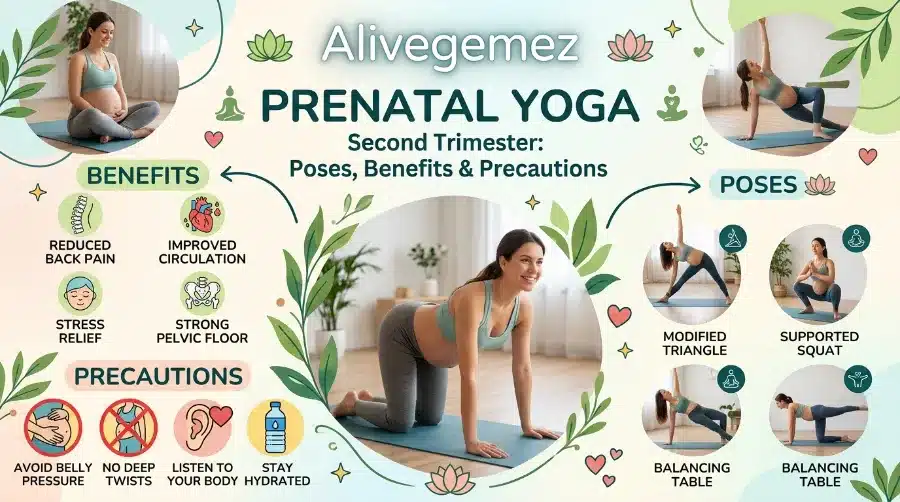
Your uterus is now rising out of the pelvis, so morning sickness typically fades, appetite comes back, energy returns. This is often called the “honeymoon phase” of pregnancy for good reason. Your center of gravity is moving forward though, your ribcage is starting to expand, your lower back is taking on new pressure it didn’t carry a month ago.
Prenatal Yoga Second Trimester: Poses, Benefits and Precautions
Here’s what matters for your practice: a pregnancy yoga second trimester routine has to account for a body that’s changing weekly, not a body that’s stable. What felt fine at week 15 might feel completely different at week 22. If you already read our guide to prenatal yoga first trimester practice, you know the theme continues here, listen first, push never.
The Real Benefits Of Prenatal Yoga Second Trimester Practice
I don’t like vague wellness promises, so let’s be specific. Research from the American College of Obstetricians and Gynecologists notes that people who exercise regularly through pregnancy show lower rates of gestational diabetes, high blood pressure, cesarean delivery, plus faster postpartum recovery. Prenatal yoga sits comfortably inside that recommended activity range for most low-risk pregnancies.
Beyond the clinical data, here’s what I actually see in students practicing 2nd trimester yoga safe routines week after week:
- Less back and hip pain. As your belly grows, your lumbar spine compensates. Gentle backbends, hip openers, cat-cow flows relieve that pressure fast.
- Better sleep. Combining movement with breathwork lowers cortisol, which is often the hidden reason pregnant clients can’t switch their brain off at night.
- Improved digestion. Twists (the safe, open kind), forward folds with space for the belly, stimulate sluggish digestion, a very common second trimester complaint.
- Reduced swelling. Circulation-focused poses, especially anything involving elevated legs, help manage the fluid retention that often starts showing up around this stage.
- Stronger pelvic floor plus core awareness. This becomes directly useful during labor, then again during postpartum recovery.
- Lower anxiety. Prenatal students consistently report that a regular practice, even just 20 minutes, calms the racing thoughts that tend to show up mid-pregnancy.
One of my longtime clients, a 34-year-old teacher I worked with in 2023, started a three-times-a-week prenatal yoga second trimester practice at week 15 after struggling with sciatic pain since her first trimester ended. By week 24, she told me her pain had dropped from a daily 6 out of 10 to an occasional 2. That’s not a guarantee for everyone, but it’s a pattern I’ve watched repeat itself with dozens of students who commit to consistent, gentle practice rather than sporadic intense sessions.
If back pain specifically is your main concern right now, this detailed breakdown of second trimester pregnancy back pain is worth a read alongside this guide.
Best Prenatal Yoga Second Trimester Poses (With Modifications)
This is the part everyone actually wants, so let’s get into it. Every pose below works well for a typical yoga pregnancy second trimester body, roughly weeks 14 through 26, assuming a low-risk pregnancy with provider clearance.
- Cat-Cow (Marjaryasana-Bitilasana) — Mobilizes the spine, relieves lower back tension, feels almost immediately good. Do 8-10 slow rounds.
- Supported Warrior II — Builds leg strength, opens the hips, improves the balance that starts feeling shakier around week 20. Use a wall for extra support if needed.
- Wide-Legged Forward Fold (with a block under your hands) — Creates space for the belly, gently lengthens the hamstrings without any compression.
- Seated Side Bend — Opens the ribcage, which is expanding to make room for your growing uterus, often relieves that “can’t take a full breath” feeling.
- Gentle Open Twist (from the upper back, not the belly) — Aids digestion, releases tension between the shoulder blades, a common complaint by week 18 or so.
- Supported Bridge Pose (with a block under the sacrum) — A gentle backbend that opens the chest, counters the forward-rounding shoulders pregnancy tends to cause.
- Goddess Pose — Strengthens the inner thighs, pelvic floor, hips, directly useful for labor positioning later.
- Side-Lying Savasana — Replaces traditional Savasana once lying flat on your back stops feeling comfortable, usually somewhere between weeks 18 and 22.
For a full guided sequence with props plus hold times, Yoga International’s prenatal yoga sequence for your second trimester is one of the better structured routines available online, plus it pairs nicely with the poses above. Olaben also put together a solid yoga routine for the second trimester if you want a second reference point before building your own flow.
Second Trimester Yoga Safety: What To Avoid, Why It Matters
This is the section I wish more blogs took seriously instead of glossing over. A safe prenatal yoga second trimester practice depends as much on what you skip as what you do.
Avoid these:
- Lying flat on your back for extended periods past roughly week 20, since the weight of your uterus can compress the vena cava, reducing blood flow, sometimes causing dizziness or nausea
- Deep abdominal compression, including tight closed twists, intense boat pose holds, long plank holds
- Belly-down (prone) poses like Bow Pose, Locust Pose, Superman
- Hot yoga, power vinyasa, or any class that pushes your heart rate into a genuinely strenuous zone
- Fast, jumpy transitions between poses, since your loosened joints are more prone to strain
- New, unfamiliar balance poses without support, since your center of gravity keeps shifting
A few smart safety habits:
- Keep a water bottle within reach; dehydration risk rises during pregnancy
- Use props generously, blocks, bolsters, a wall, a chair, there’s zero shame in modifying
- Stop immediately if you feel dizziness, shortness of breath, unusual cramping, or reduced fetal movement, then call your provider
- Check in with your OB or midwife before starting, especially if you have a high-risk pregnancy, placenta previa, or a history of preterm labor
The ACOG’s own guidance is refreshingly direct on this point: exercise is considered safe plus desirable for most pregnant people without medical complications. That said, “safe” always depends on your individual history, so this general framework is not a substitute for a conversation with your own doctor.
If you started your practice earlier in pregnancy plus want a refresher on what was, or wasn’t, considered safe at the time, our guide on prenatal yoga first trimester safe practices covers the earlier-stage precautions in detail.
The 4-7-8 Breathing Technique: How To Do It, When To Use It
Breath is half of yoga, and honestly, it might be the more valuable half during pregnancy. The 4-7-8 breathing technique, popularized by Dr. Andrew Weil, is one of the simplest tools I hand my prenatal students, especially once second trimester anxiety or restless sleep starts creeping in.
How to do it:
- Exhale completely through your mouth
- Close your mouth, inhale quietly through your nose for a count of 4
- Hold the breath gently for a count of 7
- Exhale completely through your mouth, making a soft “whoosh” sound, for a count of 8
- Repeat for 3-4 rounds
An important modification for pregnancy: most childbirth educators, plus several prenatal specialists, recommend shortening the hold portion during pregnancy, using a 4-4-8 or 4-5-8 pattern instead of a full 7-count hold. Extended breath-holding isn’t ideal for pregnant bodies, so this small adjustment keeps the calming benefit without the strain.
When to use it:
- Before bed, when pregnancy insomnia hits (extremely common by the second trimester)
- During a moment of acute anxiety or overwhelm
- Right before a prenatal appointment if nerves are running high
- As a closing practice at the end of your prenatal yoga second trimester session
The technique works by activating your parasympathetic nervous system, essentially telling your body it’s safe to relax. Combined with a physical practice, it’s one of the fastest tools I’ve seen for calming a racing mind mid-pregnancy.
Building A Simple Weekly Prenatal Yoga Second Trimester Routine
Consistency beats intensity here, always. A realistic weekly rhythm for most healthy second trimester bodies looks something like this.
| Day | Focus | Duration |
|---|---|---|
| Monday | Standing poses plus hip openers | 25-30 min |
| Tuesday | Rest or gentle walk | — |
| Wednesday | Cat-cow, seated twists, breathwork | 20 min |
| Thursday | Strength-focused flow (Warrior series, Goddess pose) | 30 min |
| Friday | Rest or light stretching | 10-15 min |
| Saturday | Full restorative session, side-lying savasana | 30-40 min |
| Sunday | Rest or prenatal class with community | — |
This structure keeps you inside the ACOG-recommended range of moderate activity most days of the week without overloading a body that’s already working hard to grow a person.
Prenatal Yoga By Trimester: A Quick Comparison
Sometimes seeing the full picture side by side makes the second trimester’s advantages clearer.
| Factor | First Trimester | Second Trimester | Third Trimester |
|---|---|---|---|
| Energy levels | Often low, fatigue-heavy | Peak energy, “honeymoon phase” | Declining, heavier, slower |
| Balance | Mostly stable | Starting to shift | Significantly altered |
| Best focus | Gentle movement, rest | Building strength, stamina | Restorative, labor prep |
| Main caution | Overheating, overexertion | Belly compression, back-lying | Balance, swelling, fatigue |
| Ideal session length | 15-25 min | 20-45 min | 15-30 min |
Visualized as relative comfort plus energy across pregnancy, the pattern generally looks like this:
Energy & Comfort Trend Across Pregnancy (relative scale)

First Trimester   ███░░░░░░░  (low-moderate)
Second Trimester  ████████░░  (high)
Third Trimester   █████░░░░░  (moderate, declining)
This is exactly why so many providers, including instructors at UK studios like triyoga, actually recommend starting a dedicated prenatal yoga second trimester practice even for people who did nothing structured during the first trimester.
Keyword And Content Gaps We Found (And Filled)
While researching this guide, we looked closely at ten of the top-ranking US, UK, plus Europe-based resources on this topic, including Healthline, Yoga International, Americord, Art of Living, PregActive, Sampoornayoga, Parenting FirstCry, the Peloton blog, Olaben, plus triyoga in the UK. A few patterns stood out.

Most of these sites rank well for broad terms like “prenatal yoga poses,” “pregnancy yoga second trimester,” “safe yoga during pregnancy,” plus general trimester-by-trimester breakdowns. What almost none of them cover in real depth: how breathing techniques like 4-7-8 specifically apply to second trimester anxiety plus sleep, real weekly routine structures with rest days built in, or an honest side-by-side comparison of what changes physically from trimester to trimester rather than treating pregnancy as one static state.
That gap is exactly what this guide set out to close, combining the pose plus safety information competitors cover well with the practical routine building, breathwork integration, plus trimester comparisons most of them skip.
Frequently Asked Questions
Is prenatal yoga second trimester practice safe for beginners?
Generally yes, assuming a low-risk pregnancy plus provider clearance. The second trimester is actually one of the better times to start yoga for the first time, since energy has usually returned plus the belly isn’t yet large enough to limit movement significantly.
What is prenatal 20 weeks yoga supposed to look like?
By week 20, most instructors recommend shifting away from any pose requiring extended time flat on your back, adding more standing plus side-lying options instead. This is also a common point where balance starts feeling noticeably different, so wall or chair support becomes more useful.
How many times a week should I practice yoga pregnancy second trimester style?
Three to five sessions a week, 20 to 45 minutes each, at a moderate intensity, fits comfortably within ACOG’s general activity guidelines for most healthy pregnancies.
Can 2nd trimester yoga safe practice help with labor prep?
Yes. Poses that strengthen the pelvic floor, open the hips, build core stability, such as Goddess Pose plus supported squats, are commonly used in childbirth preparation classes for exactly this reason.
Is hot yoga ever okay during the second trimester?
No. Overheating raises risks for both parent plus baby, so hot yoga, power vinyasa, plus any high-heat class should be avoided throughout pregnancy, not just the second trimester.
Quick Quiz: Test Your Prenatal Yoga Second Trimester Knowledge
1. Around what week should you generally stop lying flat on your back for extended periods? A) Week 8 B) Week 20 C) Week 35
2. Which of these poses should be avoided during the second trimester? A) Cat-Cow B) Bow Pose (belly-down) C) Supported Bridge
3. What is the modified breath-hold count for 4-7-8 breathing during pregnancy? A) 4-7-8 (unchanged) B) 4-4-8 or 4-5-8 C) 10-10-10
4. How many sessions per week does a typical second trimester routine include? A) 1 session B) 3-5 sessions C) 7 sessions daily
5. What is the second trimester generally known as among prenatal instructors? A) The danger zone B) The honeymoon phase C) The final stretch
Answer Key: 1-B, 2-B, 3-B, 4-B, 5-B
Conclusion
Prenatal yoga second trimester practice genuinely earns its reputation as the sweet spot of pregnancy fitness. Your energy is back, your body still moves with relative ease, plus every gentle backbend, hip opener, mindful breath you take now is quietly preparing you for labor, postpartum recovery, the months ahead. Start slow, listen closely, lean on props whenever needed, keep your provider looped in. That combination, more than any single pose, is what actually makes this stage of your practice both safe plus deeply worthwhile. For more guidance across every stage of pregnancy, explore the full library of prenatal wellness guides at RealYogaHub.
References
- American College of Obstetricians and Gynecologists (ACOG). Exercise During Pregnancy. acog.org
- Healthline. Prenatal Yoga Poses for Strength and Soothing, Every Trimester. healthline.com
- Yoga International. A Prenatal Yoga Sequence for Your Second Trimester. yogainternational.com
- Cleveland Clinic. How To Do the 4-7-8 Breathing Exercise. health.clevelandclinic.org
- Medical News Today. 4-7-8 Breathing: How It Works, Benefits, Techniques, Uses. medicalnewstoday.com
- Olaben. The Best Yoga Routine for the Second Trimester. olaben.com
- iShine Yoga. Second Trimester Pregnancy Back Pain. ishineyoga.com