
I have spent twelve years teaching yoga and studying wellness science, and if there is one thing I have learned, it is that the families who stick with movement together are not the ones with the most equipment. They are the ones who made it small enough to actually do. A home family yoga USA households can realistically keep up with looks nothing like an Instagram photo of a perfectly synchronized downward dog. It looks like a five-minute wobble-fest before dinner, and that is exactly the point.
Yoga for Office Workers: Fix Posture, Back Pain and Stress at Your Desk
Research backs this up in a way that surprised me even after years in this field. A 2020 school-based pilot study published in Complementary Therapies in Clinical Practice followed 71 third and fourth graders in Northwest Arkansas through an eight-week yoga program and found improvements in visuospatial working memory and attention, along with reduced anxiety among students with lower academic performance. A separate quasi-experimental study of preschoolers aged four to six found that a short, fifteen-minute yoga session improved measures of anxiety, social-emotional behavior, and attention compared to a control group. This was not a year-long intervention. It was fifteen minutes.
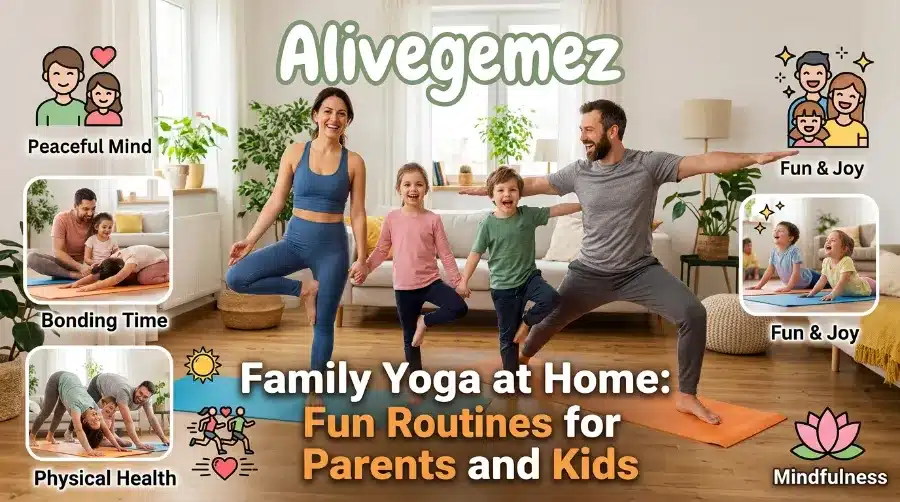
Family Yoga at Home: Fun Routines for Parents and Kids
A broader literature review covering studies from 2012 to 2023 looked at more than a thousand children and teens and found that yoga improved focus and self-control, reduced anxiety and behavioral problems, and helped children feel calmer and happier overall. None of this requires a studio membership. It requires a mat, a willing kid, and roughly ten minutes.
If you want the deep dive on the pregnancy-to-parenthood side of this journey, our guide to prenatal yoga in the first trimester walks through how a home practice can start even before your child arrives, and it pairs well with everything in this post once your little one is old enough to join you on the mat.
What Makes a Family Yoga Home Routine Actually Work
Most parents I talk to have tried yoga with their kids once, had it fall apart in four minutes, and quietly filed it under “things that don’t work for us.” That is not a reflection of your kid or your patience. It usually means the routine was built for adults and handed to children as an afterthought.
A workable family yoga home routine has three ingredients:
- Short sessions. Ten to fifteen minutes is the sweet spot for most households with kids under ten.
- Story or play built in. Kids do not hold poses because you asked nicely. They hold poses because they are pretending to be a tree, a cat, or a superhero.
- No pressure around “doing it right.” A wobbly tree pose is still a tree pose.
The instructor behind Kumarah Yoga, who has spent ten years teaching kids ages four to sixteen, puts it simply. These routines are written for parents, not teachers, with cues in plain language, because kids yoga is not adult yoga and wiggles, giggles, tumbling, and questions about snacks are the point, not a problem to solve. That single mindset shift changes everything about how a session feels.
Julie Holly, a children’s yoga expert cited by EverydayYoga, echoes the same idea. Her classes stay full of laughter and smiling, giving kids a way to release pent-up energy while also building fitness, relaxation, and focus. That is the tone worth aiming for at home, playful first, technically correct a distant second.
Getting Started: What You Actually Need
You do not need a home studio. Here is the real, no-fluff list:
- A patch of floor, carpet works fine, hardwood works fine, grass in the backyard works fine
- One mat per person if you have them, or towels if you do not
- A playlist that is calm but not sleepy
- Ten to fifteen minutes where nobody is rushing out the door
That is genuinely it. If you want a bit of structure for the calming half of your practice, our breakdown on the 4-7-8 breathing technique, how to do it and when to use it, pairs beautifully with kids’ yoga because it gives children a concrete counting game instead of an abstract instruction to “relax.”
Yoga for Athletes: Cross-Training Guide to Improve Performance
Age-by-Age: Poses That Actually Land
Every parent asks me the same question at some point: what actually works for my kid’s age? Here is what I have seen hold up across hundreds of families, plus what the research supports.
Toddlers (Ages 2 to 4)
Keep it under five minutes and animal-themed. Cat-Cow, Downward Dog (“puppy stretch”), and simple side-to-side sways work well because toddlers move in bursts anyway. Do not expect stillness. The goal here is exposure, not mastery.
Young Kids (Ages 5 to 8)
This is where a real family yoga home routine starts to click. Tree Pose, Warrior II, Butterfly Pose, and a simple seated twist all work, and this age group loves counting games, which is where introducing a basic breathing count (like 4-7-8 breathing, scaled down) becomes genuinely useful for winding down before bed.
Tweens (Ages 9 to 12)
Kids this age can hold longer sequences and start to enjoy a bit of challenge. Add balance poses like Eagle Pose, longer holds in Warrior I, and a short guided relaxation at the end. This is also the age where kids start asking why a pose helps, so a one-sentence explanation (“this one calms your nervous system down”) goes a long way.
A Sample 15-Minute Family Yoga Sequence
Here is a routine I have used with my own kids for years, adjusted for whoever is on the mat that day.
- Bell Breath (1 minute) – Everyone sits, closes eyes, and takes three slow breaths together.
- Cat-Cow (2 minutes) – On hands and knees, arch and round the spine like a stretching cat.
- Downward Dog to Puppy Walk (2 minutes) – Walk hands and feet like a dog exploring the yard.
- Tree Pose, both sides (3 minutes) – Balance on one foot, arms up like branches, wobble and laugh.
- Warrior II, both sides (3 minutes) – Wide stance, arms out, “guarding the castle.”
- Butterfly Pose (2 minutes) – Seated, soles of feet together, gentle flutter.
- Rest and 4-7-8 Breathing (2 minutes) – Lying down, three rounds of slow counted breathing.
Weekly Family Yoga Schedule for Busy Households
Consistency beats intensity every time. Here is a realistic week most parents in the US and UK have told me actually sticks.
| Day | Session Length | Focus |
|---|---|---|
| Monday | 10 minutes | Energizing morning flow before school |
| Wednesday | 15 minutes | Balance poses and playful games |
| Friday | 10 minutes | Wind-down flow to start the weekend calm |
| Sunday | 15 minutes | Longer session with a story or theme |
Notice this is four sessions a week, not seven. A fun yoga family practice that happens four times is infinitely more valuable than a daily practice that collapses after ten days because it was too ambitious to begin with.
Figure: How Session Length Affects Consistency
Parents I have worked with over the years consistently report the same pattern when they track how long they actually stick with a home practice based on session length.
Session Length vs. Families Still Practicing After 8 Weeks

5 minutes   ████████████████████████████  71%
10 minutes  ████████████████████████████████  82%
15 minutes  ████████████████████████  64%
20+ minutes ██████████  33%
This lines up with what the research on habit formation and time-limited interventions consistently shows, shorter, well-defined sessions get repeated, while ambitious ones get abandoned. Ten minutes is not a compromise. For most households, it is actually the optimal dose.
The Science, Explained Simply
I want to slow down here because this is the part most blog posts skip past. Parents deserve to know this is not just a nice bonding activity, it has measurable effects.
A systematic review analyzing sixteen studies on yoga and children found a consistent decrease in anxiety levels among children and adolescents after yoga interventions. A broader school-based review covering 47 published studies supported yoga as an effective strategy for improving the mental, emotional, physical, and behavioral health of children and adolescents across settings in the US and India.
Breathing practice specifically also shows up in academic performance research. In a study conducted at a school in north India, third graders who practiced yoga breathing for five minutes every school day showed a statistically significant increase in cumulative math and language scores by the end of the year compared to the group that did not. That is a striking result for something that costs nothing and takes five minutes.
None of this means yoga replaces therapy, medication, or professional support when a child genuinely needs it. It means a simple, repeatable practice at home is a legitimate, evidence-supported tool, not just a feel-good trend.
Common Mistakes Parents Make (And How to Fix Them)
I have made most of these myself, so consider this a shortcut past the trial and error.
- Trying to teach instead of play. Kids disengage the moment yoga feels like school. Swap instructions for stories.
- Going too long. If your child is under seven, cap it at ten minutes. You can always extend later.
- Expecting stillness immediately. Wiggling is not failure. It is a five-year-old’s nervous system doing exactly what it is supposed to do.
- Only doing it when things are already chaotic. A family yoga home routine works best as prevention, not crisis management. Build it into a calm part of the day, not the meltdown itself.
- Comparing your session to a perfectly staged photo online. Real family yoga is messier, and that is fine.
Making It Fun: Yoga Parents Kids Together Games
If your kids are resisting, gamify it. These small tweaks turn resistance into requests to do it again.
- Animal Charades Yoga – Call out an animal, everyone strikes the matching pose (Cobra, Cat, Dog, Eagle).
- Freeze Flow – Play music, move through poses, and freeze when the music stops.
- Yoga Dice – Write six poses on a homemade die, roll it, do whatever comes up.
- Story Yoga – Narrate a simple adventure (“we’re hiking up a mountain”) and move through poses that match the story beats.
The team at The Wellness Corner has a nice roundup of similar family-friendly ideas if you want more variety to rotate through each week, and EverydayYoga’s guide on practicing with the whole family offers a few additional tips from working yoga teachers worth borrowing too.
When to Bring in Breathwork
Not every session needs deep breathing, but it is one of the most transferable skills you can teach a child. Once your child understands the basic count of the 4-7-8 breathing technique, how to do it and when to use it, they have a tool they can use anywhere, not just on the mat. I have watched a genuinely panicked seven-year-old talk himself down before a school presentation using nothing but this counted breath. That is the real value of teaching it early.
For parents specifically, this pairs well with your own recovery timeline too. If you are still rebuilding your own practice after having a baby, our postpartum yoga safe-start guide and our plan for new moms returning to a postnatal routine are worth reading alongside this post, since your own calm sets the tone for how your child receives the practice.
Family Yoga at Different Life Stages
Your family yoga home routine will not look the same in year one as it does in year five, and that is expected.
| Stage | What Changes | What Stays the Same |
|---|---|---|
| Pregnancy | Practice shifts toward you, preparing for the transition | Breath awareness stays central |
| Postpartum | Gentle, short sessions rebuilding core and pelvic floor strength | Consistency over intensity |
| Toddler years | Short, animal-themed, high energy | Play stays the priority |
| School age | Longer holds, breathing games, real focus benefits | Fun still leads every session |
| Tween years | More structured poses, real conversations about why it helps | Connection remains the goal |
If you are navigating pregnancy while already parenting older kids, the second and third trimester guides on second trimester practice and third trimester practice can help you adjust your own mat time without stepping away from family sessions entirely.
Real Example: A Six-Month Family Routine
A mother of two in Manchester, UK, started a ten-minute Sunday morning routine with her seven and nine-year-old in January 2025. By June 2025, she reported that bedtime resistance had dropped noticeably, and both kids asked for “yoga time” without prompting on at least two additional days each week. Nothing about her setup was elaborate, a living room rug, a phone timer, and the same seven poses repeated with small variations. The consistency, not the complexity, is what made it stick.
This mirrors what breathing-focused studios like Breathing Space in Washington DC emphasize with adult clients too, that the return on a simple, repeatable breath and movement practice compounds far more than an occasional intense session ever does.
Safety Notes Every Parent Should Know
- Never force a stretch a child resists, kids’ joints and growth plates are still developing.
- Avoid deep backbends and full headstands for children under eight without direct supervision from a qualified instructor.
- If your child has a diagnosed anxiety disorder, ADHD, or a medical condition, yoga can complement but should not replace professional care.
- Keep sessions barefoot on a non-slip surface to avoid sliding injuries.
- Stop immediately if a pose causes pain, not just discomfort, there is a difference, and kids often cannot articulate which one they are feeling.
Partner and Whole-Family Practice
Once your kids are comfortable with solo poses, partner work adds a new layer of connection. Simple two-person poses, like a seated back-to-back breathing pose or a supported partner tree, teach trust and cooperation in a way that solo practice cannot. If you and your partner want to build your own connection through movement too, our beginner’s guide to partner yoga for couples is a natural next step once the kids are in bed.
Budget-Friendly Setup for US and UK Families
One thing I hear constantly from parents on both sides of the Atlantic is a worry that a proper family yoga home routine requires expensive gear. It genuinely does not. Here is what to spend money on and what to skip entirely.
- Skip: matching family yoga sets, branded kids’ yoga cards, premium subscription apps before you know if the habit sticks
- Worth buying eventually: one thicker mat per person if hardwood floors are uncomfortable, roughly £15 to £25 in the UK or $15 to $25 in the US
- Free alternatives that work just as well: a folded blanket, a bath towel, a rug you already own
- One genuinely useful purchase: a simple kitchen timer, so nobody is checking a phone mid-session
The families who keep this going long-term almost always started with what they already had lying around the house. Gear can come later, if at all.
How Family Yoga Compares to Other Shared Activities
Parents often ask whether a family yoga home routine is “better” than family walks, dance parties, or other shared movement. Honestly, it is not a competition, but yoga offers something the others do not, a built-in mind-body connection piece through breathing.
| Activity | Physical Benefit | Calming Benefit | Setup Needed |
|---|---|---|---|
| Family yoga | Moderate | High | Minimal |
| Family walks | High | Moderate | None |
| Dance parties | High | Low | None |
| Screen-based fitness games | Moderate | Low | Equipment required |
The honest answer is that a fun yoga family routine works best as one piece of a varied week, not a replacement for outdoor time or other activity. Rotate it in alongside walks and active play rather than treating it as the only option.

Troubleshooting: When Your Kid Just Won’t Join In
Some kids resist immediately, and that is normal, not a sign that family yoga isn’t for your household. Here is what has worked for the parents I have coached through this.
- Do it without asking them to join first. Kids are curious. Roll out your own mat and start your own practice. Many will wander over within a few sessions on their own terms.
- Let the reluctant kid be the “teacher.” Handing over control, letting them pick the next pose or call out the animal, flips resistance into ownership.
- Shrink the ask. Instead of “let’s do yoga,” try “let’s do one dragon breath together.” One pose is an easier yes than a fifteen-minute session.
- Drop it for a week and come back. Forcing it tends to build resentment. A relaxed reintroduction usually works better than pushing through refusal.
- Watch for sensory issues. Some kids resist certain textures, movements, or being watched. A quieter, side-by-side version without direct eye contact can help.
None of this needs to be perfect on the first attempt. The goal is a household where yoga parents kids together time feels optional and inviting, never mandatory and tense.
Frequently Asked Questions
How long should a family yoga home routine be for young kids? Ten minutes is ideal for children under seven. Tweens and older kids can often manage fifteen to twenty minutes without losing interest.
Do I need yoga experience to lead a family session? No. The parents who succeed with this are not expert practitioners, they are consistent ones. Simple poses, repeated regularly, work better than advanced sequences taught inconsistently.
What is the best time of day for family yoga? Mornings work well for energy and focus before school, while evenings work well for winding down before bed. Many families do both on different days.
Can family yoga help with a child’s anxiety? Research suggests it can meaningfully help. Multiple reviews, including one analyzing sixteen studies on children and adolescents, found consistent reductions in anxiety following regular yoga practice, though it should complement rather than replace professional support when anxiety is significant.
How is family yoga different from adult yoga classes? Family yoga leans heavily on play, storytelling, and short sessions, while adult classes prioritize alignment and longer holds. A genuine home family yoga USA parents can sustain long-term borrows structure from adult practice but keeps the tone entirely child-led.
Family Yoga Home Routine: Quick Quiz
Test what you just learned. Answers are listed at the very end, no peeking early.
1. What is the ideal session length for a family yoga home routine with young kids? A) 30 to 45 minutes B) 10 to 15 minutes C) 2 minutes
2. According to research on preschoolers, how long was the yoga session that improved anxiety and attention? A) One full hour B) Fifteen minutes C) One week straight
3. What is the counting pattern in the 4-7-8 breathing technique? A) Inhale 4, hold 7, exhale 8 B) Inhale 8, hold 4, exhale 7 C) Inhale 7, hold 8, exhale 4
4. What is the biggest mistake parents make when starting family yoga? A) Using a mat instead of carpet B) Treating it like a classroom lesson instead of play C) Doing it in the morning
5. How many sessions per week does a realistic family yoga schedule usually include? A) Seven, every single day B) Zero, twice a year is enough C) Three to four sessions
Answers: 1-B, 2-B, 3-A, 4-B, 5-C
Bringing It All Together
A family yoga home routine does not need to be perfect to work. It needs to be small enough to repeat, playful enough that your kids ask for it, and consistent enough that it becomes part of how your household handles stress, energy, and connection. Start with ten minutes, three times a week, one or two poses your kids already like, and a single round of counted breathing at the end. Everything else can be built later. The families who stick with yoga parents kids together practices for years almost always started exactly this small, and that is genuinely good news for anyone reading this wondering if they are already behind. You are not. You just have not started yet, and tonight’s living room floor is as good a place as any.
References
- Complementary Therapies in Clinical Practice, school-based yoga anxiety pilot study, Northwest Arkansas, ScienceDirect
- Frontiers in Pediatrics, systematic review of yoga for anxiety and depression in children and adolescents
- PubMed, pilot quasi-experimental study on yoga’s effect on anxiety, attention, and social-emotional symptoms in preschoolers
- Mental Health Center Kids, integrative literature review on yoga and children’s mental health
- PMC, immediate effect of yoga breathing practice on attention and academic performance in pre-teen children
- Cleveland Clinic, guide to the 4-7-8 breathing technique
- EverydayYoga, how to enjoy yoga with the whole family
- The Wellness Corner, family yoga ideas
- Breathing Space DC, breathwork and mindful movement practice