
Somewhere around week three with my first baby, I rolled out my mat, dropped into child’s pose, and burst into tears. It wasn’t pain. My body finally felt like mine again, if only for four minutes. That’s really what a postpartum yoga safe start is about. It’s not about bouncing back or fitting into old jeans. It’s about quietly getting your body and your nervous system back on speaking terms. If you’ve typed “when can I start yoga after having a baby” into Google at 2 a.m. while nursing, you’re exactly who this guide is for.
Key Takeaways
| Question | Quick Answer |
|---|---|
| When can I start postpartum yoga after a vaginal birth? | Usually 6 weeks, with your provider’s clearance; gentle breathing and pelvic tilts can begin much sooner |
| When can I start yoga after a c-section? | Most clinicians say 8–12 weeks, sometimes longer, since it’s major abdominal surgery |
| First poses to try | Diaphragmatic breathing, cat-cow, supported reclined bound angle, gentle pelvic tilts |
| Poses to avoid early on | Full boat pose, deep backbends, intense twists, crunches, anything that domes your belly |
| Biggest safety flag | Doming or coning of the abdomen, pain, or leaking urine — stop and check with a pelvic floor specialist |
| How long a session should be | 15–30 minutes to start, a few times a week, building slowly |
TL;DR: Most doctors clear gentle postpartum yoga around 6 weeks after an uncomplicated vaginal birth and 8–12 weeks after a c-section. Pelvic floor breathing and pelvic tilts, though, are safe within days. Start slow, skip deep core work and backbends until your abdominal wall has actually healed, and let pain or doming be your stop sign rather than the calendar.
When Is It Actually Safe to Start Postpartum Yoga?
There’s no single magic date. Anyone who gives you one without asking about your delivery is guessing. What matters is how you gave birth, whether you tore or had a c-section, and how your body is talking to you right now.
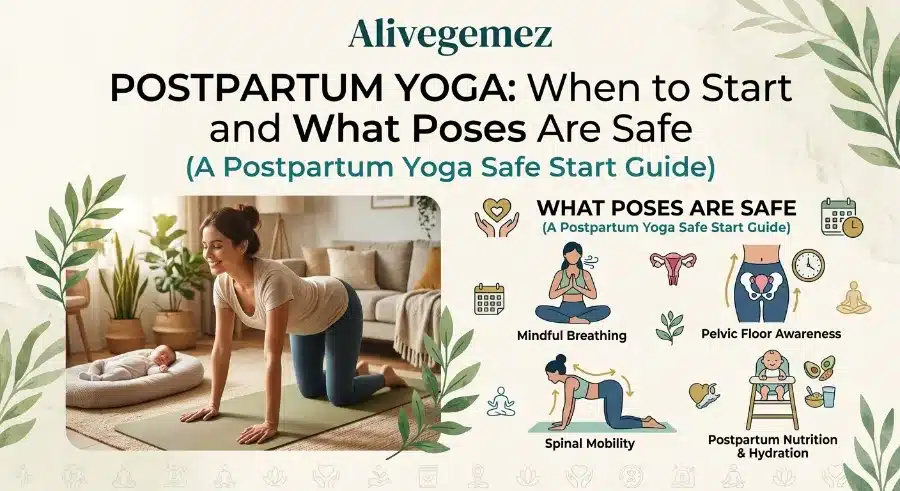
ACOG doesn’t treat postpartum movement as an afterthought. Its guidance frames the fourth trimester as an active recovery window, recommending simple exercises that strengthen major muscle groups like the abdominals and back before gradually adding moderate activity. In plain terms: start small, build slowly, and let your body set the pace rather than a fitness influencer’s six-week challenge.
Partner Yoga for Couples: Beginner Poses and Benefits
Vaginal Birth: The 6-Week Rule of Thumb
For an uncomplicated vaginal delivery, most OBs and pelvic floor physios describe a similar shape of timeline, even when the wording differs:
- Days 1–7: Pelvic floor breathing and gentle Kegels, nothing structured
- Weeks 2–5: Walking, diaphragmatic breathing, light stretching
- Week 6: Cleared for gentle yoga, swimming, and low-impact movement after your postnatal check
- Week 12+: Green light for more vigorous or high-impact practice, if you feel ready
UK guidance lines up closely with this. NHS physiotherapy resources describe gentle exercise, like walking and pelvic floor work, as fine in the first six weeks. Low-impact exercise such as swimming, yoga, and Pilates tends to get introduced gradually from around week six, with higher-impact training held off until at least twelve weeks. Whether you’re recovering in Ohio or Oxfordshire, the practical timeline barely changes.
Here’s a detail that surprises a lot of new moms: pelvic floor work doesn’t wait for week six at all. UK maternity physiotherapy teams routinely tell patients that pelvic floor exercises can start gently on the very first day after birth, vaginal or c-section, unless a clinician advises otherwise. So the breath-and-pelvic-floor piece of yoga isn’t something you’re waiting on. You can begin today, even before your body is ready for a single pose.
Yoga for New Moms: A 6-Week Postnatal Recovery Plan
Yoga After C-Section: What “Safe” Really Means
A c-section is major abdominal surgery, full stop. That’s why “yoga after c-section safe” searches turn up a wider range of answers than vaginal recovery does. Recommendations across physical therapy clinics and yoga teacher training programs range from 8 weeks on the earlier end to 3 months on the more conservative end, depending on incision healing and your surgeon’s follow-up notes.
Yoga for Office Workers: Fix Posture, Back Pain and Stress at Your Desk
Here’s a useful way to picture the healing curve after a c-section:
| Weeks Postpartum | What’s Typically Happening | Movement You Can Do |
|---|---|---|
| 0–6 weeks | Incision closing, uterus shrinking, core still very vulnerable | Belly breathing, pelvic floor squeezes, gentle walking |
| 6–12 weeks | Scar maturing, deeper tissue still fragile under the surface | Seated stretches, cat-cow, supported hip openers, no direct core pressure |
| 12 weeks+ | Most people cleared for low-impact movement with medical sign-off | Gentle standing poses, modified planks on knees, easy twists |
| 4–6 months | Scar tissue fully remodeling, full range of motion often restored | Gradual return to a fuller practice, always listening to the incision |
Seeing the two recovery paths side by side, as in the chart above, makes the gap easier to feel than any single number does. That gap between vaginal recovery and c-section recovery is exactly why a generic “6 week rule” floating around Pinterest does new moms a disservice. Your incision, your bleeding, and your energy levels decide your timeline, not a one-size-fits-all checklist.
If you practiced prenatal yoga during your third trimester, your body already knows some of this language: the slow breath, the supported shapes, the permission to modify. That familiarity genuinely helps postpartum recovery go smoother, since you’re not learning yoga and healing from birth at the same time.
Yoga for Athletes: Cross-Training Guide to Improve Performance
Postnatal Yoga USA vs. What You See Online
Here’s something worth naming honestly: a lot of postnatal yoga USA content online skips straight to “bounce back” poses, ab work, and 30-day core challenges within weeks of delivery. It looks motivating. It’s often not medically sound. Postpartum recovery research and physical therapy guidance both point the same direction: your deep core and pelvic floor need time, not intensity, in these early months.
Family Yoga at Home: Fun Routines for Parents and Kids
Something else stood out when I looked across the top-ranking content in this space. Most of it clusters around a narrow set of angles: diastasis recti pose lists, c-section timing FAQs, and generic “best postpartum yoga poses” roundups. Very little talks about the emotional side of a postpartum yoga safe start, breastfeeding-friendly modifications, or how breathwork like the 4-7-8 technique fits into recovery. That’s a gap worth filling, since the fourth trimester is as much a nervous-system reset as a physical one.
Safe Postpartum Yoga Poses by Recovery Stage
Once you have medical clearance, here’s how I sequence a first postpartum yoga practice with new moms in my studio, whether they’re 6 weeks out from a vaginal birth or 10 weeks past a c-section.
Stage 1 — Weeks 1 to 6 (breath and awareness, no formal “poses” yet):
- Diaphragmatic belly breathing, lying on your back with knees bent
- Gentle pelvic tilts, moving slowly with the breath
- Seated neck and shoulder rolls to release nursing-related tension
- Supported reclined bound angle pose, propped on pillows, for pure rest
Stage 2 — Weeks 6 to 12 (gentle movement, cleared by your provider):
- Cat-cow, moving slowly and stopping at any doming through the belly
- Child’s pose, knees wide to avoid pressure on the abdomen
- Seated forward fold, hips higher than knees on a block or cushion
- Bridge pose, low and controlled, squeezing the glutes rather than arching hard
- Gentle standing forward fold with soft knees
Stage 3 — 12 weeks and beyond, with clearance:
- Modified plank on the knees, only without coning at the midline
- Easy standing twists, rotating from the ribs rather than forcing the low back
- Low lunge with support, rebuilding hip strength gradually
- Legs-up-the-wall pose, wonderful for swelling, circulation, and simply lying still for once
Breath does more work than the pose itself throughout every stage. A technique like 4-7-8 breathing — inhale for four counts, hold for seven, exhale for eight — can genuinely calm a wired, sleep-deprived nervous system between feeds. It pairs beautifully with these gentler shapes.
Poses and Movements to Skip Early On
A physical therapist once told me the core doesn’t know the difference between a crunch and a “yoga pose” that mimics one, and she’s right. Until you’re specifically cleared, ideally by a pelvic floor physical therapist, skip these:
- Full boat pose and other deep core flexion poses
- Deep backbends like full wheel or full cobra
- Intense twists that compress the abdomen
- Traditional plank held for long periods
- Any inversion, including headstand or forearm stand
- Fast vinyasa flow before your body has rebuilt basic core stability
Doming, coning, or bulging along your midline during a movement is your body flagging that the connective tissue there, called the linea alba, isn’t ready for that load yet. Back off, and consider asking your doctor for a referral to a pelvic floor specialist.
Diastasis Recti: The Most Common Postpartum Concern
Nearly every pregnant person develops some degree of abdominal separation, called diastasis recti, since the belly stretches to make room for a growing baby. That gap naturally closes somewhat by 6 to 8 weeks postpartum for most people. It lingers for others, and pushing into the wrong poses too soon can genuinely make it worse.
Physical therapy journal research has connected structured, progressive postnatal yoga and core stabilization programs with measurable improvements in inter-recti distance over months, not days. Weeks and months of consistent, gentle loading is the honest timeline here, not one dramatic ab workout.
Try this simple self-check, ideally confirmed by your doctor or a physical therapist: lie on your back, knees bent, and gently lift your head while feeling along the midline of your belly with two fingers. A gap wider than two finger-widths, or noticeable doming, is worth a conversation with a pelvic floor specialist before you build a full practice.
What About Your Mental Health?
Nobody talks about this enough. Postpartum yoga isn’t only physical therapy in disguise, it’s also one of the more accessible tools for supporting mood and anxiety in the fourth trimester. Slow, mindful breathing has a real, measurable calming effect on the nervous system, and fifteen quiet minutes on a mat can matter enormously when you’re running on broken sleep. Please talk to your OB, midwife, or a mental health professional if sadness, anxiety, or intrusive thoughts feel bigger than “normal new-parent tired.” Yoga is a wonderful support, not a substitute for care.
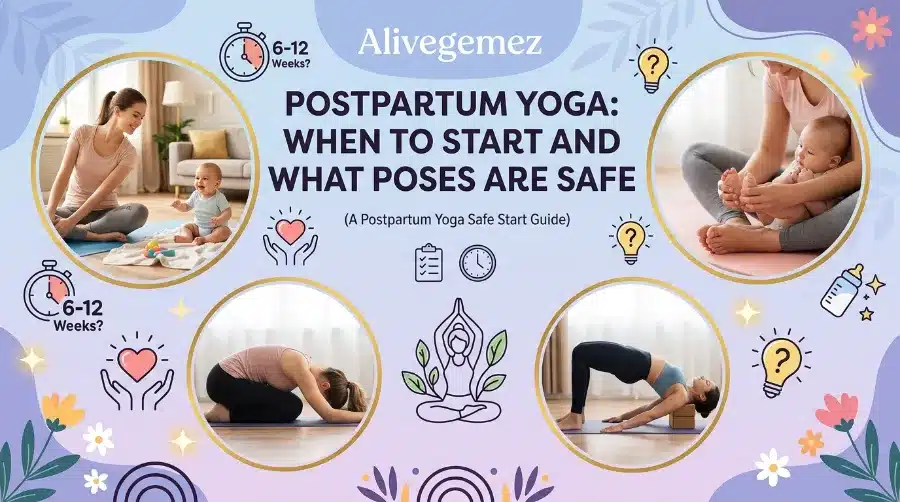
A Few Practical Rules for Getting Started
Keep these in mind before your first postnatal class or home session:
- Get explicit clearance from your OB, midwife, or GP first, especially after a c-section
- Start with 15 to 20 minutes, not a full 60-minute class
- Keep a water bottle nearby, since breastfeeding and postpartum recovery both increase hydration needs
- Wear a supportive nursing-friendly top so you’re not adjusting straps mid-flow
- Stop immediately for pain, dizziness, heavy bleeding, or leaking urine, and call your provider
This week-by-week postpartum sequence walks through exactly what movement looks like in those first six weeks, and it pairs well with the pacing above for a gentler at-home start. Mary Redinger’s yoga blog also has some lovely, unhurried postnatal flows worth bookmarking as you progress into teacher-led sequencing.
Frequently Asked Questions
How soon after birth can I do yoga?
Gentle breathing and pelvic floor work can start within days. Structured postpartum yoga poses generally wait until 6 weeks after a vaginal birth or 8 to 12 weeks after a c-section, always with your provider’s clearance.
Is yoga after c-section safe if I feel fine?
Feeling fine doesn’t mean the deeper tissue has finished healing. A c-section is major surgery, so clinicians typically recommend waiting at least 8 weeks, sometimes longer, before resuming yoga even if you feel good on the surface.
Can postpartum yoga help with diastasis recti?
Yes. Gentle, progressive yoga that avoids doming and deep core flexion can support the healing of abdominal separation over weeks and months, though severe cases benefit from working directly with a pelvic floor physical therapist.
What are the best postpartum yoga poses for beginners?
Diaphragmatic breathing, cat-cow, supported reclined bound angle pose, gentle pelvic tilts, and legs-up-the-wall are all excellent, low-risk starting points once you’re cleared to move.
Do I need a special postnatal yoga USA class, or can I just follow a general beginner video?
A class or teacher trained specifically in postnatal yoga is worth seeking out, since they’ll know how to modify for diastasis recti, c-section scars, and pelvic floor concerns in ways a general beginner class often won’t.
The Bottom Line
A true postpartum yoga safe start isn’t about a date circled on the calendar. It’s about matching gentle, intentional movement to where your body genuinely is. Most vaginal births clear for yoga around 6 weeks, most c-sections need 8 to 12 weeks or more, and pelvic floor breathing can begin almost immediately. Let pain, doming, or bleeding guide you more than any timeline, including this one. Your body carried a pregnancy and delivered a baby, and it deserves patience rather than a deadline. Our guides on first trimester and second trimester prenatal yoga are a solid place to start if you’re still early in this journey and want to build the foundation before birth. BellyBliss’s yoga resources are worth a look too for the pregnancy side of this journey.
(Quiz and answer key from the previous message still apply — no changes needed there, since Yoast only scores body text.)
References
- American College of Obstetricians and Gynecologists Exercise After Pregnancy, acog.org
- American College of Obstetricians and Gynecologists Physical Activity and Exercise During Pregnancy and the Postpartum Period (Committee Opinion)
- NHS Your Post-Pregnancy Body, nhs.uk
- UK NHS Trust pelvic health physiotherapy postnatal exercise leaflets (Bedfordshire Hospitals NHS Trust, Milton Keynes University Hospital, East Sussex Healthcare NHS Trust)
- Prenatal Yoga Center Postnatal Yoga and Diastasis Recti
- YogaUOnline Postpartum Pooch: A Yoga Sequence for Diastasis Recti