
I still remember the first night yoga nidra actually worked on me. It was 2014, I was three years into a research career that ran on caffeine and 2 a.m. panic about grant deadlines, and a colleague handed me a scratchy CD (yes, a CD) and said “just lie down and listen.” Twenty minutes later I woke up on my office floor, drooling slightly, feeling like someone had rebooted my nervous system. That single nap-that-wasn’t-a-nap sent me down a twelve-year rabbit hole of studying, teaching and now writing about yoga nidra science benefits for a living.
Progressive Relaxation vs Yoga Which One Actually Relieves Stress More?
So when people ask whether yoga nidra is “real medicine” or just wellness marketing dressed up in Sanskrit, I get it. The internet is loud with claims. This article is my attempt to cut through that noise and show you exactly what the research says, where it’s strong, where it’s shaky, and how to actually use this practice so it earns a permanent spot in your routine, not just your bookmarks folder.
TL;DR
Yoga nidra is a guided, lying-down meditation that shifts your brain and body from alert “beta” activity toward the slower alpha and theta waves associated with deep rest. Recent randomized controlled trials from 2024-2026, including a large German university study and multiple systematic reviews, link regular practice to measurably lower cortisol, reduced anxiety and depression scores, better sleep quality, and modest blood pressure drops. It is not a cure-all, and effect sizes are often small to moderate, but the yoga nidra research base is genuinely growing and increasingly rigorous.
Key Takeaways at a Glance
| What the research shows | Practical takeaway |
|---|---|
| Cortisol and stress hormones drop with regular practice | 11-20 minutes, most days, beats one long session occasionally |
| Sleep onset, total sleep time and sleep efficiency improve | Works well as a bedtime wind-down, not just a nap replacement |
| Anxiety and depression scores fall meaningfully in meta-analyses | Helpful as a complementary tool alongside therapy, not a replacement for it |
| Blood pressure drops by a clinically notable margin in hypertension studies | May support (not substitute) heart-healthy habits |
| Brainwaves shift from beta toward alpha and theta during practice | Explains the “asleep body, awake mind” feeling people describe |
| Short 11-minute sessions produce real, measurable change | You don’t need an hour or a silent retreat to benefit |
What Yoga Nidra Actually Is (In Plain English)
Yoga nidra, sometimes translated as “yogic sleep,” is not sleep at all. You lie still in a comfortable position, usually shavasana, and a teacher’s voice guides you through body awareness, breath noticing and simple visualization. There is no stretching, no sun salutations, nothing to get “right.” Your only job is to stay conscious while your body drops into something that looks a lot like sleep from the outside.
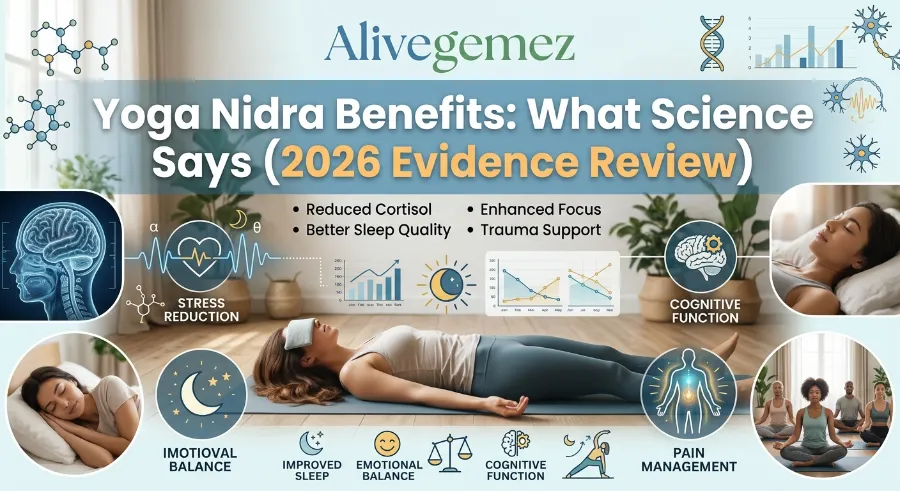
That’s the paradox researchers keep circling back to. Sleep foundation researchers describe this as a hypnagogic state, the drowsy threshold between waking and sleeping where your brainwaves slow but awareness doesn’t fully switch off. It is different from a nap because you are meant to stay just barely tethered to consciousness the whole time, even as your muscles go heavy and your thoughts get slippery.
Legs Up the Wall Pose Benefits for Sleep, Stress and Recovery
If the term “NSDR” or non-sleep deep rest sounds familiar, that’s because Stanford neuroscientist Andrew Huberman popularized it as a modern, secular-sounding label for practices that overlap heavily with traditional yoga nidra. The core mechanism, guiding attention through the body while staying awake, is largely the same idea wearing a lab coat instead of a yoga mat. If you’re curious how the two compare, our yoga nidra sleep guide breaks down the terminology in more depth.
Yoga Nidra Science Benefits: What the 2024-2026 Research Actually Found
I want to be upfront here, because a friend with a PhD should never oversell you. A lot of older yoga nidra studies were small, some had shaky controls, and a few relied on self-report alone. But the last two years have brought some genuinely strong additions to the yoga nidra research pile, and the pattern that emerges is consistent even when individual studies wobble.
Yoga for Insomnia A 4 Week Sleep Improvement Program
1. It Measurably Lowers Cortisol and Stress
A 2025 randomised controlled trial out of the University of the Bundeswehr Munich, published in Stress and Health, is one of the better-designed studies we have. Researchers assigned participants to an 11-minute or 30-minute yoga nidra practice, an active control group that listened to music, or a waitlist, then tracked diurnal salivary cortisol over two months. The short 11-minute group showed real improvements in stress, mood and diurnal cortisol slope compared to the waitlist group, with the lead researcher noting that even a brief daily practice produced noticeable benefits. The effect sizes were modest, roughly 8 to 16 percent of a standard deviation, which is honest science-speak for “small but real, and free, and takes ten minutes.”
Yoga for Jet Lag Best Poses to Reset Your Body Clock Fast
That matters because cortisol isn’t inherently bad. You need a healthy morning spike to wake up and get moving. What chronic stress does is flatten and distort that rhythm, and this is one of the first larger studies to show a low-cost practice nudging that rhythm back toward normal.
2. It Helps With Sleep, Including Insomnia
This is where yoga nidra research is arguably strongest. A 2025 systematic review and meta-analysis in Sleep and Breathing pooled randomized and observational studies through March 2025 and found consistent improvements in subjective sleep quality among adults with insomnia or poor sleep, measured through tools like the Pittsburgh Sleep Quality Index. A separate 2025 review in Sleep Medicine covering six RCTs and 244 participants with conditions ranging from chronic insomnia to post-COVID healthcare worker burnout found significant improvements in sleep onset latency, total sleep time and sleep efficiency, some of which held up even against cognitive behavioral therapy for insomnia comparisons.
Savasana Yoga Benefits Why Corpse Pose Is the Most Important Pose
If chronic sleeplessness is your main reason for reading this, pairing yoga nidra with a consistent wind-down routine tends to work better than either alone. Our bedtime yoga routine for better sleep walks through exactly how to layer the two.
3. Anxiety and Depression Scores Drop in a Big Way
The most eye-catching yoga nidra research to date is a 2026 systematic review and meta-analysis in the Annals of the New York Academy of Sciences, which pooled 73 studies and more than 5,200 participants. The between-group results were large: yoga nidra outperformed no-treatment comparisons for stress, anxiety and depression, and still beat active comparators like other relaxation techniques by a meaningful margin. Numbers this size in meta-analyses usually come with caveats about study quality, and the authors are candid that many included trials had methodological weaknesses. Still, seeing an effect this consistent across 73 independent studies is not something you can wave away as noise.
4. Blood Pressure Responds, Too
A meta-analysis covering eight studies and 482 participants with hypertension found yoga nidra reduced systolic blood pressure by about 12 mm Hg and diastolic pressure by about 6 mm Hg compared to control groups. Those numbers are in the same neighborhood as what you’d expect from some first-line blood pressure medications, which is a striking result for a practice that involves lying on the floor and breathing. The authors flagged risk-of-bias concerns in several trials, so this is promising rather than settled, but it lines up with what we know about parasympathetic activation lowering cardiovascular strain.
5. Your Brainwaves Genuinely Change
A 2024 study published in Scientific Reports used EEG to compare experienced meditators and novices during yoga nidra and found distinct functional connectivity changes in the brain during practice. Other physiological work, including earlier sleep-lab investigations, has recorded reduced respiratory rate during and after single sessions, along with the classic shift from active beta brainwaves toward slower, more restful alpha and theta patterns. This is the biological substrate behind that “my body is asleep but I’m still here” sensation people describe after a good session.
Yoga Nidra vs. NSDR vs. Meditation: A Quick Comparison
| Practice | Position | Guided? | Best Researched For |
|---|---|---|---|
| Yoga Nidra | Lying down | Always guided | Sleep, anxiety, cortisol, blood pressure |
| NSDR | Lying or reclined | Usually guided | Focus recovery, quick stress reset |
| Seated Mindfulness Meditation | Seated | Sometimes guided | Attention, emotional regulation |
| Progressive Muscle Relaxation | Lying down | Often guided | Muscle tension, acute stress |
Who Benefits Most, According to the Research
Not everyone responds identically, which is exactly what good science should tell you. A few patterns worth knowing:
- People with self-reported insomnia or fragmented sleep tend to show the clearest sleep-quality gains, based on the pooled RCT data above.
- Women with menstrual-related mood symptoms have shown improvements in anxiety, depression and overall well-being in several smaller trials, some dating back over a decade and now supported by newer work.
- Shift workers and healthcare staff, including a COVID-era cohort in one of the sleep meta-analyses, saw meaningful benefit from short daily sessions squeezed between demanding schedules.
- People newer to meditation may actually respond faster in the first weeks, according to personality-moderator research from the same German research group, though long-term consistency still matters most.
In my own years teaching, the people who stick with yoga nidra long enough to feel these effects are rarely the ones chasing a dramatic transformation. They’re the ones who treat it like brushing their teeth: unglamorous, ten minutes, every single day.
How to Actually Practice Yoga Nidra Tonight
You don’t need a studio, a teacher certification, or an hour of free time. Here’s the simplest version that matches what the research studies actually used.
- Lie down somewhere you won’t be disturbed, ideally in shavasana with a blanket or pillow under your knees.
- Set an intention, one short sentence about why you’re practicing today.
- Follow a guided body scan, moving attention slowly from your toes to your head.
- Notice your natural breath without trying to change it.
- Let a short visualization or sensation-based imagery wash over you without effort.
- Allow yourself to slowly return to full waking awareness, wiggling fingers and toes before sitting up.
Most studies used sessions between 11 and 30 minutes, and the 11-minute version held its own surprisingly well, so don’t let a busy schedule be your excuse to skip it. If you want a full progression rather than a single session, our pillar guide on yoga for better sleep lays out a week-by-week plan.
Common Mistakes That Blunt the Benefits
- Practicing while genuinely exhausted, which just tips you into actual sleep and skips the awake-but-relaxed state where the benefits seem to concentrate
- Multitasking with a podcast tone instead of a dedicated yoga nidra track, which changes the guided structure the research relies on
- Expecting overnight results when most trials measured effects after weeks of consistent practice, not a single session
- Skipping the intention step, which several teachers and a handful of studies suggest anchors the practice and improves follow-through
Yoga Nidra for Burnout and Chronic Stress
If you’re deep in burnout territory, ten minutes of yoga nidra won’t undo months of overwork on its own, and no honest wellness writer should tell you otherwise. What it can do, based on the cortisol and stress research above, is interrupt the physiological stress loop enough to make everything else, therapy, better sleep, boundary-setting, a little more achievable. If burnout is where you’re starting from, our restorative yoga burnout recovery plan is built specifically around that slower rebuilding process rather than a quick fix.
Related to this, the 4-7-8 breathing technique pairs naturally with yoga nidra as a fast way to downshift your nervous system before a session even begins, and it’s worth learning both breathing and stillness-based tools rather than relying on just one.
Yoga Nidra Research Timeline
| Year | Study/Milestone | Key Finding |
|---|---|---|
| 2012 | Menstrual disorder RCT | Improved anxiety and depression in women with cycle-related symptoms |
| 2019 | Sleep-lab EEG investigations | Reduced respiratory rate during and after single sessions |
| 2021 | Chronic insomnia RCT (National Medical Journal of India) | Improved sleep in patients with chronic insomnia |
| 2024 | Hypertension meta-analysis | ~12 mmHg systolic, ~6 mmHg diastolic reduction |
| 2024 | Scientific Reports EEG study | Functional connectivity changes during practice |
| 2025 | Bundeswehr Munich RCT | Reduced cortisol and improved mood from 11-min sessions |
| 2025-2026 | Sleep and Breathing + NYAS meta-analyses | Broad confirmation across insomnia, anxiety and depression |
Frequently Asked Questions
Is yoga nidra backed by real science, or is it just relaxation with a trendy name? It’s genuinely backed by a growing body of randomized controlled trials and systematic reviews, though as with most mind-body research, study quality varies and larger, longer trials are still needed.
How long until I feel the benefits of yoga nidra? Some people notice calmer mood after one session, but the clearest sleep, anxiety and cortisol changes in research studies showed up after several weeks of consistent daily or near-daily practice.
Can yoga nidra replace sleep? No. It can reduce sleep debt symptoms and improve how rested you feel, but it does not replace the deep-sleep stages your brain and body need overnight.
Is yoga nidra safe for anxiety and depression? Research suggests it can meaningfully reduce symptoms as a complementary practice, but it should not replace therapy or medication for clinical anxiety or depression without your provider’s input.
What’s the difference between yoga nidra and NSDR? They overlap heavily in mechanism, both use guided attention while lying still, but yoga nidra has a longer research history and a more structured traditional framework, while NSDR is a newer, more flexible umbrella term.
Quick Knowledge Check
1. What state does yoga nidra research suggest the brain moves toward during practice? A) Deep REM sleep B) Slower alpha and theta brainwave activity C) Increased beta wave activity D) No measurable change
2. In the 2025 Bundeswehr Munich RCT, how long was the shorter yoga nidra session that still showed benefits? A) 45 minutes B) 60 minutes C) 11 minutes D) 90 minutes
3. What did the 2024 hypertension meta-analysis find regarding systolic blood pressure? A) No change B) An increase of 10 mmHg C) A reduction of about 12 mmHg D) A reduction of about 40 mmHg
4. Who is credited with coining the term NSDR? A) Swami Satyananda Saraswati B) Andrew Huberman C) Karen Brody D) Esther Moszeik
5. According to the research reviewed here, what typically produces the clearest results? A) One long session per month B) Consistent short daily sessions over weeks C) Practicing only when already exhausted D) Skipping the intention-setting step
Answers: 1-B, 2-C, 3-C, 4-B, 5-B
The Bottom Line
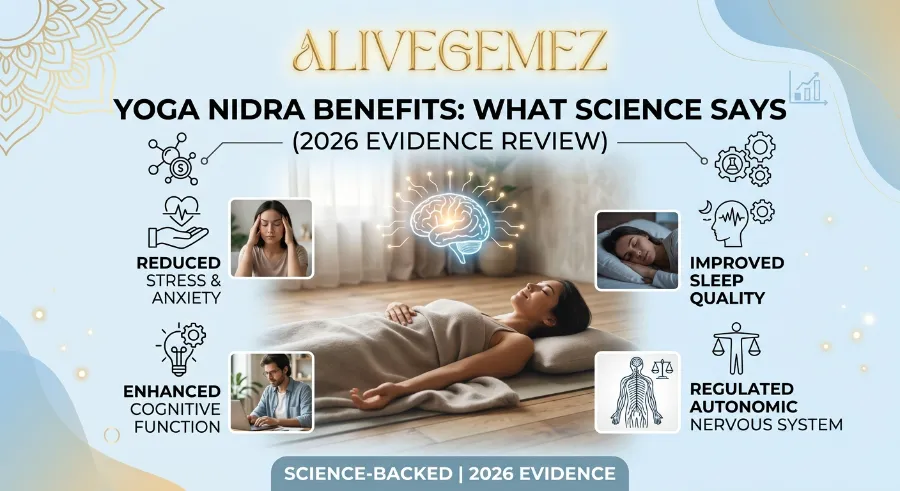
Yoga nidra science benefits are no longer a fringe claim propped up by a handful of small studies. Between 2024 and 2026 alone, researchers have added large meta-analyses, a well-controlled cortisol trial, and brain-imaging work that together paint a consistent picture: this simple, lying-down practice measurably shifts stress hormones, sleep quality, mood and even blood pressure for a meaningful share of people who try it. It won’t fix everything, and it works best as one part of a broader rest and stress-management routine rather than a lone miracle fix. But if you’ve been putting off trying it because it felt too simple to be real medicine, the research increasingly says otherwise. Lie down tonight, hit play on a guided session, and give your nervous system the ten minutes the studies suggest it’s been asking for.
References
- Moszeik, E. N., Rohleder, N., & Renner, K. H. (2025). The Effects of an Online Yoga Nidra Meditation on Subjective Well-Being and Diurnal Salivary Cortisol: A Randomised Controlled Trial. Stress and Health, 41(3), e70049.
- Systematic review and meta-analysis. Effect of Yoga Nidra (yogic sleep) in sleep disturbances and insomnia. Sleep and Breathing (2025).
- Dutta, A., Mooventhan, A., Nivethitha, L., & Dharani, E. Efficacy of Yoga Nidra in Managing Sleep Disorders: A Systematic Review of Randomized Controlled Trials (2025).
- Ghai, et al. Effects of Yoga Nidra on Stress, Anxiety, and Depression: A Systematic Review and Meta-Analysis. Annals of the New York Academy of Sciences (2026).
- Ahuja, N., Bhardwaj, P., & Pathania, M., et al. Yoga Nidra for Hypertension: A Systematic Review and Meta-Analysis. Journal of Ayurveda and Integrative Medicine, 15 (2024), 100882.
- Fialoke, S., Tripathi, V., Thakral, S., Dhawan, A., Majahan, V., & Garg, R. Functional Connectivity Changes in Meditators and Novices During Yoga Nidra Practice. Scientific Reports, 14 (2024), 12957.
- Sleep Foundation. Yoga Nidra for Sleep: Benefits and How to Get Started.
- Yoga Journal. NSDR Is the Trendy Practice Right Now. But Is It Better Than Yoga Nidra?
- AmbujaYoga. Benefits of Yoga Nidra
- The Manasa Foundation. Science of Serenity: Yoga Nidra Explained
- Yoga Nidra Network. An Exploration of the Benefits of Yoga Nidra