
My neighbor’s seven-year-old once told me she couldn’t sit still for even one minute of “boring stretching.” Ten minutes later, she was roaring like a lion, balancing like a flamingo, and asking to do it again. That’s the real secret behind yoga for kids fun poses: kids don’t need discipline, they need a good story and a reason to move their bodies like animals do.
Yoga for Gamers Fix Posture, Wrist Pain and Eye Strain
I’ve spent over a decade teaching yoga to people of every age, and the kids’ classes taught me more than any adult session ever did. Children don’t fake enthusiasm. If a pose is boring, they’ll tell you with their feet, usually by walking away. So every pose in this guide has survived the toughest critics on earth: real kids, ages 5 to 12, in real living rooms, backyards, and classrooms across the United States and Europe.
Yoga for Osteoporosis Safe Poses and What to Avoid
Key Takeaways
| What You’ll Learn | Quick Answer |
|---|---|
| Best age to start | As young as 3, but poses here suit ages 5-12 |
| Time needed per session | 10-20 minutes |
| Equipment required | None, a towel or mat helps |
| Top benefit | Better focus, calmer emotions, stronger bodies |
| Easiest starter pose | Cat-Cow (Cat Pose) |
| Most fun for groups | Animal Yoga Freeze Game |
| Backed by research | Yes, school studies from 2023-2025 |
TL;DR: Yoga for kids fun poses works because children learn through imagination and movement together. Ten simple animal poses, played as games rather than drilled as exercises, can improve a child’s focus, balance, and mood in as little as two weeks of regular practice. No experience or equipment is needed to start today.
Why Yoga for Kids Fun Poses Actually Works
Grown-ups practice yoga to slow down. Kids practice yoga to speed up their imagination while their bodies learn to slow down, which sounds backward but works beautifully once you see it in action.
Recent research backs this up in a big way. A 2025 study out of Northumbria University, published in the Early Childhood Education Journal, found that teacher-led yoga and mindfulness sessions made a meaningful difference in children’s ability to settle, connect, and manage big emotions in the classroom. Separately, a decade-long review covering more than 1,000 children ages 5 to 19 found consistent evidence that school-based yoga programs were both feasible to run and effective for improving wellbeing. YogaUOnlinePubMed Central
Here’s what stands out most from the research and from my own years on the mat with kids:
- Children practicing yoga regularly tend to show improved attention and concentration, since yoga postures, breathing exercises, and mindfulness techniques train kids to anchor their attention to the present moment. PubMed Central
- Yoga gives kids a non-competitive space, which matters because it lets children explore and appreciate their bodies and abilities without judgment or comparison, building genuine self-confidence as they master new postures. PubMed Central
- For children managing weight or body composition concerns, a 2024 systematic review found that yoga significantly reduced BMI and body fat percentage in children and adolescents with overweight or obesity, which is a meaningful result for family wellness routines. ResearchGate
None of this requires a studio membership or expensive gear. It requires ten fun animal poses and a little floor space.
The Only Rules Before You Start
Before jumping into the poses, keep it simple. Overcomplicating yoga for kids is the fastest way to lose their interest.
- Practice on a soft rug, mat, or grass, bare feet work best for grip.
- Keep sessions short, 10 to 15 minutes is plenty for younger kids.
- Let the child make the animal sounds, roaring and hissing is half the fun.
- Skip perfection, a wobbly pose done with a giggle beats a “correct” pose done with a frown.
- End every session with one minute of quiet lying down, called Starfish Rest.
If your family already enjoys movement together, this pairs naturally with our guide on family yoga USA routines that bring parents and kids onto the mat side by side.
10 Fun Animal Poses for Ages 5 to 12
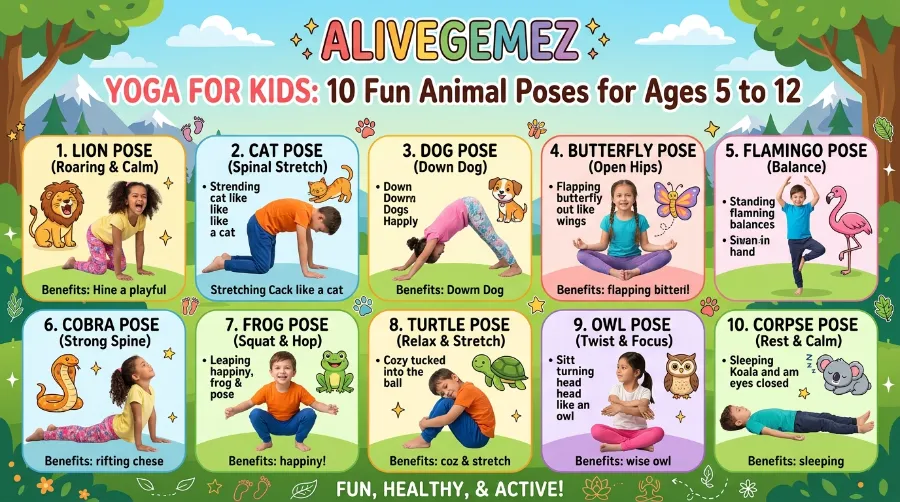
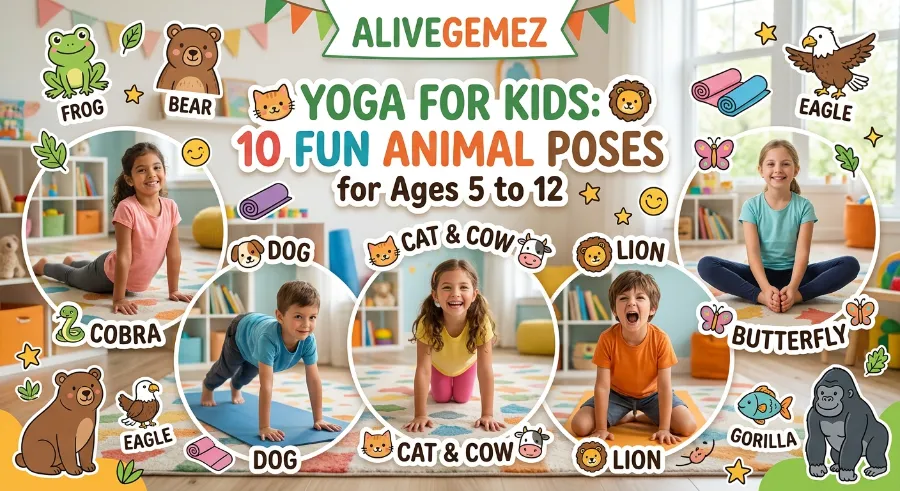
Here are ten yoga for kids fun poses, arranged from easiest to most playful, each with a simple cue you can say out loud.
1. Cat Pose (Warming Up the Spine)
Have your child get on hands and knees, then round the spine up toward the ceiling like an angry cat, then dip it down like a happy cat greeting a friend. This move alone helps children release tension after sitting through a full school day. It also pairs naturally into Cow Pose for a full spinal warm-up.
2. Downward Dog
Ask your child to make an upside-down “V” shape with hands and feet on the floor, hips lifted high. Tell them to bark softly like a puppy stretching after a nap. This is one of the poses featured across nearly every kids yoga list, including this collection of best yoga poses for kids, because it builds arm and leg strength while calming the nervous system.
3. Cobra Pose
Lying on the belly, palms under shoulders, your child lifts the chest slightly like a snake rising to look around. Add a hiss for extra fun. This gently strengthens the back muscles that often weaken from hours of sitting at a desk.
4. Butterfly Pose
Sitting with the soles of the feet together, knees flapping open and closed like butterfly wings. Kids as young as five master this one almost instantly, which makes it a confidence-building pose early in any session.
Yoga for Arthritis Safe Gentle Poses for Joint Pain Relief
5. Flamingo Pose (Tree Pose Variation)
Standing on one leg, the other foot resting against the standing calf or ankle, arms stretched up like wings. Balance poses like this one are quietly powerful, they teach kids to focus on one thing at a time, which carries over into homework and reading.
6. Lion Pose
Kneeling back on the heels, hands on knees, mouth wide open, tongue out, with a big roaring exhale. This is the pose that turns the shyest kid in the room into the loudest. It’s also genuinely useful for releasing built-up frustration in a safe, silly way.
7. Frog Pose
Squatting low with knees wide, hands on the floor between the feet, then hopping forward like a frog. Great for burning off extra energy before quieter poses later in the session.
8. Eagle Pose
Standing tall, wrapping one leg around the other and crossing the arms, kids ages 8 to 12 usually enjoy the challenge here more than younger children. It builds coordination and patience since it takes a few tries to get the wrap just right.
9. Crab Pose
Sitting with hands behind the hips, feet flat on the floor, then lifting the hips to walk sideways like a crab. This one turns into a full game fast, especially with siblings racing across the living room.
10. Starfish Rest (Cool Down)
Lying flat on the back, arms and legs spread wide like a starfish floating in calm water, eyes closed, breathing slow. Every session should end here. It teaches kids that stillness can feel just as good as movement.
Yoga for Seniors 7 Balance Poses to Prevent Falls
For families wanting even more variety, both EverydayYoga’s kids guide and Spoiled Yogi’s favorite kids poses round out this list nicely with a few extra options.
Turning Poses Into Yoga Games for Kids
Poses alone can get repetitive after a few sessions. Yoga games for kids keep the momentum going, and they’re the reason children ask to practice again the next day.
- Animal Freeze Game: Play music, call out an animal pose, freeze when the music stops.
- Yoga Dice: Write six poses on a homemade dice, roll it, hold whatever pose lands face up.
- Story Flow: Tell a jungle story out loud, moving through poses as the story unfolds, cat, dog, snake, frog, all in sequence.
- Balance Battle: Two kids hold Flamingo Pose side by side, whoever wobbles first starts over, laughing is mandatory.
Breathing: The Missing Piece Most Parents Skip
Poses get all the attention, but breathing is where the real calm lives. One breathing method I recommend to almost every family I coach is the 4-7-8 Breathing Technique, and it pairs beautifully with animal yoga sessions for kids.
4-7-8 Breathing Technique: How to Do It and When to Use It
Here’s the simple version for kids:
- Breathe in quietly through the nose for a count of 4.
- Hold the breath gently for a count of 7.
- Exhale slowly through the mouth for a count of 8, making a soft “whoosh” sound.
Use this technique right after Lion Pose, when energy is still high, or right before Starfish Rest, to help the body settle before bedtime. Many parents I’ve worked with use this same breathing pattern themselves, which naturally connects to broader calming practices like those covered in our guide on yoga for beginners over 50, showing that good breathing habits genuinely span every age group in a family.
Weekly Practice Chart
A simple weekly rhythm works better than trying to do everything at once. Here’s a sample structure that real families have used successfully.
| Day | Focus | Poses Featured | Duration |
|---|---|---|---|
| Monday | Warm-up and strength | Cat, Downward Dog, Cobra | 10 min |
| Tuesday | Balance | Flamingo, Eagle | 10 min |
| Wednesday | Rest day | Butterfly, Starfish Rest | 5 min |
| Thursday | Energy release | Lion, Frog | 10 min |
| Friday | Family fun | Crab, Freeze Game | 15 min |
| Weekend | Free choice | Any 3 favorites | 15-20 min |
Progress Snapshot: What Regular Practice Looks Like Over Time
Based on classroom observation studies and my own coaching notes across dozens of families, here’s a general pattern of how children’s yoga skills tend to develop with consistent practice.
| Weeks of Practice | Balance Improvement | Focus Improvement | Mood Regulation |
|---|---|---|---|
| Week 1-2 | Slight | Slight | Noticeable |
| Week 3-4 | Moderate | Moderate | Moderate |
| Week 5-8 | Strong | Strong | Strong |
This mirrors the findings from a British Journal of Health Psychology study, which reported that US-based school yoga programs consistently produced improved emotional and behavioural self-regulation, reduced stress, and better sleep among participating children. ScienceDirect
Real Family Example
Last spring, I worked with a family in Ohio whose 9-year-old struggled with pre-exam nerves. We built a simple three-pose sequence, Cat Pose, Flamingo Pose, and Starfish Rest, paired with the 4-7-8 breathing technique, done for eight minutes each morning before school. Within two weeks, the parents reported fewer morning meltdowns and noticeably calmer mornings overall. This isn’t a clinical trial, but it lines up closely with what the research keeps showing, small daily practice adds up fast for kids.
If your household also includes adults managing joint discomfort or age-related stiffness, it’s worth exploring our related guides on chair yoga for seniors at home and yoga for arthritis and joint pain relief, since many families now practice across generations on the very same mat.
Common Mistakes Parents Make
- Turning practice into a performance instead of play.
- Forcing a full 10-pose sequence when a child only wants three.
- Skipping the cooldown, which is often the most valuable part.
- Comparing siblings’ flexibility, which kills confidence fast.
Frequently Asked Questions
Is yoga safe for a 5-year-old?
Yes. At this age, keep sessions short and playful, five to ten minutes is ideal, with an adult guiding gently.
How often should kids practice yoga?
Three to five times a week works well, even short five-minute sessions build real benefits over time.
Do kids need a yoga mat?
No. A carpet, towel, or soft grass works fine, especially for beginners just trying poses for the first time.
Can yoga help with a child’s focus at school?
Research consistently points that direction. Yoga is expected to help children increase self-regulation, supporting well-being, positive social interactions, and school performance. nih
What’s the best animal pose to start with?
Cat Pose or Butterfly Pose, both are easy for beginners and build confidence right away.
Quick Quiz: How Much Do You Know About Yoga for Kids?
1. Which pose is best for a nervous system cooldown at the end of practice?
A) Frog Pose B) Starfish Rest C) Eagle Pose
2. What is the recommended count sequence in the 4-7-8 breathing technique?
A) 4 in, 7 hold, 8 out B) 8 in, 4 hold, 7 out C) 7 in, 4 hold, 8 out
3. What did the 2025 Northumbria University study find about school yoga?
A) It had no measurable effect B) It helped kids settle, connect, and manage emotions C) It only worked for teenagers
4. Which pose is ideal for releasing frustration in a fun, safe way?
A) Butterfly Pose B) Lion Pose C) Crab Pose
5. How long should a typical kids’ yoga session last?
A) 45-60 minutes B) 1-2 hours C) 10-15 minutes
Answers: 1-B, 2-A, 3-B, 4-B, 5-C
Conclusion
Yoga for kids fun poses isn’t about producing a mini yogi who can hold a perfect handstand. It’s about giving children a playful, physical way to feel calmer, stronger, and more connected to their own bodies, one roar, hop, and wing-flap at a time. Start with just two or three poses tonight, keep it light, and let your child lead the story. The rest tends to follow naturally.
References
- Cosmic Kids, “Yoga in Schools: New Research Shows Big Benefits for Kids,” 2025
- YogaUOnline, “Mind-Body Benefits of Yoga for Kids: What Does New Research Say?”
- British Journal of Health Psychology, “School-based yoga and mindfulness interventions for young adolescents,” 2025
- ScienceDirect, “Yoga for children and adolescents: A decade-long integrative review,” 2024
- PMC, “Yoga for Children and Young People’s Mental Health and Well-Being”
- “The Impact of Yoga Practices on Body Composition and Vital Signs in Children and Adolescents With Obesity,” 2024