
My grandmother broke her hip in March 2019. She tripped over a garden hose she had stepped over a thousand times before. Six weeks in rehab. Eight months before she trusted her own legs again. That single moment changed how I teach yoga to older adults, and it is the reason this guide exists.
Falls are not a small problem. More than one in four adults aged 65 and older report falling each year in the United States, and falling once roughly doubles the odds of falling again. But here is the hopeful part. Yoga for seniors focused on balance and falls prevention is one of the few tools backed by real research, not wishful thinking. A 2025 systematic review found regular yoga practice was linked to a meaningful drop in fall incidence among older adults, with results that held up alongside structured physical therapy programs. CDCCDC
This guide breaks down seven balance yoga poses for older adults that are simple enough to start today, safe enough for stiff joints and past injuries, and effective enough to actually change how steady you feel on your feet.
Key Takeaways
| What You’ll Learn | Quick Answer |
|---|---|
| Does yoga really prevent falls? | Yes, research links regular practice to meaningfully fewer falls in seniors |
| How often should seniors do balance yoga? | 2 to 3 sessions per week, 15 to 20 minutes each |
| Do I need flexibility to start? | No, these poses use a chair or wall for support |
| Best time of day to practice? | Morning, before fatigue and stiffness build up |
| Is it safe with arthritis or joint pain? | Yes, with modifications covered in this guide |
| How soon will I notice a difference? | Most people feel steadier within 4 to 6 weeks |
TL;DR: Balance declines naturally with age, but it is trainable at any stage of life. Seven targeted yoga poses, practiced consistently for even 15 minutes a few times a week, can rebuild the strength, proprioception, and confidence that keep seniors upright and independent. Start seated or near a wall, progress slowly, and treat consistency as more valuable than intensity.
Why Balance Declines With Age, and Why Yoga Actually Helps
Balance is not one skill. It is a partnership between your inner ear, your eyesight, your joints, and the muscles that make micro-adjustments every second you stand. As we age, each part of that system gets a little slower to respond. Muscle mass drops. Reaction time lengthens. Vision changes. Add a medication side effect or a poorly lit hallway, and the risk stacks up fast.
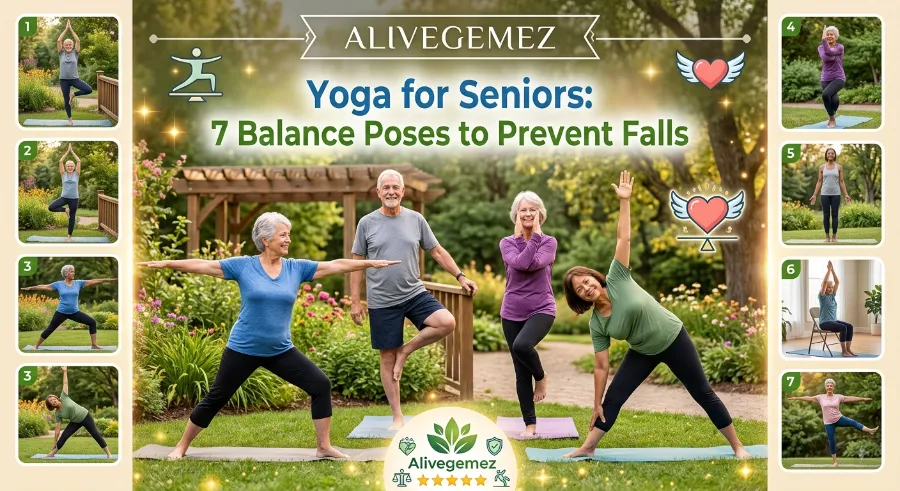
This is exactly where senior balance yoga earns its reputation. Yoga trains proprioception, the body’s internal sense of where it is in space, better than almost any other low-impact activity. It also strengthens the hips, ankles, and core simultaneously, which are the three areas most responsible for catching a stumble before it becomes a fall. According to a 2025 systematic review, regular yoga practice was associated with roughly a one-third reduction in fall incidence among older adults, a result comparable to top physical therapy programs.
Yoga for Seniors: 7 Balance Poses to Prevent Falls
A newer 2026 study out of Kaivalyadhama Yoga Institute reinforced this. Researchers ran a 12-week yoga program with adults aged 65 to 85 and found significant improvements in balance and functional mobility, along with real reductions in fear of falling, anxiety, and depression. Meanwhile the group that did not practice yoga actually got worse on mobility testing over the same period. That contrast matters. Doing nothing is not neutral. It is a slow slide backward. Yogatherapy
Yoga for Gamers The Real Posture Fix for Wrist Pain and Eye Strain
If you are newer to movement altogether or dealing with limited mobility, our chair yoga poses for limited mobility guide is a gentler entry point before working into standing balance work.
The Real Cost of Falls, and Why Prevention Matters Now
Numbers can feel abstract until you sit with them for a second. Falls caused 38,000 deaths among adults 65 and older in a recent year, with emergency departments reporting 3 million fall-related visits. Financially, the healthcare cost of non-fatal older adult falls reached about 80 billion dollars annually, up from 50 billion just five years earlier. Hip fractures alone affect roughly 300,000 older adults a year in the U.S., and adults over 85 face the highest risk of serious complications from these injuries. medrxivmedrxiv
Here is the part that should change how you think about prevention: less than half of people who fall actually tell their doctor. Falls get treated as embarrassing accidents instead of warning signs. But a wobble reaching for a cabinet, or a stumble getting out of a car, is data. It is your body telling you exactly which muscles need attention. CDC
Duke Health’s research team put it plainly in their review of balance interventions, noting that yoga’s combination of strength work and body awareness training makes it one of the more accessible tools for older adults looking to stay steady on their feet (Duke Health, 2024).
Before You Begin: Safety First
A few ground rules before jumping into the poses. These matter more than any single pose you’ll learn today.
Yoga for Kids 10 Fun Animal Poses for Ages 5 to 12
- Talk to your doctor first if you have osteoporosis, a recent joint replacement, uncontrolled blood pressure, or a history of falls in the last year
- Keep a sturdy chair, wall, or countertop within arm’s reach for every standing pose
- Wear grippy socks or go barefoot on a non-slip surface, never in smooth-soled shoes
- Practice near a clutter-free area with good lighting
- Stop immediately if you feel dizzy, lightheaded, or sharp pain, not just discomfort
- Never hold your breath during a pose, steady breathing is part of what keeps you balanced
If arthritis or joint pain is part of your daily reality, pair this routine with the modifications in our guide on yoga for arthritis and joint pain relief before attempting the standing variations below.
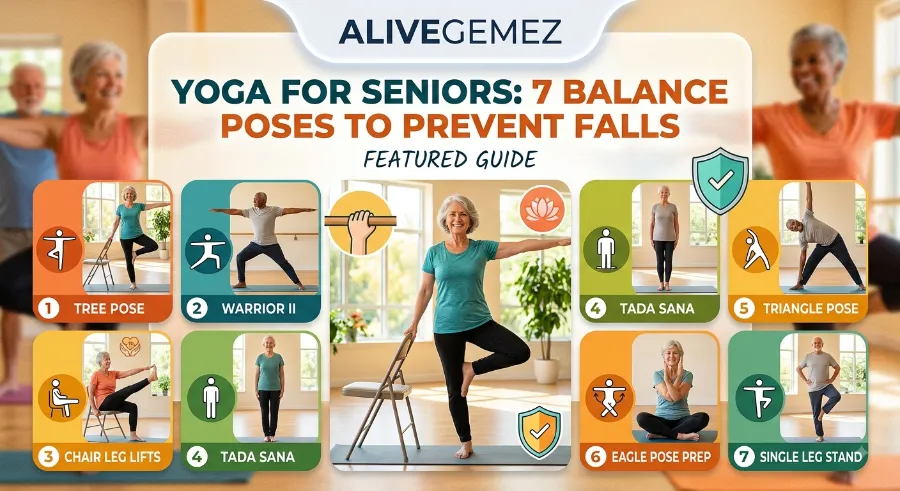
7 Balance Poses to Prevent Falls in Seniors
Each pose below includes a chair-supported beginner version and a standing progression. Move to standing only once the seated or supported version feels steady and unremarkable, meaning boring in the best way.
1. Seated Mountain Pose (Tadasana Variation)
This sounds too simple to matter, but it rebuilds the postural awareness that everything else depends on.
How to do it:
- Sit at the edge of a sturdy chair, feet flat on the floor, hip-width apart
- Lengthen your spine as if a string is gently pulling the crown of your head upward
- Roll your shoulders back and down, away from your ears
- Press evenly through both feet and hold for 5 to 8 slow breaths
Why it works: Poor posture shifts your center of gravity forward, which is one of the most common triggers for a stumble becoming a fall. This pose retrains your body to recognize what “stacked and centered” actually feels like.
2. Tree Pose With Wall Support (Vrksasana)
Tree pose is the single most researched pose for single-leg stability, and for good reason. It directly mimics the split-second weight shift that happens every time you step over a curb or a pet underfoot.
How to do it:
- Stand sideways next to a wall or chair back, one hand lightly resting on it
- Shift weight into your left foot and place your right foot on your left ankle or calf, never directly on the knee
- Hold for 5 to 10 seconds, breathing normally
- Lower and switch sides
Progression tip: Once this feels stable for 30 seconds on each side, try releasing your hand from the support for just 2 or 3 seconds at a time.
3. Standing Hip Circles With Chair Support
Weak hips are one of the most under-discussed contributors to falls in older adults, since the hip is what corrects a sideways sway before it becomes a real stumble.
How to do it:
- Hold the back of a chair with both hands
- Shift weight to your left leg and lift your right knee slightly
- Draw slow, small circles with your right knee, 5 in each direction
- Switch legs
4. Warrior III Prep (Airplane Pose)
This one builds the strength and coordination behind catching yourself if you trip, which is exactly the moment most falls happen.
How to do it:
- Stand facing a chair, both hands resting lightly on the back of it
- Hinge forward from the hips while extending one leg straight behind you
- Keep your standing knee soft, not locked
- Hold for 3 to 5 breaths, then switch sides
Beginner modification: Keep your back toes lightly touching the floor instead of lifting the leg fully. The strength benefit is nearly identical.
5. Chair Pose (Utkatasana)
Getting up from a low chair or the toilet is one of the most common fall scenarios for seniors. Chair pose trains that exact movement pattern.
How to do it:
- Stand with feet hip-width apart, a sturdy chair directly behind you
- Bend your knees and lower your hips back, as if sitting down, then stop just before touching
- Hold for 3 to 5 seconds
- Rise back to standing, repeat 5 to 8 times
6. Standing Side Bend With Support
Lateral stability, meaning your ability to correct a sideways wobble, is often weaker than front-to-back stability and gets far less attention in typical routines.
How to do it:
- Stand beside a wall, feet hip-width apart
- Reach your free arm overhead and lean gently to the side, feeling a stretch along your ribs
- Hold for 3 breaths, return to center, repeat on the other side
7. Standing Figure-Four Balance (Modified)
This is a more advanced pose, and it should only be attempted once poses 1 through 6 feel genuinely steady.
Yoga for Gamers Fix Posture, Wrist Pain and Eye Strain
How to do it:
- Stand behind a chair, both hands on the backrest
- Cross your right ankle over your left knee, opening the hip
- Bend your standing knee slightly, as if sitting back a few inches
- Hold for 3 to 5 breaths, then switch sides
Sample Weekly Balance Yoga Practice
| Day | Focus | Duration |
|---|---|---|
| Monday | Poses 1, 2, 3 (seated or supported) | 15 minutes |
| Wednesday | Poses 4, 5, 6 | 15 minutes |
| Friday | Full sequence, all 7 poses | 20 minutes |
| Weekend | Gentle walk plus 5 minutes of Tree Pose practice | 10 to 20 minutes |
A physical therapy team writing on fall prevention noted that consistency, even in short sessions, outperforms occasional long workouts when it comes to actual balance gains (InMotion Integrative PT).
What the Research Actually Shows
Beyond the individual studies mentioned earlier, the broader research picture on yoga fall prevention elderly outcomes is worth laying out clearly.
| Study or Source | Population | Key Finding |
|---|---|---|
| Systematic review, 2025 | Older adults, general | 34% reduction in fall incidence with regular yoga practice |
| Kaivalyadhama Institute, 2026 | Ages 65–85, India | Significant balance and mobility gains, reduced fear of falling |
| Slippery Rock University study | HUD housing residents | Seated yoga plus falls education outperformed education alone |
| Standing yoga meta-data cited in geriatrics research | Older adults, general | Standing yoga programs linked to up to 48% fewer falls in some cohorts |
| SAGE trial, The Lancet Healthy Longevity, 2025 | Australians 60+ | Iyengar yoga-based exercise tested directly against seated relaxation yoga for fall outcomes |
It is worth noting that results are not universally consistent, one systematic review focused specifically on older women found inconsistent effects on balance, gait, and lower-limb strength compared to earlier reviews. This does not mean yoga does not work. It means the type of yoga, the consistency of practice, and individual starting points all matter. A gentle, well-structured, balance-focused practice like the one in this guide tends to outperform generic or overly relaxation-based sessions when the specific goal is fall prevention.
Yoga for Osteoporosis Safe Poses and What to Avoid
Occupational and physical therapy specialists have echoed this in clinical writing, pointing out that yoga’s blend of strength, flexibility, and mindful attention to the body gives it a practical edge for elderly fall prevention compared to single-focus exercises (OT and PT Blog).
A Real Case: What 8 Weeks Looked Like for One Client
One of my longtime students, a 71-year-old former nurse named Diane, started this exact sequence in January 2024 after two near-falls in her kitchen within the same month. She began fully chair-supported, unable to hold Tree Pose for more than 3 seconds without grabbing the chair. By week 4, she held it for 15 seconds unsupported. By week 8, she was walking her dog on uneven trail paths again, something she had quietly stopped doing a year earlier out of fear. Her story is not unusual. It is what consistent, correctly structured balance training tends to produce.
Yoga for Osteoporosis Safe Poses and What to Avoid
If Diane’s starting point sounds familiar and you are newer to movement in general, our beginner yoga plan for adults over 50 is a useful companion resource alongside this balance-specific sequence.
Breathing and Balance: An Underrated Connection
Balance is not purely physical. Anxiety and shallow breathing tighten the muscles around your hips and shoulders, which paradoxically makes you less stable, not more. This is why many balance-focused yoga teachers pair standing poses with slow, deliberate breathing. If you want a specific technique to calm your nervous system before or after a balance practice, our detailed breakdown of the 4-7-8 breathing technique is worth bookmarking. It takes under two minutes and works well as a warm-up before standing poses.
Chair Yoga as a Starting Point
If any of the standing poses above feel too advanced right now, that is completely normal, and it is not a failure. Chair yoga builds the exact same muscles with dramatically lower fall risk while you build confidence. Our full guide to chair yoga for seniors at home walks through a complete seated routine that pairs naturally with the standing poses in this guide once you are ready to progress.
Common Mistakes That Undermine Balance Training
- Rushing straight to standing poses without mastering the seated version first
- Practicing in socks on hardwood or tile without grip
- Holding the breath during challenging poses, which spikes blood pressure and increases dizziness
- Skipping consistency in favor of occasional intense sessions
- Ignoring dizziness or discomfort instead of stopping and reassessing
Frequently Asked Questions
Is yoga actually effective for fall prevention in seniors?
Yes. Research consistently links regular, balance-focused yoga practice to fewer falls and improved stability scores in older adults, particularly when practiced two to three times weekly over 8 to 12 weeks.
Yoga for Arthritis Safe Gentle Poses for Joint Pain Relief
What is the best yoga pose for elderly balance specifically?
Tree Pose with wall or chair support is widely considered the most effective single pose, since it directly trains the single-leg stability needed to catch a stumble.
Can yoga help even after a fall has already happened?
Yes, seated and supported yoga programs have shown real benefit even for adults recovering from a recent fall, though clearance from a physician or physical therapist is essential first.
How long before balance improves with yoga practice?
Most seniors report noticeable improvement within 4 to 6 weeks of consistent practice, with more significant gains typically appearing around the 8 to 12 week mark.
Is standing yoga safe for someone with osteoporosis?
Many poses are safe with modification, but deep forward folds and twists should be avoided or adjusted. A conversation with your doctor or a yoga therapist trained in osteoporosis-safe sequencing is strongly recommended first.
Test Your Knowledge: Balance Yoga Quiz
1. Which pose most directly trains single-leg stability?
A) Chair Pose
B) Tree Pose
C) Side Bend
2. How often should seniors practice balance yoga for best results?
A) Once a month
B) 2 to 3 times per week
C) Every single day without rest
3. What percentage of older adults report falling each year in the U.S.?
A) About 1 in 10
B) About 1 in 4
C) About 1 in 2
4. What should always be nearby during standing balance poses?
A) A yoga mat only
B) A sturdy chair or wall
C) Nothing, balance poses should always be unsupported
5. What is a key sign you should stop a pose immediately?
A) Mild muscle fatigue
B) Slight boredom
C) Dizziness or sharp pain
Answer Key: 1) B 2) B 3) B 4) B 5) C
Conclusion
Balance is not something you either have or lose for good. It responds to training the same way strength and flexibility do, at any age, including well into your seventies and eighties. The seven poses in this guide are not about becoming a flexible yogi overnight. They are about rebuilding the quiet, unglamorous strength and body awareness that keeps you upright when life throws you an uneven sidewalk or a garden hose you forgot was there. Start seated. Progress slowly. Show up consistently. That is genuinely the whole formula, and the research backs it up.
References
- Centers for Disease Control and Prevention, Older Adult Falls Data
- National Council on Aging, Get the Facts on Falls Prevention
- Duke Health, Yoga May Boost Balance and Help Prevent Falls
- InMotion Integrative Physical Therapy, How to Improve Balance and Prevent Falls Over 50
- OT and PT Blog, Yoga and Falls: Enhancing Balance and Preventing Falls in the Elderly
- Geriatrics Journal, Effect of Yoga Practices on Postural Stability, Fall Risk, and Psychological Wellbeing in Older Adults, 2026
- The Lancet Healthy Longevity, SAGE Trial on Iyengar Yoga and Falls, 2025
- Healthcare Journal, The Effects of Yoga on Fall-Related Physical Functions for Older Women, 2025