
Here is something nobody told you when you searched for yoga plus size beginners content: most yoga content was never built with your body in mind. The poses, the props, the pacing, all of it was designed around a narrow idea of what a “yoga body” looks like. That is not a personal failing on your part. It is a gap in the industry, and it is one we are here to close.
I have spent twelve years teaching yoga to bodies of every shape, and some of my most dedicated students started exactly where you are now, unsure if a mat was even for them. So let’s fix that today, together, one honest step at a time.
TL;DR: Yoga for plus-size beginners works best when poses are modified for your actual body, not forced into a shape that was never designed for you. Props, wider stances, and chair support make almost every pose accessible, and consistency matters more than flexibility. You do not need to lose weight, look a certain way, or touch your toes to belong on a yoga mat.
Key Takeaways
| Focus Area | What You Need to Know |
|---|---|
| Who this guide is for | Complete beginners in larger bodies, any age, any fitness level |
| Core philosophy | Body positive yoga USA style: function over form, comfort over perfection |
| Equipment | A sturdy mat, 2 blocks, 1 strap, 1 chair (all optional but helpful) |
| Session length | Start with 15-20 minutes, 3 times a week |
| Biggest mindset shift | Modification is not weakness, it is smart practice |
| Safety priority | Joint protection, breath control, and never forcing a stretch |
Why Plus-Size Beginners Deserve a Different Starting Point
Traditional yoga instruction often assumes a certain range of motion, a certain body shape, and a certain amount of available floor space around the hips and belly. When those assumptions do not match your body, poses that look simple in a magazine photo can suddenly feel impossible, painful, or embarrassing. That is not because something is wrong with you. It is because the instructions were incomplete.
A 2025 systematic review published in Obesity Reviews looked at multiple studies on yoga interventions in people with higher body weight and found that yoga positively affected BMI, body fat percentage, and heart rate across the studies analyzed. That is real, peer-reviewed evidence, not marketing talk. Yoga genuinely helps larger bodies, when it is taught correctly. Wellness Creative Co
Equally important, a 2022 study on size-inclusive yoga programs found something many plus-size students already feel intuitively. Participants who did a size-inclusive yoga and journaling program showed meaningful drops in body shame alongside real gains in body appreciation and physical activity confidence. In plain words, the right kind of yoga class does not just move your body. It changes how you feel inside it. Osho
This is where inclusive yoga poses matter so much. When a pose is modified thoughtfully instead of forced, your nervous system gets to relax instead of brace. That single shift is often the difference between someone quitting after one class and someone practicing for years.
If you are new to movement altogether, or you are returning to yoga after a long break, you might also enjoy our beginner-friendly yoga plan for those starting later in life, which shares many of the same pacing principles used here.
The Body Positive Yoga USA Movement Is Not a Trend
Body positive yoga USA studios and online platforms have grown steadily since around 2018, driven largely by plus-size instructors who got tired of waiting for an invitation and simply built the space themselves. Instructors like those featured on Yoga for Bigger Bodies have spent years documenting exactly which cues and modifications actually serve larger bodies, rather than guessing.
This matters because representation changes behavior. When a beginner sees an instructor who looks like them holding a pose confidently, the pose suddenly feels achievable. Confidence, it turns out, is teachable.
For home practice, resources such as DoYogaWithMe’s plus-size collection offer video classes specifically paced and cued for larger bodies, which can be a helpful bridge before stepping into a studio.
Getting Started: What Yoga Plus Size Beginners Actually Need
Before touching a single pose, let’s talk logistics, since this is where most beginners quietly struggle and rarely ask for help.
Equipment That Actually Helps
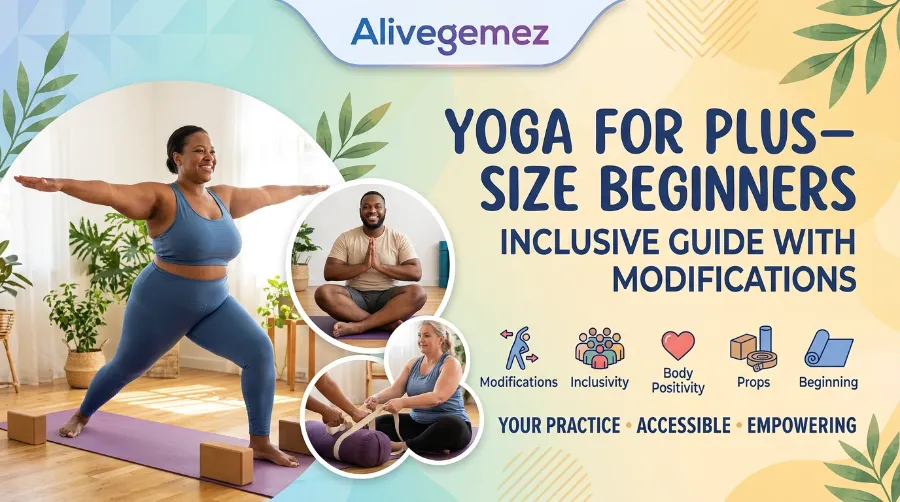
You do not need expensive gear to start. However, a few simple props remove a surprising amount of friction:
- A thick mat (6mm or more) for extra knee and joint cushioning
- Two yoga blocks to shorten the distance between your hand and the floor
- One strap to extend your reach in seated stretches
- A sturdy chair for balance poses and seated modifications
- A folded blanket for extra hip or knee support
If chairs sound unusual for a yoga session, they are actually a well-established modification tool. Our guide to chair yoga poses for limited mobility breaks down exactly how a chair can replace floor-based poses without losing any of the benefit.
Space and Setup
Give yourself more floor space than you think you need, roughly the width of two mats side by side. Wide-legged poses need room, and cramped space is one of the top reasons plus-size beginners feel restricted during a session.
Inclusive Yoga Poses for Absolute Beginners
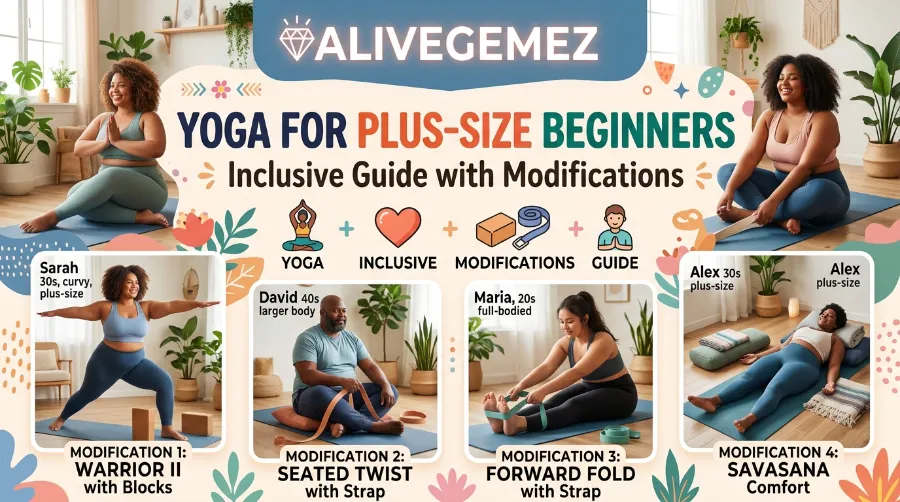
Here is where theory turns into practice. Below are foundational poses, each with a specific modification built for larger bodies, not an afterthought bolted onto a standard instruction.
1. Modified Mountain Pose (Tadasana)
Stand with your feet hip-width apart instead of together, since a wider base gives you better balance and more stability through the hips. Let your belly relax rather than sucking it in, because a relaxed core actually breathes better and holds posture longer. Hold for 5 slow breaths before moving on.
2. Wide-Legged Forward Fold
Instead of trying to fold flat, place two blocks under your hands at whatever height lets your spine stay long. Bend your knees generously, because a soft knee protects your lower back far more than a straight leg ever will. This single modification turns a frustrating pose into a genuinely relaxing one.
3. Chair-Supported Warrior II
Stand near a wall or chair for light balance support, step your feet wide, and bend your front knee only as far as feels stable. Reach your arms out at shoulder height rather than forcing a deep lunge. This builds leg strength safely, which is exactly what a true beginner needs first.
4. Supported Child’s Pose
Place a folded blanket between your calves and thighs for extra room, and separate your knees as wide as needed so your belly has space to rest comfortably. Rest your forehead on a block if the floor feels too far away. This pose should feel like relief, never like squeezing into a box.
5. Seated Cat-Cow (Chair Version)
Sit tall in a sturdy chair, hands on knees, and alternate between arching and rounding your spine with your breath. This is one of the most effective inclusive yoga poses for anyone with knee or wrist sensitivity, since it delivers the same spinal mobility as the floor version.
If joint discomfort is a regular concern for you, our detailed piece on yoga for arthritis and joint pain relief pairs well with these modifications.
A Simple Weekly Starter Plan
Consistency beats intensity every single time, especially in the first month. Here is a realistic starting structure:
| Day | Focus | Duration |
|---|---|---|
| Monday | Gentle mobility + breathwork | 15 minutes |
| Wednesday | Standing poses with chair support | 20 minutes |
| Friday | Restorative floor poses | 20 minutes |
| Weekend | Optional rest or short walk | Flexible |
Notice this plan builds in rest days on purpose. Recovery is part of training, not a break from it, and plus-size beginners in particular benefit from giving joints time to adapt.
Yoga Larger Bodies Modifications: The Rules That Change Everything
There are three modification principles that apply across almost every pose in yoga larger bodies practice, and once you learn them, you can adapt nearly any class yourself.
Widen your stance. Almost every standing pose becomes more stable and more comfortable with a wider base, regardless of what the demonstration photo shows.
Prioritize breath over depth. If you cannot breathe fully in a pose, you have gone too deep. Back off until your breath is smooth again, since the breath is the actual measure of a correct pose, not how it looks.
Use props without apology. A block, strap, or chair is not a beginner crutch you eventually outgrow. Experienced practitioners in every body size use props for years, because props make poses smarter, not easier.
Breathing Techniques That Support Your Practice
Breathwork is arguably the most underrated tool in yoga plus size beginners routines, largely because it requires no flexibility at all and works immediately.
The 4-7-8 Breathing Technique
This simple technique calms your nervous system in under a minute and works especially well before bed or during a stressful moment.
- Exhale completely through your mouth
- Inhale quietly through your nose for a count of 4
- Hold your breath for a count of 7
- Exhale fully through your mouth for a count of 8
- Repeat for 4 rounds total
Use this technique whenever you feel anxious before a class, overwhelmed during a pose, or simply need to unwind at the end of a long day. Many of my students use it as a bridge into their yoga practice, doing a few rounds seated in a chair before ever stepping onto the mat.
Real Progress Looks Different Than You Expect
One of my longtime students, a woman in her early forties who started practicing in January 2023, could not sit fully upright in a cross-legged position during her first month. By August 2023, roughly seven months later, she was holding a modified Warrior II for a full minute without wall support. Her weight had not changed dramatically. Her confidence, her balance, and her breath control had changed completely.
That story repeats constantly in body positive yoga USA spaces. Progress in yoga larger bodies practice rarely looks like weight loss on a scale. It looks like climbing stairs without knee pain, sleeping better, or finally feeling calm during a stressful meeting because you know how to breathe through it.
Common Mistakes Plus-Size Beginners Make (And How to Avoid Them)
Even motivated beginners tend to repeat a few avoidable mistakes early on.
- Copying a thin instructor’s exact hand and foot placement instead of adjusting for your own proportions
- Holding the breath during effortful poses, which raises tension instead of releasing it
- Skipping warm-up because a class “looks easy” on video
- Avoiding poses out of embarrassment rather than trying a modified version first
- Comparing your first month to someone else’s second year
Recognizing these patterns early saves months of frustration, and honestly, every single one of them is completely normal to fall into at first.
Finding a Class or Instructor Who Actually Gets It
Not every studio has caught up with inclusive yoga poses yet, and that is worth saying plainly rather than dancing around it. Before joining a class, it helps to ask a few direct questions.
Does the instructor offer modifications without singling you out in front of the room. Are props visibly available and normalized, not treated as a special request. Does the class description mention “all bodies welcome” with actual evidence of that, such as size-diverse instructor photos or student testimonials.
Online collections such as 1om1’s plus-size yoga selection can also be a useful starting point if in-person studios in your area still feel intimidating.
When You Are Ready to Go Further
Once the basics of yoga plus size beginners practice feel comfortable, several paths open up naturally. Some students move toward balance-focused sequences, which pairs well with our guide on yoga for better balance and fall prevention, even outside the senior audience it was originally written for, since the balance principles apply broadly.
Others explore posture-focused practice if long hours at a desk or a screen have left the shoulders tight, a topic we cover in depth in yoga for gamers and posture correction. And if yoga is becoming a family activity, our piece on fun yoga poses for kids makes a great next stop for parents practicing alongside their children.
For a broader foundation on accessible practice generally, our pillar guide on chair yoga for seniors at home shares many overlapping modification principles, even though it targets a different age group.
Frequently Asked Questions
Is yoga safe for plus-size beginners with joint pain?
Yes, when poses are modified properly. Chair-supported and prop-assisted versions reduce joint strain significantly, and starting slowly allows your body to adapt safely over several weeks.
Do I need to be flexible before starting yoga plus size beginners classes?
No. Flexibility is a result of consistent practice, not a requirement to begin. Most beginners, regardless of size, start with limited flexibility.
How often should a beginner practice?
Two to three sessions a week of fifteen to twenty minutes is a realistic, sustainable starting point, based on what most consistent long-term students actually maintain.
Will yoga help with weight loss?
Some research suggests modest benefits for body composition, though yoga’s strongest documented benefits are stress reduction, mobility, and improved body image rather than dramatic weight change.
What if I cannot get down to the floor easily?
Chair yoga offers a full, effective practice without ever touching the floor, and many poses translate directly into a seated version.
Yoga Plus Size Beginners: Quick Knowledge Quiz
1. What is the primary purpose of widening your stance in standing poses?
A) To make the pose look better in photos
B) To improve stability and balance
C) To increase flexibility instantly
2. How long should you hold each round of the 4-7-8 breathing technique count?
A) Inhale 4, hold 7, exhale 8
B) Inhale 8, hold 4, exhale 7
C) Inhale 7, hold 8, exhale 4
3. What should guide how deep you go into a pose?
A) How the pose looks in a demonstration photo
B) Your breath staying smooth and full
C) How long other students hold the pose
4. According to research referenced in this guide, size-inclusive yoga programs were linked to which outcome?
A) Increased body shame
B) Reduced body shame and increased body appreciation
C) No measurable psychological effect
5. What is a recommended realistic starting frequency for beginners?
A) Daily 90-minute sessions
B) Once a month
C) Two to three sessions a week, fifteen to twenty minutes each
Answer Key: 1-B, 2-A, 3-B, 4-B, 5-C
Conclusion
Yoga plus size beginners practice is not about earning your place on the mat, it is about recognizing you already belong there. Every modification in this guide exists because your body deserves instructions built for it, not borrowed from someone else’s proportions. Start small, breathe often, use props without hesitation, and let progress look like whatever it actually looks like for you. That is genuinely the whole practice.
References
- Caner, N., et al. (2025). The Impact of Yoga Practices on Body Composition and Vital Signs in Children and Adolescents With Obesity: A Systematic Review and Meta-Analysis. Obesity Reviews.
- Webb, J.B., et al. (2022). Yoga at Every Size: A Preliminary Evaluation of a Brief Online Size-Inclusive Yoga and Body Gratitude Journaling Intervention. Frontiers in Global Women’s Health.
- Yoga for Bigger Bodies. Available at yogaforbiggerbodies.org
- DoYogaWithMe Plus-Size Yoga Collection. Available at doyogawithme.com