
Have you ever felt like your own body turned against you overnight? Tired for no reason. Gaining weight without changing a single habit. Skipping periods. Losing hair in the shower drain. If any of this sounds familiar, you already know that hormones run the show. You are not imagining it, and you are not broken. In fact, millions of women across the United States and Europe live with a hormonal condition such as PCOS or a thyroid disorder. Most of them were never taught that a simple, consistent yoga for hormonal balance women practice can quietly support the very glands causing all the chaos. I have spent twelve years teaching yoga and researching the endocrine system. This guide, therefore, is everything I wish someone had handed me the day I was diagnosed with hypothyroidism at 29.
Yoga for PCOS 10 Science Backed Poses for Hormonal Balance
Vagus Nerve Yoga 7 Poses to Reset Your Nervous System
TL;DR: Yoga will not cure PCOS or thyroid disease, but a targeted, consistent practice can lower cortisol, support insulin sensitivity, calm the nervous system that controls your hypothalamus-pituitary-ovarian and hypothalamus-pituitary-thyroid axes, and ease common symptoms like fatigue, bloating and irregular cycles. Pair it with proper medical care, not instead of it, for the best results.

Key Takeaways at a Glance
| Focus Area | What Yoga Can Realistically Do | Best Practices |
|---|---|---|
| PCOS | Improve insulin sensitivity, lower stress hormones, support regular cycles | Twisting poses, restorative yoga, slow vinyasa |
| Thyroid health | Support circulation to the neck, reduce cortisol load on the axis | Shoulder stand variations, neck stretches, pranayama |
| Cortisol and stress | Lower baseline anxiety, improve sleep quality | Yin yoga, 4-7-8 breathing, yoga nidra |
| Mood and cycle symptoms | Reduce PMS intensity, ease perimenopause symptoms | Forward folds, gentle backbends, breathwork |
| Long term consistency | Better outcomes appear after 8 to 12 weeks of regular practice | 3 to 5 sessions weekly, 20 to 45 minutes each |
Your hormones do not operate in isolation. Estrogen, progesterone, thyroid hormone, cortisol and insulin all talk to each other constantly, and stress is often the loudest voice in that conversation. This is where yoga women hormones research gets genuinely interesting, because yoga’s biggest superpower is not a single pose. It is the way it lowers cortisol and calms an overworked nervous system, which then gives your endocrine glands room to actually function.
Yoga for Gut Health 8 Poses That Improve Digestion Fast
Why Women’s Hormones Get So Complicated
Your endocrine system is a network, not a single organ. The hypothalamus and pituitary gland in your brain send signals to your thyroid, ovaries, and adrenal glands. Each one, in turn, responds to the others in a feedback loop. However, chronic stress, poor sleep, inflammation, and blood sugar swings can all throw this loop off balance. This is exactly why so many women bounce between doctors before getting an actual diagnosis.
A 2025 workforce survey found that among roughly 59 million US women aged 18 to 44, about 6%, or 3.5 million women, reported a lifetime PCOS diagnosis. However, researchers widely agree the real number is much higher, since PCOS is so frequently missed. In fact, other national estimates place the true rate closer to one in ten women, with up to three-quarters of cases going undiagnosed for years.
The PCOS Diagnosis Gap Is Real
On average, it takes over four years from the first noticeable symptom to an actual PCOS diagnosis, according to peer-reviewed research published in BMC Women’s Health in 2023. If your doctor brushed off your irregular periods as “just stress,” you are far from alone, and this is exactly why self-advocacy plus supportive practices like yoga hormonal balance women routines matter so much while you wait for answers.
Thyroid conditions follow a similar pattern. Hypothyroidism affects up to 5% of the general population, with researchers estimating another 5% remain undiagnosed, and it disproportionately affects women, especially after pregnancy or during the perimenopausal years.
How Yoga Actually Affects Hormones: What the Research Shows
Let’s cut the fluff. Yoga is not a replacement for levothyroxine or metformin. However, the physiological mechanisms are well documented and worth understanding. After all, they explain why so many of my students genuinely feel different after a few consistent weeks.
The Four Main Mechanisms
- Cortisol regulation. Slow, breath-led movement activates your parasympathetic nervous system, and as a result, cortisol drops. Chronically high cortisol interferes with ovulation, worsens insulin resistance, and can suppress thyroid hormone conversion.
-
Yoga for Thyroid Problems What Works and What to Avoid
- Improved insulin sensitivity. Up to 70% of women with PCOS also deal with insulin resistance. Meanwhile, yoga has been shown in multiple small trials to improve glucose metabolism, mainly through stress reduction and gentle movement. Therefore, this connection is one of the most practical benefits available.
- Circulatory support to the thyroid. Some poses gently stretch and compress the front of the neck, such as supported shoulder stand or fish pose. These are traditionally believed to stimulate blood flow to the thyroid gland, and some quasi-experimental research backs modest hormonal shifts after consistent practice.
-
Yoga for High Blood Pressure Safe Poses and Breathing Guide
- Better sleep architecture. Poor sleep raises cortisol and disrupts the release of luteinizing hormone, which governs ovulation. For this reason, restorative yoga and yoga nidra are two of the most effective tools for improving deep sleep without medication.
What the Studies Actually Found
A systematic review examined yoga’s effect on thyroid-stimulating hormone across 11 qualifying studies. Overall, hypothyroid patients tended to show a decrease in TSH, and hyperthyroid patients tended to show a decrease in T4 after consistent practice. That said, the review also noted that perimenopausal women showed less measurable change, which is an honest and important caveat rather than a marketing claim.
Yoga for Menopause Symptoms Relief Ease Hot Flashes, Sleep Better and Balance Mood Naturally
In addition, a more recent randomized controlled trial out of AIIMS Rishikesh tested a three-month integral yoga program in women already on levothyroxine therapy. The yoga group showed measurable improvements in thyroid profile, cholesterol markers, medication dependence, and depressive symptoms compared to the control group. As a result, researchers described yoga as a low-cost, low-risk add-on therapy rather than a standalone cure.
Yoga for PCOS: A Realistic, Step-By-Step Approach
If you searched for yoga women hormones or yoga PCOS thyroid USA content hoping for a magic sequence, I want to be honest with you upfront: consistency beats intensity every single time. Twenty minutes done four times a week outperforms one exhausting ninety-minute class you dread and skip.
Best Yoga Poses for PCOS Symptom Relief
- Supta Baddha Konasana (Reclined Bound Angle Pose): Opens the hips and pelvis, encourages blood flow to the reproductive organs, and is deeply calming for the nervous system.
- Malasana (Yogi Squat): Improves pelvic circulation and can ease bloating, one of the most common daily complaints among women with PCOS.
- Ardha Matsyendrasana (Seated Spinal Twist): Gently massages the abdominal organs and may support digestion and detoxification pathways.
- Setu Bandhasana (Bridge Pose): Activates the glutes and hamstrings while mildly stimulating the thyroid and stretching the front of the hips.
- Viparita Karani (Legs Up the Wall): A restorative pose that lowers cortisol quickly, especially useful before bed.
A Simple Weekly Template
- Monday, Wednesday, Friday: 30 minutes of slow vinyasa focused on hip openers and twists.
- Tuesday or Thursday: 20 minutes of restorative yoga with props, holding each pose for 3 to 5 minutes.
- Saturday or Sunday: 15 minutes of yoga nidra or guided relaxation for deep nervous system recovery.
One of my long-time students, a 34-year-old marketing manager in Chicago, was diagnosed with PCOS in 2021. She started this exact template in January 2024. By April 2024, after roughly 14 consistent weeks, her cycle had returned to a predictable 32 to 34 day pattern for the first time in three years. She also reported better sleep and noticeably fewer afternoon energy crashes. Meanwhile, her endocrinologist made no medication changes during that period. This strongly suggests the lifestyle shift, not a new prescription, was driving the improvement.
Anti-Inflammatory Yoga Routine How to Reduce Inflammation Naturally
Yoga for Thyroid Health: What Actually Helps
Whether you are managing Hashimoto’s, subclinical hypothyroidism, or hyperthyroidism, the goal of a yoga endocrine health practice is not to “fix” your thyroid through poses alone. It is to reduce the systemic stress load that makes thyroid dysfunction harder to manage and symptoms harder to tolerate.
Poses Traditionally Used to Support Thyroid Function
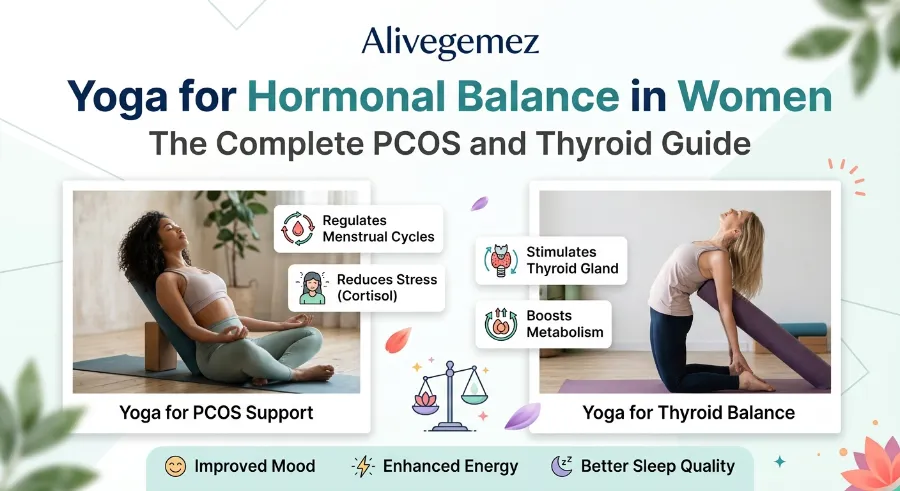
- Sarvangasana (Supported Shoulder Stand): One of the most researched poses for thyroid support, though anyone with neck issues, high blood pressure, or glaucoma should skip it or use a trained teacher’s guidance.
- Matsyasana (Fish Pose): Opens the throat and chest, often paired directly after shoulder stand to counterbalance the neck flexion.
- Ustrasana (Camel Pose): A gentle backbend that stretches the front of the neck and can feel emotionally releasing for many women.
- Ujjayi Pranayama: A slow, ocean-sounding breath technique used in almost every published yoga-thyroid study, likely because it calms the vagus nerve and lowers systemic stress hormones.
A quasi-experimental study involving 45 middle-aged adults found something interesting. After 12 weeks of daily combined yoga practice, participants showed measurable changes in TSH, T3, and T4 compared to a waitlisted control group. Of course, this is a small study, and it is not proof that yoga alone regulates thyroid hormone. Still, it is a genuinely useful data point for anyone wondering whether consistent practice is worth the time investment.
A 12-Week Thyroid-Focused Routine
| Week | Focus | Frequency |
|---|---|---|
| Weeks 1 to 4 | Gentle neck-safe poses, breath awareness, building the habit | 3x weekly, 20 minutes |
| Weeks 5 to 8 | Add supported shoulder stand, fish pose, longer holds | 4x weekly, 30 minutes |
| Weeks 9 to 12 | Full sequence plus ujjayi pranayama and yoga nidra | 5x weekly, 35 to 45 minutes |
The 4-7-8 Breathing Technique: How to Do It and When to Use It
If there is one single tool I recommend to nearly every woman dealing with hormonal chaos, it is the 4-7-8 breathing technique. It costs nothing, takes under two minutes, and directly targets the stress response that so often sits underneath PCOS flare-ups, thyroid fatigue and sleepless nights.
How to Practice 4-7-8 Breathing
- Sit or lie down comfortably and let your shoulders drop away from your ears.
- Close your mouth and inhale quietly through your nose for a count of 4.
- Hold your breath gently for a count of 7.
- Exhale completely through your mouth, making a soft whoosh sound, for a count of 8.
- Repeat this cycle 4 times to start, working up to 8 rounds as it becomes more comfortable.
When to Use It
- Before bed, to quiet a racing mind and support deeper sleep, which directly affects cortisol and reproductive hormone timing.
- Before a stressful meeting, appointment, or confrontation, since it activates the vagus nerve almost immediately.
- During a PCOS or thyroid symptom flare, such as anxiety, heart palpitations, or a hot flash, to shorten the intensity of the moment.
- As a nightly habit paired with legs-up-the-wall pose for a five-minute reset that supports the same yoga hormonal balance women goals as a full class.
A word of caution: if you feel lightheaded, shorten the counts to 2-4-6 instead of forcing the full 4-7-8 ratio, and always breathe at a pace that feels sustainable rather than strained.
Case Study: Combining Yoga With Medical Thyroid Treatment
A 2025 randomized controlled trial conducted at AIIMS Rishikesh recruited 62 women already diagnosed with hypothyroidism and already taking levothyroxine. Half continued their normal routine, while the other half added a three-month structured yoga program running five days a week for sixty minutes per session. The yoga group ended the trial with better thyroid markers, improved cholesterol numbers, reduced dependence on their medication dosage, and notably fewer depressive symptoms compared to the control group. Researchers were careful to frame yoga as a scalable, low-cost complement to standard treatment rather than a replacement, which mirrors exactly what I tell my own students: yoga plus your doctor beats yoga instead of your doctor, every single time.
Yoga and the Gut-Brain Connection How Your Practice Shapes Your Mood
PCOS and Thyroid by the Numbers
| Statistic | Figure | Source Type |
|---|---|---|
| US women aged 18-44 with a lifetime PCOS diagnosis | Approximately 6% (roughly 3.5 million women) | National Health and Wellness Survey, 2024 data |
| Estimated true PCOS prevalence, including undiagnosed cases | 7% to 12%, possibly as high as 1 in 7 | CDC and multiple peer-reviewed estimates |
| Average time to PCOS diagnosis after symptom onset | 4.3 years | BMC Women’s Health, 2023 |
| US population with hypothyroidism | Up to 5%, with another 5% undiagnosed | Peer-reviewed systematic review |
| Annual US healthcare cost tied to PCOS | Approximately 8 billion dollars | Journal of Clinical Endocrinology and Metabolism |
Bringing It All Together: A Sustainable Weekly Plan
You do not need ninety minutes a day or a perfectly quiet room with candles. You need a routine you will actually repeat. Here is the plan I give new students working through hormone imbalance, whether the root cause is PCOS, thyroid dysfunction, perimenopause, or general chronic stress.
- Daily minimum: 5 minutes of 4-7-8 breathing, ideally before bed.
- Three times weekly: 20 to 30 minutes of slow, targeted asana practice from the pose lists above.
- Weekly: One longer restorative or yin session, 30 to 45 minutes, prioritizing legs-up-the-wall, reclined bound angle, and supported fish pose.
- Monthly check-in: Track your cycle, sleep quality and energy levels so you can see real patterns rather than relying on how you feel on any single hard day.
If you want a deeper dive into targeted sequences, our team at RealYogaHub has built out full class libraries specifically for women navigating hormonal conditions. It is worth exploring once you have the basics from this guide down. In addition, a few other resources are worth reading. This practical breakdown of restoring hormonal balance through yoga is a good start. This piece on targeted yoga for women’s hormones offers another angle. So does this guide on yoga for women’s hormonal balance, and all three echo similar pose recommendations. For the clinical side, this PubMed thyroid and yoga review and the CDC’s own data on PCOS prevalence among US women are excellent starting points if you want the primary sources yourself.
Frequently Asked Questions
Can yoga alone cure PCOS or thyroid disease? No. Yoga supports symptom management and stress reduction, but PCOS and thyroid disorders both require proper medical diagnosis and, in most cases, ongoing treatment alongside lifestyle changes.
How long before I notice results from yoga hormonal balance women routines? Most women in published studies noticed measurable changes between 8 and 12 weeks of consistent practice, though subjective improvements in sleep and mood often show up within the first 2 to 3 weeks.
Is hot yoga safe if I have a thyroid condition? Not always. Excessive heat can be taxing for people with hyperthyroidism or Graves’ disease specifically, so check with your doctor before adding heated classes to your routine.
What is the single best pose to start with? Legs-up-the-wall pose combined with 4-7-8 breathing is the lowest-risk, highest-reward starting point for almost every woman dealing with hormonal stress.
Can I do yoga during my period if I have PCOS? Yes, though many teachers recommend skipping deep inversions like full shoulder stand during heavy flow days and sticking to gentle, restorative poses instead.
Quick Knowledge Quiz
1. Which hormone is most directly lowered through slow, breath-led yoga practice? A) Estrogen B) Cortisol C) Melatonin
2. What percentage of PCOS cases in the US may go undiagnosed? A) Roughly 10% B) Roughly 40% C) Up to 75%
3. Which pose is most commonly cited in thyroid-focused yoga research? A) Warrior II B) Supported Shoulder Stand C) Downward Dog
4. How long is the recommended hold time in 4-7-8 breathing for the breath-hold phase? A) 4 seconds B) 7 seconds C) 8 seconds
5. According to the AIIMS Rishikesh trial, what was the yoga group’s outcome compared to the control group? A) No measurable difference B) Worse thyroid markers C) Improved thyroid profile and reduced medication dependence
Answer Key: 1-B, 2-C, 3-B, 4-B, 5-C
Conclusion
Your hormones are not a mystery you have to solve alone. And they are not a moral failing either. Whether you are navigating PCOS, a thyroid diagnosis, or simply a body that feels off in ways you cannot quite name yet, help is available. A consistent yoga hormonal balance women practice, built on real research rather than vague promises, can genuinely support your nervous system, your cycle, and your day-to-day energy. So start small, stay consistent, and keep your medical team in the loop. Above all, give yourself the same patience you would give a good friend working through the exact same thing.
References
- BLDE University Journal of Health Sciences, “Effect of Yogic Practices on Thyroid Hormones: A Review”
- PubMed, “Can Yoga Help to Manage the Symptoms of Thyroid Diseases?”
- ResearchGate, “Effect of Combined Yoga Programme on Blood Levels of Thyroid Hormones: A Quasi-Experimental Study”
- ScienceDirect, “Yogic Management of Hypothyroidism in Females: A Randomized Controlled Trial”
- ScienceDirect, “Effects of Yoga on Hypothyroidism: A Systematic Review”
- PubMed, “Effect of 6 Months Intense Yoga Practice on Lipid Profile, Thyroxine Medication and Serum TSH Level in Women Suffering from Hypothyroidism”
- CDC National Center for Health Statistics, “Endometriosis, Polycystic Ovary Syndrome, and Uterine Fibroids in Women Ages 20-49: United States, 2022-2023”
- Journal of Clinical Endocrinology and Metabolism, “Polycystic Ovary Syndrome Underdiagnosis Patterns by Individual-Level and Spatial Social Vulnerability Measures”
- ISPOR, “Prevalence of Polycystic Ovary Syndrome and Burden of Disease Among Women Ages 18-44 in the US, National Health and Wellness Survey”