
Somewhere between a slow hatha class and a Kundalini Yoga session with gongs, mantras, and rapid breath-of-fire, most students ask the same question: kundalini vs hatha yoga, which one is actually built for me? Indeed, I’ve taught both styles for twelve years, and I still watch beginners walk into the wrong room at least once a month — a hatha lover wandering into a Kundalini class expecting a nap, or a Kundalini devotee stuck in a 90-minute hatha hold, bored out of their mind by minute forty.
learn more about bikram vs hot yoga difference tips and expert advice.
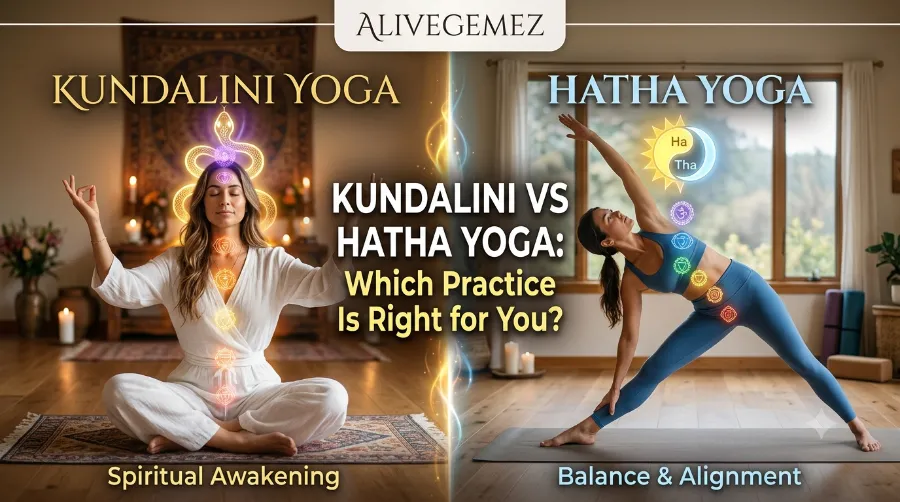
TL;DR: Hatha yoga slows things down with postures, breath, and stillness, so it suits people who want a gentle, body-first entry into yoga. By contrast, Kundalini yoga moves faster, mixing breathwork, chanting, and repetitive movement, so it suits people chasing an emotional or spiritual shift, not just a stretch. Either way, neither one “wins” — your nervous system, your goals, and your tolerance for chanting will decide which practice actually sticks.
To get a better understanding of how meditation vs exercise exactly what to expect.
Therefore, this guide settles the kundalini vs hatha yoga question with real comparisons, not vague spiritual talk. Specifically, you’ll get the history, the science, and the practical differences, plus a short quiz at the end so you can stop guessing and start practicing the style that fits your body and your goals. Meanwhile, if you’d rather browse other yoga comparisons first, our homepage rounds up every style guide we’ve published.
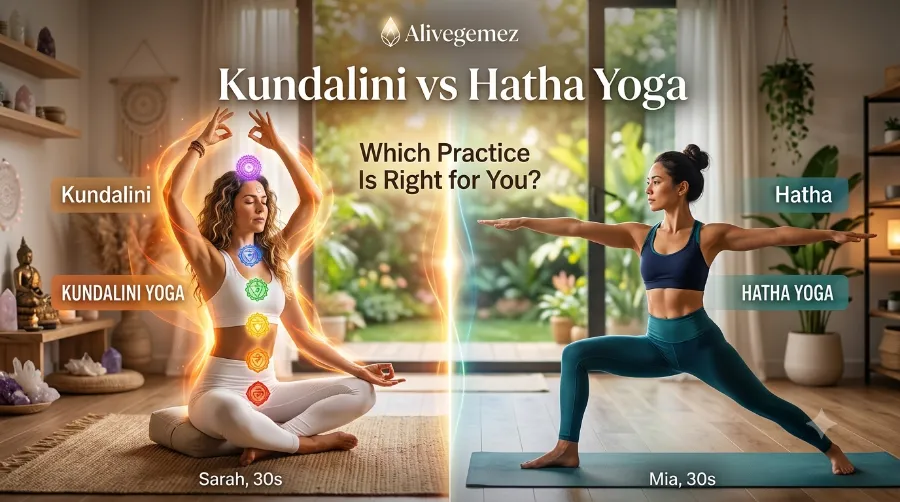
Key Takeaways
| Question | Hatha Yoga | Kundalini Yoga |
|---|---|---|
| Pace | Slow, held postures | Fast, repetitive, kriya-based |
| Main focus | Physical alignment, breath, stillness | Energy movement, chanting, breathwork |
| Best for | Beginners, stress relief, flexibility | Emotional release, spiritual growth, mental focus |
| Typical class length | 45–75 minutes | 60–90 minutes |
| Chanting involved | Rarely | Almost always |
| Research support | Strong for flexibility, pain, sleep | Strong for anxiety, PTSD, OCD, memory |
| Good first yoga class? | Yes, very approachable | Only if you’re open to chanting and quick pacing |
What Is Hatha Yoga, Really?
Hatha yoga is the umbrella term for almost every posture-based yoga style practiced in the West, though most studios use “hatha” to mean a slower class built around held poses, steady breathing, and a bit of meditation at the end. Specifically, the word itself splits into “ha” (sun) and “tha” (moon), pointing at a practice built to balance opposite forces in the body.
In a typical class, you’ll move through standing poses, seated stretches, and some backbends, then finish with a long relaxation called savasana. Notably, nobody rushes. For instance, a teacher might hold a warrior pose for five full breaths before moving on, which gives your muscles time to actually lengthen rather than just get stretched for a second.
As a result, hatha yoga builds flexibility, joint mobility, and baseline strength through bodyweight holds. Additionally, the slow pace trains patience, since you’re forced to sit with discomfort in a pose instead of rushing past it. In fact, if you’ve ever compared hatha vs vinyasa for beginners, you already know hatha is the gentler entry point, while vinyasa links poses into a moving flow. For a deeper technical breakdown of the tradition’s roots, YogaMasti has a useful hatha vs Kundalini comparison worth reading too.
Where Hatha Yoga Came From
Historically, hatha yoga traces back over a thousand years to Indian yogic texts, most notably the Hatha Yoga Pradipika, written around the 15th century by Swami Svatmarama. That text laid out physical postures, breathing techniques, and cleansing practices, all designed to prepare the body for deeper meditation. Today, modern hatha classes in gyms across the US and Europe are essentially a simplified, secular version of that older system, stripped of most ritual and kept mostly for the physical benefits.
What Is Kundalini Yoga, Really?
By comparison, Kundalini yoga takes a completely different approach. Rather than holding a pose for stillness, a Kundalini class strings together repetitive movements called kriyas, paired with specific breathing patterns, chanting, and long meditations, all aimed at “awakening” energy said to sit coiled at the base of the spine.
Historically, Yogi Bhajan brought Kundalini Yoga to the United States in 1969, teaching his first public class in Los Angeles that same year, then founding the 3HO organization shortly after to spread the practice across North America. Since then, Kundalini studios have opened in nearly every major US city, as well as across the UK, Germany, and Scandinavia, where the practice has a particularly strong following. The Elbow Room has a good overview of Kundalini’s history and philosophy if you want to go deeper on this thread.
For example, a single Kundalini set might ask you to pump your arms overhead for three straight minutes while breathing rapidly through your nose, chant a mantra like “Sat Nam” for eleven minutes straight, then sit in total silence for another eleven. Consequently, it feels intense, occasionally strange for a first-timer, though the structure is precise, not random.
The Spiritual Layer Behind Kundalini Yoga
Among spiritual yoga types, Kundalini sits closest to the mystical end of the spectrum. Specifically, the tradition describes kundalini energy as a coiled force at the base of the spine that rises through seven energy centers, called chakras, as a person practices consistently over months or years. Even so, you don’t need to believe in chakras to benefit physically from the breathwork, though the spiritual framing is baked into nearly every class, unlike most hatha sessions.
Kundalini vs Hatha Yoga: The Real Differences
Here’s where the kundalini hatha comparison gets practical. Although both styles fall under the broader yoga umbrella, they feel almost nothing alike once you’re actually on the mat.
1. Pacing and structure
Hatha moves slowly, pose by pose, with plenty of stillness. Meanwhile, Kundalini moves in repetitive bursts, often set to a timer, with rapid transitions between movement, chanting, and silence.
2. Physical intensity
Generally, a beginner hatha class rarely spikes your heart rate. In contrast, a Kundalini kriya involving three minutes of breath-of-fire, plus arm pumps, absolutely will, closer to interval training than to stretching.
3. Role of breathwork
Hatha uses steady, quiet breathing, mostly to support the poses. On the other hand, Kundalini treats breath as the main event, using techniques like breath-of-fire, alternate nostril breathing, and long breath retention as central tools, not side notes.
4. Chanting and mantra
Hatha classes almost never chant. Conversely, Kundalini classes chant nearly every time, often in Gurmukhi, a language tied to Sikh scripture, since Yogi Bhajan built much of the practice on that tradition.
5. Goal of the practice
Ultimately, hatha aims at physical balance and a calm mind through the body. Kundalini, however, aims at emotional release and what practitioners call spiritual awakening, using the body as a tool to get there faster.
Overall, if you’ve already explored how hot yoga compares to a regular studio class, you’ll recognize this pattern — the poses can look similar across styles, yet the internal experience, the pacing, and the intent behind each style diverge sharply. Kundalini Yoga Shala also breaks this comparison down well in their Kundalini vs hatha guide, if you want a second perspective from practitioners inside the tradition.
What the Research Actually Says
I don’t like recommending a practice based on vibes alone, so here’s what current research shows about each style, current as of 2026. For deeper reading, the NCCIH tracks much of this research on an ongoing basis if you want to explore primary sources yourself.
The Evidence Behind Hatha Yoga
For hatha yoga specifically, most of the clinical evidence centers on physical outcomes: flexibility, chronic pain, blood pressure, and sleep quality. For example, a 2020 study published by the American Osteopathic Association found that practitioners in moderate-level classes, done three times weekly for three months, lost an average of 3.5 kg (about 7.7 lbs), alongside measurable drops in chronic pain scores. Consequently, hatha remains one of the best-supported styles for anyone managing a physical condition first.
The Evidence Behind Kundalini Yoga
Surprisingly, Kundalini yoga has a strong mental-health research base for a “spiritual” practice. For instance, a 2023 randomized controlled trial published in Psychiatry Research, led by Hoge and colleagues, compared Kundalini Yoga against cognitive behavioral therapy for generalized anxiety disorder, finding Kundalini Yoga produced meaningful symptom reductions, competitive with CBT in the short term. Similarly, a 2024 randomized trial in Psychology & Health, run with Portuguese university students during the pandemic, found that six weeks of online Kundalini Yoga measurably improved psychological functioning versus a passive control group. Furthermore, a 2025 systematic review covering roughly 1,370 participants across 15 randomized trials concluded Kundalini Yoga meaningfully reduces anxiety, PTSD, OCD, and depression symptoms, while also improving memory, executive function, and sleep quality, with no serious adverse events reported.
How the Evidence Compares
| Outcome measured | Hatha Yoga evidence | Kundalini Yoga evidence |
|---|---|---|
| Flexibility & mobility | Strong, well-established | Moderate |
| Chronic pain | Strong (AOA 2020 study) | Limited direct data |
| Anxiety & GAD | Moderate | Strong (Hoge et al., 2023) |
| PTSD & OCD | Limited direct data | Strong (2025 systematic review) |
| Sleep quality | Moderate to strong | Strong |
| Memory & focus | Limited direct data | Strong (2025 systematic review) |
| Blood pressure | Moderate | Modest improvement noted |
In addition, yoga’s broader growth backs up why this comparison matters right now. Currently, roughly 1 in 9 US adults practices yoga in some form, with over 300 million practitioners worldwide as of 2025, plus a US studio market valued north of $12 billion. Notably, stress relief recently overtook flexibility as the number-one reason Americans step onto a mat, cited by 51% of practitioners in a 2026 industry survey — which happens to be exactly the terrain where Kundalini Yoga’s research base is strongest.
Which One Should You Choose? A Simple Decision Framework
Rather than telling you to “listen to your intuition,” here’s a concrete way to decide between kundalini yoga vs hatha yoga based on what you actually want.
- Pick hatha if you’re brand new to yoga, you want physical results first, or chanting makes you uncomfortable.
- Pick Kundalini if you’re dealing with anxiety, burnout, or emotional stagnation, and you’re open to breathwork, chanting, and mantra.
- Pick hatha if your schedule only allows short, low-intensity sessions squeezed between meetings.
- Pick Kundalini if you want a practice that also functions like a moving meditation, not just a stretch.
- Try both if you’re still unsure — most studios in the US and UK offer drop-in rates specifically so you can compare a single class of each before committing.
For example, I’ve had clients start in hatha for six months to build body awareness, then move into Kundalini once they wanted a deeper emotional or spiritual layer. Generally, that sequencing works well for a lot of people, though there’s no rule saying you can’t start with Kundalini on day one. Meanwhile, if your main goal is weight management rather than spirituality, it’s worth comparing yoga against Pilates for weight loss before picking a yoga style at all, since your goal should shape the workout, not the other way around.
How to Start: A Beginner’s First Month
Whichever style pulls you in, here’s a simple four-week starting plan.
- Week 1: Take two classes, one hatha, one Kundalini, at a local studio or through a reputable app. Notice which one you look forward to repeating.
- Week 2: Commit to your chosen style twice weekly, keeping sessions under 60 minutes so soreness or overwhelm doesn’t kill your motivation.
- Week 3: Add one at-home session using a free YouTube class, focusing on breath quality over how deep a pose looks.
- Week 4: Reflect on sleep, stress, and mood changes, then decide whether to continue, switch styles, or blend both into your weekly routine.
That said, a quick note on safety: Kundalini’s rapid breathing techniques, along with long kriyas, aren’t ideal during pregnancy, with certain heart conditions, or with uncontrolled high blood pressure, so check with a doctor first if any of those apply to you. By contrast, hatha is generally gentler, though anyone recovering from a recent injury should still get individual poses cleared by a physical therapist. Additionally, for readers who find their body actually prefers gentle, restful practice over anything energizing, it’s worth also looking at how yin yoga differs from restorative yoga, since both sit even further toward the slow end of the spectrum than hatha does. Likewise, anyone weighing a faster-paced option instead should also see our ashtanga vs power yoga breakdown, while readers who just want to know how yoga stacks up against plain stretching can check yoga vs stretching differences.
Kundalini vs Hatha Yoga: Frequently Asked Questions
Is Kundalini yoga more spiritual than hatha yoga?
Yes. Specifically, Kundalini builds chanting, mantra, and energy-focused philosophy directly into every class, while hatha typically keeps the spiritual layer optional or absent entirely, focusing instead on posture and breath.
Can beginners start with Kundalini yoga, or should they start with hatha first?
Either way, beginners can start with both, though hatha tends to feel more familiar since it resembles typical gym-based stretching classes, while Kundalini asks new students to get comfortable with chanting and rapid breathing right away.
Which style burns more calories, kundalini or hatha?
Generally, Kundalini burns more calories per session due to faster movement and breath-of-fire techniques, though hatha still builds strength and mobility effectively over time, particularly in longer, pose-heavy classes.
Is Kundalini yoga safe for anxiety or PTSD?
According to multiple randomized controlled trials, including a 2023 study comparing it to CBT, Kundalini Yoga can meaningfully reduce anxiety and PTSD symptoms, though it should complement, not replace, professional mental health treatment for serious conditions.
Do I need special training to teach or practice Kundalini yoga?
Practicing requires no special training, just an open mind toward chanting and breathwork. Teaching, however, does require certification through an accredited school like the Kundalini Research Institute.
Test Yourself: Kundalini vs Hatha Yoga Quiz
1. Which yoga style typically involves chanting mantras like “Sat Nam”?
A. Hatha Yoga
B. Kundalini Yoga
C. Neither style
2. Who is credited with bringing Kundalini Yoga to the United States in 1969?
A. Swami Svatmarama
B. Yogi Bhajan
C. B.K.S. Iyengar
3. Which style is generally slower, with longer held postures?
A. Kundalini Yoga
B. Hatha Yoga
C. Both are equally fast
4. According to recent research, which style shows the strongest evidence for reducing anxiety and PTSD symptoms?
A. Hatha Yoga
B. Kundalini Yoga
C. Neither has research support
5. Which breathing technique is closely associated with Kundalini Yoga?
A. Breath-of-fire
B. Simple belly breathing only
C. Holding your breath the entire class
Answer Key: 1-B, 2-B, 3-B, 4-B, 5-A
Conclusion
Ultimately, kundalini vs hatha yoga isn’t really a competition, but rather a question of matching a practice to your nervous system and your goals. On one hand, hatha rewards patience, builds a strong physical foundation, and welcomes total beginners without asking them to chant on day one. On the other hand, Kundalini asks for more openness upfront, though it pays that openness back with research-backed relief for anxiety, PTSD, and mental fog, alongside a genuine spiritual dimension many practitioners describe as life-changing. So, try one class of each this month, pay attention to how your body and mind respond afterward, then let that feeling, not a trend, decide where you keep showing up.
References
- Hoge, E.A., Simon, N.M., Szuhany, K., et al. (2023). Comparing Kundalini Yoga, cognitive behavioral therapy, and stress education for generalized anxiety disorder. Psychiatry Research, 327, 115362.
- Brandão, T., Martins, I., Torres, A., Remondes-Costa, S. (2024). Effect of online Kundalini Yoga on mental health of university students during Covid-19 pandemic: A randomized controlled trial. Psychology & Health, 39(6), 567-580.
- Giridharan, S., Pandiyan, B. (2024/2025). Evaluating the Efficacy of Kundalini Yoga for Mental Health and Well-being: A Systematic Review of Randomized Controlled Trials. Psychology and Mental Health Care, 8(7).
- Evidence-Based Clinical Effectiveness of Kundalini Yoga: Systematic Review of RCTs Across Multiple Health Conditions. PubMed, 2025.
- American Osteopathic Association (2020). Study on yoga and chronic pain outcomes.
- Zippia (2026). Yoga Industry Statistics.
- BookRetreats (2026). State of Retreats Report / Latest Yoga Statistics.