
Your doctor just said the words “your blood pressure is a bit high,” and now you’re sitting in the parking lot Googling on your phone. I’ve been exactly there, both as the person getting the news and as the practitioner sitting across from clients who got it too. Twelve years of teaching yoga and a doctorate in health science taught me one thing above everything else: yoga high blood pressure management is not about chasing a perfect pose. It is about teaching your nervous system a different way to respond to the day.
Anti-Inflammatory Yoga Routine How to Reduce Inflammation Naturally
This guide walks you through the safe poses, the breathing patterns, and the weekly rhythm that actual research supports for lowering blood pressure, plus what to skip if you have hypertension, prehypertension, or you’re managing blood sugar alongside it. No fluff, no spiritual detours, just what works.
Yoga for Menopause Symptoms Relief Ease Hot Flashes, Sleep Better and Balance Mood Naturally
Key Takeaways
| What You’ll Learn | Why It Matters |
|---|---|
| Best yoga poses for high blood pressure | Gentle, restorative poses lower systolic pressure without spiking it during practice |
| Poses to avoid with hypertension | Deep backbends and inversions can raise pressure suddenly in unmanaged cases |
| The 4-7-8 breathing technique | A slow-breath pattern that activates your body’s natural calming response in minutes |
| Yoga and blood sugar (type 2 diabetes) | Regular practice is linked to measurable drops in fasting glucose and HbA1c |
| A realistic weekly routine | Consistency beats intensity for long-term blood pressure control |
TL;DR: A consistent, gentle yoga practice combined with slow breathing techniques like 4-7-8 can lower systolic blood pressure by roughly 5 to 8 mmHg on average, according to recent clinical research. The safest approach pairs restorative poses, seated forward folds, and legs-up-the-wall with daily pranayama, while avoiding deep backbends, headstands, and breath-holding poses until your pressure is stable. Pair this with your doctor’s guidance, not instead of it.
Why Yoga Actually Lowers Blood Pressure
Before we get into poses, it helps to know what’s actually happening in your body, since that’s what makes this practice worth your time instead of just another wellness trend.
High blood pressure is largely a nervous system problem before it’s a heart problem. When your sympathetic nervous system (your fight-or-flight gear) stays switched on for too long, your blood vessels stay constricted, your heart works harder, and your numbers creep up. Yoga high blood pressure protocols work by nudging your body toward the parasympathetic side, the rest-and-digest state where vessels relax and heart rate settles.
Yoga for High Blood Pressure Safe Poses and Breathing Guide
This isn’t guesswork. A 2025 systematic review and meta-analysis published in PLOS One pooled 30 randomized controlled trials involving 2,283 participants and found yoga produced a mean systolic blood pressure reduction of nearly 8 mmHg compared to waitlist controls. An earlier but frequently cited meta-analysis found similar results, showing yoga had a modest but significant effect on both systolic and diastolic blood pressure, with the strongest results coming from programs that combined postures, meditation, and breathing together rather than any single element alone.
That last point matters more than most articles on yoga high blood pressure management tell you. Poses alone are not the whole story. Breath and stillness are doing just as much work as the stretching.
If you’re also dealing with hormonal shifts alongside blood pressure changes (common in perimenopause and PCOS), it’s worth reading our pillar guide on yoga for hormonal balance in women, since the same nervous-system pathways overlap heavily.
Safe Yoga Poses for High Blood Pressure
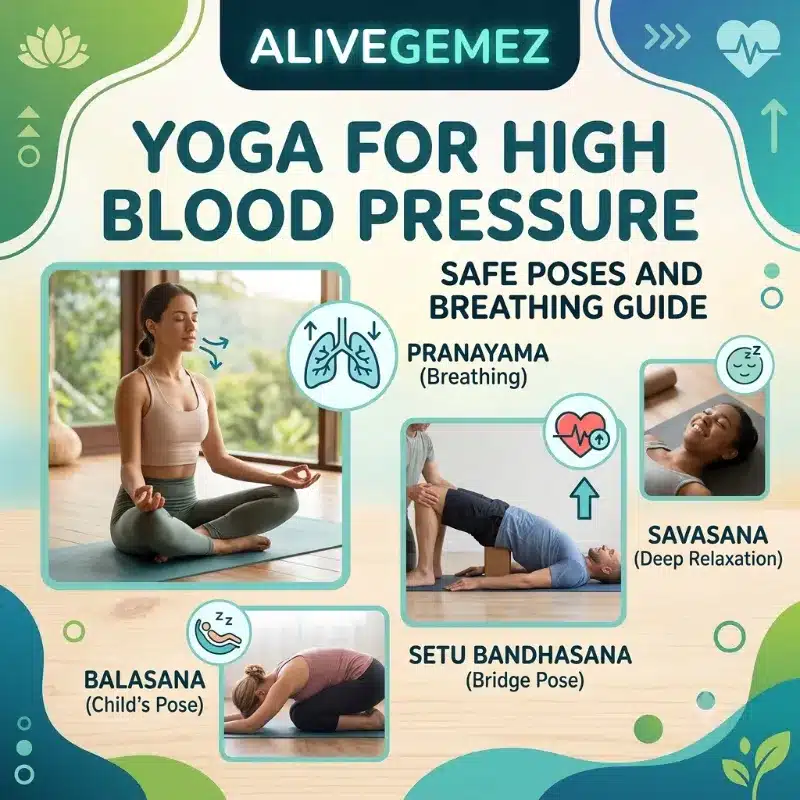
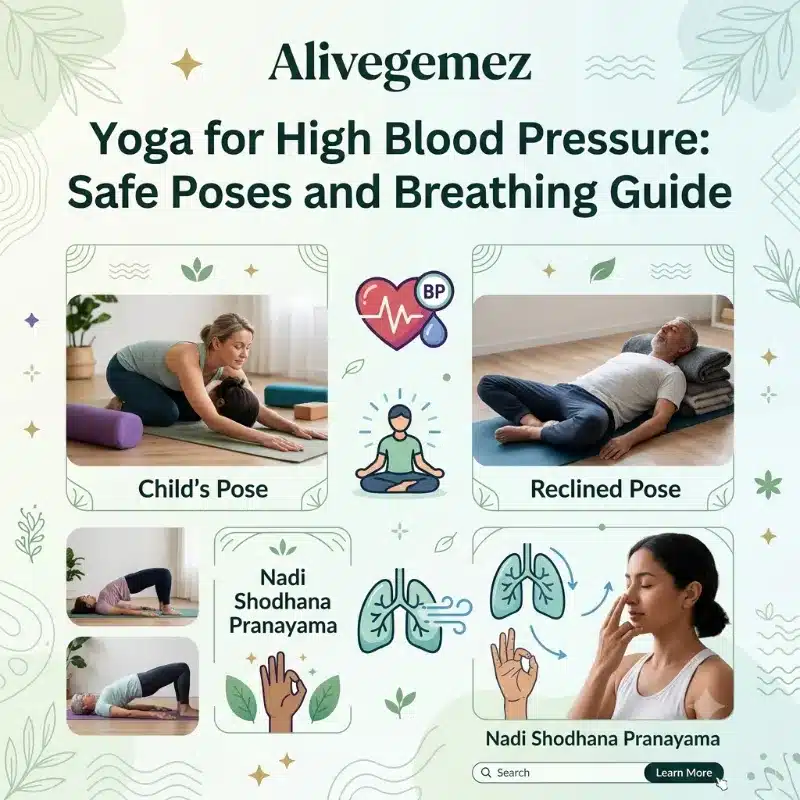
The golden rule for yoga high blood pressure practice: keep your head at or above your heart, move slowly, and never hold your breath. Here are the poses I recommend most often, in the order I’d actually teach them in a class.
1. Legs-Up-The-Wall Pose (Viparita Karani)
This is the single most recommended pose for hypertension in clinical yoga therapy circles, and for good reason. Lying down with your legs resting up a wall shifts blood flow without any muscular effort, which lets your heart rate drop within a few minutes.
- Lie on your back, hips a few inches from the wall
- Rest your legs straight up against it
- Stay for 5 to 10 minutes, breathing slowly through your nose
2. Seated Forward Fold (Paschimottanasana), Supported
A gentle forward fold, done with a bent knee or a bolster under your torso, calms the nervous system without the blood pressure spike that comes from deep, unsupported folds.
3. Reclining Bound Angle Pose (Supta Baddha Konasana)
This restorative shape opens the chest and hips while keeping you fully supported on the floor. Many of my clients with high blood pressure fall asleep in this one, which tells you exactly how effective it is at downshifting the nervous system.
4. Child’s Pose (Balasana)
Simple, accessible, and genuinely underrated. Keep your forehead supported on a block or your forearms if your blood pressure is currently elevated, so your head isn’t dropping too low relative to your heart.
5. Corpse Pose (Savasana) with Extended Exhale
Five to ten minutes of stillness at the end of practice, paired with an exhale that’s longer than your inhale, is where a lot of the blood pressure benefit actually consolidates.
For a deeper dive into how these shapes affect your vagus nerve specifically, which is the physiological switch behind most of this calming effect, our guide on vagus nerve yoga exercises breaks it down pose by pose.
Poses and Practices to Avoid or Modify
Not every yoga pose is safe when your blood pressure is elevated or unmanaged. This is the part most generic yoga blogs skip, and it’s the part that actually protects you.
- Headstand and shoulder stand: Inverting the body increases pressure in the head and neck, which is risky with uncontrolled hypertension
- Deep, unsupported backbends like full Wheel Pose or Camel Pose, since they can spike pressure quickly
- Breath retention (Kumbhaka) in pranayama, meaning holding the breath after inhale or exhale, until your numbers are stable
- Fast-paced Vinyasa flows or hot yoga classes, which raise heart rate and core temperature simultaneously
- Kapalabhati and Bhastrika (forceful breathing techniques), since the rapid, forceful exhale pattern can raise blood pressure temporarily in sensitive individuals
If your hypertension is connected to a thyroid issue, which is more common than most people realize, it’s worth checking our article on yoga and thyroid problems to avoid before building your routine.
The 4-7-8 Breathing Technique: How to Do It and When to Use It
If you only take one tool from this entire guide, make it this one. The 4-7-8 breathing technique, popularized by Dr. Andrew Weil and rooted in the pranayama practice of pranayama ratio breathing, is the fastest, most portable way to bring blood pressure down in the moment, and it needs zero equipment.
How to do 4-7-8 breathing, step by step:
- Sit or lie comfortably, spine relatively straight, shoulders relaxed
- Exhale completely through your mouth, making a soft whoosh sound
- Close your mouth and inhale quietly through your nose for a count of 4
- Hold your breath gently for a count of 7
- Exhale completely through your mouth for a count of 8, again with that soft whoosh
- Repeat for 4 full cycles when starting out, building up to 8 over a few weeks
The ratio matters more than the exact seconds. What you’re doing is extending your exhale far past your inhale, which directly stimulates the vagus nerve and pulls your body into a parasympathetic state. Slower, longer exhales are linked to measurable, fast blood pressure drops, and research on paced breathing shows that slow breathing at around six breaths per minute produces immediate, measurable blood pressure reductions in as little as ten minutes.
When to use the 4-7-8 technique:
- First thing in the morning, before checking your phone or email
- Right before a blood pressure reading at home or at the doctor’s office, if you tend to get “white coat” spikes
- During a stressful meeting, an argument, or a traffic jam, since it works seated and fully clothed
- Right before bed, since it doubles as one of the more effective natural tools for falling asleep faster
A caution worth repeating: if you feel light-headed during the 7-count hold, shorten it. There is no prize for holding longer, and dizziness defeats the entire purpose.
Yoga, Insulin, and Glucose Control
Blood pressure and blood sugar are close cousins, medically speaking, and a large share of people managing hypertension are also managing type 2 diabetes or prediabetes. This is where yoga type 2 diabetes research gets genuinely encouraging.
A 2025 randomized controlled trial run through the Madras Diabetes Research Foundation followed 152 adults with type 2 diabetes over a 12-week structured yoga intervention with a three-month follow-up, and while HbA1c changes didn’t reach statistical significance in that particular trial, the yoga group showed statistically significant improvements in stress, depression, and cognitive function compared to the control group, all of which independently affect blood sugar regulation through cortisol.
Yoga and the Gut-Brain Connection How Your Practice Shapes Your Mood
Other trials paint an even more direct picture of yoga glucose control USA and international audiences are asking about. A pilot study published in late 2025 found that yoga and walking both meaningfully reduced blood glucose levels in adults with type 2 diabetes, with the biggest improvement showing up in the group combining both practices. A separate 2025 meta-analysis focused on Asian populations found that yoga programs lasting 12 weeks or longer produced a statistically significant reduction in HbA1c compared to control groups, reinforcing that consistency over months, not a single intense session, is what moves the needle on yoga insulin sensitivity.
Here’s the mechanism in plain language: chronic stress raises cortisol, cortisol raises blood glucose and blood pressure at the same time, and slow, mindful movement lowers cortisol. That’s the whole loop. It’s why so many people managing both conditions notice yoga helping across the board rather than just one number.
If hormone-driven blood sugar swings are part of your picture, our detailed breakdown on yoga for PCOS and hormonal balance covers the insulin resistance connection in far more depth than we have room for here.
Building a Realistic Weekly Yoga Routine for Blood Pressure
Consistency beats intensity every time with yoga high blood pressure management. Here’s the exact structure I give clients starting out, adjusted for a real work-and-family schedule.
- Monday, Wednesday, Friday: 20 minutes of gentle poses (legs-up-the-wall, seated forward fold, child’s pose) followed by 5 minutes of 4-7-8 breathing
- Tuesday, Thursday: 10 minutes of seated pranayama only, no poses, done first thing in the morning
- Saturday: A longer 30 to 40 minute restorative class or session, including savasana
- Sunday: Rest, or a gentle walk paired with a few minutes of nasal breathing
Track your blood pressure at the same time each day, ideally before your morning coffee, so you’re comparing like with like. Most people notice their resting numbers shifting somewhere between week 3 and week 8, which lines up with the 8-to-12-week timeframe used in nearly every study cited above.
Gut health also plays a quieter role in blood pressure than most people expect, largely through inflammation and the gut-brain axis. If digestion has been part of your health picture too, our guide on yoga for gut health and digestion is worth adding to your reading list.
What the Research Actually Shows: A Quick Data Snapshot
Numbers help more than adjectives here, so here’s a side-by-side of the major recent studies on yoga high blood pressure outcomes.
| Study | Sample Size | Systolic BP Change | Diastolic BP Change |
|---|---|---|---|
| PLOS One meta-analysis, 2025 (30 RCTs) | 2,283 | −7.95 mmHg | −4.93 mmHg |
| Cramer et al. meta-analysis (17 studies) | Not pooled | −4.17 mmHg | −3.62 mmHg |
| Subgroup: poses + breath + meditation combined | Not pooled | −8.17 mmHg | −6.14 mmHg |
| Prehypertension-focused review (8 studies) | Not pooled | Favored yoga (SMD −0.62) | Favored yoga (SMD −0.81) |
Visualizing the drop (average systolic mmHg reduction by intervention type):
Poses only              ████████            −4.2 mmHg
Poses + breath          ████████████████    −8.0 mmHg
Poses + breath + meditation  █████████████████  −8.2 mmHg
The pattern across nearly every study is the same: the more complete your practice, meaning poses, breath, and stillness together, the bigger the blood pressure benefit. This is exactly why a 15-minute pose-only YouTube video rarely delivers what a full practice does.
For an outside, non-affiliated clinical perspective on this same research, Harvard Health’s overview of yoga and high blood pressure is a solid, doctor-reviewed resource worth bookmarking alongside this guide.
Who Should Talk to a Doctor Before Starting
Yoga is genuinely low-risk, but a few situations call for a conversation with your physician first:
- Blood pressure readings consistently above 160/100 mmHg
- A recent cardiac event, stroke, or diagnosed arrhythmia
- Pregnancy with pregnancy-induced hypertension
- Uncontrolled type 2 diabetes with frequent glucose swings
- Glaucoma or retinal issues, since these affect which inversions are safe
None of this is meant to scare you off the mat. It’s meant to make sure the mat is actually helping.
Frequently Asked Questions
Does yoga really lower blood pressure, or is it just relaxation? It’s both, and they’re connected. Research consistently shows measurable systolic and diastolic reductions from regular yoga practice, and the mechanism behind that is the relaxation response itself lowering sympathetic nervous system activity.
How long before I see results from yoga for high blood pressure? Most clinical trials show measurable change between 8 and 12 weeks of consistent practice, 3 to 5 sessions per week. Some people notice softer, subjective changes like better sleep and less reactivity within the first two weeks.
Can yoga replace my blood pressure medication? No, and no responsible teacher or researcher will tell you otherwise. Yoga is a strong complementary tool, not a replacement for prescribed medication. Any changes to medication should go through your doctor, not your yoga mat.
Is hot yoga safe for high blood pressure? Generally not recommended without medical clearance. The combination of heat, dehydration risk, and cardiovascular demand can spike blood pressure rather than lower it.
What’s the fastest way to lower blood pressure using yoga? The 4-7-8 breathing technique is the quickest tool, often producing a noticeable calming effect within a few minutes, since it directly extends your exhale and engages the vagus nerve.
Test Your Knowledge: Yoga for Blood Pressure Quiz
1. Which pose is most commonly recommended first for people with high blood pressure? A) Full Wheel Pose B) Legs-Up-The-Wall Pose C) Headstand
2. In the 4-7-8 breathing technique, how long do you hold your breath? A) 4 seconds B) 7 seconds C) 8 seconds
3. What did the 2025 PLOS One meta-analysis find for average systolic blood pressure reduction? A) About 1 mmHg B) About 8 mmHg C) About 20 mmHg
4. Which yoga practice combination showed the strongest blood pressure results in research? A) Poses alone B) Breathing alone C) Poses, breathing, and meditation together
5. Which practice should generally be avoided with unmanaged high blood pressure? A) Legs-up-the-wall pose B) Slow seated breathing C) Headstand and deep backbends
Answer Key: 1-B, 2-B, 3-B, 4-C, 5-C
Conclusion
Managing high blood pressure through yoga isn’t about a perfect practice or an hour-long commitment you’ll abandon by week two. It’s about showing up for ten quiet minutes of legs-up-the-wall, learning the 4-7-8 breath well enough to reach for it in traffic, and letting your nervous system slowly relearn what “safe” feels like. The research backs it, real people’s numbers reflect it, and your body will tell you it’s working long before your next doctor’s visit confirms it on paper. Start small, stay consistent, and keep your physician looped in on the journey.
References
- Geiger C, Cramer H, Anheyer D, Dobos G, Kohl-Heckl WK. A systematic review and meta-analysis of yoga for arterial hypertension. PLOS One. 2025.
- Cramer H, Sellin C, Schumann D, Dobos G. Effectiveness of yoga for hypertension: Systematic review and meta-analysis. PMC. 2013.
- Effect of yoga on blood pressure in prehypertension: A systematic review and meta-analysis. PMC. 2021.
- The impact of yoga intervention on physical and mental health of adults with type 2 diabetes. International Journal of Yoga. 2025.
- Hazarika D, Khan I, Lahkar M. Effects of yoga and walking on blood glucose levels and quality of life in adults with type 2 diabetes mellitus: A pilot study. Cureus. 2025.
- Yoga practice duration and its influence on type 2 diabetes management: A meta-analysis of Asian population. iScience. 2026.
- Harvard Health Publishing. Yoga and high blood pressure.