
If you have ever rolled out your mat, dropped into shoulder stand, and then wondered “wait, is this actually good for my thyroid or am I making it worse?” you are not alone. In fact, thyroid conditions affect roughly 20 million Americans, and more than 12% of the population will deal with a thyroid issue at some point in life, according to the American Thyroid Association. Women, notably, are five to eight times more likely than men to be affected.
Yoga for Menopause Symptoms Relief Ease Hot Flashes, Sleep Better and Balance Mood Naturally
So when people search for yoga thyroid problems avoid, they usually are not looking for a generic list of “calming poses.” Instead, they want real answers: which postures genuinely support a sluggish or overactive thyroid, and which ones can quietly work against it. That is exactly what we cover here, pose by pose and breath by breath, backed by actual research and twelve years of teaching students who live with hypothyroidism, Hashimoto’s, and Graves’ disease.
Yoga for Gut Health 8 Poses That Improve Digestion Fast
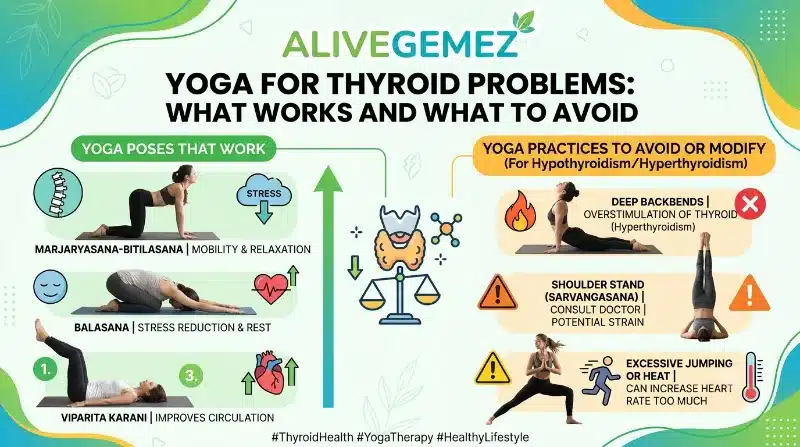
TL;DR: Gentle, neck-safe yoga (supported bridge, seated twists, legs-up-the-wall, and slow pranayama) can help regulate cortisol, support circulation to the thyroid gland, and ease common symptoms like fatigue and brain fog. However, you should approach deep or forced neck compression poses such as unsupported shoulder stand and plow pose very carefully, or skip them altogether, especially if you have thyroid nodules, Graves’ disease, or a recent diagnosis. Ultimately, yoga works best as a support alongside medical treatment, never as a replacement for it.
Yoga for High Blood Pressure Safe Poses and Breathing Guide
Key Takeaways
| Topic | What You Need to Know |
|---|---|
| Best poses for thyroid support | Supported bridge, fish pose (supported), seated twists, cat-cow, legs-up-the-wall |
| Poses to avoid or modify | Unsupported shoulder stand, plow pose, forceful neck-lock (jalandhara bandha) if you have nodules or Graves’ disease |
| Best breathing technique | Slow diaphragmatic breathing and 4-7-8 breathing to lower cortisol and support the nervous system |
| Research snapshot | A 2025 randomized controlled trial in the Journal of Medical Internet Research found a structured yoga module improved quality of life and thyroid-related symptoms in hypothyroid patients on levothyroxine |
| Bottom line | Yoga supports thyroid health, it does not cure thyroid disease, always practice alongside medical care |
Why Your Thyroid Cares What You Do on the Mat
Your thyroid is a small, butterfly-shaped gland sitting right at the front of your neck, and it runs almost everything about your metabolism, energy, temperature regulation, and even your mood. When thyroid hormone production goes off track, whether it is hypothyroidism (underactive) or hyperthyroidism (overactive), your whole body feels it. Fatigue that sleep does not fix, weight changes that make no sense, hair thinning, anxiety or brain fog, these are the everyday realities for millions of people.
Vagus Nerve Yoga 7 Poses to Reset Your Nervous System
Here is the connection most people miss. The thyroid does not operate in isolation, it ties closely to your nervous system and to your stress hormone, cortisol. Chronic stress raises cortisol, and elevated cortisol can suppress the conversion of T4 into the active thyroid hormone T3. Therefore, this is precisely where yoga for thyroid function earns its place, not as a magic fix, but as a legitimate tool for lowering the stress load your endocrine system carries every day.
What the Research Actually Shows
A 2024 systematic review in the Journal of Ayurveda and Integrative Medicine analyzed 11 clinical trials covering 516 adults, and it consistently linked structured yoga programs combining asanas, pranayama, and meditation to reduced TSH levels in people with hypothyroidism. Meanwhile, a 2025 randomized controlled trial published in the Journal of Medical Internet Research tested a scientifically designed yoga module delivered via telehealth to patients with confirmed hypothyroidism on levothyroxine, and it reported meaningful improvement in quality of life, stress reduction, and body composition.
Yoga and the Gut-Brain Connection How Your Practice Shapes Your Mood
In other words, this is not folklore, it is measurable, published research. That said, the authors are honest that larger trials are still needed before yoga becomes a formal part of thyroid treatment guidelines.
Additionally, if you are also managing a related hormonal condition, our pillar guide on yoga for hormonal balance in women is a good next stop after this article, since thyroid health and broader hormonal balance connect closely.
Yoga Hypothyroid vs Hyperthyroid: Why the Approach Is Different
This is where a lot of generic wellness content gets it wrong. Yoga hypothyroid guidance and yoga hyperthyroid guidance are not interchangeable, since an underactive thyroid and an overactive one need opposite things from your practice.
- Hypothyroidism (underactive thyroid): Your body is running slow, so a practice with a bit of gentle stimulation, sun salutations at a measured pace, and mild backbends can help lift energy and support metabolism.
- Hyperthyroidism (overactive thyroid, including Graves’ disease): Your body is already in overdrive, so intense, heat-building sequences like power vinyasa or hot yoga can aggravate symptoms such as a racing heart and anxiety. A slower, more restorative approach is usually smarter here.
- Anti-Inflammatory Yoga Routine How to Reduce Inflammation Naturally

If you have Graves’ disease or an active thyroid nodule, deep neck pressure and forceful compression poses deserve extra caution, which we cover in detail below.
What Actually Works: Thyroid Yoga Poses Worth Your Time
These are the poses I have seen genuinely help students, both in my own studio and in the clinical literature.
1. Supported Bridge Pose (Setu Bandhasana)
Bridge pose gently opens the front of the throat and chest without the compression risk of a full shoulder stand. Place a yoga block under your sacrum for support, and hold for 60 to 90 seconds while breathing slowly. Yoga therapists believe this mild, supported extension improves blood flow to the thyroid and parathyroid region.
2. Legs-Up-the-Wall (Viparita Karani)
This is one of the most underrated poses for anyone dealing with thyroid-related fatigue. Specifically, it calms the nervous system, lowers cortisol, and requires zero core strength or neck involvement. For instance, ten minutes with your legs resting up a wall, done three or four times a week, can noticeably improve sleep quality within two to three weeks for many students.
3. Seated Spinal Twist (Ardha Matsyendrasana)
Twists gently massage the thyroid and surrounding tissue while also supporting digestion, which is often sluggish in hypothyroidism. Keep the twist mild, never forced, and always initiate the rotation from your lower spine, not your neck.
4. Cat-Cow (Marjaryasana-Bitilasana)
A simple, safe way to mobilize the cervical spine without compression. This is a great warm-up before any thyroid-focused sequence and works well for both hypothyroid and hyperthyroid practitioners.
5. Supported Fish Pose (Matsyasana, modified)
Traditional fish pose can strain the neck when you do it incorrectly. The modified version, however, uses a rolled blanket under the shoulder blades so the head rests gently on the floor. This opens the throat area safely, and yoga therapists recommend it as one of the more direct thyroid yoga poses.
Here is a quick reference table comparing intensity and best-use case for each pose.
| Pose | Intensity | Best For | Frequency |
|---|---|---|---|
| Supported Bridge | Low-Moderate | Hypo and Hyper | 3-4x/week |
| Legs-Up-the-Wall | Low | Fatigue, stress, sleep | Daily |
| Seated Twist | Low | Digestion, mild stimulation | 3-4x/week |
| Cat-Cow | Low | Warm-up, neck mobility | Daily |
| Supported Fish | Low-Moderate | Throat opening | 2-3x/week |
Yoga Thyroid Problems Avoid: What to Skip or Modify
This is the part most yoga content glosses over, and it is exactly why people search yoga thyroid problems avoid in the first place. Not every pose that “opens the throat chakra” is actually safe for a compromised thyroid gland.
- Unsupported Shoulder Stand (Sarvangasana): Places significant, sustained pressure directly on the thyroid gland. If you have nodules, Graves’ disease, or an autoimmune thyroid condition like Hashimoto’s, skip this or only attempt a heavily supported version under a qualified teacher’s guidance.
- Plow Pose (Halasana): This carries a similar concern to shoulder stand, since deep neck flexion combines with body weight pressing into the throat. Avoid it during a thyroid flare or in the months right after a new diagnosis.
- Forceful Jalandhara Bandha (chin lock): Some pranayama practices use this, pressing the chin firmly into the chest. A gentle version works fine for most people, but skip a forceful, prolonged lock if you have a goiter or nodules.
- Intense heat-based practices for hyperthyroidism: Hot yoga and fast-paced power vinyasa can spike heart rate and anxiety in someone with an overactive thyroid.
- Any pose that causes neck pain, dizziness, or a choking sensation: This applies to everyone, thyroid condition or not, but people with thyroid disease should treat this as a hard stop signal, not something to push through.
According to the yoga therapy resources at Art of Living’s guide to yoga for hyperthyroidism, a slower, cooling approach tends to serve people with an overactive thyroid far better than vigorous sequences, which lines up with what clinicians generally recommend.
Real Case Example: What Six Months of Consistent Practice Looked Like
One of my long-term students, a 42-year-old woman diagnosed with subclinical hypothyroidism in early 2023, started a modified practice built around the poses listed above, three sessions a week, alongside her prescribed levothyroxine. She was not chasing a miracle, she simply wanted less fatigue and better sleep. By month four, her afternoon energy had noticeably improved, and her sleep had gone from waking three or four times a night to sleeping through most nights.
Her endocrinologist, meanwhile, tracked a modest downward trend in her TSH over that period, though her medication dose stayed the same throughout. This mirrors a 2016 pilot study published in a peer-reviewed journal: six months of consistent yoga practice improved TSH and cholesterol markers in women with hypothyroidism, alongside their existing thyroxine treatment. Ultimately, her case, like the research, reminds us that yoga is a support tool, not a substitute for prescribed medication.
Breathing for Thyroid Health: Pranayama and the 4-7-8 Technique
Breathing is arguably more important than the poses themselves when it comes to thyroid support, because slow, controlled breath work directly influences your vagus nerve and your cortisol response.
Why Breath Work Matters for Thyroid Function
Fast, shallow chest breathing keeps your nervous system in a low-grade fight-or-flight state, which keeps cortisol elevated. Elevated cortisol interferes with the conversion of T4 to active T3. Slow, diaphragmatic breathing does the opposite, it activates your parasympathetic nervous system and helps bring cortisol back down.
The 4-7-8 Breathing Technique: How to Do It and When to Use It
Dr. Andrew Weil popularized the 4-7-8 technique, and it remains one of the simplest and most effective breathing patterns for calming an overstimulated nervous system. Notably, it pairs naturally with a thyroid-focused practice.
How to do it:
- Sit or lie down comfortably, with your spine long and your shoulders relaxed.
- Exhale completely through your mouth, making a soft whoosh sound.
- Close your mouth and inhale quietly through your nose for a count of 4.
- Hold your breath gently for a count of 7.
- Exhale fully through your mouth for a count of 8, again with a soft whoosh sound.
- Repeat this cycle for 4 full rounds to start, working up to 8 rounds over a few weeks.
When to use it:
- Before bed, to support falling asleep faster, which is especially useful if hypothyroid fatigue has disrupted your sleep cycle.
- Before a stressful event, a work meeting, a medical appointment, or a flight, to lower acute anxiety.
- At the end of a yoga session, right after your final relaxation pose, to consolidate the calming effect on your nervous system.
A word of caution, if you feel lightheaded during the breath hold, shorten the counts to 4-5-6 until your body adapts. This is common for beginners and nothing to worry about.
Building a Weekly Thyroid-Friendly Yoga Routine
You do not need ninety minutes a day. In fact, consistency matters far more than duration. Below is a simple weekly structure that works well for most people managing hypothyroidism or mild hyperthyroidism symptoms; always adjust it to what your doctor has cleared for you.
- Monday, Wednesday, Friday: 20-minute gentle flow including cat-cow, supported bridge, seated twist, closing with 4-7-8 breathing.
- Tuesday, Thursday: 10-minute legs-up-the-wall plus diaphragmatic breathing, ideal for lower-energy days.
- Saturday: Longer 30 to 40-minute restorative session including supported fish pose.
- Sunday: Rest, or a short walk combined with mindful breathing.
If you are also navigating a hormonal condition like PCOS alongside thyroid concerns, our guide on yoga for PCOS and hormonal balance walks through a complementary approach that many of our readers have found useful.
Common Mistakes People Make With Thyroid Yoga
- Jumping straight into shoulder stand because a video called it “the thyroid pose.” This is outdated advice that ignores individual risk factors like nodules or Graves’ disease.
- Practicing hot yoga during a hyperthyroid flare. Heat and intensity are the opposite of what an overactive thyroid needs.
- Skipping medication because “yoga is working.” Every credible study on this topic, including the 2025 JMIR trial, used yoga alongside medical treatment, never instead of it.
- Holding the breath incorrectly during pranayama, which can spike anxiety rather than reduce it.
- Ignoring pain or a choking sensation in the neck. Sensation is information, listen to it.
For a broader technical breakdown of pose modifications by thyroid condition, Yoga Point’s guide to yoga for thyroid is a solid additional resource, and the practical sequencing tips at Samadhi Yoga Ashram’s article on yoga for thyroid health are worth reading if you want deeper sequencing detail.
Frequently Asked Questions
Can yoga cure hypothyroidism or hyperthyroidism? No. Yoga can support symptom management, stress reduction, and general well-being, but thyroid disease requires medical diagnosis and, in most cases, ongoing treatment. Think of yoga as a supportive layer, not a replacement for your endocrinologist.
Is shoulder stand always bad for the thyroid? Not always, but it carries real risk if you have nodules, Graves’ disease, or an active autoimmune flare. A supported, well-taught version may suit some people without those risk factors, ideally with an experienced teacher who knows your history guiding you.
How often should I practice yoga for thyroid support? Most of the research reviewed here used sessions three to six days a week for one to six months. Even 15 to 20 minutes most days tends to outperform one long weekly session.
Can yoga help me reduce my thyroid medication dose? Do not adjust medication based on yoga practice alone. Some studies observed modest hormone shifts, but only your prescribing doctor should make medication changes, and only based on lab results.
Is hot yoga safe with hyperthyroidism? Generally, no, since heat and vigorous movement can worsen symptoms like rapid heart rate and anxiety. Instead, choose a cooler, slower practice.
Quick Quiz: Test What You Just Learned
1. Which pose carries the most risk for someone with thyroid nodules or Graves’ disease? A) Cat-Cow B) Unsupported Shoulder Stand C) Legs-Up-the-Wall
2. What is the recommended breath hold count in the 4-7-8 technique? A) 4 seconds B) 5 seconds C) 7 seconds
3. What did the 2024 systematic review in the Journal of Ayurveda and Integrative Medicine find about yoga and TSH levels? A) No effect at all B) Structured yoga programs were linked to reduced TSH levels C) Yoga increased TSH levels
4. What type of practice is generally better suited to hyperthyroidism than hot yoga? A) Power vinyasa B) A slower, cooling, restorative practice C) Fast-paced sun salutations
5. According to the American Thyroid Association, roughly what percentage of Americans will develop a thyroid condition in their lifetime? A) About 2% B) About 12% C) About 40%
Answers: 1) B, 2) C, 3) B, 4) B, 5) B
Conclusion
Yoga will not cure a thyroid condition, but it genuinely earns its place in a well-rounded thyroid care routine when you practice it with the right knowledge. Gentle, supported poses like bridge, legs-up-the-wall, and seated twists, paired with calming breath work like the 4-7-8 technique, can meaningfully ease fatigue, stress, and sleep disruption while supporting the nervous system that your thyroid depends on. The poses to avoid, particularly unsupported shoulder stand and plow pose for anyone with nodules or Graves’ disease, matter just as much as the ones you choose to practice. Pair your mat time with your prescribed medical treatment, listen closely to what your body tells you mid-pose, and give the process months, not days, to show results. Explore more hormone-focused practices on RealYogaHub as you build a routine that actually works for your body.
References
- American Thyroid Association. General Information and Press Room. thyroid.org
- Journal of Medical Internet Research (2025). Enhancing Quality of Life in Patients With Hypothyroidism Using a Scientific Yoga Module: Randomized Controlled Trial. jmir.org
- Journal of Ayurveda and Integrative Medicine / ScienceDirect (2024). Effects of yoga on hypothyroidism: A systematic review.
- Journal of the Endocrine Society (2025). Autoimmune Thyroid Disease in the United States: Population Prevalence, Diagnosis Rates, and Trends.
- PubMed (2016). Effect of 6 months intense yoga practice on lipid profile, thyroxine medication and serum TSH level in women suffering from hypothyroidism: A pilot study.
- ScienceDirect (2025). Yogic management of hypothyroidism in females: A randomized controlled trial.