
If you were diagnosed with PCOS and told to “just lose weight and manage stress,” you already know how unhelpful that advice feels. You want something real. Something you can actually do on a Tuesday morning before work that moves the needle on your cycles, your energy, and your blood sugar. That’s exactly what yoga PCOS hormonal balance research has been building toward for over a decade, and this guide breaks down the poses, the science, and the practical routine that actually work.
Yoga for Gut Health 8 Poses That Improve Digestion Fast
TL;DR: A consistent, gentle yoga practice built around forward folds, twists, hip openers, and slow breathing can meaningfully lower insulin resistance, reduce excess androgens, and calm the irregular cycles that come with PCOS. It won’t replace your endocrinologist, but a recent Bayesian analysis of 19 trials found yoga outperformed most other exercise types for improving insulin resistance markers in women with PCOS.

Key Takeaways
| What You’ll Learn | Why It Matters |
|---|---|
| The 10 best PCOS yoga poses | Target insulin resistance, ovarian blood flow, and cortisol |
| How yoga affects insulin resistance | Yoga ranked above most cardio and strength formats in a 2025 network meta-analysis |
| PCOS insulin resistance yoga science | Real HOMA-IR and testosterone data from clinical trials |
| A realistic weekly routine | Built for real schedules, not 90-minute studio classes |
| When yoga isn’t enough on its own | Honest limits, so you know when to loop in a doctor |
Polycystic ovary syndrome affects somewhere between 8% and 13% of reproductive-age women in the United States, though estimates run as high as 20% depending on which diagnostic criteria a clinic uses. Globally, the picture is similar or worse: a 2026 meta-analysis in Human Reproduction Update put adult prevalence at 12.1% using the widely used Rotterdam criteria, with Europe sitting around 11.7% and the Americas around 10.5%. That means most yoga studios in the US and Europe have at least a few students quietly dealing with irregular periods, stubborn weight around the midsection, or acne that won’t budge no matter what skincare routine they try.
Vagus Nerve Yoga 7 Poses to Reset Your Nervous System
Here’s the thing nobody tells you at diagnosis: PCOS is not one condition. It’s a cluster of hormonal and metabolic patterns insulin resistance, elevated androgens, disrupted ovulation — that show up differently in every woman. That’s exactly why a rigid, one-size-fits-all workout plan usually backfires. Yoga insulin resistance research has shown something different: because yoga works on the nervous system as much as the muscles, it addresses the stress-cortisol-insulin loop that keeps so many PCOS symptoms locked in place.
Why Yoga Actually Helps With PCOS (Not Just Vibes)
Let’s get specific instead of vague. PCOS symptoms are driven largely by two interconnected problems:
- Insulin resistance. Roughly 65-70% of women with PCOS have some degree of insulin resistance, which pushes the ovaries to produce more testosterone.
- Chronic low-grade stress response. Elevated cortisol worsens insulin resistance, and insulin resistance worsens cortisol regulation. It’s a loop, and it’s exhausting.
A 2023 systematic review and meta-analysis published in the Journal of Alternative and Complementary Medicine pooled data from PCOS yoga trials and found measurable improvements after a consistent practice: fasting insulin dropped, HOMA-IR (the standard insulin resistance marker) fell, and clinical signs of excess androgen decreased. A separate 2025 Bayesian network meta-analysis comparing yoga, moderate cardio, high-intensity interval training, resistance training, and combined training across 19 randomized trials found yoga ranked highest for reducing HOMA-IR, ahead of every other exercise format tested, including HIIT.
Yoga for Thyroid Problems What Works and What to Avoid
That doesn’t mean yoga is “better than exercise” in some universal sense. It means yoga’s combination of muscular engagement, slow breathing, and parasympathetic activation hits a specific mechanism the stress-insulin loop that pure cardio or lifting doesn’t directly target.
Yoga for Menopause Symptoms Relief Ease Hot Flashes, Sleep Better and Balance Mood Naturally
What the Research Actually Measured
| Outcome Measured | Typical Change Reported in Yoga Trials |
|---|---|
| Fasting insulin | Reduced |
| HOMA-IR (insulin resistance score) | Reduced, meaningfully in several trials |
| Menstrual regularity | Improved cycle frequency |
| Clinical hyperandrogenism (acne, hair growth) | Reduced |
| Fasting blood glucose | Modest reduction |
A smaller but well-designed 2021 randomized controlled trial out of Sarem Hospital in Tehran followed 61 women with PCOS undergoing infertility treatment. The intervention group did structured yoga for six weeks; the control group received standard care only. The yoga group showed measurable improvements in anthropometric markers and clinical PCOS signs compared to controls — a short window, which is exactly the point. You don’t need a year to see change.
The 10 Science-Backed Poses for Hormonal Balance
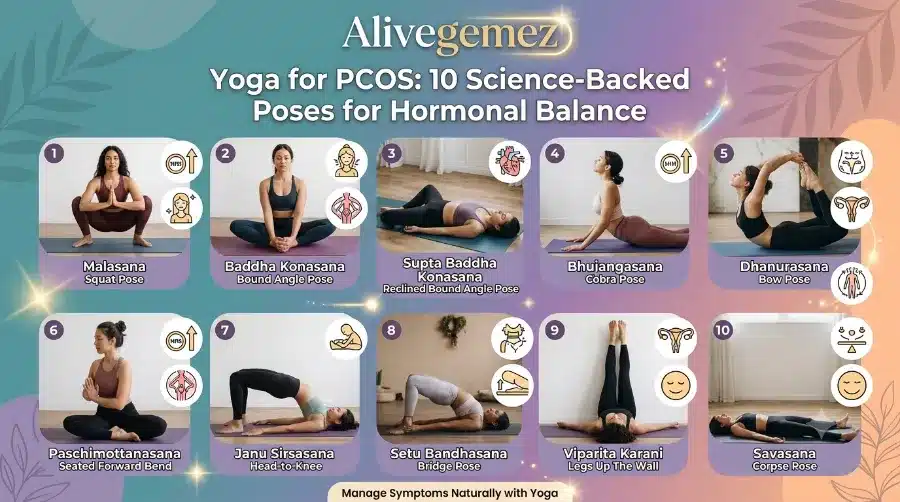
These PCOS yoga poses were chosen because each targets one of three things: insulin sensitivity, ovarian and pelvic blood flow, or cortisol regulation. You don’t need to do all 10 every day — pick 5-6 and rotate.
- Supta Baddha Konasana (Reclining Bound Angle Pose) — Opens the hips and groin, increases blood flow to the pelvic region, and is deeply calming for the nervous system. Hold 3-5 minutes with support under the knees.
- Bhujangasana (Cobra Pose) Stimulates the ovaries and improves circulation to the adrenal glands, which play a direct role in androgen production.
- Setu Bandhasana (Bridge Pose) Activates the thyroid and improves blood flow to reproductive organs; also a gentle way to build core and glute strength, which supports insulin sensitivity.
- Malasana (Garland Pose / Yogi Squat) A deep hip opener that also engages the legs, one of the largest muscle groups in the body and a key driver of glucose uptake.
- Ardha Matsyendrasana (Seated Spinal Twist) Twists gently compress and release the abdominal organs, which some practitioners describe as a “massage” for digestion and detoxification pathways.
- Dhanurasana (Bow Pose) Stimulates the pancreas, which is directly relevant to insulin regulation.
- Paschimottanasana (Seated Forward Fold) Calms the sympathetic nervous system and lowers cortisol; forward folds are consistently linked to reduced stress hormone output.
- Viparita Karani (Legs-Up-the-Wall Pose) One of the simplest, most restorative poses available; excellent for evening cortisol regulation and often recommended for anyone dealing with anxiety alongside PCOS.
- Ustrasana (Camel Pose) Opens the chest and stimulates the thyroid and adrenal glands.
- Sarvangasana (Shoulder Stand, or a supported alternative) Traditionally linked to thyroid stimulation, which matters because thyroid dysfunction frequently overlaps with PCOS. Skip this one if you have neck issues, high blood pressure, or are newer to yoga a supported bridge pose is a safer substitute.
For a deeper breakdown of how these poses fit into a broader hormone-balancing practice, our pillar guide on yoga for hormonal balance walks through sequencing for every phase of the menstrual cycle.
A Realistic Weekly Routine
You don’t need an hour a day. Consistency beats intensity here, every time.
- Monday, Wednesday, Friday: 20-25 minutes poses 1, 3, 4, 6, 8
- Tuesday, Thursday: 15 minutes of pranayama-focused practice, including 4-7-8 breathing (inhale 4 counts, hold 7, exhale 8), which lowers heart rate and cortisol within a few rounds
- Saturday: Longer 40-minute flow combining all 10 poses
- Sunday: Rest, or a gentle restorative sequence built around poses 1 and 8
If you’re newer to any of these shapes, our detailed guide to yoga for PCOS poses breaks down modifications for beginners, and this overview of yoga’s effect on weight control and hormonal balance is worth reading if weight management is your main concern right now.
Yoga and Ovarian Health: What the Evidence Actually Shows
A 2026 systematic review in PMC looked specifically at yoga’s effect on Anti-Müllerian hormone (AMH), androgen levels, and metabolic markers in women with PCOS. The evidence is still limited researchers were careful to note that larger, more rigorous trials are needed but the existing studies point toward yoga meaningfully influencing AMH, androgen, and insulin levels. That’s a genuinely encouraging signal for yoga ovarian health, even with the caveat that this field needs more research before anyone can call it definitive.
Anti-Inflammatory Yoga Routine How to Reduce Inflammation Naturally
This is where honesty matters more than hype. Yoga is not a replacement for metformin, inositol, or hormonal treatment when those are medically indicated. What it does appear to do is improve the metabolic environment your ovaries are operating in less insulin resistance generally means less androgen overproduction, and better blood flow to the pelvic region supports whatever else your treatment plan includes.
Yoga and the Gut-Brain Connection How Your Practice Shapes Your Mood
For a therapy-focused deep dive into sequencing yoga specifically for PCOS symptom management, this practitioner guide on yoga therapy for PCOS covers more advanced sequencing than we have room for here.
Common Mistakes Women Make With PCOS Yoga
- Going too hard, too fast. Aggressive power yoga can spike cortisol in an already stressed system. Slower, more restorative styles tend to outperform intense vinyasa for hormonal outcomes specifically.
- Skipping the breathwork. The pranayama component isn’t optional decoration — it’s doing real work on the cortisol-insulin loop.
- Expecting overnight results. Most trials showing measurable HOMA-IR and hormone changes ran 8-12 weeks minimum. Give it a full cycle or two before judging results.
- Practicing inconsistently. Three sessions one week and zero the next won’t create the metabolic adaptation that consistent practice does.
FAQ
Can yoga alone cure PCOS?
No. PCOS has no single cure, and yoga works best as one part of a broader plan that may include diet, sleep, stress management, and medical treatment where appropriate.
How long before I see changes in my cycle?
Most research shows measurable metabolic changes within 8-12 weeks of consistent practice, though menstrual regularity can take longer to normalize.
Is hot yoga safe for PCOS?
It can be, but it’s not necessarily better. The calming, restorative styles referenced in this guide have stronger evidence for hormonal outcomes than heated, high-intensity formats.
Do I need to see a doctor before starting?
If you have high blood pressure, thyroid conditions, or are pursuing fertility treatment, check with your doctor before adding inversions like shoulder stand.
What’s the single best pose to start with if I only have 5 minutes?
Legs-Up-the-Wall (Viparita Karani). It requires zero flexibility, calms the nervous system fast, and is safe for nearly everyone.
Quick Quiz: How Well Do You Know PCOS Yoga?
1. Which mechanism is most directly targeted by yoga’s stress-reducing effect?
A) Muscle hypertrophy
B) The cortisol-insulin loop
C) Bone density
2. In the 2025 network meta-analysis, how did yoga rank for reducing HOMA-IR compared to other exercise types?
A) Lowest of all six formats
B) Highest of all six formats
C) Tied with resistance training
3. Which pose is considered the safest, most accessible option for someone with only 5 minutes?
A) Shoulder Stand
B) Camel Pose
C) Legs-Up-the-Wall Pose
4. Roughly what percentage of women with PCOS have some degree of insulin resistance?
A) 10-15%
B) 65-70%
C) 95-100%
5. How long did most trials run before showing measurable hormone or metabolic changes?
A) 1-2 weeks
B) 8-12 weeks
C) 2 years
Answers: 1-B, 2-B, 3-C, 4-B, 5-B
Yoga for High Blood Pressure Safe Poses and Breathing Guide
Conclusion
PCOS can feel like your body is working against you, but the research on yoga is genuinely encouraging: consistent, gentle practice built around the right poses and real breathwork measurably improves insulin resistance, calms the stress response driving so many symptoms, and supports the ovarian environment your other treatments are working within. Start small, stay consistent, and give your body the 8-12 weeks the research says it actually needs. For more cycle-specific sequencing, visit RealYogaHub and explore our full library of hormone-focused practices.
References
- Frontiers in Reproductive Health, Yoga as a Complementary Intervention for PCOS Management: A Systematic Review (2026)
- Human Reproduction Update, Prevalence of Polycystic Ovary Syndrome: A Global and Regional Systematic Review and Meta-Analysis (2026)
- PMC, Effects of Yoga Interventions on Anti-Müllerian Hormone, Androgen Levels, and Metabolic Parameters in Women with PCOS (2026)
- PMC, The Effects of Different Exercises on Insulin Resistance and Testosterone Changes in Women with PCOS: A Network Meta-Analysis (2025)
- Evidence-Based Complementary and Alternative Medicine, Yoga Effects on Anthropometric Indices and PCOS Symptoms in Women Undergoing Infertility Treatment: An RCT (2021)
- Journal of Alternative and Complementary Medicine, Effect of Yoga Therapy on Health Outcomes in Women with PCOS: A Systematic Review and Meta-Analysis (2023)