
Your heart is racing before a meeting that hasn’t even started yet. Your mind is already three worst-case scenarios deep. You’ve heard that meditation calms anxiety. You’ve also heard that exercise calms anxiety. So which one do you actually reach for when your chest feels tight and your thoughts won’t slow down?
That question sits at the center of one of the most common searches in wellness right now, and for good reason. Anxiety is not a rare experience anymore. Roughly 1 in 5 US adults have been diagnosed with an anxiety condition at some point, and about 1 in 8 say they feel anxious on a regular basis, according to CDC data. In the UK, recent figures from the Office for National Statistics put high anxiety levels at 33% of adults, rising to over 40% among people under 30.
learn more about bikram vs hot yoga difference tips and expert advice.
I’ve spent 12 years teaching yoga and studying the research behind stress and the nervous system, and I get asked this exact question almost every week: meditation vs exercise for anxiety, which one should I actually do? The honest answer is more interesting than a simple winner. Below, I’ll walk you through what the actual clinical trials say, where each practice shines, and how to build a plan that fits your real life instead of an Instagram version of it.
To get a better understanding of how meditation vs exercise exactly what to expect.
TL;DR
Both meditation and exercise measurably reduce anxiety, but they work through different pathways in the brain and body. Research suggests meditation tends to produce slightly stronger and faster reductions in psychological anxiety symptoms, while exercise delivers more consistent physical stress relief and mood stability over time. The combination of the two, even in small doses, outperforms either practice done alone.
Key Takeaways
| Factor | Meditation | Exercise |
|---|---|---|
| Speed of relief | Often felt within one session (10–20 minutes) | Usually felt within 20–30 minutes of moderate activity |
| Best for | Racing thoughts, rumination, panic symptoms | Physical tension, restlessness, low mood tied to anxiety |
| Research strength | Strong for GAD, panic disorder, chronic worry | Strong for general anxiety, especially mind-body forms like yoga |
| Equipment needed | None | Varies (some options need none, like walking) |
| Consistency needed for results | 8 weeks of regular practice, per most clinical trials | 3–4 sessions per week, per most clinical trials |
| Realistic starting point | 5–10 minutes daily | 20–30 minutes, 3 times a week |
Why This Comparison Actually Matters
Most anxiety advice online tells you to “just meditate” or “just work out” like it’s a light switch. It isn’t. If you’ve ever tried to sit still and meditate while your leg is bouncing with nervous energy, you already know that stillness isn’t always the answer. If you’ve ever gone for a run while your mind replayed an argument on a loop, you know movement alone doesn’t always quiet the noise either.
The meditation vs exercise anxiety debate matters because your nervous system doesn’t respond to a one-size-fits-all fix. Anxiety shows up differently depending on the person, the day, and even the time of day. A stress relief comparison USA-based clinicians now use in practice increasingly points toward matching the tool to the type of anxiety you’re experiencing, not picking a single “best” practice and sticking with it no matter what.
What Happens in Your Brain and Body With Each Practice
How Meditation Affects Anxiety
Meditation, particularly mindfulness-based practices, works largely by changing your relationship to anxious thoughts rather than eliminating them. Brain imaging studies have repeatedly shown that consistent meditation practice reduces activity in the amygdala, the brain’s threat-detection center, while strengthening connections to the prefrontal cortex, the region responsible for rational thought and emotional regulation.
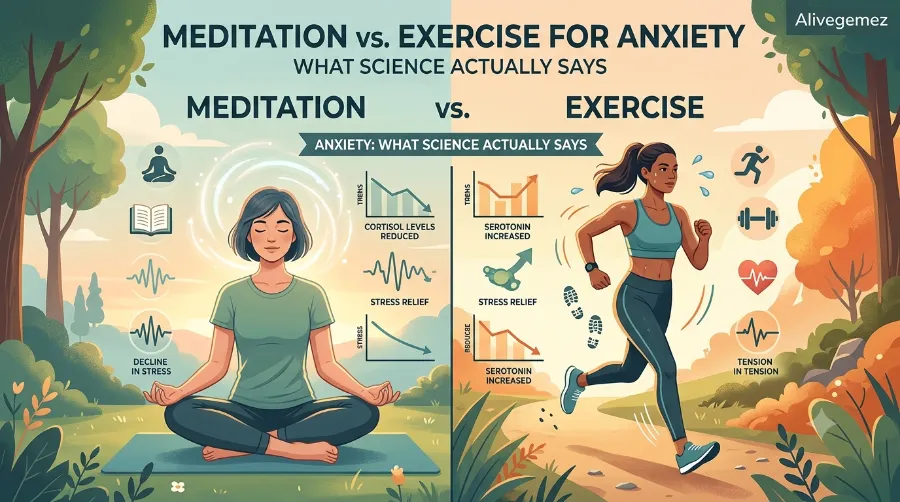
A randomized controlled trial published in the Journal of Scientific Exploration in 2024 compared a meditation group (45 participants) against an exercise group (27 participants) over several weeks. Both groups improved on measures of well-being and anxiety, though meditation showed particularly strong effects on psychological measures tied to rumination and worry.
An earlier but frequently cited review in the American Journal of Health Promotion pooled five randomized controlled trials with 325 total participants comparing non-active meditation directly against exercise. Meditation outperformed exercise on psychosocial outcomes, including anxiety, in that pooled analysis. That doesn’t mean exercise failed. It means meditation had a slight edge specifically for the mental, worry-based side of anxiety in those particular trials.
If you want the deeper research trail on this, the Medito Foundation’s breakdown of meditation and exercise for anxiety is a genuinely useful read, and it doesn’t oversell either practice.
How Exercise Affects Anxiety
Exercise reduces anxiety through a completely different set of mechanisms. Physical activity burns off excess cortisol and adrenaline, the two stress hormones responsible for that jittery, on-edge feeling. It also triggers the release of endorphins and increases levels of brain-derived neurotrophic factor (BDNF), a protein linked to improved mood regulation and resilience to future stress.
Harvard Health has reported that regular aerobic exercise can be as effective as medication for some people with mild to moderate anxiety, particularly when done consistently over several weeks. Their review of the research is worth reading directly if you want the clinical detail behind that claim, and you can find it in their piece on exercise and anxiety treatment.
A 2025 meta-analysis published in PubMed Central pooled data across studies on exercise interventions for anxiety and found that mind-body forms of exercise, meaning practices like yoga and tai chi that combine movement with breath awareness, had a notably stronger effect (SMD −0.77) than conventional exercise alone (SMD −0.39). That single finding matters a lot for the meditation vs exercise anxiety question, because it suggests the two practices aren’t actually opposites. The most effective exercise for anxiety often already contains an element of meditation.
Meditation vs Exercise Anxiety Comparison: Head to Head
Here’s a direct exercise meditation anxiety comparison based on the areas people care about most.
| Category | Meditation | Exercise |
|---|---|---|
| Reduces racing thoughts | Strong evidence | Moderate evidence |
| Reduces physical tension | Moderate evidence | Strong evidence |
| Improves sleep | Strong evidence | Strong evidence |
| Time to first noticeable effect | 10–20 minutes | 20–30 minutes |
| Long-term brain changes | Increased gray matter density in prefrontal cortex after 8 weeks (Harvard-affiliated MBSR studies) | Increased BDNF and hippocampal volume with consistent aerobic training |
| Accessibility | Can be done anywhere, no gear | Some options need space or equipment |
| Social component | Usually solo | Can be social (classes, group runs) |
Real Numbers From Real Studies
I don’t like vague claims like “studies show,” so here are specific figures worth knowing.
- A 2025 meta-analysis covering 7,387 participants across 61 randomized controlled trials found mind-body exercise produced a statistically significant small-to-moderate reduction in anxiety symptoms compared to control groups.
- SAMHSA’s 2024 National Survey on Drug Use and Health found that 7.4% of US adults, about 19.4 million people, had moderate-to-severe generalized anxiety.
- The World Health Organization reported in 2025 that only about 1 in 4 people with an anxiety disorder actually receive treatment, which is exactly why accessible, low-cost tools like meditation and exercise carry so much weight for everyday anxiety management.
- The Washington Post covered a landmark clinical trial comparing mindfulness meditation directly against an anti-anxiety medication (escitalopram) and found the two produced similar reductions in anxiety symptoms over eight weeks. You can read that full coverage in their report on mindfulness meditation and anxiety medication.
When Meditation Is Probably Your Better Option
Meditation tends to work best when your anxiety shows up as mental noise. If your main struggle is a spinning mind, catastrophic thinking, or trouble falling asleep because your brain won’t stop narrating, meditation directly targets that pattern.
It’s also the more practical choice when:
- You’re short on time. Even five focused minutes of breath-based meditation can lower heart rate and reduce the intensity of an anxiety spike.
- You’re dealing with a panic episode. Physical exertion during acute panic can sometimes intensify the racing-heart sensation, while slow breathing calms it.
- You have physical limitations that make regular exercise difficult right now.
- You want a practice you can do at your desk, on a plane, or in bed at 2am.
When Exercise Is Probably Your Better Option
Exercise tends to win when anxiety shows up physically, meaning restlessness, muscle tension, a wired feeling in your body, or anxiety tied to low mood. Movement gives that excess energy somewhere to go.
Exercise is likely the stronger pick when:
- You notice your anxiety comes with physical restlessness or a need to move.
- Your anxiety is tangled up with low motivation or mild depressive symptoms, since exercise reliably lifts mood in a way sitting quietly sometimes can’t.
- You want long-term resilience, not just in-the-moment relief. Regular movement changes your baseline stress response over months.
- You do better with structure and a clear finish line, like a 30-minute walk or a class schedule.
The Research-Backed Middle Ground: Mind-Body Practice
Here’s the part most articles comparing meditation vs exercise anxiety skip entirely. The research doesn’t actually point to a clean winner because the strongest results consistently come from practices that blend both. Yoga is the clearest example, since it pairs physical movement with breath control and present-moment awareness in a single session.
If you’re weighing where to start, our guide on yoga vs pilates for weight loss breaks down how these mind-body practices compare for people focused on physical goals, though the anxiety benefits of yoga specifically come from the breath and awareness component, not the calorie burn.
For beginners trying to decide which yoga style fits an anxious nervous system best, our comparison of Hatha vs Vinyasa yoga for beginners is a genuinely useful next step, since the pacing of each style changes how calming or energizing the practice feels.
If your anxiety runs hot and restless, a more heat-based practice might help burn off that nervous energy, and our breakdown of hot yoga vs regular yoga covers exactly how the two differ in intensity and effect on the nervous system.
Some people wonder whether stretching alone gets close to the same calming effect as full yoga practice. Short answer, not quite, and our piece on yoga vs stretching differences explains why the breathwork component is what actually drives the anxiety-reducing effect.
If you already exercise regularly and want a more vigorous mind-body option, our comparison of Ashtanga vs Power yoga is worth a look, since both combine physical intensity with structured breath patterns.
On the gentler end, if racing thoughts are your main issue and you want maximum nervous-system downshift, our guide to Yin yoga vs restorative yoga covers the slower, longer-hold practices research links to strong parasympathetic activation.
For a practice built specifically around breath and energy work, our article on Kundalini vs Hatha yoga explains how each approaches anxiety differently through breath pattern and pacing.
And if heat and humidity feel calming rather than stressful for your body, our comparison of Bikram vs hot yoga can help you pick between the two most common heated formats.
A Simple 4-Week Plan Combining Both
You don’t need 90 minutes a day. Here’s a realistic weekly structure based on the dosages used in most clinical trials.
Week 1–2 (Building the habit)
- 5 minutes of breath-focused meditation each morning
- 20-minute walk, 3 times a week
Week 3–4 (Adding intensity)
- 10 minutes of meditation, morning or evening
- 30-minute movement session, 4 times a week, mixing walking, yoga, or light cardio
Ongoing maintenance
- 10–15 minutes of meditation, most days
- 3–4 movement sessions per week, at least one being a mind-body format like yoga
This structure matches what the research actually tested. Most meditation trials used 8-week programs with daily short sessions, and most exercise trials used 3–4 sessions weekly over 8 to 12 weeks before measuring results. Expecting a full transformation after one session of either practice sets you up to quit too early.
Common Mistakes People Make With Both Practices
- Expecting instant, permanent relief from one session instead of building consistency over weeks
- Choosing a meditation style that feels too still when their body actually needs movement first
- Picking high-intensity exercise when their nervous system is already in overdrive, which can spike cortisol further in the short term
- Skipping the practice entirely on hard days, when hard days are exactly when it helps most
- Treating meditation and exercise as competitors instead of using both depending on the day
Anxiety Trends Across the US and Europe
Anxiety rates have climbed steadily over the past several years across both regions, and the data helps explain why this comparison gets searched so often.
| Region | Recent Anxiety Statistic | Source Year |
|---|---|---|
| United States | 7.4% of adults (19.4 million) with moderate-to-severe GAD | SAMHSA, 2024 |
| United States | 19% of adults diagnosed with an anxiety condition at some point | CDC, 2024 |
| United Kingdom | 33% of adults report high anxiety, rising to 43% among ages 16–29 | ONS, 2026 |
| Global | Only 1 in 4 people with an anxiety disorder receive treatment | WHO, 2025 |
These numbers point to the same conclusion clinicians keep repeating. Accessible, low-cost, evidence-backed tools matter more than ever, and meditation plus movement are two of the few options that are genuinely free and available to almost anyone, anywhere.
Frequently Asked Questions
Is meditation or exercise better for anxiety? Neither wins across the board. Meditation tends to work faster on racing thoughts and worry, while exercise tends to work better on physical tension and low mood tied to anxiety. Combining both produces the strongest results in most clinical trials.
How long does it take for meditation to reduce anxiety? Many people notice some calming effect within a single 10 to 20 minute session, but most clinical improvement is measured after 8 weeks of consistent daily practice.
How much exercise do you need to reduce anxiety symptoms? Most research uses 3 to 4 sessions per week of 20 to 30 minutes, sustained over 8 to 12 weeks, to produce measurable anxiety reduction.
Can meditation replace anxiety medication? Some research, including a trial covered by the Washington Post, found mindfulness meditation produced similar results to a common anti-anxiety medication over 8 weeks. This should never replace personalized medical advice, and anyone on medication should talk to their doctor before making changes.
What type of exercise is best for anxiety? Mind-body exercise formats like yoga and tai chi show the strongest research support, outperforming conventional exercise alone in several recent meta-analyses.
Quick Quiz: Which Practice Fits Your Anxiety?
1. When anxiety hits, what happens first? A) My mind starts spiraling with thoughts B) My body feels tense, restless, or wired C) Both happen at the same time
2. How much time do you realistically have most days? A) 5 to 10 minutes B) 20 to 30 minutes C) It depends on the day
3. What helps you fall asleep faster on a stressful night? A) Slowing my breathing down B) Physically tiring myself out C) A mix of both
4. What’s harder for you right now? A) Sitting still with my thoughts B) Finding motivation to move my body C) Neither, I just don’t know where to start
5. What would you rather build into your routine long-term? A) A quiet daily practice B) A movement habit C) A combined mind-body practice like yoga
Answer key: Mostly A’s, start with meditation. Mostly B’s, start with exercise. Mostly C’s, a mind-body practice like yoga is your strongest starting point.
The Bottom Line
Meditation vs exercise for anxiety isn’t really a competition once you look at the actual research. Each one targets a different piece of the anxiety puzzle, meditation calms the mind, exercise regulates the body, and the strongest evidence keeps pointing back to practices that combine both. Start small, stay consistent for at least a few weeks before judging results, and pick the practice that matches what your anxiety actually feels like on a given day. That single shift, matching the tool to the symptom instead of picking one and forcing it to work every time, is what actually moves the needle.
If you’re ready to explore where yoga fits into this picture, RealYogaHub has practical, research-backed guides to help you build a routine that works for your specific version of anxiety.
References
- Centers for Disease Control and Prevention (2024). Anxiety symptom prevalence data, US adults.
- Substance Abuse and Mental Health Services Administration (2024). National Survey on Drug Use and Health.
- Office for National Statistics, UK (2026). Adult anxiety levels report.
- World Health Organization (2025). Anxiety disorders fact sheet.
- Penberthy et al. (2024). Impact of Meditation Versus Exercise on Psychological Characteristics, Journal of Scientific Exploration, Vol. 38, No. 1.
- Chen, Mazalan, Koh and Gu (2025). Effect of exercise intervention on anxiety among college students: a meta-analysis, PMC.
- ScienceDirect (2024). The effects of mind body exercise on anxiety: A systematic review and meta-analysis of randomized controlled trials.
- Harvard Health Publishing. Can exercise help treat anxiety?
- The Washington Post (2023). Mindfulness meditation vs. anxiety medication.
- Medito Foundation. Chip away at anxiety with meditation and exercise.