
TL;DR: Yin yoga vs restorative yoga comes down to one thing: effort. Yin gently stresses your connective tissue in held poses of three to five minutes to build flexibility and resilience. Restorative yoga removes effort completely, propping your body up so it can fully rest for five to twenty minutes per pose. If you want a mild edge and a mobility boost, choose yin. If you want total surrender and deep nervous-system rest, choose restorative.
To get a better understanding of how meditation vs exercise exactly what to expect.
Walk into a studio, glance at the class schedule, and you will likely see both “Yin” and “Restorative” listed back to back, often on the same evening. They look the same on paper. Quiet room, dim lights, a stack of bolsters by the door, and a teacher who barely raises their voice. So why do two classes with nearly identical vibes get separate names? That question sits at the heart of the yin yoga vs restorative yoga debate, and after 12 years of teaching both styles across studios in the US and Europe, I can tell you the difference is not just semantics. It changes what your body actually experiences on the mat.
learn more about bikram vs hot yoga difference tips and expert advice.
I still remember the first time a student pulled me aside after a Tuesday evening class in 2019 and asked, “Wait, was that Restorative or was that Yin? My hips felt like they were working.” That single question is the reason this guide exists. Understanding the yin restorative comparison is not academic trivia. It determines whether you leave class feeling stretched and challenged, or feeling like you just woke up from the best nap of your life.
learn more about kundalini vs hatha yoga tips and expert advice.
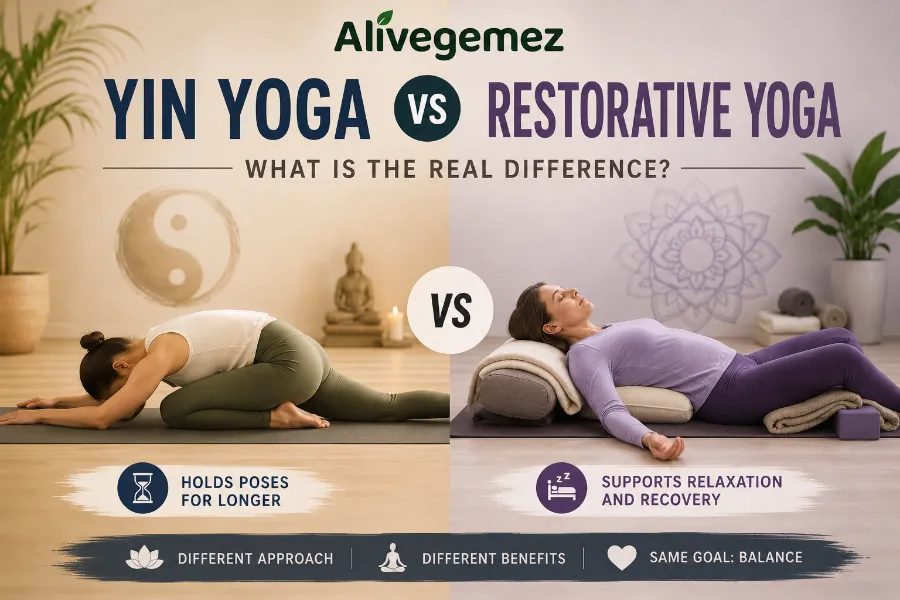
Key Takeaways at a Glance
| Factor | Yin Yoga | Restorative Yoga |
|---|---|---|
| Main goal | Stretch connective tissue, build flexibility | Full nervous-system rest, zero effort |
| Pose hold time | 3 to 5 minutes | 5 to 20 minutes |
| Number of poses per class | 6 to 10 | 3 to 5 |
| Sensation | Mild stretch, a noticeable edge | Total comfort, little to no sensation |
| Prop use | Light support to hold a stretch safely | Heavy support so the body does nothing |
| Origin | Developed by Paulie Zink, popularized by Paul Grilley and Sarah Powers in the 1970s-80s | Rooted in B.K.S. Iyengar’s therapeutic teachings |
| Best for | Tight hips, stiff joints, mobility goals | Burnout, anxiety, insomnia, recovery |
| Nervous system effect | Shifts toward parasympathetic through mild challenge | Shifts toward parasympathetic through total ease |
If you already practice a faster style, this guide pairs well with our comparison of hatha vs vinyasa yoga for beginners, since knowing your yang practice makes it much easier to choose the right yin practice.
What Is Yin Yoga, Really?
Yin yoga targets the connective tissues of your body, meaning your fascia, ligaments, and joint capsules, rather than your muscles. Muscles love repetition and short holds. Connective tissue responds to something different: slow, sustained pressure over several minutes.
In a typical class, you will settle into a pose such as Butterfly, Dragon, or Saddle and stay there for three to five minutes without moving. There is no flowing between poses, no music-driven sequencing, and almost no muscular engagement. Instead, the teacher usually invites you to find your “edge,” a place where you feel a real but bearable stretch, and then simply wait.
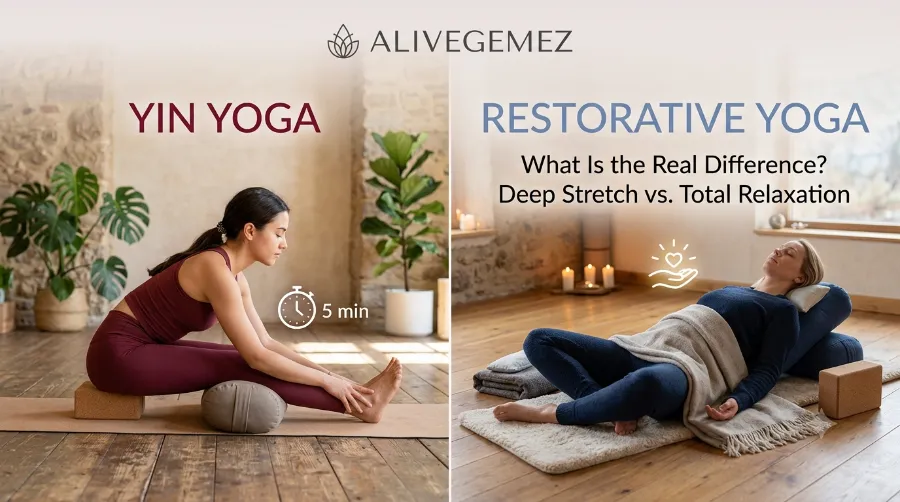
Here is what makes yin misunderstood: it is not passive. Your body is doing quiet, internal work the entire time. Paul Grilley, who helped popularize yin yoga in the West during the 1980s after studying with martial artist and yoga teacher Paulie Zink, described the deep sensation that shows up after releasing a pose as the “rebound,” a rush of blood and awareness back into the tissue you just stressed.
The Three Principles of Yin Yoga
Every yin pose follows the same basic framework, and once you know it, every class makes more sense:
- Come into the pose to an appropriate edge, roughly 70% of your available range, not your absolute maximum.
- Find stillness, resisting the urge to fidget, adjust, or deepen the stretch every 30 seconds.
- Hold the position for a set time, typically 3 to 5 minutes, sometimes up to 7 for advanced practitioners.
- This structure is why yin yoga can feel surprisingly intense, especially in poses like Saddle or Sleeping Swan. You are not relaxing so much as building tolerance, similar to how holding a plank builds strength over time, except here the target is tissue elasticity rather than muscle. The team at Yin Yoga’s official resource makes a similar point, noting that the mild stress applied in yin is intentional, not an accident of a slow class.
Common Yin Yoga Benefits
- Increased joint mobility, particularly in the hips, spine, and shoulders
- Better long-term flexibility because connective tissue, unlike muscle, needs sustained load to change shape
- A calmer nervous system through extended stillness and breath awareness
- Improved circulation to areas that rarely get direct attention, like the sacrum and inner thighs
- A meditative mental training ground, since sitting with discomfort for minutes at a time builds real patience
If tight hips are your main complaint, our deeper dive into yoga vs stretching explains exactly why yin outperforms a standard gym stretch routine for long-term range of motion.
What Is Restorative Yoga, Really?
Restorative yoga takes the opposite approach. Instead of asking your body to work at all, it removes every ounce of effort. You are fully supported by props, bolsters under your knees, blankets under your spine, blocks under your arms, so that gravity has nothing left to pull on unsupported tissue.
Restorative yoga traces back to B.K.S. Iyengar, who developed many of these supported shapes after a childhood filled with illness left him searching for gentler, healing ways to practice. His therapeutic approach eventually evolved into what we now call Restorative Yoga, a style built entirely around comfort, not challenge.
A restorative class usually includes only three to five poses for the entire session, because each one is held for 5 to 20 minutes. Reclined Bound Angle, Supported Child’s Pose, and Legs Up the Wall are class staples for good reason: they require almost no adjustment once you settle in, so your body can stop bracing and finally let go.
What Actually Happens in a Restorative Pose
There is no “edge” in restorative yoga. If you feel any real sensation, a teacher will usually add another prop until the discomfort disappears completely. The goal is a body so well-supported that your muscles receive the message that it is safe to stop working entirely.
This matters because most of us spend our days in low-grade sympathetic activation, meaning our “fight or flight” system stays quietly switched on from emails, traffic, and constant notifications. Restorative yoga interrupts that pattern by removing every physical demand, which gives your parasympathetic nervous system, the “rest and digest” side, room to take over. As Yin and Meditation explains it, the body only fully lets go once it registers that no effort is being asked of it, and that registration is the whole mechanism behind restorative practice.
Common Restorative Yoga Benefits
- Deep activation of the parasympathetic nervous system
- Lower cortisol and reduced perceived stress after consistent practice
- Improved sleep quality, especially useful before bed
- A gentle, accessible option for pregnancy, illness recovery, or chronic pain
- A reset for the mind during periods of grief, burnout, or major life transitions
For anyone recovering from a high-intensity training block, this comparison connects well with our guide on hot yoga vs regular yoga, since knowing when to turn up the heat and when to cool down completely keeps your whole practice balanced.
Yin Yoga vs Restorative Yoga: The Real Differences Explained
Now that you understand each style individually, here is where the yin restorative comparison gets specific. Five factors separate these two practices, even though they can look nearly identical from the doorway of a studio.
1. Purpose: Tissue Stress vs Total Ease
Yin introduces controlled, mild stress to your connective tissue so it adapts over time, similar to how bones respond to weight-bearing exercise. Restorative removes stress entirely, prioritizing comfort above all else. This single difference explains almost everything else on this list.
2. Sensation Level
In yin, you should feel something, a stretch that asks something of you without becoming painful. In restorative, feeling almost nothing is the entire point. If a restorative pose is uncomfortable even slightly, that typically signals a prop is missing.
3. Hold Times and Pace
| Practice | Typical Hold Time | Poses per 60-Minute Class |
|---|---|---|
| Yin Yoga | 3 to 5 minutes | 6 to 10 poses |
| Restorative Yoga | 5 to 20 minutes | 3 to 5 poses |
4. Prop Philosophy
Both styles use props, but for very different reasons. In yin, props help you find a safe, appropriate edge and prevent overstretching a joint. In restorative, props do the opposite job entirely, replacing effort so your body can go fully limp.
5. Naming Convention
Fun fact many students never learn: several yin poses have distinct names specifically to reinforce intention. Pigeon Pose in a vinyasa class becomes “Swan” or “Sleeping Swan” in a yin class, a small rebrand that reminds you to soften the muscular engagement and let the connective tissue do the work instead. Mandala Yoga covers this naming shift well too, and it is a small detail that trips up even seasoned students switching between styles.
Yin Yoga vs Restorative Yoga: Which Should You Choose?
This is the question that actually matters, since most people landing on a “passive yoga styles” search are not trying to win a trivia contest. They want to know what to book for Tuesday at 6pm. Here is a simple way to decide.
Choose Yin Yoga if:
- You sit at a desk most of the day and your hips, hamstrings, or lower back feel chronically tight
- You want measurable, long-term flexibility gains, not just a temporary loosening
- You can tolerate mild discomfort in exchange for a bigger long-term payoff
- You enjoy a slightly meditative challenge rather than pure comfort
Choose Restorative Yoga if:
- You are dealing with burnout, high anxiety, or a recent stressful life event
- You are recovering from an injury, surgery, or illness and need zero physical demand
- You struggle with insomnia and want a wind-down practice before bed
- You simply need permission to stop doing anything for an hour
Many experienced practitioners rotate between both depending on the week. A demanding month at work might call for two restorative sessions, while a training block for a marathon might call for yin twice a week to keep the hips and IT bands supple. If you are weighing intensity levels across your whole practice, our breakdown of Ashtanga vs Power Yoga is a useful companion piece for the opposite end of the spectrum.
Real-Life Examples: How This Plays Out in an Actual Studio
Theory is useful, though nothing beats a real scenario. Here are two short case studies drawn from actual classes I have taught.
Case Study 1, March 2023: A 41-year-old marketing executive in Chicago came to my Tuesday evening yin class complaining of chronic hip tightness after ten years of daily desk work. After eight consistent weeks of yin practice, twice weekly, she measured a visible improvement in her seated forward fold, moving from fingertips barely reaching her shins to resting her palms flat on the floor. That kind of range-of-motion shift rarely happens from muscle stretching alone. It happens because connective tissue, given enough sustained time under gentle load, genuinely remodels.
Case Study 2, October 2024: A 34-year-old nurse in Manchester, UK, working rotating night shifts, started attending a Sunday restorative class specifically to manage sleep disruption. Within four sessions, she reported falling asleep roughly 20 minutes faster on the nights following practice, based on her own sleep-tracker data. Nothing about her physical body changed dramatically. What changed was her nervous system’s ability to downshift out of a chronic low-grade stress state.
These two stories capture the yin yoga vs restorative yoga divide better than any definition could. One practice changes your tissue. The other changes your state.
What the Research Actually Says
This is not just studio folklore. A 2025 systematic review and network meta-analysis examining exercise and cortisol found that among all exercise modalities studied, yoga produced the largest reduction in cortisol levels, with a standardized mean difference of -0.59, outperforming other movement-based interventions in the analysis. Separate research published in 2025 has also linked consistent yoga practice to measurable downregulation of sympathetic nervous system activity alongside improved heart rate variability, both signs of a body shifting successfully out of chronic stress mode.
None of the available research separates yin from restorative specifically, since both fall under the broader “yoga” umbrella in most clinical trials. Still, the physiological mechanism lines up with what students report anecdotally: extended stillness, whether achieved through mild tissue stress or total prop support, reliably nudges the body toward parasympathetic dominance.
Common Mistakes People Make With Yin and Restorative Yoga
Even experienced yogis mix these up in ways that limit their results. Watch for these:
- Treating yin like a stretching class. Fidgeting, adjusting every 20 seconds, or chasing a deeper stretch defeats the purpose. Stillness is the mechanism, not an accident.
- Under-propping restorative poses. If you feel any strain, add a blanket, block, or bolster immediately. Comfort is not optional in this style, it is the entire method.
- Choosing yin when your body needs restorative. During high-stress weeks, an active yin edge can sometimes feel like one more demand rather than relief. Listen to what your nervous system is actually asking for.
- Assuming both are “beginner” or “easy.” Long holds test patience more than most people expect, and restorative stillness can bring up emotions that surprise first-timers.
- Skipping props out of ego. Both styles rely heavily on props, and using fewer of them does not make you more advanced.
For a broader look at where slow yoga styles fit against strength-based practice, our pillar guide on yoga vs Pilates for weight loss rounds out the full picture of how different styles serve different goals.
Frequently Asked Questions
Is yin yoga harder than restorative yoga?
Yes, generally. Yin asks your body to sit with mild discomfort for minutes at a stretch, while restorative removes discomfort almost entirely through heavy prop support.
Can beginners do yin or restorative yoga?
Both styles welcome beginners. In fact, they are often gentler entry points than a fast-paced vinyasa class, since there is no complex sequencing to memorize.
Which burns more calories, yin or restorative yoga?
Neither burns significant calories. Both are recovery-focused practices, not cardio or strength training, so weight loss is not their primary purpose.
How often should I practice yin or restorative yoga?
One to three sessions per week is a reasonable target for most people, adjusted based on stress levels, training load, and how your body responds.
Can I do yin yoga and restorative yoga in the same week?
Absolutely, and many teachers recommend it. Alternating between the two covers both flexibility goals and nervous-system recovery goals.
Is restorative yoga good for anxiety?
Many practitioners and several small studies suggest restorative yoga can meaningfully lower perceived stress and anxiety by shifting the body toward parasympathetic dominance, though individual results vary and it should not replace professional mental health care when needed.
Test Your Knowledge: Yin vs Restorative Quiz
1. How long are poses typically held in Yin Yoga?
A) 30 to 60 seconds
B) 3 to 5 minutes
C) 20 to 30 minutes
2. Who is Restorative Yoga’s teaching lineage most closely associated with?
A) B.K.S. Iyengar
B) Pattabhi Jois
C) Bikram Choudhury
3. What is the main goal of props in a Restorative Yoga class?
A) To deepen the stretch
B) To completely support the body so it does no work
C) To build muscular strength
4. In Yin Yoga, what did Paul Grilley call the sensation felt right after releasing a pose?
A) The release
B) The rebound
C) The float
5. Which practice typically includes more poses within a single 60-minute class?
A) Restorative Yoga
B) Yin Yoga
C) They always include the same number
Answer Key: 1-B, 2-A, 3-B, 4-B, 5-B
Conclusion
Yin yoga vs restorative yoga is not a contest with a winner, it is a choice between two different tools for two different needs. Yin gently challenges your connective tissue to build real, lasting flexibility, while restorative removes effort entirely so your nervous system can finally exhale. Neither style is “better” in any universal sense, though one is almost certainly what your body is asking for right now. Pay attention to what today feels like, tight and stiff, or wired and exhausted, and let that answer guide you to the right mat.
References
- YogaRenew Teacher Training, “The Difference Between Yin and Restorative Yoga,” yogarenewteachertraining.com
- Yoga Journal, “What’s the Difference Between Yin Yoga and Restorative Yoga?” yogajournal.com
- Yin Yoga official resource, yinyoga.com
- Yin and Meditation, “Is It Yin Yoga or Restorative,” yinandmeditation.com
- Mandala Yoga, “Yin Yoga v Restorative Yoga,” mandalayoga.ie
- NCBI/PMC, “The Optimal Exercise Modality and Dose for Cortisol Reduction in Psychological Distress: A Systematic Review and Network Meta-Analysis,” 2025
- Frontiers in Psychiatry, “Effects of yoga on stress in stressed adults: a systematic review,” 2024