
If you’ve ever stood in a studio lobby staring at a class schedule, wondering what the difference between an “Ashtanga” class and a “Power Vinyasa” class actually is, you’re not alone. Both classes leave you drenched in sweat. Both promise strength, focus, and a serious full-body workout. But they are built on completely different philosophies, and picking the wrong one for your body and your goals is the fastest way to lose interest in yoga altogether.
learn more about yin yoga vs restorative yoga tips and expert advice.
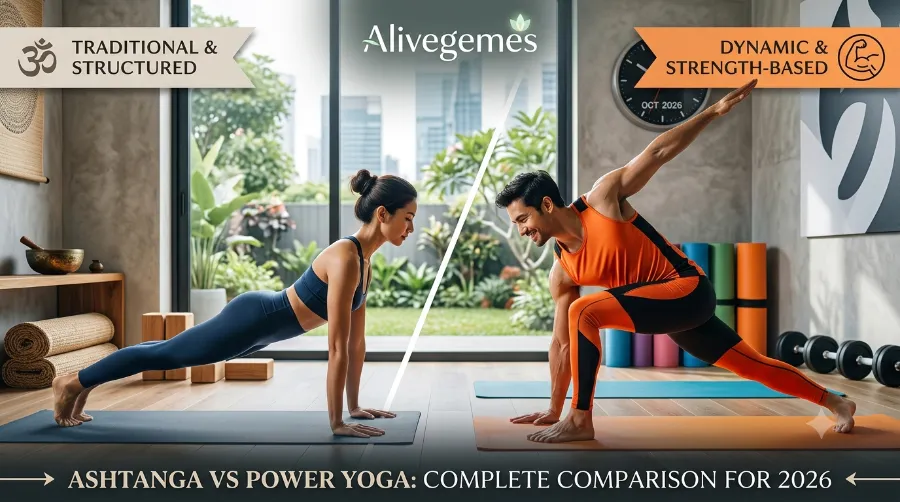
I’ve taught both styles for over a decade, and I still get asked this question almost every week: ashtanga vs power yoga, which one should I actually do? This guide gives you the honest answer, backed by research, real numbers, and lessons from years on the mat, not textbook definitions copied from a dictionary.
learn more about kundalini vs hatha yoga tips and expert advice.
TL;DR: Ashtanga is a fixed, traditional sequence of poses done in the exact same order every single class, which builds discipline and deep body awareness over months and years. Power yoga is a flexible, gym-influenced style with no fixed sequence, built for calorie burn, strength, and variety. If you want structure and tradition, choose ashtanga. If you want flexibility and a harder cardio-style workout, choose power yoga.
learn more about bikram vs hot yoga difference tips and expert advice.
Key Takeaways at a Glance
| Factor | Ashtanga Yoga | Power Yoga |
|---|---|---|
| Origin | Developed by K. Pattabhi Jois, based on ancient Sanskrit texts | Developed in the 1990s in the West as a modern adaptation |
| Sequence | Fixed, identical every class | Flexible, changes by instructor and mood |
| Pace | Fast, but predictable | Fast, unpredictable, often music-driven |
| Best for | Discipline, tradition, long-term mastery | Strength, calorie burn, variety, gym-goers |
| Calorie burn (avg per hour)* | 400 to 550 calories | 300 to 600 calories |
| Beginner friendly | Moderate, gets easier once memorized | High, no memorization required |
| Typical class length | 60 to 90 minutes | 45 to 75 minutes |
*Calorie ranges are estimates based on body weight, intensity, and MET (metabolic equivalent) values used in exercise science research, and will vary from person to person.
What Is Ashtanga Yoga, Really?
Ashtanga means “eight limbs” in Sanskrit, and it refers to a full philosophical system, not just a sequence of poses. The physical practice most people call ashtanga yoga today was popularized by Sri K. Pattabhi Jois in Mysore, India, in the mid-20th century, and it’s built on a set series of postures performed in the exact same order every time, connected by a specific breathing pattern called ujjayi and a movement style called vinyasa krama.
learn more about bikram vs hot yoga difference tips and expert advice.
Here’s the part most beginners don’t expect: in a traditional ashtanga class, you don’t get to skip ahead. You start with sun salutations, move through a standing sequence, then into the Primary Series, and you only progress to the next posture once your teacher feels you’ve earned it. This is very different from the free-flowing structure people often picture when they think about intense yoga types.
A few things that make ashtanga distinct:
- The sequence never changes, so your body learns exactly what’s coming next
- Progress is measured by advancing through the series, not by variety
- Traditional classes are taught “Mysore style,” meaning everyone practices at their own pace in the same room, guided individually
- Breath and movement are locked together on every single transition
This repetition sounds boring on paper, but in practice it becomes almost meditative. If you’re the kind of person who likes to track progress in a very specific, structured way, similar to how a piece I’ve referenced before on hatha vs vinyasa yoga for beginners explains structured versus flowing styles, ashtanga will likely feel like home.
What Is Power Yoga, Really?
Power yoga has a very different origin story. It emerged in the United States in the early 1990s, largely through teachers like Bryan Kest and Beryl Bender Birch, who wanted to make the intensity of ashtanga more accessible to Western students without the rigid, unchanging structure. It’s sometimes nicknamed “gym yoga” because it was intentionally designed to appeal to athletes and gym-goers who wanted a serious workout, not just a spiritual practice.
To get a better understanding of how meditation vs exercise exactly what to expect.
Unlike ashtanga, power yoga has no fixed sequence. Every studio, every teacher, and often every single class is different. A power yoga class might include:
- Extended plank and chaturanga holds for strength
- Faster-paced sun salutations set to music
- Balance work, core sequences, and sometimes light weights
- A heated room, though not always
This makes power yoga one of the more approachable dynamic yoga styles for beginners, because you’re not expected to memorize anything. You simply follow the teacher in the moment. If your studio also offers hot classes, it’s worth understanding how heat changes the equation, and our breakdown of hot yoga vs regular yoga covers that in detail.
Ashtanga vs Power Yoga: The Core Differences
Let’s get specific, because “ashtanga vs power yoga” search results online tend to blur these two styles together, and that’s honestly where most people get confused.
1. Structure and Sequence
This is the single biggest ashtanga power yoga difference. Ashtanga follows a memorized, unchanging sequence. Power yoga is improvised within a general framework. If structure motivates you, ashtanga wins. If you get bored doing the same thing repeatedly, power yoga wins.
2. Teaching Style
Ashtanga is traditionally taught Mysore-style, with hands-on adjustments and a teacher moving around the room correcting individuals. Power yoga is almost always taught as a led class, with the instructor cueing everyone through the same flow at the same time, often with music playing in the background.
3. Intensity and Pacing
Both are intense, but they’re intense in different ways. Ashtanga intensity comes from repetition and discipline over a 60 to 90 minute practice. Power yoga intensity comes from variety, faster transitions, and strength-focused holds packed into a shorter window, usually 45 to 75 minutes.
4. Philosophy vs Fitness
Ashtanga carries more of its original spiritual and philosophical framework, rooted in the eight limbs described in the Yoga Sutras of Patanjali. Power yoga strips much of that away and focuses primarily on physical results, which is exactly why it became so popular in Western gyms and boutique studios throughout the 2000s and 2010s.
5. Who Actually Teaches It
Ashtanga teacher training is often centered on demonstrating mastery of the specific series, frequently including study in Mysore, India. Power yoga instructors typically complete a general 200-hour yoga teacher training and then layer their own style, music choices, and sequencing on top.
Ashtanga vs Power Yoga for Weight Loss and Calorie Burn
This is usually the real reason people search “ashtanga vs power yoga” in the first place, so let’s talk numbers.
Research using standard MET (metabolic equivalent) values, the same measurement system used across exercise science, shows that both styles fall into the moderate-to-vigorous intensity range. A 2020 estimate from Mayo Clinic exercise physiologist Edward Laskowski, often cited in fitness research, put ashtanga yoga calorie burn at roughly 486 calories per hour for a 154-pound person. Separate MET-based calculations for power yoga, using a MET value of around 4.0 to 6.0, put the burn between 300 and 600 calories per hour depending on pace, body weight, and whether the room is heated.
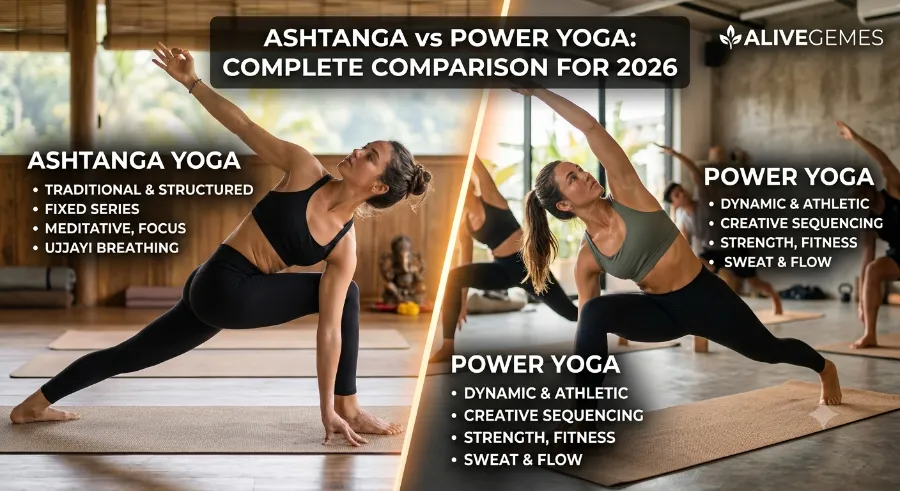
| Yoga Style | Estimated Calories per Hour (154 lb / 70 kg person) |
|---|---|
| Restorative or Yin | 120 to 200 |
| Hatha | 240 to 300 |
| Vinyasa Flow | 300 to 500 |
| Ashtanga | 400 to 550 |
| Power Yoga | 300 to 600 |
| Hot or Bikram Yoga | 330 to 460 (90 min session) |
Two important notes from my own teaching experience. First, these numbers assume a genuinely vigorous class. A slow, gentle “power yoga” class taught by a soft-spoken instructor will not hit the top end of that range, and neither will an ashtanga class where you’re new and moving slowly through unfamiliar poses. Second, calorie burn shouldn’t be the only reason you choose a style. If weight management is your main goal, it’s worth reading our comparison of yoga vs Pilates for weight loss, which puts these numbers into a broader fitness context.
Real Case Study: 12 Weeks, Two Students, Two Styles
A few years into teaching, I worked with two students who started at almost the same fitness level. One, a 34-year-old client I’ll call Sarah, committed to Mysore-style ashtanga three mornings a week. The other, a 29-year-old client named Marcus, chose a power yoga studio near his office and went four evenings a week.
After 12 weeks, both reported meaningful changes, but the results looked different. Sarah’s flexibility improved dramatically, she could touch her palms flat on the floor for the first time, and she described a noticeable increase in mental discipline that carried into her work life. Marcus reported a visible increase in upper body and core strength, along with roughly 6 pounds of fat loss, which he attributed to the consistent, higher-intensity pace of his classes.
Neither result is “better.” It’s simply a real-world snapshot of what each style tends to produce when practiced consistently, and it lines up closely with what published research on yoga’s physical effects has generally found: structured, repetitive practices tend to improve flexibility and mind-body awareness first, while faster, strength-based practices tend to show muscular and metabolic changes first.
Which One Is Right for You?
Ask yourself these questions before choosing between ashtanga and power yoga.
- Do you like routine or variety? If repeating the same sequence for months sounds calming, pick ashtanga. If it sounds tedious, pick power yoga.
- Are you training for strength and cardio, or for discipline and tradition? Power yoga tends to prioritize the former, ashtanga the latter.
- How much time do you have? Ashtanga’s full Primary Series traditionally runs 90 minutes. Power yoga classes are often built to fit a 45 to 60 minute lunch break or evening slot.
- Do you want a teacher correcting you hands-on, or a class you can follow along with immediately? Mysore-style ashtanga leans toward individual correction. Power yoga is almost always a group-paced flow.
- Are you brand new to yoga entirely? If so, many teachers, myself included, actually recommend starting with a general vinyasa or hatha class first. Our guide to hatha vs vinyasa yoga for beginners is a good place to build a foundation before jumping into either intense style.
Injury Risk: What Nobody Tells You
Both styles are physically demanding, and both carry real injury risk if you push too hard, too soon. In ashtanga, the most common issues I see are wrist strain from repeated chaturangas and hamstring tightness from forcing forward folds before the body is ready. In power yoga, the variability itself is the risk factor, since you don’t always know what’s coming next, and jumping into an unfamiliar transition at speed is how shoulder and lower back injuries happen.
My honest, evidence-based opinion after 12 years on the mat: neither style is inherently more dangerous than the other. What matters far more is the teacher’s ability to cue proper alignment and your own willingness to modify a pose instead of forcing it. If you’re newer to either style, look for a teacher who offers modifications out loud, not just once at the start of class, but throughout.
Ashtanga vs Power Yoga: A Quick Snapshot in Numbers
Yoga’s popularity has genuinely exploded over the past decade. More than 300 million people now practice yoga worldwide, and in the United States alone, roughly 35 to 36 million people, close to 11% of the population, actively practice. Male participation has more than doubled in recent years, and practitioners over 50 have roughly tripled, according to Harvard Health data. That growth applies directly to intense yoga types like ashtanga and power yoga, both of which have benefited from the broader shift toward yoga as a legitimate fitness tool, not just a relaxation practice.
Rough intensity comparison chart (MET scale, where higher means more intense):
Restorative Yoga   ██░░░░░░░░  2.0 MET
Hatha Yoga         ███░░░░░░░  2.5 MET
Vinyasa Flow        ████░░░░░░  3.5 MET
Power Yoga           █████░░░░░  4.0-6.0 MET
Ashtanga             █████░░░░░  4.0-6.0 MET
Hot/Bikram Yoga        ██████░░░░  6.0+ MET
How They Compare to Other Yoga Styles
If ashtanga and power yoga both sound too intense right now, that’s a completely reasonable place to start slower. Not everyone needs a dynamic yoga style right away, and building a base with gentler movement first often leads to better long-term results. It’s also worth understanding how yoga in general compares to simple stretching, since the two get confused constantly. Our piece on yoga vs stretching differences breaks down exactly why yoga does more than loosen your muscles.
For a broader map of where these styles sit within the entire yoga landscape, DoYogaWithMe’s guide to types of yoga is a genuinely useful resource, and the original PowerYoga.com breakdown of traditional yoga versus power yoga is one of the clearest explanations of how the modern power style diverged from its ashtanga roots. Cymbiotika also published a detailed comparison of ashtanga and power yoga worth reading if you want an additional perspective beyond this guide.
My Honest Take After 12 Years of Teaching Both
If you asked me to pick one style for a student who has never done either, I’d lean toward power yoga first, purely because the learning curve is gentler and the flexible sequencing means you’re never left guessing what comes next. Once someone has built a base level of strength and body awareness, I often see them naturally gravitate toward ashtanga because they start craving the structure and the sense of mastery that comes from progressing through a known series.
That said, this is a personal, experience-based opinion, not a universal rule. I’ve had students go straight into Mysore-style ashtanga as complete beginners and thrive because the individualized pacing suited them better than a fast group class ever would. The honest answer to “ashtanga vs power yoga, which is better” is that the better style is the one you’ll actually keep showing up for.
Frequently Asked Questions
Is ashtanga harder than power yoga?
Not necessarily. Ashtanga is more physically demanding for beginners because the sequence is fixed and challenging poses appear early on. Power yoga difficulty varies widely by teacher and studio, so it can be gentler or harder than ashtanga depending on the class.
Can beginners do power yoga?
Yes. Power yoga is generally considered more beginner-accessible than ashtanga because there’s no memorized sequence to learn, and instructors typically offer modifications throughout class.
Which burns more calories, ashtanga or power yoga?
They’re close. Ashtanga tends to average 400 to 550 calories per hour, while power yoga ranges from 300 to 600 calories per hour depending on intensity, so the real difference usually comes down to how hard a specific class is taught, not the style label itself.
Is power yoga the same as vinyasa?
They’re related but not identical. Power yoga grew out of vinyasa and ashtanga traditions, but it typically emphasizes strength holds and gym-style intensity more than a standard vinyasa flow class does.
How many times a week should I practice ashtanga or power yoga?
Most teachers recommend 3 to 4 sessions per week for noticeable strength and flexibility gains, with at least one rest or gentle recovery day built in to avoid overtraining.
Conclusion
Ashtanga and power yoga both deliver serious physical and mental benefits, but they get there through different paths. Ashtanga offers structure, tradition, and a deep sense of progress built through repetition. Power yoga offers flexibility, variety, and a workout-first approach that fits naturally into a busy Western lifestyle. Neither is objectively superior, and the real answer to ashtanga vs power yoga comes down to your personality, your schedule, and what actually keeps you coming back to the mat. Try both if you can, pay attention to how your body and mind respond, and let that experience, not a blog post, make the final call.
Quick Quiz: Test What You Learned
1. Which style follows a fixed, unchanging sequence of poses?
A) Power Yoga
B) Ashtanga Yoga
C) Restorative Yoga
2. Roughly how many calories can ashtanga burn per hour for a 154-pound person?
A) About 150 calories
B) About 250 calories
C) About 486 calories
3. Where and when was power yoga developed?
A) In India during the 1950s
B) In the United States during the early 1990s
C) In Europe during the 1980s
4. Which style is typically taught Mysore-style, with individualized pacing?
A) Power Yoga
B) Ashtanga Yoga
C) Hatha Yoga
5. Which factor most affects calorie burn in both styles?
A) The color of your yoga mat
B) The intensity and pace of the specific class
C) The time of day you practice
Answer Key: 1-B, 2-C, 3-B, 4-B, 5-B
References
- Laskowski, E. (2020), calorie estimates for yoga styles, as cited via Mayo Clinic exercise physiology commentary
- Harvard Health Publishing, calories burned by activity and yoga demographic data
- BookRetreats.com, Yoga Statistics Report 2026
- American Council on Exercise (ACE), yoga intensity and calorie research
- Compendium of Physical Activities Tracking Guide, Arizona State University College of Nursing & Health Innovation
- Cymbiotika Health Hub, Ashtanga Yoga vs Power Yoga: Understanding the Differences and Benefits
- DoYogaWithMe, A Guide to Types of Yoga
- PowerYoga.com, The Difference Between Traditional Yoga and Power Yoga