
I still remember the sound. A soft click in my student’s knee during Lotus pose, followed by a wince she tried to hide. That one moment taught me more about knee safety than any anatomy textbook ever did. If you have been told to “just push through” tight or painful knees in yoga class, please stop right there.
Bad knees do not mean your yoga practice is over. It means you need smarter choices. Finding safe yoga poses bad knees can actually get behind is not about avoiding the mat, it is about avoiding the handful of positions that load the joint the wrong way. This guide walks you through the five poses that cause the most trouble, why they hurt, and exactly what to do instead so your practice keeps building strength instead of breaking it down.
Knee pain touches more people than you might think. Research shows 32.5 million US adults currently live with clinical osteoarthritis of the knee, hip, or hand, and more than half of people with symptomatic knee osteoarthritis are younger than 65. This is not just an “older person” problem. If your knees ache after a class, you are in good company, and there is a clear fix. Uncmedrxiv.
Want to learn more about 10 hip opening yoga poses read our latest blog post
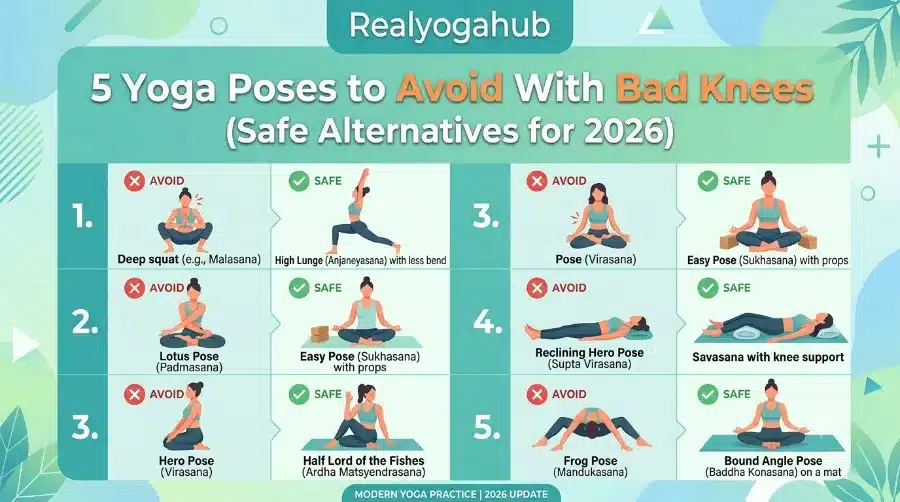
Key Takeaway Table
| What Hurts Knees | Why | What To Do Instead |
|---|---|---|
| Deep Lotus and Hero-style folds | Forces hip rotation the joint cannot absorb | Half Lotus, Bound Angle with blocks |
| Locked straight legs in standing poses | Causes hyperextension of the knee joint | Micro-bend plus quad engagement |
| Twisting knees under body weight | Strains ligaments and menisci | Supported variations, props under the knee |
| Prolonged deep kneeling | Compresses the front of the knee | Blanket or bolster support |
| Fast transitions between bent and straight legs | No time for muscles to stabilize the joint | Slow, controlled movement with breath |
Understanding Why Certain Yoga Poses Hurt Bad Knees
Your knee is a hinge joint sitting between the thighbone and shinbone, cushioned by cartilage and held together by ligaments. It is built to bend and straighten, not to twist or bear sideways load. Once you understand this, knee friendly yoga stops feeling like a mystery and starts feeling like common sense.
Most yoga knee injury cases come down to three repeat offenders:
- Hyperextension, when the knee locks and bends slightly backward under load.
- Deep external or internal hip rotation forced through the knee instead of the hip.
- Sideways or twisting pressure on a bent knee.
Physical therapist Bill Reif puts it simply, noting that knee discomfort in yoga usually comes down to putting more pressure on the knee than it can comfortably handle. That pressure can come from poor alignment, an extreme bend, or too much body weight resting on the joint. James Rind Physio
If you already practice regularly, our pillar guide to the 50 best yoga poses for beginners is a good place to build a foundation before tackling more advanced knee work.
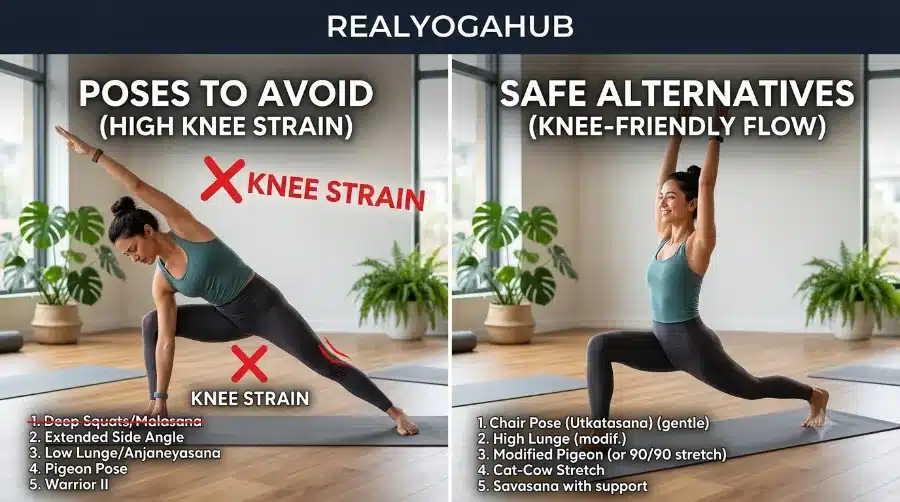
5 Yoga Poses to Avoid With Bad Knees
1. Full Lotus Pose (Padmasana)
Full Lotus asks your hip to rotate outward far enough to stack your ankle on the opposite thigh. When your hips are not flexible enough, that rotation gets borrowed from the knee instead, and the result can be a strained or torn ligament. Yoga teacher Ray, a 31-year-old practitioner from Louisville, Kentucky, heard a chorus of pops in his knee attempting Lotus and needed six months to walk without pain again. MyYogaTeacher
Safe Alternative: Half Lotus, or a simple cross-legged seat with a block under each knee. Warm your hips first with Bound Angle pose or Cow Face pose before attempting any lotus-style shape.
2. Hero’s Pose (Virasana) Without Support
Hero’s Pose demands deep internal hip rotation while kneeling, the opposite motion from Lotus. Attempting it without hip flexibility creates torque on the inside of the knee that can damage or tear the medial meniscus. Yoga Journal
Safe Alternative: Sit on a block or bolster placed between your heels so your hips do not have to over-rotate to reach the floor. Keep your shins parallel rather than letting your feet splay wide.
3. Pigeon Pose Held Too Long
Half Pigeon feels amazing for hip openness, but the front knee sits in a bent, twisted position that carries most of your body weight. As one physical therapist explains, the gravitational weight of your body in this posture puts pressure on the knee joint, and flexing your toes toward your shins helps keep the surrounding muscles activated. Wrist
Safe Alternative: Try Reclined Figure Four instead, lying on your back and crossing one ankle over the opposite thigh. You get the same hip release with zero weight bearing down on the knee.
4. Locked-Knee Triangle Pose (Trikonasana)
Triangle Pose straightens the front leg fully, which tempts many practitioners to lock the knee. That locked position is a classic hyperextension setup, and yoga instructor Zurcher recommends you activate your quadriceps to avoid hyperextension whenever transitioning into a straight-leg pose. Wrist
Safe Alternative: Keep a soft micro-bend in the front knee, engage the thigh muscle, and shift weight slightly toward the balls of your feet rather than the heels. This single cue also protects poses like Warrior variations for beginners.
5. Deep Child’s Pose Without Padding
Child’s Pose looks harmless, and it is genuinely restorative, but sitting your hips fully onto your heels puts the knee into extreme flexion for an extended time. Experts note this position can irritate the knee, especially when the posture is held for a long duration. Wrist
Safe Alternative: Slide a rolled blanket behind your knees or place a bolster between your thighs and calves. You can also modify into supported Hero’s Pose. Our full breakdown of Child’s Pose benefits and modifications covers more variations if this is a pose you return to often.
The 3 Golden Rules of Safe Yoga for Bad Knees
Before you try any pose, run it through this quick checklist.
- Never force a range of motion your hips cannot supply, the knee will absorb the difference.
- Keep a micro-bend in straight-leg poses instead of locking the joint completely.
- Move slowly through transitions, especially when shifting from a bent knee into a straight one, similar to the guidance used in a 10-minute morning yoga routine.
According to orthopedic surgeon Dr. Ferdinand Chan, most knee pain his patients experience has nothing to do with structural damage. He estimates 80 to 90 percent of his patients with chronic knee pain have tightness and imbalance rather than a serious injury, and he often recommends a trial of yoga for two to four weeks before considering anything more invasive. Yoga International
Knee Pain By The Numbers (2026 Data)
| Statistic | Figure |
|---|---|
| US adults with knee, hip, or hand osteoarthritis | 32.5 million Unc |
| Adults 45+ with knee osteoarthritis | Up to 30 percent – |
| People with symptomatic knee OA who are under 65 | More than half medrxiv |
| Chan’s patients with knee pain from tightness, not injury | 80 to 90 percent Yoga International |
These figures matter because they show something reassuring, most knee pain is manageable, not permanent. Once you know which poses to avoid, safe yoga knees work becomes about smart modification rather than giving up your practice entirely.
How to Build a Knee-Safe Practice Long Term
Building durability around the knee is not a single fix, it is a habit you repeat.
- Warm the hips before any deep bend, using poses from a flexibility-focused 30-day plan.
- Strengthen the quadriceps and hamstrings together so they co-activate and stabilize the joint, a technique detailed well by Dr. J. Negus’s guide to safe yoga for knee pain.
- Support foundational poses like Downward Dog with proper knee alignment so the knee stays neutral even in an inversion-style stretch.
- Ease into a full Sun Salutation sequence only once your knees can move through a lunge without strain.
- If back pain shows up alongside knee discomfort, our guide to yoga poses for back pain relief addresses the connection between hip tightness and compensating joints.
For additional clinical perspective, US News Health outlines further modifications, including keeping your feet and knees pointed straight up in seated postures with straight legs, and straightening legs fully without lifting the heels off the floor to avoid hyperextension. You can read more in their full guide on yoga for knee pain. Yoga International also offers a helpful breakdown of ten knee-friendly pose modifications worth bookmarking for your home practice. Yoga International
Quick Knowledge Quiz
1. Which pose puts the most sideways stress on the knee from forced hip rotation?
A) Child’s Pose
B) Full Lotus Pose
C) Mountain Pose
2. What is the safest way to avoid hyperextension in Triangle Pose?
A) Lock the front knee fully straight
B) Keep a micro-bend and engage the quadriceps
C) Point the toes inward
3. What prop helps most in Hero’s Pose for tight hips?
A) A block or bolster under the hips
B) A heavier yoga mat
C) Ankle weights
4. What percentage of Dr. Chan’s chronic knee pain patients have tightness or imbalance rather than injury?
A) 10 to 20 percent
B) 80 to 90 percent
C) 50 percent exactly
5. What is a safer alternative to Half Pigeon for hip opening?
A) Full Lotus
B) Reclined Figure Four
C) Deep Camel Pose
Answer Key: 1-B, 2-B, 3-A, 4-B, 5-B
Frequently Asked Questions
Is yoga safe if I already have knee osteoarthritis?
Yes, in most cases. Physical therapists commonly recommend a gentle, modified practice, and research shows it can improve flexibility and reduce inflammation over time.
What is the single biggest mistake people make with bad knees in yoga?
Locking the knee completely straight in standing poses. A small bend paired with quad engagement prevents most hyperextension injuries.
Can props really make a difference?
Yes. A block under the hips, a blanket behind the knee, or a strap around the thigh changes the angle of load enough to remove pain from many poses entirely.
Should I stop yoga completely if a pose hurts?
No, just stop that specific pose. Swap it for one of the alternatives above and keep the rest of your practice going.
How long before knee pain from yoga improves with modification?
Many people notice a difference within two to four weeks of consistent, correctly modified practice, though this varies by the underlying cause.
Conclusion
Bad knees are not a reason to give up yoga, they are a reason to practice with more intention. Once you know which five poses tend to cause trouble and which safe alternatives protect the joint instead, you get to keep every benefit yoga offers without the pain. Start slow, use your props, listen to your body, and let your knees guide the pace rather than your ego.
References
- US News Health, Best Yoga Poses for Knee Pain
- Dr. J. Negus, Safe Yoga for Knee Pain
- Yoga International, 10 Knee-Friendly Pose Modifications
- Yoga Synergy, Yoga Therapy for Knee Problems
- Yoga Journal, Yoga and Knee Pain
- CDC and Osteoarthritis Action Alliance, US Osteoarthritis Prevalence Data 2025-2026