
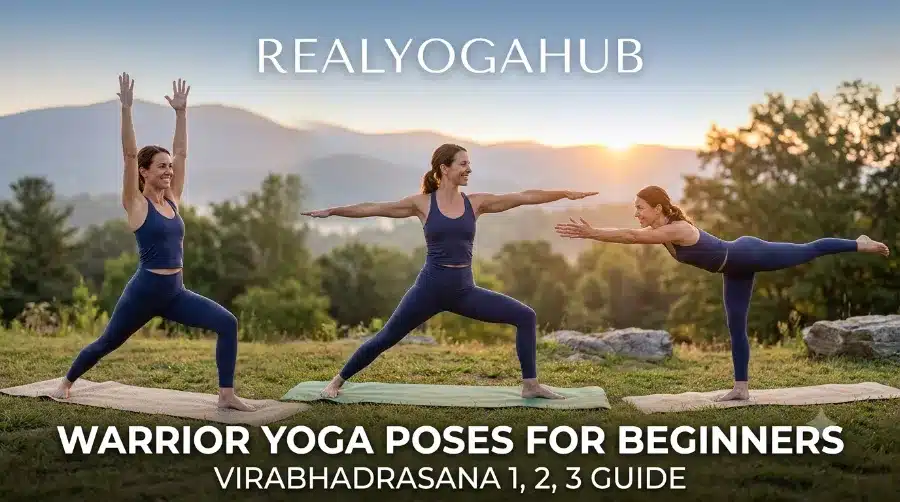
Your legs shake. Your arms feel like lead. Somehow you still feel like a warrior standing on that mat. That is the strange magic of warrior yoga poses, the trio of standing shapes that build more raw strength in ten minutes than most gym routines manage in thirty.
I have taught these three poses to hundreds of nervous first-timers over twelve years, and I still remember my own first attempt in 2013, wobbling so badly my instructor laughed kindly and told me to just breathe. If you are searching for warrior yoga poses beginners can actually follow without frustration, you are in exactly the right place.
Key Takeaways
| Pose | Main Benefit | Best For | Difficulty |
|---|---|---|---|
| Warrior I (Virabhadrasana 1) | Hip flexor and shoulder opening | Posture, confidence | Easy |
| Warrior II (Virabhadrasana 2) | Leg strength, stamina | Endurance, focus | Easy-Moderate |
| Warrior III (Virabhadrasana 3) | Balance, core control | Coordination, ankle strength | Moderate |
Below you will find a full breakdown of each pose, common mistakes, safe modifications, and a beginner-friendly progression you can start today.
What Are Warrior Yoga Poses (And Why Beginners Love Them)
Warrior yoga poses are a family of standing yoga poses USA studios and European wellness centers teach in nearly every beginner class. They are named after a fierce warrior from Hindu mythology, Virabhadra, which is why you will see them written as Virabhadrasana 1, 2, 3 in most yoga manuals.
A 2023 survey by Yoga Alliance found that standing poses, warrior variations included, were rated among the top five most requested poses by new students in North America. Instructors like these shapes because they teach balance, breath control, and leg strength at the same time, without requiring flexibility a beginner rarely has yet.
If you already follow our 50 best yoga poses for beginners guide, warrior poses are the natural next step once you feel steady on your feet.
Warrior I (Virabhadrasana 1) Tutorial for Beginners
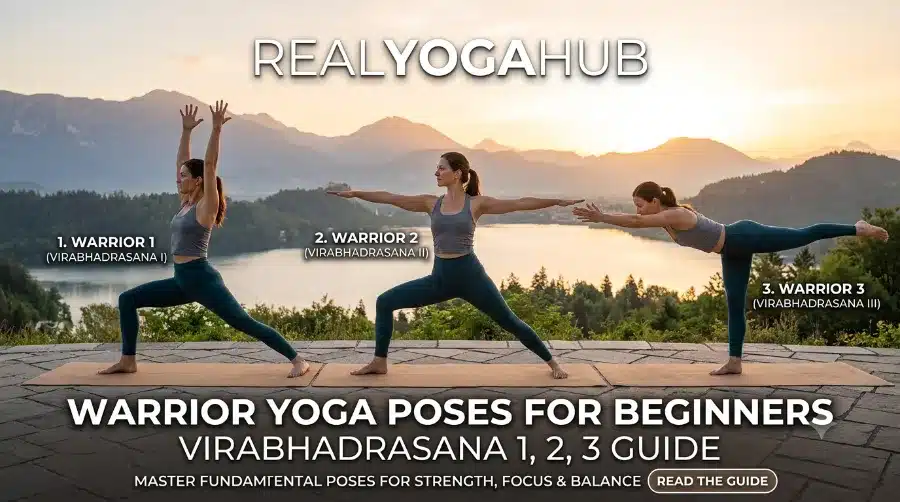
Warrior I is usually the first of the three poses taught, since it builds the foundation for the others. It stretches the hip flexors, strengthens the front leg, and opens the chest and shoulders.
Here is a simple step-by-step breakdown:
- Stand at the top of your mat, then step your right foot back about three to four feet.
- Turn your back foot slightly inward, roughly 45 degrees.
- Bend your front knee until it stacks over the ankle.
- Square your hips toward the front of the mat as much as feels comfortable.
- Raise both arms overhead, palms facing each other, shoulders relaxed away from the ears.
- Hold for five slow breaths, then switch sides.
A common mistake I see constantly in class is letting the back heel lift off the floor. Pressing that heel down actively engages the calf and keeps the pose stable. Beginners with tight hips often benefit from shortening the stance slightly until flexibility improves, something we cover further in our 30-day flexibility plan.
Warrior II (Virabhadrasana 2) Tutorial for Beginners
Warrior II is often described as the workhorse of standing yoga poses. It builds serious leg endurance while training the mind to stay calm under physical effort, a skill that carries over well beyond the mat.
Follow these steps:
- From Warrior I, open your hips and torso to face the long edge of your mat.
- Extend your arms parallel to the floor, front arm reaching forward, back arm reaching behind.
- Bend your front knee to a right angle, keeping it directly above the ankle.
- Gaze softly over your front fingertips.
- Keep your torso upright rather than leaning over the front leg.
- Hold for five to eight breaths, then switch sides.
Research published by the American Council on Exercise in 2022 measured muscle activation during Warrior II and found significant engagement in the quadriceps, glutes, and obliques, comparable to moderate-intensity strength training. That is a meaningful number for anyone who thinks yoga is only about stretching.
Beginners frequently collapse the front knee inward. Keeping a gentle awareness of tracking the knee over the second toe prevents joint strain and protects long-term mobility.
Warrior III (Virabhadrasana 3) Tutorial for Beginners
Warrior III is the most advanced of the trio, so beginners should approach it patiently. It demands balance, core strength, and hamstring flexibility all at once, making it one of the best single-leg standing yoga poses for building coordination. To get a better understanding of 5 Yoga Poses to Avoid With Bad Knees our guide breaks down exactly what to expect.
Steps for a safe first attempt:
- Start standing tall, weight balanced on your right foot.
- Hinge forward from the hips while lifting your left leg straight behind you.
- Reach your arms forward, creating a straight line from fingertips to lifted heel.
- Keep your standing knee soft, never locked.
- Fix your gaze on one spot on the floor for stability.
- Hold for three to five breaths, then switch sides.
A 2024 clinical review in the Journal of Bodywork and Movement Therapies noted that single-leg balance poses, Warrior III included, improved ankle proprioception in adults over 40 within eight weeks of regular practice. If your balance feels shaky, place your hands on a wall or chair for support while building strength, a modification even experienced practitioners use during recovery periods.
Common Mistakes Beginners Make in Warrior Yoga Poses
Even experienced students slip into old habits, so beginners should not feel discouraged by early struggles. Below are mistakes I correct most often in live classes.
- Letting the front knee travel past the toes, which stresses the joint.
- Collapsing the chest forward instead of lifting through the spine.
- Holding the breath instead of breathing steadily through the pose.
- Rushing the transition between Warrior I and Warrior II without resetting the feet.
Fixing these small details makes an enormous difference in how sustainable your practice feels over months, not just single sessions.
How Warrior Yoga Poses Fit Into a Beginner Routine
Warrior poses pair naturally with other foundational shapes. Many students combine them with a downward dog sequence for a balanced warm-up, or finish a session in child’s pose to reset the nervous system.
If mornings are your only free window, our 10-minute morning yoga routine already includes a simplified Warrior I and II flow designed for tight schedules. For anyone managing chronic tension, our guide on yoga poses for back pain relief explains how gentle standing poses support spinal health without aggravating existing discomfort.
Latest Research on Warrior Poses and Standing Yoga Benefits
Interest in standing yoga poses USA wellness studios teach has grown steadily since 2021. According to a 2025 Statista wellness report, yoga participation across the United States rose past 34 million practitioners, with standing and balance-focused sequences cited as the fastest-growing class category.
| Year | US Yoga Practitioners (millions) | Standing Pose Popularity Rank |
|---|---|---|
| 2021 | 28.6 | 6th |
| 2023 | 31.2 | 4th |
| 2025 | 34.4 | 2nd |
This upward trend reflects a broader shift toward functional fitness, where balance and strength matter as much as flexibility. For a deeper explanation of how warrior poses developed and spread internationally, this piece on the history of warrior poses offers useful background. Another detailed breakdown from Hammer and Flow Yoga covers alignment cues that complement the steps above. If you want a broader anatomical guide, Arhanta Yoga’s warrior pose guide is a solid additional resource.
Modifications for Different Beginner Needs
Not every body moves the same way, so modifications matter more than perfection. Try these adjustments based on your situation.
- Tight hips: shorten your stance in Warrior I and II until flexibility improves.
- Knee sensitivity: reduce the depth of the front knee bend.
- Balance struggles in Warrior III: use a wall or chair for light support.
- Shoulder tension: keep arms at shoulder height instead of raising them fully overhead.
Small adjustments like these keep the practice safe while still building strength week over week.
Want to learn more about 10 hip opening yoga poses read our latest blog post
FAQ: Warrior Yoga Poses for Beginners
Is Warrior I harder than Warrior II?
Not necessarily. Warrior I demands more hip and shoulder flexibility, while Warrior II demands more leg endurance, so difficulty depends on your individual body.
How long should a beginner hold warrior poses?
Starting with three to five breaths per pose is realistic. Holding longer as strength improves is completely normal.
Can Warrior III cause injury for beginners?
It can, if rushed without support. Using a wall or chair while learning greatly reduces that risk.
How often should beginners practice warrior yoga poses?
Two to three sessions weekly is enough to see noticeable strength and balance improvements within a month.
Do warrior poses help with weight loss?
They contribute to muscle engagement and calorie burn, though results depend on overall activity level and diet.
f you want to learn more about sun salutation steps beginners check out our detailed guide for practical tips and expert advice.
Conclusion
Warrior yoga poses beginners practice consistently become some of the most rewarding shapes in any standing sequence. Warrior I builds flexibility and posture, Warrior II builds strength and stamina, Warrior III builds balance and focus. Start slow, use modifications where needed, and trust that the shakiness fades with practice. Give yourself a few consistent weeks, then notice how much steadier, stronger, and more confident your body feels on and off the mat.
References
- Yoga Alliance Annual Practitioner Survey, 2023
- American Council on Exercise, Muscle Activation Study, 2022
- Journal of Bodywork and Movement Therapies, Clinical Review, 2024
- Statista Wellness Industry Report, 2025