
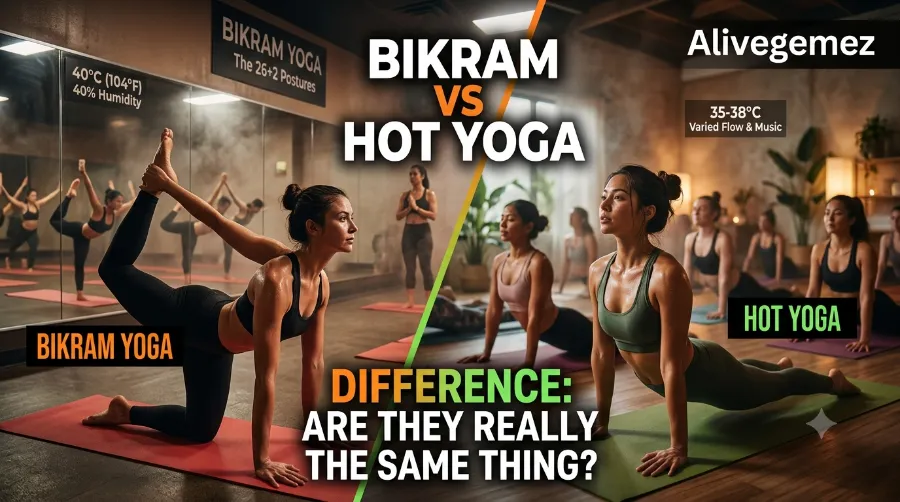
TL;DR: The bikram vs hot yoga difference comes down to structure. Bikram is a fixed, copyrighted-in-spirit sequence of 26 poses and 2 breathing exercises, done the same way every single time, in a room held near 105°F with 40% humidity. Hot yoga is the umbrella term for any heated class, which means the poses, the temperature, and the pace can change from studio to studio, and even from week to week. If you want predictability, pick bikram. If you want variety, pick hot yoga.
If you’ve walked into a studio that says “hot yoga” on the sign but your friend swears she’s doing “bikram,” you’re both right, and you’re both a little confused. I get this question at least twice a week from students who’ve been practicing for years and still can’t explain the bikram vs hot yoga difference to a friend without stumbling. So let’s clear it up properly, with real numbers, real research, and the kind of practical detail you actually need before you book a class and sweat through your leggings.
To get a better understanding of how meditation vs exercise exactly what to expect.
Key Takeaways at a Glance
| Factor | Bikram Yoga | Hot Yoga (general) |
|---|---|---|
| Pose sequence | Fixed, 26 poses + 2 breathing exercises, same order always | Varies by studio, teacher, and class type |
| Room temperature | ~105°F (40.5°C) | Ranges from 80°F to 105°F depending on studio |
| Humidity | ~40% (sometimes up to 60%) | Varies widely, often lower than bikram |
| Class length | Always 90 minutes | Usually 60 to 75 minutes |
| Music | None, silent practice | Often music-driven, playlist-based |
| Best for | Discipline, tracking progress, beginners who like routine | Practitioners who want variety, flow, or a faster pace |
| Teacher training | Standardized 9-week certification originally tied to founder | Independent studio or brand-specific training |
What Bikram Yoga Actually Is
Bikram yoga was created in the 1970s by Bikram Choudhury, and it has never changed since. That’s the whole point. Every bikram class on the planet, whether you’re in Karachi, Chicago, or Berlin, follows the identical 26-posture sequence plus two breathing exercises, always performed in the same order, always across a 90-minute class. Nothing gets swapped out. Nothing gets shortened.
The room is heated to roughly 105 degrees Fahrenheit (40.5°C) with humidity sitting around 40%, though some studios push it closer to 60%. There’s no music. There’s a mirror in front of you so you can watch your own alignment. The instructor talks you through the same dialogue, class after class, which sounds repetitive until you realize that’s exactly why so many people love it: your body learns the pattern, so you can actually feel when you’re improving.
If you want the full breakdown of the poses themselves, I’ve mapped out every single one with photos and cues in our hot yoga vs regular yoga comparison, which is worth reading before your first class.
The 26 Poses, In Order
Here’s the sequence practitioners follow every time, start to finish:
- Standing Deep Breathing (Pranayama)
- Half Moon Pose with Hands to Feet
- Awkward Pose
- Eagle Pose
- Standing Head to Knee Pose
- Standing Bow Pulling Pose
- Balancing Stick Pose
- Standing Separate Leg Stretching Pose
- Triangle Pose
- Standing Separate Leg Head to Knee Pose
- Tree Pose
- Toe Stand Pose
- Dead Body Pose (Savasana)
- Wind Removing Pose
- Sit-Up
- Cobra Pose
- Locust Pose
- Full Locust Pose
- Bow Pose
- Fixed Firm Pose
- Half Tortoise Pose
- Camel Pose
- Rabbit Pose
- Head to Knee Pose with Stretching
- Spine Twisting Pose
- Blowing in Firm Pose (Kapalbhati Pranayama)
I remember the first time I taught this exact sequence back in 2014, a student told me she’d finally figured out why her lower back pain had disappeared after three months. It wasn’t magic. It was repetition, done correctly, in the same order, week after week, so her body actually learned the movement instead of guessing at a new flow every class.
What Hot Yoga Actually Means
Here’s where most of the confusion starts. “Hot yoga” isn’t a style. It’s a temperature setting applied to almost any kind of yoga. A hot vinyasa class, a hot power class, a hot flow class, they’re all hot yoga, and none of them are required to follow the 26-pose sequence.
Room temperatures in a typical hot yoga vs bikram yoga comparison show real variation. Bikram studios sit near 105°F, while general hot yoga studios might run anywhere from 80°F to 105°F, depending on the brand. CorePower Yoga, for example, keeps its C2 hot flow classes between 93°F and 98°F, noticeably cooler than a traditional bikram room. Evolation Yoga, founded by a former senior bikram instructor, keeps the same 105°F setting but renamed the sequence “Primary Hot Series” to distance itself from the bikram brand name.

Music is common in hot yoga classes. The pace moves faster. Poses link together in a flow rather than being held and released one at a time. This makes hot yoga feel more like a cardio workout, while bikram feels more like a structured, almost meditative discipline.
For a side-by-side breakdown of how hot yoga stacks up against a cooler, traditional practice, our guide on hatha vs vinyasa yoga for beginners covers the pacing differences in more depth.
Bikram Yoga vs Hot Yoga: The Real Comparison Table
| Aspect | Bikram | Hot Yoga |
|---|---|---|
| Structure | Rigid, unchanging | Flexible, teacher-led |
| Heat | 105°F, 40% humidity | 80-105°F, humidity varies |
| Duration | 90 minutes, always | 60-75 minutes typically |
| Music | None | Usually yes |
| Predictability | Very high | Low to moderate |
| Injury risk if new | Moderate, due to heat plus unfamiliar poses | Moderate, due to heat plus fast pacing |
| Popular brands | Original Bikram studios, Evolation Yoga | CorePower, Moksha, Hot 26 studios |
Why the Heat Even Matters
The heat isn’t decoration. It’s the whole reason people either love or hate this style of practice. A warmer room increases blood flow, loosens connective tissue faster, and makes deep stretching feel more accessible, especially for people who’ve never touched their toes in a cold room in their life.
But the heat also carries real physiological demands. Research on Bikram yoga has looked specifically at cardiovascular effects. A 16-week randomized controlled trial published through BMC Complementary Medicine and Therapies had participants attend three to five bikram classes per week for 16 weeks, studying heart rate variability and associated cardiovascular disease risk factors in stressed and sedentary adults. A separate study out of the University of Texas at Austin, led by researcher Stacy D. Hunter, tested whether the heated environment itself changed outcomes by comparing 12 weeks of heated Bikram yoga at 40.5°C against a thermoneutral 23°C version in middle-aged adults, and found that arterial stiffness measures did not differ significantly between the heated and non-heated groups.
That last point genuinely surprised me the first time I read it, because so much of the bikram marketing leans on “the heat is what heals you.” The research suggests the postures themselves, not necessarily the heat, may be doing more of the cardiovascular work than people assume. If you’re choosing a class purely for heart health, the temperature might matter less than simply showing up consistently.
Real Studio Numbers From 2026
Studio owners I’ve spoken with this year report a shift in demand. Several independent hot yoga studios across the US have quietly lowered their room temperatures from the traditional 105°F down to 95-98°F after members complained about dizziness and dropout rates during the first month of membership. One studio owner in Austin told me her retention rate improved noticeably after making that single change, because new students weren’t quitting in week two from heat exhaustion.
Meanwhile, dedicated bikram studios that stuck with the original 105°F, 40% humidity, 90-minute format report a smaller but far more loyal customer base. These are often long-time practitioners who specifically want the unchanging structure rather than a trendy flow class.
Safety Notes Before You Book Your First Class
A few things I tell every new student, regardless of which style they choose:
- Drink water steadily in the hours before class, not just right before you walk in
- Skip a heavy meal for at least two hours beforehand
- Bring a non-slip towel or mat, since sweat pools fast in a 100-degree room
- Rest in Child’s Pose or Savasana anytime you feel lightheaded, no exceptions
- Avoid your first hot class if you’re pregnant, have uncontrolled blood pressure, or have a history of heat-related illness without talking to a doctor first
If you’re comparing the heated approach against a cooler practice altogether, our article on yoga vs stretching differences explains why heat changes flexibility outcomes compared to a plain static stretch routine.
Which One Should You Actually Choose?
If you like routine, if you want to track your own progress pose by pose, and if you don’t mind silence and a mirror in front of you, bikram is probably your style. If you get bored easily, want music, and prefer a faster-moving practice that changes week to week, hot yoga in its broader form will suit you better.
Neither one is objectively superior. I’ve had students switch from bikram to a general hot flow class after two years and tell me their bodies felt “awakened” by the variety. I’ve also had hot yoga regulars switch to bikram and finally feel like they understood their own alignment for the first time because the sequence never changed underneath them.
For readers weighing heated practice against gentler restorative options, our comparison of yin yoga vs restorative yoga is a useful next stop, especially if the heat itself feels like too much right now.
A Quick Detour Into the Bikram Controversy
It would be dishonest to write about bikram yoga without mentioning why so many studios have quietly dropped the name. Bikram Choudhury filed a series of copyright lawsuits in the 2000s against studios teaching his sequence without paying licensing fees, though courts eventually ruled that yoga postures themselves cannot be copyrighted. Around the same time, Choudhury faced multiple sexual harassment and assault allegations from former students and employees, which led many studio owners to rebrand their classes simply as “hot yoga” or “26 and 2” to separate the practice from its founder’s reputation.
This history matters if you’re choosing a studio, since some practitioners specifically avoid the bikram name for these reasons while still practicing the identical sequence under a different label. If you want a deeper dive into how yoga branding intersects with founder controversy, the team over at 3Tribes’ hot yoga vs bikram guide covers this angle well, and Hot Yoga For Life’s guide breaks down the studio rebranding trend in more detail. Yoga teacher Erica Josephson also has a thoughtful personal take on bikram yoga vs hot yoga on her blog worth reading if you want a practitioner’s first-person view.
Frequently Asked Questions
Is bikram yoga harder than hot yoga?
Not necessarily harder, just more rigid. Bikram’s fixed sequence can feel more demanding mentally because you can’t skip a pose you dislike, while general hot yoga lets teachers adjust difficulty class by class.
Can beginners do bikram yoga?
Yes, though your first class will likely feel overwhelming. Take breaks in Savasana whenever needed, and don’t expect to hold every pose the full time on day one.
Does hot yoga burn more calories than bikram?
Faster-paced hot flow classes typically burn more calories per session due to continuous movement, while bikram’s held postures burn fewer calories but build more isometric strength.
Is it safe to do hot yoga every day?
Most instructors recommend three to five sessions per week rather than daily practice, giving your body time to rehydrate and recover from the heat exposure.
What should I wear to a heated yoga class?
Lightweight, moisture-wicking fabric works best. Avoid heavy cotton, since it holds sweat and gets uncomfortably heavy halfway through class.
Test Your Knowledge: Bikram vs Hot Yoga Quiz
1. How many poses make up the traditional bikram sequence?
A) 20 poses
B) 26 poses
C) 32 poses
2. What is the typical bikram studio temperature?
A) 85°F
B) 95°F
C) 105°F
3. What sets hot yoga apart from bikram yoga?
A) Hot yoga always uses the same 26 poses
B) Hot yoga can vary in sequence, pace, and temperature
C) Hot yoga is never heated above 80°F
4. How long does a standard bikram class last?
A) 60 minutes
B) 75 minutes
C) 90 minutes
5. Why did some studios stop using the word “bikram” in their branding?
A) The sequence changed over time
B) Legal and reputational issues involving the founder
C) The heat requirement was removed
Answer Key: 1-B, 2-C, 3-B, 4-C, 5-B
Conclusion
The bikram vs hot yoga difference really just comes down to consistency versus variety. Bikram gives you the exact same 26 poses, the exact same heat, the exact same 90 minutes, every single time. Hot yoga gives you a heated room and lets everything else shift depending on the studio and teacher. Neither approach is wrong, and honestly, the best way to know which one fits your body is to try a class of each and pay attention to how you feel afterward, not just during. If you’re still deciding between yoga styles broadly, our pillar guide on yoga vs pilates for weight loss is a solid starting point, and you can always browse more comparisons back on the RealYogaHub homepage.
References
- Hunter SD, et al. “The Effect of Bikram Yoga on Arterial Stiffness and Endothelial Function in Middle-Aged Adults.” University of Texas at Austin, ClinicalTrials.gov.
- “Effects of heated and thermoneutral yoga interventions on arterial stiffness in middle-aged adults.” PubMed, National Library of Medicine.
- “Effect of a 16-week Bikram yoga program on heart rate variability and associated cardiovascular disease risk factors in stressed and sedentary adults: A randomized controlled trial.” BMC Complementary Medicine and Therapies.
- “The Effect of Bikram Yoga on Arterial Stiffness in Young and Older Adults.” Journal of Alternative and Complementary Medicine.
- ThermoPro. “Best Temperature and Humidity in Hot Yoga Studio.”
- 3Tribes. “Hot Yoga vs Bikram: What’s the Difference?”
- Hot Yoga For Life. “Hot Yoga vs Bikram Guide.”
- Erica Josephson. “Bikram Yoga vs Hot Yoga: What’s the Difference?”