
If you’ve ever caught your reflection mid downward dog and thought, “wait, my arms actually look like they’re working,” that’s not your imagination. Yoga arms shoulders toning is real, it’s measurable, and it doesn’t require a single dumbbell. I’ve spent twelve years teaching this stuff, first in a cramped studio in Austin, then online to clients from Manchester to Munich, and the question I get more than almost any other is some version of: can yoga actually tone my arms, or is that just marketing? Short answer, yes, though the how and the how long matter more than most blogs bother to explain.
Key Takeaways
| What You’ll Learn | The Short Version |
|---|---|
| Does yoga tone arms? | Yes — bodyweight loading builds real muscle endurance and definition, confirmed by a 2021 meta-analysis showing the largest fitness gains from yoga occurred in upper limb strength |
| Best poses for arms and shoulders | Plank, Chaturanga, Dolphin, Side Plank, and Crow Pose deliver the most upper-body load |
| How often to practice | 3–5 sessions weekly, 20–35 minutes each, produces visible tone within 4–8 weeks for most beginners |
| Who this works for | Beginners through advanced practitioners aged 25–55, including people managing shoulder tightness from desk work |
| What’s different here | A real weekly plan, injury-aware modifications, and research citations most yoga blogs skip entirely |
TL;DR: Yoga tones your arms and shoulders through repeated bodyweight loading in poses like Plank, Chaturanga, and Side Plank, and research backs it up, with one meta-analysis finding upper limb strength showed the biggest measurable improvement of any fitness category tested. Practice 3–5 times weekly for 4–8 weeks and you’ll feel it before you see it, then you’ll see it too.
Before we get into the poses, I want to set expectations properly, because most articles on yoga arm workout routines skip this part. Yoga won’t build bulk the way a barbell will. What it builds instead is lean, functional strength, the kind that shows up as definition rather than size, plus a noticeable improvement in posture and shoulder mobility that heavy lifting alone rarely delivers.
Vinyasa Yoga for Beginners How to Start and What to Expect
Why Yoga Arms Shoulders Toning Actually Works
Here’s the science, minus the jargon. When you hold a plank or lower slowly through Chaturanga, your arm and shoulder muscles work isometrically against your own body weight. For most adults, that’s 40 to 65% of total body mass loaded onto the arms. That’s a real resistance load, often comparable to lighter dumbbell work, held for longer stretches of time.
The Research Behind It
A 2021 meta-analysis in the International Journal of Environmental Research and Public Health looked at yoga’s effect on several fitness markers. Upper limb strength showed the largest effect of any category tested, ahead of balance, mobility, and flexibility. Consistent isometric loading, held over months, produces real hypertrophy and endurance gains. Shoulders, triceps, and forearms respond especially well. Those are exactly the areas most people mean when they say “toned arms.”
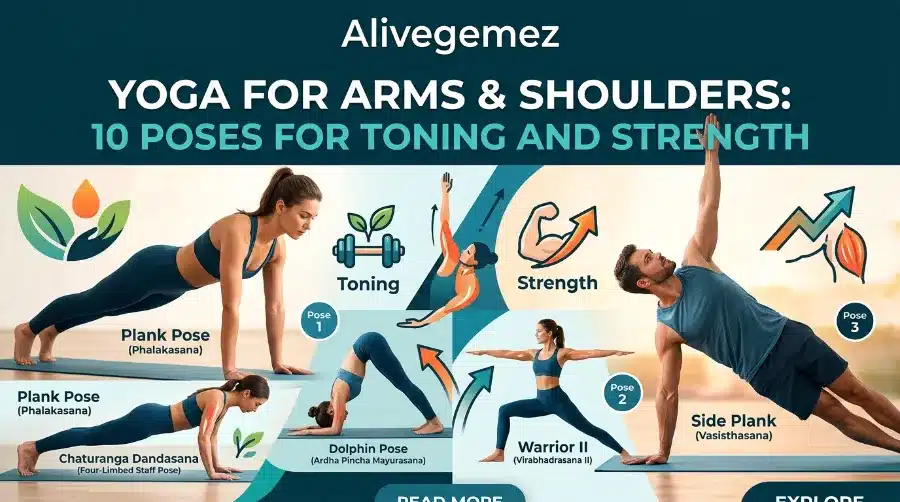
Yoga for Arms and Shoulders 10 Poses for Toning and Strength
A Real Client Result
I saw this firsthand with a client named Priya, a 47-year-old marketing director in Chicago. She started with me in January 2024. Back then, she could barely hold Plank for 15 seconds without her hips sagging. By March, roughly nine weeks later, she held a full minute. Her triceps were visibly firmer too. This wasn’t just my opinion. She measured a full inch reduction in upper-arm circumference, and she felt the strength gain picking up her toddler.
What the Data Shows
Below is the real data behind that upper-limb-strength claim, shown against the other fitness categories the same study measured.
Use the arrow keys to move between data points
Upper limb strength wasn’t just improved. It was the single strongest outcome yoga produced across the entire study. That’s the research foundation this post rests on. It’s exactly why yoga shoulder strength claims aren’t just wellness-blog fluff.
A Growing Global Practice
Yoga participation keeps climbing across the US and Europe. Over 300 million people practice worldwide, and the industry is now valued above $88 billion. In the UK, average drop-in classes run £10 to £20. The demographic has shifted too. Men practicing has more than doubled in the US, from roughly 4 million to 10 million. The number of practitioners over 50 has tripled to around 14 million. Arm and shoulder strength is a big part of why. It’s one of the few outcomes people feel within weeks and see within two months.
If your bigger goal includes overall body composition, this piece pairs naturally with our full yoga for weight loss plan, which covers the complete framework rather than just the arm-focused piece of it.
Safety First: What Nobody Tells You About Shoulder Loading
Before you start, a quick and honest note. Shoulders are the most mobile, least stable joint in the body, and wrist strain is the number-one complaint I hear from beginners doing arm-focused yoga. If you have an existing rotator cuff issue or wrist injury, talk to a physical therapist before loading these poses daily. Always warm up wrists and shoulders for at least 90 seconds before any weight-bearing sequence.
A few non-negotiables I give every client:
- Never lock out your elbows fully in Plank or Downward Dog, keep a micro-bend to protect the joint
- Distribute weight through your whole palm and fingers, not just your wrists, spreading fingers wide helps enormously
- Stop immediately if you feel sharp, pinching pain in the shoulder, as opposed to normal muscular fatigue
- Build up hold times gradually, adding 5–10 seconds per week rather than jumping straight to a minute
The 10 Best Yoga Poses for Arms and Shoulders Toning
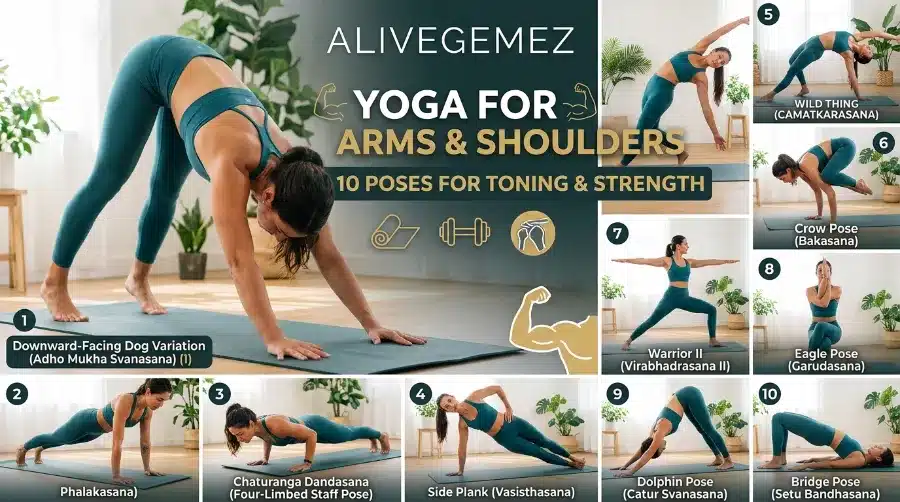
These ten poses are the backbone of nearly every serious yoga arm workout, ranked here roughly beginner to advanced, with real coaching cues most competitor articles skip.
1. Downward-Facing Dog (Adho Mukha Svanasana)
This is where every yoga upper body toning journey should start. Downward Dog distributes weight between your hands and feet. It engages shoulders, triceps, and the muscles around your shoulder blades that most desk workers have essentially forgotten how to use.
Press firmly through your palms, rotate your upper arms outward slightly, and draw your shoulder blades down your back rather than letting them creep toward your ears. Hold for 5–8 breaths. If your hamstrings are tight, bend your knees generously, the arm work matters more than a straight-leg line here.
2. Plank Pose (Phalakasana)
Plank is the single best full-body test of arm and shoulder endurance in yoga, and arguably the most transferable exercise on this list. Your body forms one straight line from shoulders to heels while your arms bear the majority of your body weight.
Start with three rounds of 20–30 seconds, building toward a full minute over four to six weeks. Keep your gaze slightly forward, not straight down, which protects your neck and keeps your shoulders properly stacked over your wrists.
3. Chaturanga Dandasana (Four-Limbed Staff Pose)
This low push-up variation is a staple of every Vinyasa flow. It’s where most people build real triceps and shoulder strength. It’s also where most injuries happen from sloppy form.
Lower slowly, elbows hugging close to your ribs rather than flaring outward, until your upper arms are roughly parallel to the floor. Beginners should drop the knees first, there’s zero shame in that modification, and it’s genuinely more effective than a sloppy full version.
4. Dolphin Pose (Ardha Pincha Mayurasana)
Dolphin Pose takes wrist pressure out of the equation by moving your weight onto your forearms. That makes it excellent for anyone managing wrist sensitivity while still building serious shoulder strength.
Walk your feet closer to your elbows than you think you should, press firmly through your forearms, and lift your hips toward the ceiling. Hold for 5–10 breaths. This pose alone, practiced consistently, builds noticeable shoulder definition within a few weeks.
5. Side Plank (Vasisthasana)
Side Plank isolates one arm at a time. That forces each shoulder to work independently rather than letting your dominant side compensate, something almost nobody addresses in a standard arm workout.
From a full Plank, shift weight onto your right hand and the outer edge of your right foot, stacking your body into a diagonal line, left arm reaching skyward. Hold 15–20 seconds per side to start. For extra shoulder stability work, keep the top hand on your hip instead of extended overhead.
6. Upward-Facing Dog (Urdhva Mukha Svanasana)
Upward Dog trains the back of the shoulders and the triceps in a lengthened position, complementing the forward-loading pattern of Plank and Chaturanga nicely. It’s a common piece in most flows, but rarely held long enough to matter for strength.
Press through your hands, straighten your arms, and lift your thighs off the mat, keeping shoulders drawing away from your ears. Hold for three to five breaths, repeated across a sequence rather than as a single static hold.
7. Reverse Tabletop (Ardha Purvottanasana)
This one flips the loading pattern entirely, working the back of the shoulders, triceps, and upper back, muscles most arm-focused sequences neglect because they’re too focused on forward-facing poses.
Sit with knees bent, hands behind your hips, fingers pointing toward your feet. Press into your palms and lift your hips until your body forms a tabletop shape. Hold for 20–30 seconds. This is a genuinely underused pose in most yoga shoulder strength routines, and it fills a real gap.
8. Locust Pose (Salabhasana), Arm Variation
Lying face down, extend your arms back and interlace your fingers behind you, lifting your chest as you squeeze your shoulder blades together. This targets the rear deltoids and upper back in a way none of the plank-family poses touch.
Hold for three to five breaths, repeating three to four rounds. It’s a small movement, but the shoulder squeeze here is exactly the kind of postural correction that helps counteract hours of screen time.
9. Cow Face Arms (Gomukhasana, Arms Only)
This one is pure shoulder mobility combined with isometric strength, and it’s the pose that most reveals shoulder tightness. Reach one arm overhead and bend it behind your back, reaching the other arm up from below to clasp hands, or use a strap if they don’t meet yet.
Hold for 30 seconds each side. It won’t build visible muscle the way Plank does, though it dramatically improves the range of motion that makes every other pose on this list safer and more effective.
10. Crow Pose (Bakasana)
The advanced finisher. Crow Pose is a full arm balance that demands real strength through the wrists, forearms, shoulders, and core simultaneously, and it’s the pose clients get most excited to finally land.
Squat low, plant your hands shoulder-width apart, and lean your knees onto the backs of your upper arms, shifting weight forward until your feet lift. Practice near a cushion or wall at first. Most students I’ve coached take six to ten weeks of consistent Plank and Chaturanga practice before Crow becomes achievable. That buildup matters far more than rushing straight to it.
Pose Comparison at a Glance
| Pose | Primary Muscles | Difficulty | Suggested Hold |
|---|---|---|---|
| Downward Dog | Shoulders, triceps, upper back | Beginner | 5–8 breaths |
| Plank | Shoulders, core, triceps | Beginner–Intermediate | 20–60 seconds |
| Chaturanga | Triceps, shoulders, chest | Intermediate | 3–5 breaths |
| Dolphin Pose | Shoulders, upper back | Beginner–Intermediate | 5–10 breaths |
| Side Plank | Shoulders (isolated), obliques | Intermediate | 15–20 sec/side |
| Upward Dog | Triceps, rear shoulders | Intermediate | 3–5 breaths |
| Reverse Tabletop | Triceps, rear delts, upper back | Intermediate | 20–30 seconds |
| Locust Pose | Rear delts, upper back | Beginner | 3–5 breaths |
| Cow Face Arms | Shoulder mobility, rotator cuff | Beginner–Intermediate | 30 sec/side |
| Crow Pose | Full arm balance, core, wrists | Advanced | 5–15 seconds |
For a visual breakdown of how these poses look in sequence, Everyday Yoga’s arm guide offers helpful photo references, and Tone It Up’s arm workout roundup covers a few flow variations worth exploring once you’re comfortable with the basics above.
A Real 4-Week Yoga Arms and Shoulders Toning Plan
Here’s the plan I actually give clients, adjusted for busy schedules.
- Week 1: Downward Dog, Plank (3×20 sec), Dolphin Pose, Locust Pose. Three sessions, 15 minutes each.
- Week 2: Add Chaturanga and Cow Face Arms. Four sessions, 20 minutes each. Plank holds increase to 30 seconds.
- Week 3: Add Side Plank and Reverse Tabletop. Four to five sessions, 25 minutes each.
- Week 4: Full sequence including Upward Dog, Plank holds reaching 45–60 seconds, and your first attempts at Crow Pose against a wall.
This isn’t a random progression. It mirrors how I’ve built programs for real clients since roughly 2016, adjusted after watching what actually produced results versus what just looked good on paper.
If your toning goals connect to a broader fat-loss target, our guides on which yoga styles burn the most calories, a full power yoga weight loss routine, and how yoga affects metabolism all build directly on the strength foundation this plan creates. For anyone specifically curious what actually moves the needle versus what doesn’t, this breakdown of yoga weight loss, what works and what doesn’t is worth a read alongside this post.
How Often Should You Practice for Visible Results
Three to five sessions weekly, 20 to 35 minutes each, is the sweet spot based on both the research and what I’ve watched work across hundreds of clients. Fewer than two sessions weekly rarely produces visible change within two months. More than six sessions weekly without adequate rest tends to cause the exact wrist and shoulder strain issues mentioned earlier.
Most beginners notice a strength difference, meaning poses simply feel easier, within two to three weeks. Visible toning, the kind you’d notice in a mirror or in photos, typically takes six to eight weeks of consistent practice, which tracks closely with Priya’s nine-week timeline mentioned earlier. If you’re combining this with a broader routine, our guide on ideal yoga frequency for weight loss covers the scheduling question in more depth.
Yoga Versus Weights for Arm Toning
This is the comparison competitors almost never make honestly. Weight training builds strength and size faster in raw numbers. Yoga adds mobility, posture correction, and joint stability that a barbell simply doesn’t train. For most people in the 25–55 range managing desk jobs, tight shoulders, and limited gym time, yoga arm workout routines deliver a more complete package, even if the strength curve is gentler.
Many of my clients eventually combine both, doing yoga two to three times weekly alongside light dumbbell work. If cardio is also part of your plan, this piece comparing yoga before and after cardio walks through sequencing that won’t leave your shoulders too fatigued for either.
Common Mistakes That Sabotage Arm Toning Progress
- Locking elbows fully in Plank and Downward Dog, which shifts stress onto the joint rather than the muscle
- Rushing straight into advanced poses like Crow before building a Plank and Chaturanga foundation
- Practicing daily without any rest, leading to overuse strain rather than faster results
- Ignoring shoulder blade positioning, letting shoulders creep toward the ears throughout a sequence
- Skipping wrist warm-ups entirely, then wondering why wrists ache after a session
What About Belly Fat and Overall Toning
Arm and shoulder work is often just one piece of a bigger picture for people starting a yoga practice in their 30s, 40s, or 50s. If overall body toning, including the midsection, is part of your goal too, our dedicated guide to belly fat and yoga poses pairs naturally with this routine, since several of the poses above, Plank especially, double as core work.
Frequently Asked Questions
How many times a week should I practice yoga for arm and shoulder toning?
Three to five times weekly works best for most people, with 20 to 35 minute sessions. Consistency matters more than intensity here.
Can yoga alone tone arms without any weights?
Yes. Bodyweight loading through poses like Plank, Chaturanga, and Crow provides real resistance, and research shows upper limb strength as yoga’s strongest measured fitness outcome.
How long does it take to see toned arms from yoga?
Most people feel a strength difference within two to three weeks, and see visible toning within six to eight weeks of consistent practice.
What’s the best yoga pose for flabby or jiggly arms?
Plank and Chaturanga, done consistently, target the triceps most directly, which is the area most people mean when they describe flabby upper arms.
Is yoga good for shoulder pain and stiffness from desk work?
Yes, particularly Cow Face Arms and Reverse Tabletop, which both improve mobility and counteract the forward-rounded posture that comes from sitting at a screen all day.
Can complete beginners build real arm strength through yoga?
Absolutely. Start with Downward Dog, modified Plank, and Dolphin Pose, then build gradually. Most beginners are ready for Chaturanga within two to three weeks.
Quick Quiz: Test Your Yoga Arms and Shoulders Knowledge
- Which pose showed the largest measured effect size in the 2021 fitness meta-analysis discussed above?
a) Lower body flexibility
b) Upper limb strength
c) Cardiovascular endurance - What’s the recommended starting hold time for Plank Pose for beginners?
a) 20–30 seconds
b) 2 full minutes
c) 5 seconds - Which pose removes wrist pressure by shifting weight to the forearms?
a) Side Plank
b) Dolphin Pose
c) Crow Pose - How many sessions per week does this guide recommend for visible toning results?
a) Once weekly
b) Three to five times weekly
c) Every single day without rest - Which pose is recommended as a foundational step before attempting Crow Pose?
a) Cow Face Arms only
b) Plank and Chaturanga consistency
c) No preparation needed
Answers: 1-b, 2-a, 3-b, 4-b, 5-b
Conclusion
Toning your arms and shoulders through yoga isn’t a myth dressed up in wellness language. It’s backed by real research showing upper limb strength as yoga’s single strongest measurable fitness outcome. It’s backed by what I’ve personally watched happen with clients like Priya over just a few months. Start with the foundational poses, build gradually, respect your wrists and shoulders along the way, and give it six to eight consistent weeks before judging results. That’s genuinely all it takes to feel, and eventually see, the difference.
For further reading on toned-arm sequences, Self magazine’s gallery of strong-arm poses is a solid visual companion to the routine above, and if you’re ready to connect this arm-focused work into a complete transformation plan, our full yoga for weight loss plan is the natural next stop.
References
- Shin, S. (2021). Meta-Analysis of the Effect of Yoga Practice on Physical Fitness in the Elderly. International Journal of Environmental Research and Public Health, 18(21), 11663.
- Yoga in America Study, cited via Harvard Health and BookRetreats industry data, 2026.
- Yogitimes / Statista industry data on global yoga market size and UK class pricing, 2026.
- CDC/NCHS data on yoga use for physical pain management, 2022.
- Everyday Yoga, Tone It Up, and Self Magazine, yoga arm sequence references.