
It’s 11:47 PM. You are lying in bed, phone finally face-down on the nightstand, and your brain decides this is the perfect time to replay a conversation from 2019. Sound familiar? You are not broken and you are not alone. Roughly one in three American adults get less sleep than their body actually needs, and that number has barely budged in over a decade according to CDC survey data. A bedtime yoga routine for sleep is one of the few tools that is free, backed by real research, and works whether you are 25 or 55.
Yoga for Better Sleep The Complete Science-Based Night Routine 2026
I have taught yoga for twelve years, and the question I get asked more than any other in my evening classes is some version of “what can I actually do tonight to fall asleep faster?” Not someday. Tonight. This guide gives you exactly that: a simple, ten-minute bedtime yoga routine for sleep, the science behind why it works, and the small adjustments that make the biggest difference for real people with real schedules.
Key Takeaways
| What You’ll Learn | Quick Answer |
|---|---|
| Does bedtime yoga actually help you sleep? | Yes. A 2025 network meta-analysis of 1,348 people found yoga increased total sleep time by nearly 2 hours and cut the time it takes to fall asleep by about 30 minutes |
| How long should a nighttime yoga sequence be? | 10 minutes is enough. Consistency matters more than duration |
| Best bedtime yoga poses for sleep | Child’s Pose, Legs-Up-The-Wall, Supine Twist, Reclined Butterfly, Corpse Pose |
| Best breathing technique to pair with it | 4-7-8 breathing, done for 4 rounds after your last pose |
| When to start the routine | 30-60 minutes before your target sleep time, lights already dimmed |
| Who should modify or skip certain poses | Pregnant readers, anyone with glaucoma, recent eye surgery, or severe acid reflux (skip Legs-Up-The-Wall and deep twists — check with your doctor) |
TL;DR: A short, gentle bedtime yoga routine for sleep, paired with slow breathing, tells your nervous system it’s safe to power down. Ten minutes of Child’s Pose, Legs-Up-The-Wall, a supine twist, and 4-7-8 breathing before bed can help you fall asleep faster and stay asleep longer, and you don’t need any experience to start tonight.
Why Your Body Fights Sleep (and Why Yoga Before Sleep Poses Help)
Here’s the part nobody explains well. Falling asleep is not something you force. It’s something your nervous system has to allow. When you’re stressed, scrolling, or still mentally at your desk, your sympathetic nervous system, the “fight or flight” branch, stays switched on. Cortisol stays elevated. Your heart rate stays a touch too fast. Sleep becomes a battle instead of a landing.
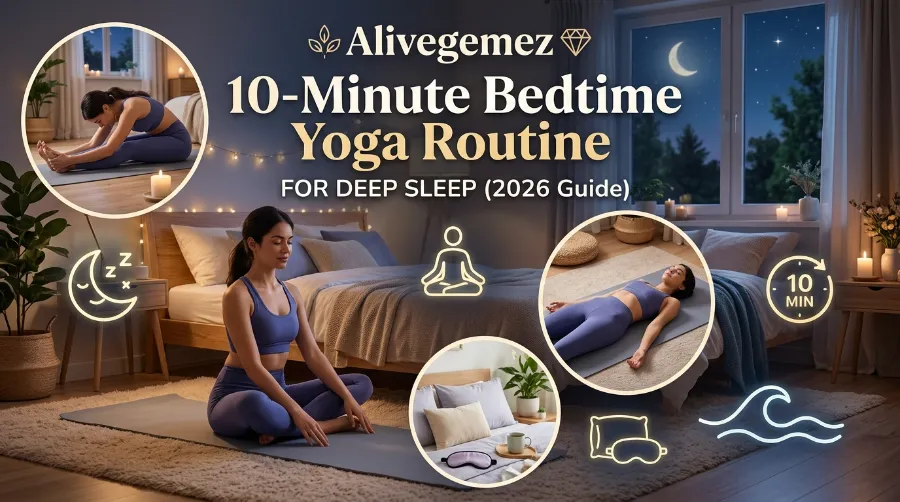
A nighttime yoga sequence works because it does the opposite job. Slow, supported stretches combined with long exhales activate your parasympathetic nervous system, the “rest and digest” branch, through the vagus nerve. Your heart rate drops. Your muscles release tension you didn’t even know you were holding in your jaw, shoulders, and hips. This is not a spiritual claim, it’s basic physiology, and it’s why bedtime yoga routine sleep practices have become one of the most searched wellness topics of 2026.
Yoga for Jet Lag Best Poses to Reset Your Body Clock Fast
The research backs this up in a big way. A July 2025 study published in BMJ Evidence-Based Medicine pooled 22 clinical trials and over 1,300 participants comparing yoga, tai chi, walking, jogging, and several non-exercise treatments for insomnia. Yoga came out near the top: practitioners saw total sleep time increase by close to two hours, sleep efficiency improve by nearly 15%, and the time spent lying awake after waking up in the night drop by almost an hour. A separate 2025 analysis out of Harbin Sport University found that shorter, more consistent yoga sessions, even under 30 minutes, done a few times a week outperformed longer, sporadic sessions for improving sleep quality. That’s genuinely good news if you only have ten minutes before your eyes start closing on their own.
The 10-Minute Bedtime Yoga Routine for Sleep, Pose by Pose
Do this on your bed, a mat, or even a rug beside your bed. Keep the lights low, phone away, and move slowly between each shape. There is no goal here except softness.
1. Seated Breath Check (1 minute)
Sit cross-legged or on your heels. Close your eyes. Take five slow breaths, making your exhale slightly longer than your inhale. This single minute resets your attention from your to-do list to your body, and it’s the step most people skip, even though it’s the one that matters most.
Progressive Relaxation vs Yoga Which One Actually Relieves Stress More?
2. Child’s Pose (2 minutes)
Kneel, big toes touching, knees wide. Fold forward, arms stretched out or resting alongside your body, forehead on the mat or a pillow. This is one of the most effective yoga before sleep poses because it gently compresses the abdomen, encouraging slower, deeper breathing, and it takes pressure off a tired lower back after a full day of sitting or standing.
3. Legs-Up-The-Wall (2-3 minutes)
Sit sideways next to a wall, then swing your legs up and lie back, hips close to the wall, arms resting palms-up. This pose is a favorite among sleep researchers because it encourages venous return, essentially helping blood move back toward your heart, which can ease swelling in the feet and calm a racing mind after a long day on your feet.
Skip or modify this one if you’re pregnant, have glaucoma, or have had recent eye surgery — a bolster under the hips instead of the wall works well too.
4. Supine Spinal Twist (2 minutes, both sides)
Lying on your back, hug one knee to your chest, then let it fall across your body while your arms open wide. Hold for about a minute per side. Twists like this release tension along the spine and low back, an area that quietly stores the stress of an entire day at a desk or behind the wheel.
5. Reclined Butterfly (1-2 minutes)
Lying on your back, bring the soles of your feet together and let your knees fall open, like a book. Place a pillow under each knee if your hips feel tight. This hip-opener is one of the gentlest yoga before sleep poses in this entire routine, and it’s the one my students say feels the most like “permission to stop.”
6. Corpse Pose with 4-7-8 Breathing (2 minutes)
Lie flat, arms at your sides, palms up, legs relaxed. This is where you finish the sequence.
4-7-8 Breathing Technique: How to Do It and When to Use It
This breathing pattern, made popular by Dr. Andrew Weil, is the single most requested add-on to any bedtime yoga routine sleep practice I teach, and for good reason. It’s simple enough to do half-asleep, which is exactly the point.
How to do it:
- Exhale completely through your mouth, making a soft whoosh sound
- Close your mouth and inhale quietly through your nose for a count of 4
- Hold your breath for a count of 7
- Exhale completely through your mouth for a count of 8
- Repeat for 4 full rounds
When to use it: Right after your last yoga pose, while lying in Corpse Pose, or any time you wake up at 3 AM with your mind racing. It also works well seated on the edge of a plane seat, before a hard conversation, or during a work meeting that’s making your chest feel tight, it’s not exclusive to bedtime.
Savasana Yoga Benefits Why Corpse Pose Is the Most Important Pose
The science here is honestly a little more nuanced than the wellness internet lets on, and I’d rather tell you the real picture. There isn’t yet a large standalone clinical trial proving the exact 4-7-8 ratio outperforms other slow-breathing patterns. What we do know, from a 2026 randomized controlled study on university students and several 2025-2026 clinical trials on post-surgical patients, is that 4-7-8 breathing consistently improved measured sleep quality scores compared to control groups. The extended exhale, twice as long as the inhale, is the real engine here: it shifts your body firmly toward parasympathetic, “rest and digest” mode, and that mechanism is well-established in breathing research even outside the 4-7-8 label specifically.
Yoga for Insomnia A 4 Week Sleep Improvement Program
A Simple Nighttime Yoga Sequence for Different Sleep Struggles
Not every restless night looks the same, so here’s how I’d adjust the sequence depending on what’s actually keeping you up.
- Racing mind, can’t stop thinking: Spend an extra minute in Child’s Pose and add 2 more rounds of 4-7-8 breathing at the end
- Physically restless, tight body: Add a gentle standing forward fold before you get into bed, then move through the sequence as written
- Lower back pain: Skip the twist if it aggravates you, and hold Legs-Up-The-Wall a minute longer instead
- Waking up at 2-3 AM and can’t get back to sleep: Skip the full sequence, just do Corpse Pose with 4 rounds of 4-7-8 breathing right where you’re lying
Real Numbers: What the Research Actually Shows
I want to be straight with you here, because the wellness world loves to round numbers up. Here’s what a July 2025 network meta-analysis in BMJ Evidence-Based Medicine, covering 1,348 participants across 22 trials, actually found when comparing yoga to other insomnia treatments.
| Outcome Measured | Effect of Yoga |
|---|---|
| Total sleep time | Increased by close to 2 hours |
| Sleep efficiency | Improved by nearly 15% |
| Time awake after falling asleep | Reduced by almost 1 hour |
| Time it takes to fall asleep (sleep latency) | Reduced by roughly 30 minutes |
| Trial length used in study | 4 to 26 weeks |
A rough visual of how yoga compared to other exercise-based insomnia treatments in that same review, ranked by overall sleep-quality improvement, looked like this:
Yoga            ████████████████████  Strongest effect
Tai Chi         █████████████████
Walking/Jogging ███████████████
Strength Training ██████████
Mixed Aerobic   ████████
(Simplified visual summary based on relative effect sizes reported in Bu, Z., et al., BMJ Evidence-Based Medicine, 2025.)
For context on why this matters at a population level: CDC data from 2024 shows 30.5% of U.S. adults get short sleep, defined as fewer than 7 hours a night, and only about 55% of adults report waking up feeling well-rested. If a free ten-minute routine can meaningfully move those numbers, it’s worth the ten minutes.
How Yoga Before Sleep Poses Compare to Other Sleep Aids
-$-$
| Approach | Cost | Side Effects | Best For |
|---|---|---|---|
| Bedtime yoga routine sleep practice | Free | None reported | Nightly habit, long-term sleep quality |
| Sleep medication | Grogginess, dependency risk | Short-term, doctor-supervised use | |
| CBT-I (Cognitive Behavioral Therapy for Insomnia) | None | Chronic insomnia, gold-standard treatment | |
| Melatonin supplements | $ | Vivid dreams, next-day grogginess in some users | Jet lag, occasional use |
| Screen time before bed | Free | Delayed sleep onset, poorer sleep quality | Generally best avoided |
Worth noting: CBT-I remains the clinically recommended first-line treatment for chronic insomnia, and if you’ve struggled with sleep for months rather than weeks, it’s worth talking to a doctor or sleep specialist alongside trying this routine, not instead of it.
Common Mistakes That Cancel Out Your Bedtime Yoga Routine for Sleep
- Doing it right after an intense workout. Give your heart rate at least an hour to settle first
- Keeping bright lights on during the sequence. Dim lighting cues melatonin production, bright light blocks it
- Checking your phone between poses. Even one notification can undo ten minutes of calm
- Rushing through it like a workout. This sequence isn’t meant to build strength, it’s meant to slow you down
- Expecting results after one night. Most people notice a real shift within 1-2 weeks of doing this consistently, similar to the 8-10 week windows used in clinical yoga-for-sleep trials
Building This Into an Actual Nighttime Yoga Sequence Habit
The routine only works if you actually do it, so here’s the practical part. Pair it with something you already do every night, brushing your teeth or setting tomorrow’s alarm, so it attaches to an existing habit instead of relying on willpower alone. Keep a mat or even just a folded blanket permanently by your bed so there’s zero setup friction. If ten minutes feels like too much on a genuinely exhausting night, do just Legs-Up-The-Wall and the 4-7-8 breathing, two minutes is still better than zero.
For a broader look at how yoga supports sleep long-term, including which poses to build into a full evening wind-down beyond just this routine, our complete guide to yoga for better sleep walks through the deeper practice. And if bedtime yoga is new to you altogether, RealYogaHub has beginner-friendly sequences that make a good starting point before you build up to a full nighttime routine.
If you’d rather follow along with video guidance the first few times, Yoga With Adriene’s 10-minute bedtime sequence is a gentle, well-paced option, and DAREBEE’s better sleep yoga workout offers a slightly more structured version if you like a printable routine. For another expert breakdown of pose order and pacing, DOYOU’s bedtime yoga sequence guide is also worth a look.
Frequently Asked Questions
Does a bedtime yoga routine actually help with sleep, or is it just placebo? The effect is measurable, not just anecdotal. A 2025 network meta-analysis of over 1,300 participants found yoga meaningfully improved total sleep time, sleep efficiency, and time spent awake at night compared to no treatment, and the effect sizes were comparable to some non-drug clinical interventions.
How long before bed should I do a nighttime yoga sequence? Aim for 30 to 60 minutes before your target sleep time, with lights already dimmed. Doing it too close to a stimulating activity, like a heated conversation or intense scrolling session, blunts the effect.
Can beginners do yoga before sleep poses with zero experience? Yes. Every pose in this routine is fully supported by the floor or a wall, requires no flexibility, and can be modified with pillows. This is genuinely one of the most beginner-friendly forms of yoga that exists.
Is 4-7-8 breathing safe for everyone? For most healthy adults, yes. Some people feel briefly lightheaded on the first few tries, if that happens, just breathe normally and try again with shorter counts. Anyone with a respiratory condition should check with a doctor first.
How is bedtime yoga different from regular yoga insomnia treatment programs used in clinical studies? Clinical yoga insomnia programs are typically longer, 8 to 26 weeks, and supervised, often combining yoga with sleep hygiene education. This routine borrows the same physiological principles, slow movement, extended exhales, parasympathetic activation, in a simplified, self-guided ten-minute format for nightly home use.
Bedtime Yoga Quiz: Test What You Learned
1. Which nervous system branch does a bedtime yoga routine primarily activate to help you sleep? A) Sympathetic nervous system B) Parasympathetic nervous system C) Central nervous system
2. In the 4-7-8 breathing technique, how long do you hold your breath? A) 4 seconds B) 7 seconds C) 8 seconds
3. According to the 2025 network meta-analysis, roughly how much did yoga increase total sleep time by? A) 20 minutes B) Close to 2 hours C) 4 hours
4. Which pose should be modified or skipped if you have glaucoma or recent eye surgery? A) Child’s Pose B) Legs-Up-The-Wall C) Reclined Butterfly
5. What is generally considered the clinical gold-standard first-line treatment for chronic insomnia? A) Melatonin supplements B) CBT-I (Cognitive Behavioral Therapy for Insomnia) C) Sleep medication
Answer Key: 1-B, 2-B, 3-B, 4-B, 5-B
Conclusion
A restless night doesn’t mean something is wrong with you, it usually just means your nervous system never got the memo that the day is over. A ten-minute bedtime yoga routine for sleep, five gentle poses followed by a few rounds of 4-7-8 breathing, is a small, evidence-backed way to send that memo clearly. Start tonight with just Child’s Pose and Legs-Up-The-Wall if that’s all the energy you have, then build from there. Your best sleep isn’t going to come from a $200 gadget, it’s going to come from ten quiet minutes on the floor beside your bed.
References
- Bu, Z., et al. (2025). Effects of various exercise interventions in insomnia patients: a systematic review and network meta-analysis. BMJ Evidence-Based Medicine. DOI: 10.1136/bmjebm-2024-113512
- Harbin Sport University research on yoga intensity and sleep quality outcomes, as reported in Sleep and Biological Rhythms, 2025
- Centers for Disease Control and Prevention. Short Sleep Duration and Sleep Difficulties Among Adults: United States, 2024. National Center for Health Statistics
- Centers for Disease Control and Prevention. FastStats: Sleep in Adults
- Mualifah, D., Herawati, I. (2026). Effect of the 4-7-8 Breathing Technique on Sleep Quality. Physiotherapy Study Program, Faculty of Medicine, Udayana University
- University of Michigan Medical School. The Simple 4-7-8 Breathing Technique Can Help You Relax and Sleep Better
- Medical News Today. 4-7-8 breathing: How it works, benefits, techniques, and uses (reviewed October 2025)