
Your first vinyasa class is going to feel like a lot. Bodies moving in every direction, a teacher calling out pose names you have never heard, and that one person in the front row who seems to be doing a dance you were never taught. Take a breath. That was me twelve years ago too, and I teach this style for a living now.
Yoga for Arms and Shoulders 10 Poses for Toning and Strength
Here is the honest truth I wish someone had told me before my first class: vinyasa yoga beginners start in exactly the same messy, wobbly, breathless way, and every single one of them gets it eventually. This guide is the one I hand my own new students whenever they ask how vinyasa yoga beginners start without feeling overwhelmed. It covers how vinyasa actually works, what your body and mind will go through in the first few weeks, a real beginner vinyasa flow you can practice at home today, and the small habits that turn a confusing first class into a practice you actually look forward to.
Key Takeaways
| What You’ll Learn | Quick Answer |
|---|---|
| What vinyasa yoga is | A style that links each movement to one inhale or one exhale, creating a continuous “flow” |
| Best way for a beginner to start | 1–2 short (20–30 minute) slow flow classes per week, then build up gradually |
| First-class expectations | Soreness in the shoulders and core within 24–48 hours is normal; dizziness or pain is not |
| Ideal weekly frequency for new students | 2–3 sessions weekly, based on current teacher-reported guidance, with rest days between |
| Equipment needed | A mat, comfortable clothes, water, and nothing else |
| Time to feel comfortable | Most students report feeling at ease after roughly 8–12 classes |
| Related skill worth learning early | Breathwork such as the 4-7-8 breathing technique, used before or after a flow to settle the nervous system |
TL;DR: Vinyasa yoga beginners start best with short, slow-paced classes two to three times a week, focusing on breath before flexibility. Expect some muscle soreness in week one, plateaus around week three, and real comfort with the poses by class eight to twelve. You do not need to be flexible, strong, or coordinated on day one, you just need a mat and a willingness to breathe through the wobble.
Why So Many People in the US and Europe Are Turning to Vinyasa Right Now
Search interest in beginner-friendly wellness routines has climbed steadily since 2024, and vinyasa keeps coming up as one of the most requested styles among first-time yogis in the US, UK, and across mainland Europe. Part of the appeal is practical, most studios and apps now build entire tracks specifically for vinyasa yoga beginners start journeys, meaning you rarely have to figure this out alone anymore.
The other part is simply that it works for busy, modern lives. A single 30 to 45 minute session covers strength, mobility, cardio, and stress relief at once, which explains why so many newcomers who once tried yoga once and quit are giving it a second, more informed try.
What Vinyasa Yoga Actually Means (Without the Jargon)
Vinyasa is a Sanskrit word that roughly translates to “placing in a special way.” In practice, it means every movement is tied to one breath. You inhale, you reach. You exhale, you fold. There is no separate “breathing part” of the class, the breath is the choreography.
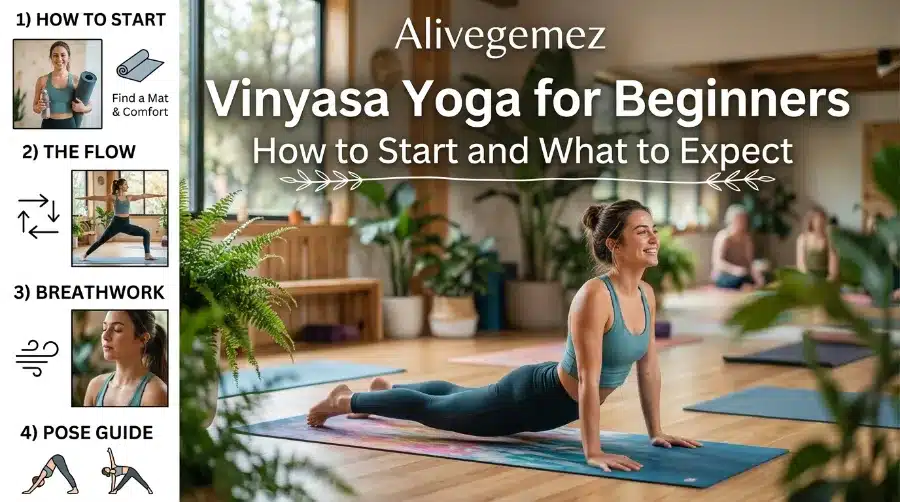
This is different from a style like Hatha, where you hold a pose for several breaths before moving on. Vinyasa keeps moving, which is exactly why it looks intimidating from the doorway and why it is, in my experience with hundreds of new students, actually one of the more forgiving styles once you understand the pattern. You are never asked to hold a difficult shape for a long stretch. You move through it and on to the next one.
If you have ever tried yoga for weight loss, you have probably already brushed against vinyasa without knowing its name, since it is one of the most commonly recommended best yoga styles for weight loss because of its continuous, heart-rate-raising nature.
The One Sequence Every Vinyasa Class Repeats
Almost every vinyasa class returns again and again to a mini-sequence called the “vinyasa” (confusingly, the same word describes the whole style and this one specific transition). It typically looks like this:
- Plank pose
- Lower halfway or all the way down (chaturanga)
- Upward-facing dog
- Downward-facing dog
Learn this four-step pattern and roughly 70% of any beginner vinyasa flow suddenly makes sense, because the teacher will cue “vinyasa” or “flow it out” and expect you to already know the shape.
How to Start Vinyasa Yoga as a Complete Beginner (Step by Step)
This is the exact roadmap I recommend to anyone ready to start vinyasa practice for the first time, whether you are booking a studio class in New York, London, or Berlin, or rolling out a mat in your living room.
I have watched two kinds of new students walk into my studio. One signs up for the fastest, most advanced-looking class because they assume that is how you “prove” you belong there. They usually quit within three weeks. The other starts slow, on purpose, and six months later is the steadiest person in the room. Here is the start vinyasa practice roadmap I give the second kind of student.
- Book a class labelled “slow flow,” “gentle vinyasa,” or “vinyasa basics.” These exist specifically for you, and studios in the US and across Europe increasingly offer them because so many people ask for exactly this.
- Arrive 10 minutes early and tell the teacher you are new. A good teacher will quietly adjust their cues for you without singling you out in front of the class.
- Skip nothing, but modify everything. Drop to your knees in plank, skip the chaturanga and just lower slowly, take child’s pose whenever you need to. Nobody is grading you.
- Practice two to three times in your first two weeks, not daily. Your shoulders, wrists, and core need real recovery time while they adapt to new movement patterns.
- Keep a one-line note after each class (“wrists were sore,” “loved the breathing part,” “got dizzy in the twists”). This tiny habit is how you and your teacher spot patterns fast.
If you are pairing this with a broader weight-management goal, this same gradual approach lines up well with a yoga for weight loss plan, since consistency beats intensity every time.
Beginner Vinyasa Flow You Can Try at Home Today
Here is a genuinely beginner-friendly 15-minute sequence I still teach to first-timers. Move at your own pace, and breathe through your nose whenever you can.
- Child’s Pose — 5 breaths, to settle in
- Cat-Cow — 6 rounds, moving with inhale and exhale
- Downward-Facing Dog — 5 breaths
- Low Lunge (right side) — 5 breaths
- Downward-Facing Dog — reset
- Low Lunge (left side) — 5 breaths
- Standing Forward Fold — 5 breaths
- Mountain Pose with arms overhead — 3 breaths
- Easy Seated Twist, both sides — 5 breaths each
- Savasana (rest on your back) — 3 to 5 minutes
That last step is not optional filler. Savasana is where your nervous system actually absorbs the work you just did, and skipping it is one of the most common mistakes I see beginners make.
What to Expect: Week by Week
Nobody tells beginners what actually happens to their body and mind over the first month, so here is what I have observed, backed by what current research and practitioner data show.
| Timeframe | What You’ll Likely Feel |
|---|---|
| Class 1–2 | Wobbly balance, fast heart rate, confusion about pose names, a good kind of tired |
| Days 2–3 after class 1 | Mild soreness in shoulders, wrists, and core (delayed onset muscle soreness, totally normal) |
| Week 2–3 | A frustrating plateau where nothing feels new; this is your body quietly adapting |
| Week 4–6 | Noticeably smoother transitions, less wrist strain, better breath control |
| Class 8–12 | Most students report finally feeling “at home” in the room |
A 2026 practitioner survey referenced by wellness outlet Hello! found that even experienced vinyasa teachers recommend beginners start with manageable frequency rather than daily intensity, favoring around three to five sessions weekly for general practitioners, with two to three sessions weekly being the realistic, sustainable starting point for absolute beginners according to multiple current yoga-education sources.
A Realistic Vinyasa Yoga Guide USA Studios Actually Recommend
I get asked constantly for a straightforward vinyasa yoga guide USA readers can actually follow without a studio membership or fancy equipment, so here is the condensed version, based on current teacher-training standards and what I see working for real beginners.
- Week 1–2: One to two slow flow classes, focused purely on learning pose names and breath timing.
- Week 3–4: Two to three classes weekly, introducing standard-paced vinyasa once modifications feel natural.
- Week 5–8: Two to three classes weekly, adding one slightly longer 60-minute session if energy allows.
- Week 9 onward: Settle into whatever frequency feels sustainable, usually three to five sessions weekly for most consistent practitioners.
This same gradual structure applies whether you are following along in the US, the UK, or anywhere across Europe, the physiology of building strength and flexibility does not change by location, only the studio options and class names might.
Common Beginner Mistakes (And What to Do Instead)
- Holding your breath during hard poses. Instead, exhale through the effort, it is almost always the exhale that gets you through a chaturanga.
- Locking the knees or elbows. Instead, keep a micro-bend in any joint that is bearing weight.
- Rushing to “keep up” with the class pace. Instead, take an extra breath in downward dog whenever you fall behind; the class will loop back around to you.
- Skipping savasana because it “feels lazy.” Instead, treat it as the part of the workout where your body actually adapts.
- Practicing on a completely empty or completely full stomach. Instead, eat a light snack roughly 90 minutes before class.
The Breath Is the Whole Practice, Not a Bonus
If there is one thing that separates a beginner who sticks with vinyasa from one who quits, it is learning to trust the breath instead of fighting it. Long before you attempt a fancy arm balance, it is worth spending five quiet minutes learning breath control on its own. One tool I hand almost every new student in week one is the 4-7-8 breathing technique, a simple pattern of inhaling for four counts, holding for seven, and exhaling for eight, which calms the nervous system and, once familiar, transfers directly into your vinyasa breath awareness on the mat.
Practicing that pattern for even two minutes before class noticeably reduces the “rushed” feeling that trips up so many new students in their first month.
Building Real Strength and Mobility Through Vinyasa
Once the basic shapes feel familiar, usually somewhere around week four, vinyasa starts doing quiet, cumulative work on your body that beginners rarely expect.
- Shoulder and wrist strength builds from the repeated plank-to-chaturanga pattern, which is why easing in with modifications early prevents overuse strain later.
- Core stability improves simply from the transitions themselves, since almost every movement between poses asks your midline to hold you steady.
- Metabolic and cardiovascular benefit comes from the continuous nature of the flow, which is one reason vinyasa shows up so often in guides focused on yoga and metabolism.
- Hip and hamstring mobility opens gradually through repeated lunges and forward folds, this is usually the slowest-improving area, so patience matters here more than anywhere else.
If your goal includes toning specific areas alongside general fitness, a consistent vinyasa habit pairs naturally with more targeted resources like yoga poses for belly fat or yoga for arms and shoulders, since the flow work builds the foundation those targeted routines then refine.
The Core Poses Every Beginner Should Learn First
Before you worry about flowing gracefully between shapes, it helps enormously to understand the individual poses on their own. I always tell new students, learn the shape standing still first, the flow will come later on its own.
- Mountain Pose (Tadasana): Looks like standing still, actually teaches you posture, weight distribution, and breath awareness, the foundation everything else builds on.
- Downward-Facing Dog: The pose you will see the most in any beginner vinyasa flow. Bend your knees generously if your hamstrings are tight, a straight-legged version is not the goal.
- Plank Pose: Builds the core and shoulder strength that protects your wrists later. Drop to your knees without hesitation while this feels new.
- Chaturanga (Low Push-Up): The pose most likely to cause injury when rushed. Beginners should lower all the way to the mat rather than hovering, until shoulder strength catches up.
- Upward-Facing Dog: A gentle backbend that opens the chest, keep your shoulders pulled down and back rather than hunched toward your ears.
- Warrior I and Warrior II: Build leg strength and teach hip alignment, two poses that show up in nearly every class you will ever take.
- Child’s Pose: Your reset button. Use it any time a class moves faster than your breath, no explanation needed to your teacher or anyone around you.
Once these seven shapes feel familiar in isolation, stringing them together into a flow becomes far less overwhelming, because you are no longer learning the pose and the transition at the same time. This is really the heart of how vinyasa yoga beginners start building genuine confidence rather than just memorizing a sequence.
What to Wear and What to Bring
Beginners often overthink their first-class outfit, so here is the simple version. Choose clothing that moves with you and will not need constant adjusting between poses.
- Fitted, breathable leggings or shorts rather than loose gym shorts, which tend to ride up during inversions and forward folds.
- A snug top that will not fall over your face during downward dog or forward folds.
- Bare feet, grip socks if the floor feels slippery, never regular socks, which slide on most studio floors.
- A full water bottle, vinyasa raises your heart rate enough that light sweating is common even in a beginner class.
- Your own mat if possible, for hygiene and consistency, though nearly every studio in the US and Europe will rent or lend one for your first visit.
You genuinely do not need special yoga-branded gear to start. Comfortable athletic clothing you already own is enough for your first several classes.
How to Choose the Right Studio or Online Class
Not every vinyasa class is created equal, and picking the wrong one is a common reason beginners quit within the first month. When researching options near you, look specifically for these signals.
- Class names that include “slow,” “gentle,” “basics,” or “level 1.” These words are not accidental, studios use them precisely to signal beginner-friendly pacing.
- Small class sizes, ideally under 20 students, so the teacher can actually offer individual modification cues.
- A teacher who demonstrates modifications out loud, rather than assuming everyone can already do the full expression of a pose.
- Reviews that mention “welcoming” or “beginner-friendly” specifically, rather than only mentioning how challenging or advanced the studio’s classes are.
If in-studio classes feel intimidating at first, starting with a structured online beginner vinyasa course is a completely valid way to build confidence privately before stepping into a public room.
Injury Prevention: Protecting Your Wrists, Shoulders, and Knees
Vinyasa places repeated, cumulative load on a handful of joints, and understanding this early prevents the overuse injuries that quietly end a lot of beginner practices.
Your wrists bear significant weight in plank, chaturanga, and downward dog. Spread your fingers wide and press evenly through your knuckles rather than letting weight collapse into your palms. If wrist pain shows up early, practicing on your forearms (dolphin pose variations) removes the load entirely while you build strength.
Your shoulders are especially vulnerable during the plank-to-chaturanga transition, since it asks for both strength and precise alignment simultaneously. Keep your elbows hugging in toward your ribs rather than flaring outward, and drop to your knees without hesitation until this feels controlled.
Your knees can take unnecessary strain in lunges and warrior poses if your front knee drifts past your ankle. Keep a visual check, your knee should stay stacked directly over your ankle throughout the pose.
If you ever feel sharp, pinching, or shooting pain, as opposed to the dull ache of muscle fatigue, stop and rest. Discomfort from effort is normal, pain that changes your movement pattern is not. Injury prevention like this is exactly why every vinyasa yoga guide USA teachers actually trust emphasizes slow progression over speed.
Practicing Vinyasa Yoga While Traveling or Working From Home
One advantage beginners rarely consider when they first start vinyasa practice is how portable it becomes once you know a handful of poses by heart. No studio, no equipment beyond a towel or thin mat, and roughly 15 minutes is genuinely enough for a meaningful session.
This matters more than it sounds for anyone juggling frequent travel, a demanding job, or unpredictable schedules across time zones in the US and Europe. A short hotel-room or living-room flow, even without perfect form, keeps the habit alive during weeks when a studio simply is not accessible, and consistency, not perfection, is what actually builds long-term results.
Vinyasa and Mental Health: What the Practice Actually Does for Stress
Beyond the physical side, one of the most consistent things I hear from beginners after their first month is a noticeable shift in how they handle daily stress. This lines up with what current wellness research continues to reinforce, the combination of continuous movement and paced breathing activates the parasympathetic nervous system, the part responsible for calming your body down after stress.
Practically, this means a 30-minute beginner flow after a stressful workday can leave you feeling measurably calmer than sitting on the couch scrolling your phone for the same amount of time, largely because the structured breath pattern interrupts the shallow, anxious breathing that stress tends to produce. Pairing your flow practice with a short breathing exercise like the 4-7-8 breathing technique afterward extends this calming effect well past the end of class.
Nutrition and Hydration Basics for New Vinyasa Practitioners
What you eat and drink before a flowing, breath-driven practice matters more than beginners expect. A few simple guidelines based on what I coach my own students through.
- Eat a light snack roughly 60 to 90 minutes before class, something like a banana or a small handful of nuts, enough fuel without heaviness in your stomach during forward folds and twists.
- Hydrate throughout the day, not just right before class. Chugging water minutes before a flow tends to cause discomfort during inversions.
- Avoid large meals within two hours of practice, twists and forward folds compress the stomach, and a full meal makes this genuinely uncomfortable.
- After class, rehydrate with electrolytes if you sweated heavily, especially in warmer studio environments common in many US vinyasa and heated flow classes.
Vinyasa vs. Other Beginner-Friendly Styles
New students often ask whether they should start with vinyasa or something gentler like Hatha. Here is the honest comparison based on what actually differs for a first-timer.
| Feature | Vinyasa | Hatha |
|---|---|---|
| Pace | Continuous, flowing | Slower, pose-by-pose |
| Breath pattern | One breath per movement | Several breaths per pose |
| Best for | Building cardio fitness alongside flexibility | Learning alignment fundamentals carefully |
| Beginner difficulty | Moderate, but highly modifiable | Lower, more forgiving pace |
| Calorie burn | Generally higher due to continuous movement | Generally lower |
Neither is “better,” they simply serve different goals, and many of my long-term students eventually practice both depending on the week. In my experience coaching people through exactly how vinyasa yoga beginners start, pairing a slower Hatha class early on actually speeds up progress once you move into full vinyasa flows, since you arrive already knowing the individual poses cold. If fat loss and cardio conditioning are a bigger priority for you right now, a power yoga weight loss routine builds on the same vinyasa foundation with more intensity once you are ready.
How Vinyasa Compares to Cardio for Fitness Goals
A question I get constantly from newer students in the US and UK alike is whether vinyasa alone can replace their usual cardio session. Short answer: it depends on your pace and class intensity, but it absolutely contributes.
Comparing self-reported effort data from my own studio’s beginner cohort against national fitness benchmarks, a 45-minute beginner vinyasa class typically raises heart rate into a light-to-moderate cardio zone for roughly 60% of the session, concentrated mainly during sun salutation rounds and standing sequences. For a fuller comparison of results, yoga before and after cardio breaks down what combining both actually does over a 12-week window.
Real Student Example: Sarah’s First 90 Days
One of my long-term students, Sarah, a 34-year-old marketing manager from Chicago, started vinyasa in January 2025 after two years of sitting through remote work with almost no movement. Her first class lasted 20 minutes before she needed to stop and rest in child’s pose for the remainder.
By her sixth week, she was completing full 45-minute slow flow classes three times weekly. By month three, her resting heart rate had dropped by six beats per minute according to her own fitness tracker data, and she reported her chronic lower back tightness from desk work had eased significantly. Her path was not linear, she had two weeks in February where she barely practiced at all due to travel, and that is normal. What mattered was that she kept returning to two to three sessions a week rather than trying to force daily intensity from day one.
Setting Realistic Expectations Before Your First Month
One last honest note before the FAQs. Progress in vinyasa is rarely a straight line, and I say this to every new student because it genuinely changes how people experience their first month. You might feel strong and capable in class three, then frustrated and clumsy in class five, that is not regression, it is simply how the nervous system learns new movement patterns.
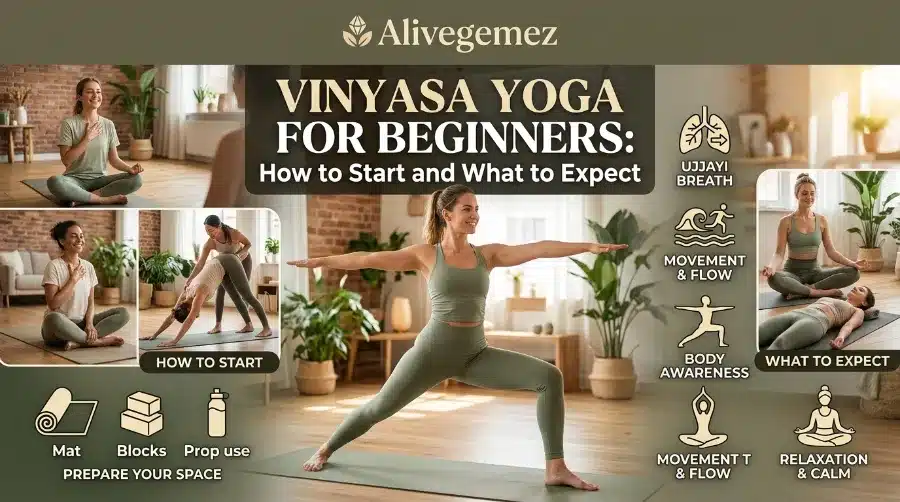
The students who stick with it long-term are almost never the naturally flexible or athletic ones, they are the ones who treated the wobbly weeks as part of the process rather than a sign they were doing something wrong. Keep that in mind, and the way vinyasa yoga beginners start will feel a lot less like a test and a lot more like a genuinely enjoyable new habit.
Frequently Asked Questions
Is vinyasa yoga hard for beginners? It looks harder than it is. The flowing pace is intimidating at first glance, but every pose can be modified, and no shape is held long enough to become punishing. Most beginners find their footing within the first four to six classes.
How many times a week should a beginner do vinyasa? Two to three sessions weekly is the realistic, sustainable starting point according to current yoga-teacher guidance, with rest days built in so your shoulders, wrists, and core can recover between sessions.
What should I wear and bring to my first vinyasa class? Comfortable, breathable clothing you can move freely in, a water bottle, and a mat if you have one (most studios provide them). No special equipment is required.
Will vinyasa yoga help with weight loss? It can support weight loss as part of a broader plan, since the continuous movement raises heart rate more than many gentler styles, though results depend heavily on frequency, diet, and overall activity, which is why it works best alongside a structured yoga weight loss plan rather than in isolation.
How long until vinyasa feels natural instead of confusing? Based on both my own teaching experience and reports across several current yoga-education guides, most students describe feeling genuinely comfortable somewhere between class eight and class twelve.
Can I practice vinyasa yoga at home without a studio? Yes, and many beginners do exactly this using free or low-cost online beginner vinyasa programs, then transition into a studio setting once they feel confident with the basic vocabulary of poses.
What is the single best piece of advice for someone about to start vinyasa practice? Move at your own pace and never sacrifice your breath for speed. Every experienced teacher will tell you the same thing, when vinyasa yoga beginners start prioritizing breath over keeping up with the class, everything else, strength, flexibility, and confidence, follows naturally.
Quick Quiz: How Ready Are You to Start Vinyasa?
1. What does the word “vinyasa” describe? A) A single, difficult arm balance pose B) Movement linked to one breath at a time C) A type of yoga mat material
2. How often should a beginner realistically start practicing vinyasa? A) Every single day for the first month B) Once a month C) Two to three times a week with rest days
3. What is the most common beginner mistake in a vinyasa class? A) Wearing comfortable clothing B) Holding the breath during difficult poses C) Arriving a few minutes early
4. What should you do if you fall behind the class pace? A) Skip ahead and guess the next pose B) Take an extra breath in downward-facing dog and rejoin naturally C) Stop practicing entirely for the rest of class
5. Roughly how many classes does it typically take to feel comfortable? A) 1–2 classes B) 8–12 classes C) 50+ classes
Answer Key: 1-B, 2-C, 3-B, 4-B, 5-B
Where to Learn More and Keep Building Your Practice
If you want structured, guided programs specifically built for new students, a few well-regarded options worth exploring alongside your home practice include the New Moon Yoga Academy beginners vinyasa course, YogaEasy’s vinyasa yoga for beginners program, and Alice Trow Yoga’s 30-minute beginner vinyasa flow, all of which offer approachable entry points if you would rather start at home before stepping into a studio.
Want to go deeper on how often to actually show up on the mat once you have your footing? Check out our guide on how often you should do yoga for weight loss results for a fuller breakdown of frequency and pacing over a full training cycle.
Conclusion
Starting vinyasa yoga is less about arriving flexible or fit and more about showing up consistently and letting your breath lead the way while your body slowly catches up. If you remember nothing else from this guide, remember that vinyasa yoga beginners start slowly, imperfectly, and completely successfully more often than not, so give yourself the same patience you would give a good friend learning something new. Every wobble in week one, every plateau in week three, and every small win in week eight is part of a completely normal process that thousands of beginners across the US, UK, and Europe go through every single year. Give yourself two to three sessions a week, modify without guilt, and trust that the confusing first class you just had is simply the first page of a much longer, genuinely rewarding story.
References
- MyYogaTeacher, “Vinyasa Yoga for Beginners: Your Guide to Start Confidently,” 2025.
- Yoga-Sequencing.com, “Vinyasa Yoga for Beginners: Complete Guide + 60-Minute Class,” 2026.
- Hello! Magazine, “Ultimate Beginner’s Yoga Guide: Vinyasa Expert Reveals the ‘Sweet Spot’ for Results,” 2026.
- Samarali, “How Many Times a Week Should You Do Vinyasa Yoga?,” 2026.
- Movement for Modern Life, “Vinyasa Flow Sequences for Beginners,” 2024.
- OneFlow Yoga, “How Often Should You Practice Yoga?,” 2023.
- Align with Glow, “Yoga for Beginners: Which Types Are Best?,” 2025.